The Maestro

Today’s Story: Beaulieu Vineyard

Beaulieu Vineyard is one of the most historic wineries in Napa Valley, founded in 1900 by Georges de Latour and his wife Fernande. I previously wrote about their history in A Winery Synonymous with Napa Valley Itself back on December 8, and if you are unfamiliar with the winery or their history I highly suggest reading this prior post.

Though I won’t rewrite the entire backstory here today, I do want to give more color on the Maestro Collection which my wine today is part of. As I discussed in my prior post, world-renowned viticulturist and enologist André Tchelistcheff joined BV and brought European methods of cultivation and pruning with him. His contributions from the start seem endless, from his tasting of the 1936 vintage of the BV Private Reserve and encouraging Georges de Latour to bottle it separately to his experimentations with micro-plots of different grape varieties and small-lot fermentation. As one of the most influential and iconic winemakers in the Napa Valley, André worked with BV for 40 years as winemaker and gained the nickname the “Maestro.” Though André retired in 1973, he joined BV again in 1991 to help the winemaking team study the effects of vintage and bottle age on 50 vintages of Private Reserve Georges de Latour and he also helped experiment with small-lot wines. It is these small-lot wines produced using unique varietals, vineyard lots, and blends that make up the Maestro Collection, justifiably named in André’s honor.

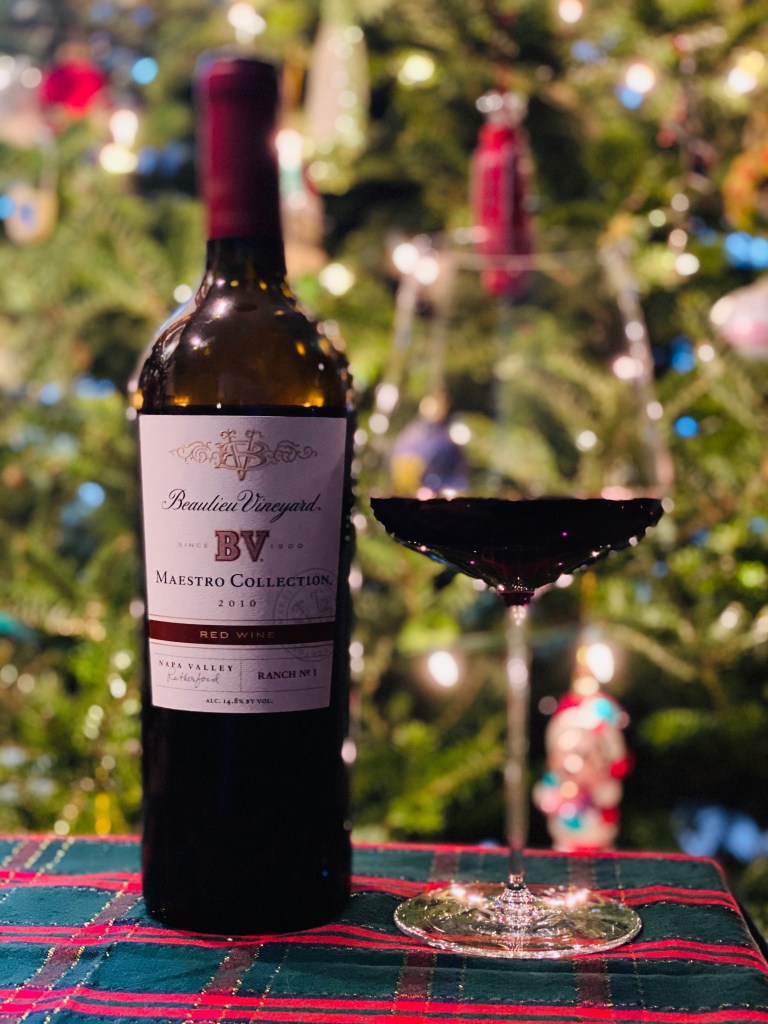
Today’s Wine: 2010 Maestro Collection Ranch No. 1 Red Blend

I unfortunately could not find a percentage breakdown of varieties in this wine, though I do know this to be Cabernet Sauvignon dominant (I assume ~70-75%) blended with Merlot and a splash of Petit Verdot. 14.8% ABV

The 2010 Maestro Collection Ranch No. 1 is medium ruby in color and almost entirely opaque. This needs about an hour to open up, but once it does the nose showcases aromas of blackberry, cassis, plum, dried earth, cigar box, chocolate, nutmeg, and oak. Once in the mouth, I get notes of blackberry, blueberry, black cherry, sweet tobacco, slate, leather, vanilla, and a hint of licorice. This wine is medium- to full-bodied with medium (+) acidity, dusty medium (+) tannins, and a long finish with herbaceous overtones.

Price: $95. While this is a delicious wine and the Maestro Collection is fairly limited, I find it hard to justify paying twice the price of a BV Tapestry Reserve which I consistently find to be good value. Pair this with steak, a good burger, or lamb.

Napa Fruit Bomb

Today’s Story: Nickel & Nickel Winery

Nickel & Nickel was established in Oakville, Napa Valley in 1997 by Gil and Beth Nickel. Though Gil was born in Oklahoma and has a background in the nursery business (his family owned Greenleaf Nursery which is one of the largest wholesale nurseries in the country), Gil and Beth moved to Napa Valley in 1976 where they founded Far Niente Winery in 1979. I reviewed a Far Niente Cabernet Sauvignon in Historic Napa Cab back on November 11. Not too far from the Far Niente property, the Nickel & Nickel winery is located on an 1880s-era farm established by John C. Sullenger following his purchase of the land in 1865. The grounds are beautiful, with a restored farmhouse and barns (built during the 1880s) set amongst flowers and horse stables. With the intent of producing only single-vineyard 100% Cabernet Sauvignon wines, Nickel & Nickel today offers roughly 20 different bottlings from vineyards in Oakville, Yountville, Calistoga, Rutherford, Oak Knoll District, Diamond Mountain District, Stags Leap District, St. Helena, and Howell Mountain. They augmented this portfolio with Chardonnay, Merlot, and Syrah with the Merlot and Syrah bottlings a bit tougher to come by.

Like many premium wineries in Napa, Nickel & Nickel institutes sustainable practices throughout their farming and winemaking processes. Before their considerations in the vineyards themselves, Nickel & Nickel is proud to be a net-zero user of electricity thanks to solar panels, they collect process water from winery operations to irrigate the vineyards, recycle extensively, and replaced company vehicles with hybrid alternatives. In the vineyards, Nickel & Nickel practices organic farming in an effort to preserve the natural tendencies of the soil while getting the best fruit possible from their vines.

Naturally, when a winery offers a wide portfolio of wines from different terroir but of the same variety it can be fun to taste several of these side-by-side. I had the opportunity to taste a couple this way in the past and found it incredibly cool to read about the different soils which you can get a glimpse of here. If you have the opportunity to taste several of these wines together, it is also fun looking at the map of the vast Nickel & Nickel vineyards here.

Today’s Wine: 2016 Branding Iron Cabernet Sauvignon

100% Cabernet Sauvignon; 14.5% ABV

The 2016 Branding Iron is an opaque deep purple/ruby in color. This certainly needs some time to open up, so I recommend decanting the wine. On the nose, I get aromas of blackberry, blueberry, plum, redcurrant, purple florals, wet stone, saturated earth, baking spice, sweet tobacco, chocolate, vanilla, and oak. Once in the mouth, this wine continues the fruit-dominated theme with notes of jammy blackberry, blackcurrant, cherry, pomegranate, green herbs, forest floor, baking spice, and oak. This wine is full-bodied with medium (+) acidity, velvety medium tannins, and a long inky finish dominated by dark fruit and baking spice.

Price: $100. Though you can tell the quality is there, I think this is priced too high given that the wine comes off as an inky people-pleaser. Though I would place a hefty bet that the majority of today’s Napa Cab lovers would enjoy this wine, I think the price-point is a deterrent for many. Pair this with steak or a good burger.

Corsican Beauty

Today’s Story: Domaine Comte Abbatucci

Domaine Comte Abbatucci was founded in 1950 (though wine history of the family estate dates back more than a century) by Antoine Abbatucci. The Abbatucci name, however, has even deeper roots in Corsica that stretch at least as far back as the French Revolution. Jean-Charles Abbatucci and Jacques-Pierre Abbatucci, for instance, were both Generals during the French Revolution with Jean-Charles considered a hero who fought with Napoléon Bonaparte. Unsurprisingly, there are streets, monuments, and entire plazas in Corsica named after various Abbatucci family members, particularly in the capital city of Ajaccio.

Circling back to the winery as it exists today, the domaine is located in the heart of the Taravo Valley in southern Corsica. During the 1960s, Antoine grew concerned with what seemed to be the impending extinction of native grape varieties thanks to life disappearing in mountain villages that were home to some of the island’s oldest vineyards. As President of the Chamber of Agriculture of Corsica, Antoine removed cuttings from each threatened vineyard he discovered and planted them in one single plot of granite soil on his estate. Through these efforts, this one plot of vineyard land is planted to 18 varieties and pays homage to the winemaking history of Corsica. The fruit from this plot goes into the wines of the highly limited Domaine Comte Abbatucci Cuvée Collection.

While Antoine created arguably one of the most important vineyard plots in Corsican winemaking, his son Jean-Charles made his own vital strides when taking over the domaine. A biodynamist at heart, Jean-Charles converted the estate to biodynamic farming in 2000 to further preserve the original terroir and grape varieties of Corsica. With care for the natural habitat of the vineyards, Jean-Charles conducts work periods based on lunar cycles and the time of day, plowing is accomplished on horseback, and a flock of sheep grazes on the natural and permanent grass cover between rows during the winter. During harvest, all fruit is harvested by hand in small boxes and carefully sorted both in the vineyards and at the winery. Winemaking is accomplished by gravity-flow, fermentation is completed only using indigenous yeasts, and maceration is gentle with alternating punch downs and pump overs. Though Jean-Charles did change the farming practices, he follows in his father’s footsteps by providing cuttings of the salvaged native varieties to other vignerons throughout Corsica.

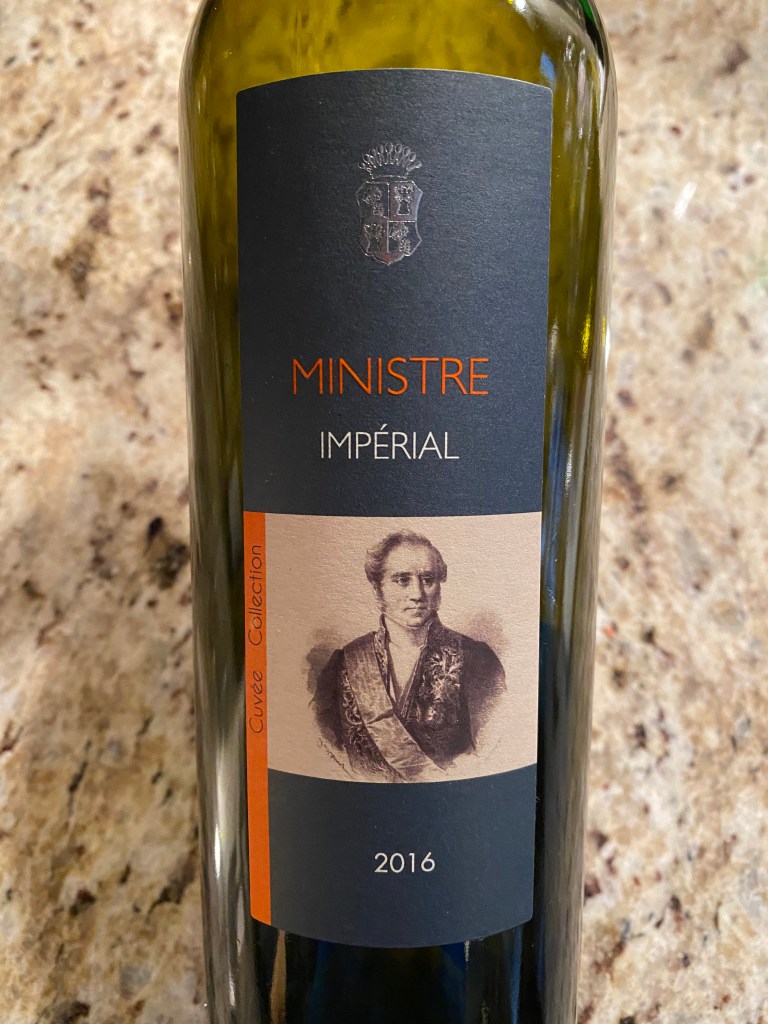
Today’s Wine: 2016 Cuvée Collection Ministre Impérial

22% Sciaccarello, 18% Nielluccio, 15% Montanaccia, 15% Carcajolo Nero, 12% Morescono, 10% Morescola, 8% Aléatico; 14% ABV

The 2016 Ministre Impérial is named for Jacques-Pierre-Charles Abbatucci, a leading military figure under Napoléon Bonaparte’s Premier Empire and later a senator and official councillor to Napoléon III. He was Jacques-Pierre Abbatucci’s grandson and Jean-Charles Abbatucci’s nephew. The wine itself is a moderately transparent pale ruby color with rose variation toward the rim. Once this opens up in the decanter, the nose emits aromas of cherry, redcurrant, boysenberry, red florals, ground herbs, leather, smoked gamey meats, earth, graphite, smokey minerality, and a hint of woodiness. On the palate, I get notes of cherry, redcurrant, wild blueberry, dried rocky soil, granite, herbs, smoke, slight peppery spice, and mineral. This is medium-bodied with medium (+) acidity, elegant and refined medium (-) tannins, and a long finish dominated by red fruit and rocky minerality. 500 cases produced.

Price: $95 (though if you can find this in Europe it seems to be closer to $60). This is a really cool wine to taste given the backstory on these varieties and the simultaneous elegance and complexity it presents for a Corsican wine. If you can find a bottle, I highly recommend giving it a try. Pair this with lamb, wild boar, veal, or charcuterie and cheese.

Rising Star in Barolo

Today’s Story: Giulia Negri

The story behind Giulia Negri and her wines is a unique one, with Giulia taking over her family’s well-established Barolo estate at the age of 24. Though she studied management and biology during college, Giulia returned to the Langhe commune of La Morra after a palate-shaping journey through Burgundy. Inspired by the wines and winemaking practices of Burgundy, Giulia started crafting small amounts of Barolo released as several “microcuvées” before fully taking control of vineyard management and production of her family’s 150-year-old estate in 2014.

Located in the Serradenari cru of La Morra, Giulia’s vineyards stretch from 400 to 536 meters (1,312 to 1,758 feet) above sea level. Not entirely shocking after reading those numbers, Serradenari is the highest point in the Barolo zone with breathtaking views of the Alps from Liguria to Mount Cervino. Though the vineyards for her Barolo bottlings command West and Southwest exposure, Giulia inherited small plots of Northern facing Chardonnay and Pinot Nero planted by her father that allow her to experiment with the varieties that helped shape her palate in Burgundy. In caring for her vineyards, Giulia practices organic farming (she started in 2014) though full conversion and certification is expected for the 2019 vintage. A traditionalist at heart, Giulia hand harvests all fruit for her wines, practices long and gentle maceration, ferments with only indigenous yeasts, and minimizes filtration. Her resulting wines are elegant in their youth thanks to fine-grained tannins, yet they have the structure to withstand the test of time in the cellar.

The Giulia Negri portfolio consists of seven wines. Her three Barolo bottlings consist of Marassio (0.8 hectare at 536 meters above sea level), Serradenari (1 hectare at 520 meters above sea level), and La Tartufaia (2 hectares at 460 meters above sea level). In addition to her Chardonnay and Pinot Nero I mentioned earlier, she also produces a Langhe Nebbiolo Pian delle Mole and a Barbera d’Alba. Though these wines can be difficult to find due to the small quantities and relative novelty of production (I had to special order mine), Giulia’s wines are worth seeking out. Though young, she seems to be making quite the name for herself and is certainly a rising star in Barolo.

For more on Giulia’s background, facts about each wine, and pictures of this beautiful estate check out the website here.

Today’s Wine: 2015 Barolo La Tartufaia

100% Nebbiolo; 14% ABV

The 2015 Barolo La Tartufaia is pale to medium ruby in color and almost entirely transparent. This wine is a blend of 80% Serradenari cru (vines planted in 2004) and 20% Brunate cru (40-year-old vines). I stole a sip right out of the bottle, but because of its youth let this decant for an hour before pouring a glass. Once the wine opens up, the nose showcases aromas of bright red cherry, redcurrant, rose petal, violet, saddle leather, forest floor, underbrush, clay, tar, and delicate oak. In the mouth, I get notes of cherry, raspberry, dried cranberry, rose, cured meat, tobacco, loamy earth, rocky minerality, slight spice, a hint of truffle, and faint presence of oak. This wine is medium- to full-bodied with moderately high acidity, ultra-fine medium (-) tannins, and a medium (+) length finish.

Price: $60. I think this is a great value for Barolo, and I love the story behind Giulia and her wines as well. Pair this with duck, quail, filet mignon, truffles, or goat/sheep cheese.

One of the Napa Greats

Today’s Story: Joseph Phelps Vineyards

Joseph Phelps Vineyards was founded in 1973 by Joseph Phelps and remains a family-owned and operated estate to this day. Though Phelps’ background is in construction and entrepreneurship, he grew an early interest in wine and established vineyards on a 670 acre former cattle ranch in Napa Valley. In 1998, Joseph’s son Bill joined the winery as Executive Chairman after a career in law and his sisters Leslie, Laurie, and Lynn later joined the Board of Directors. In 2016, family members Elizabeth Neuman and Will Phelps joined the winery team as third generation employees set on continuing the legacy Joseph started in 1973.

Today, the Phelps family owns and farms 425 acres of vineyards across St. Helena, Rutherford, Oakville, Stags Leap District, Oak Knoll District, South Napa, and Carneros as well as 100 acres over two vineyards on the western Sonoma Coast. As stewards of the land, the Phelps family practices sustainable farming in an effort to improve the long-term vitality of their vineyards and soil. Some of these efforts include olive and fruit trees planted on the Home Ranch in St. Helena (as well as fruit trees in the Backus and Las Rocas Vineyards); bees on the Home Ranch to sustain the plants, trees, and vines; chickens on the Home Ranch to provide natural fertilizer to the soil; owl and bluebird boxes constructed in every vineyard; sheep brought in to mow cover crops and naturally fertilize the soil; composting grape skins and stems for use in the vineyards; and solar panels at the winery to offset energy needs.

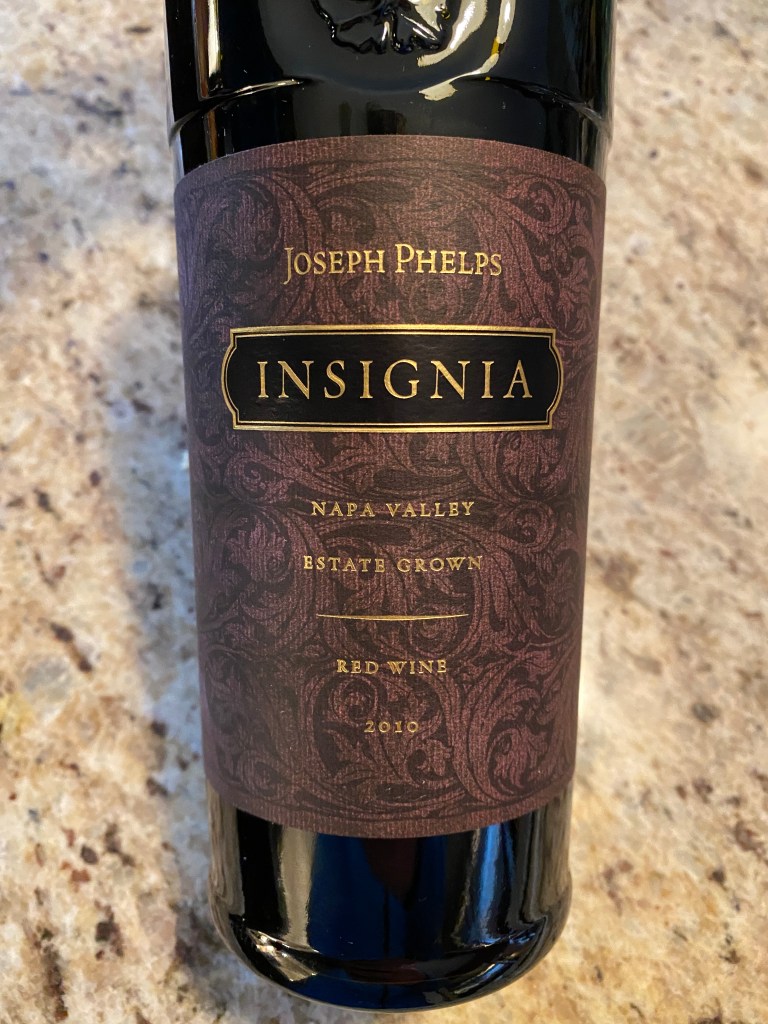
Today’s Wine: 2010 Insignia

84% Cabernet Sauvignon, 10% Petit Verdot, 4% Merlot, 2% Malbec; 14.5% ABV

The 2010 Insignia is opaque deep ruby in color with a bit of purple at its core. I let this open in the decanter for about an hour to hour and a half before drinking any. Once the wine opens up, the nose is incredibly complex and changes over time with aromas of blackcurrant, cassis, smoked meat, tobacco, cigar box, thyme, black truffle, forest floor, graphite, crushed rock, violet, and a hint of oak. The palate is similarly complex with notes of blackberry, blueberry, red fruit, cedar, tobacco, damp earth, mushroom, pepper, slight baking spice, chocolate, and a touch of vanilla. This wine is full-bodied with medium acidity, velvety medium (-) tannins, and a long finish. I could smell this wine all day and was blown away by how elegant and ever-changing this is with air.

Price: $215. Not a cheap bottle of wine, but for premium Napa that goes up against the great wines of France this is well worth the price. Pair this with steak, lean game, or grilled lamb.

Premier American Sparkling

Today’s Story: Schramsberg Vineyards

Schramsberg Vineyards was founded in 1862 by Jacob Schram when he purchased 200 acres and began the development of hillside vineyards in Napa. In 1870, Chinese laborers dug what became the first hillside caves in Napa Valley for aging and storing wine, with the winery quickly ramping up production. By 1880, Schramsberg was producing 8,403 cases of wine annually from 50 acres of vines, which ramped up to about 28,361 cases from 100 acres of vines by the year 1890. If this history sounds familiar, it’s because the Davies family purchased the Schramsberg property in 1965 and I’ve reviewed several of their still wines starting with the 2012 Ferrington Vineyards Pinot Noir in Who Wants Pie? on October 9. With their ownership, Jack and Jamie Davies started producing sparkling wines under the historic Schramsberg label with a goal of producing America’s premier sparkling wine.

Fun fact: Schramsberg Blanc de Blancs was served for President Nixon’s 1972 “Toast to Peace” with China’s Premier Zhou Enlai. Since then, Schramsberg sparkling wines have been served at official State functions by every U.S. Presidential administration.

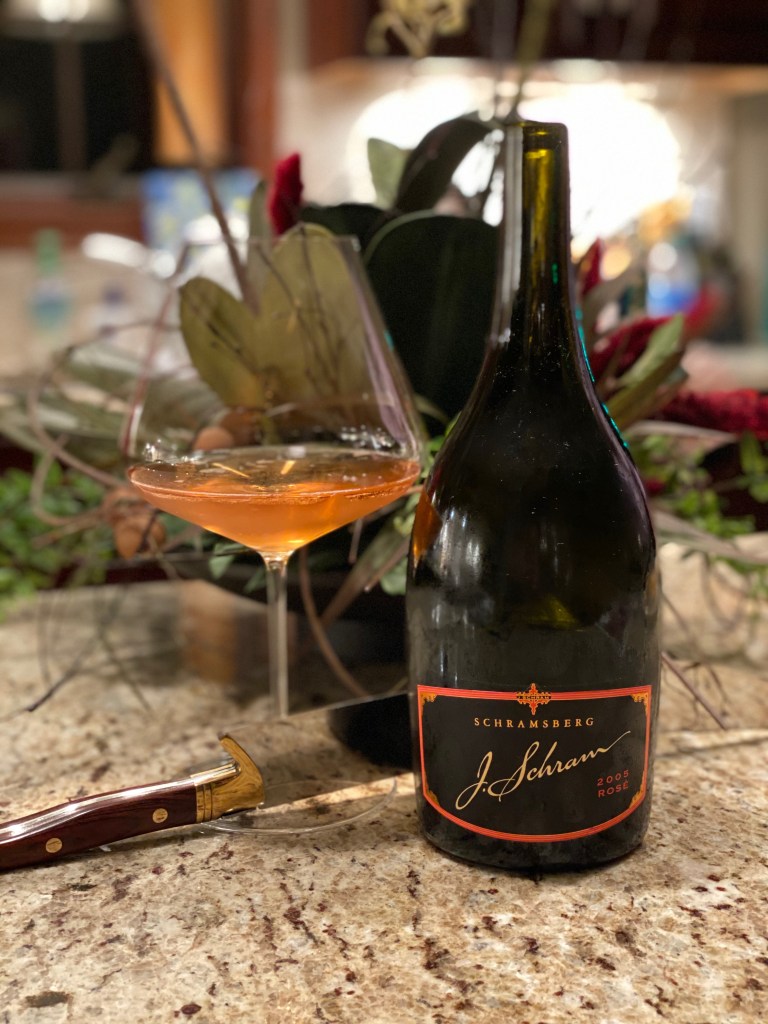
Today’s Wine: 2005 J. Schram Sparkling Rosé

79% Chardonnay, 21% Pinot Noir; 12.3% ABV

The 2005 J. Schram is a bright salmon pink in color and fully transparent. On the nose, this sparkler showcases aromas of strawberry, raspberry, peach, baked red apple, toasted almond, brioche toast, and a hint of lees. Once in the mouth, the wine shows notes of cherry, strawberry, blood orange, apricot, grapefruit, hazelnut, and lightly buttered toast. Moderately full-bodied, this sparkling wine has vibrant mouthwatering acidity into a long finish ending in notes of crisp red apple skin and crunchy red berries.

Price: $110. Though this is one of the best sparkling rosés I’ve had, I would be perfectly content saving $40 and buying a Veuve Clicquot Rosé Champagne even though it’s a NV bottling. Pair this with shrimp, salmon, cold cuts, or sweet cheese.

High Quality People Pleaser

Today’s Story: Alpha Omega

This is an easy one today so I can prepare for the Christmas Eve festivities, and if you celebrate the holiday as well my wine review shouldn’t keep you too busy! I wrote about Alpha Omega a couple times in the past, first reviewing the 2015 Unoaked Chardonnay in A Napa Take On Chablis and then the 2016 Cabernet Franc in The Cabernet in Cabernet Sauvignon.

Long story short, Alpha Omega is the creation of Robin and Michelle Baggett following their move to Napa Valley in 2006. Though Robin began his foray into wine much earlier, in 1988 as a grape grower and in 1998 by starting Tolosa Winery, Michelle worked in the design and development of hospitality brands before the couple culminated their pursuits into Alpha Omega. Today, Alpha Omega is known largely for their red wines and particularly high-quality single vineyard Cabernet Sauvignon, though they produce Chardonnay, Sauvignon Blanc, and late harvest wines as well.

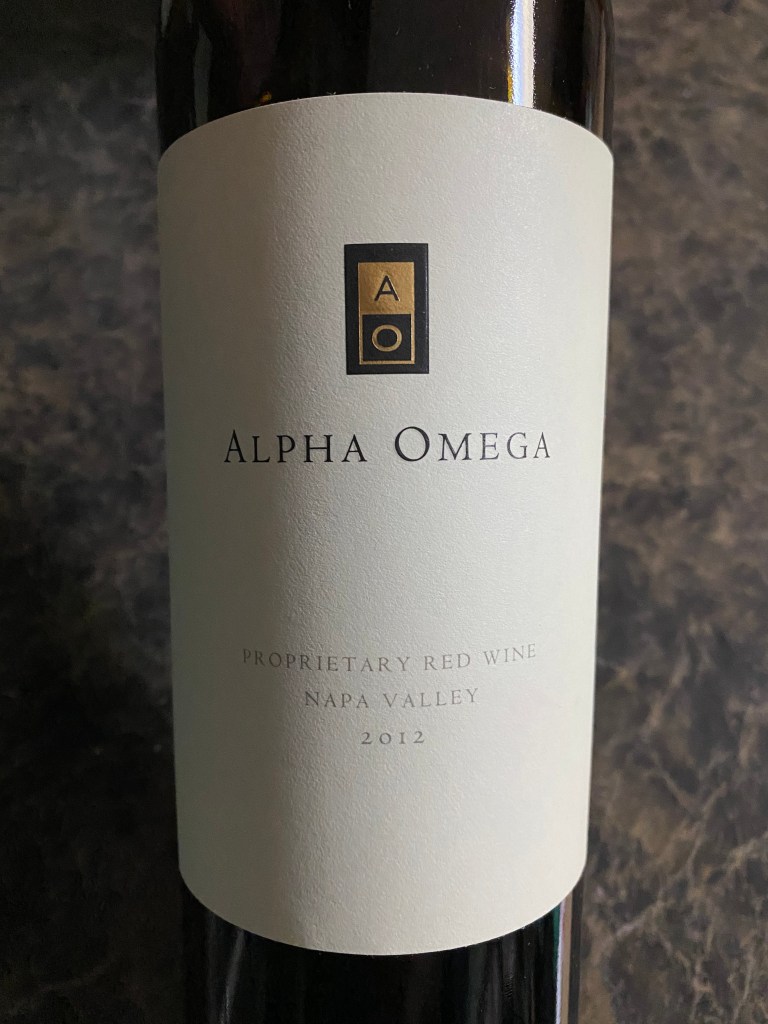
Today’s Wine: 2012 Proprietary Red Wine

61% Cabernet Sauvignon, 32% Merlot, 7% Cabernet Franc; 14.6% ABV

The 2012 Proprietary Red is opaque deep ruby in color, almost black at its core. This needs some time to breathe, though once it opens up the nose emits aromas of blackberry, blueberry, plum, cassis, black cherry, cedar, graphite, tar, cinnamon, and oak. In the mouth, this expressive palate shows notes of blackberry, juicy plum, prune, dried leather, loamy earth, cocoa, black pepper, licorice, lavender, and a touch of vanilla. This bottling from Alpha Omega is medium- to full-bodied with high acidity, grippy medium (+) tannins, and a medium (+) finish with inky, concentrated dark fruit notes dominating.

Price: $90. Personally, I would pay up for the single vineyard wines from Alpha Omega or go with a different producer in the same price range. This wine is a bit far into the “people pleasing” category in my opinion with its rich, concentrated, and expressive fruit alongside vanilla and oak. This being said, however, most people would like this. Pair this with steak, a burger, pepper-crusted tuna, or grilled lamb.

Both Complexity and Elegance from Sonoma County

Today’s Story: Vérité Winery

Vérité was founded in 1998 by wine industry visionary Jess Jackson. Though Jackson is most well-known for starting Kendall-Jackson after purchasing 80 acres of land he converted to vineyards in 1974 (he started bottling his own wine in 1982), he always wanted to create a wine that would stand up to the greatest in the world. This vision, and his belief that it could be accomplished in Sonoma County, helped lay the foundations of Vérité. During the 1990s, Jackson traveled to France and met vigneron Pierre Seillan who had already spent decades creating world-class wines in Bordeaux and Tuscany. The two struck up a friendship, and when Seillan visited California in 1997 Jackson asked him to start Vérité with him and this passion was born.

Seillan is a vigneron who follows a micro-cru philosophy throughout the viticultural and winemaking processes. This philosophy came about after Seillan worked across eight different appellations in Bordeaux, allowing him to realize the endless nuance between different vineyard sites. In bringing this philosophy to Vérité, Seillan crafts each wine from more than 50 micro-crus harvested and fermented separately before being aged in French oak barrels varying in toast. The resulting wines are characterized by an elegant and complex architecture that “embodies the timeless traditions of France and the limitless possibilities of California.” Though Jess Jackson passed away in 2011, his vision lives on through Seillan and will continue to do so under Hélène Seillan who joined as assistant winemaker to her father.

Vérité produces three wines including La Muse (Merlot dominated), La Joie (Cabernet Sauvignon dominated), and Le Désir (Cabernet Franc dominated). In addition to the micro-cru philosophy, each wine is produced with a belief that we are servants of the soil in winemaking and the wines should therefore “express the unfettered voice of the terroir.” Sonoma County is one of the most diverse winegrowing regions on earth and with vineyards located in the Bennett Valley, Alexander Valley, Chalk Hill, and Knights Valley appellations Vérité wines elegantly display this nuanced terroir.

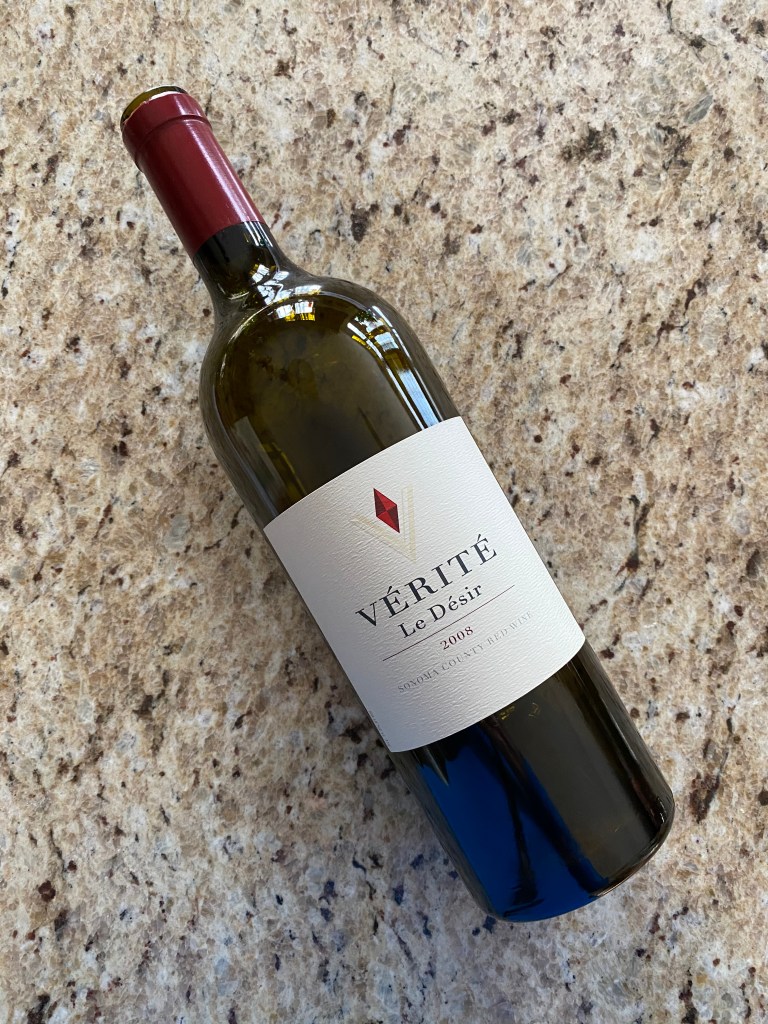
Today’s Wine: 2008 Le Désir

61% Cabernet Franc, 31% Merlot, 4% Cabernet Sauvignon, 4% Malbec; 14.3% ABV

The 2008 Le Désir is a beautiful medium ruby color. These wines are made for the long haul, so we decanted this bottle for about an hour before trying any. Once the wine opens up, the nose showcases aromas of dusty blackberry, black cherry, peppercorn, sous bois, white truffle, cigar box, mint, and oak. In the mouth, this beauty shows notes of blackberry, blueberry, purple florals, cigar box, smokey earth, green herbs, pepper, licorice, and a hint of oak. The wine is full-bodied with medium acidity, medium (+) tannins, and a long finish.

Price: $400. I’ve wanted to try a wine from Vérité for quite some time, though it is no easy price to stomach. Thanks to a very generous friend who brought this over for a party, I finally got a glimpse into why their wines are so pricey. Pair this with grilled beef (especially filet mignon), duck, or lamb.

A Beautiful Marriage of Oakville and Stags Leap District

Today’s Story: Futo Wines

Futo Wines was founded in 2002 by Tom and Kyle Futo when they purchased Oakford Vineyards. Futo started as a 40 acre property with 7 acres planted under vine in the hills of Oakville, though Tom and Kyle added an adjoining 117 acres in 2004. This new property resulted in the addition of 6 acres of vineyards that were planted under the direction of famed viticulturist David Abreu and winemaker Mark Aubert. 2004 also marked the first vintage of Futo Wines, 80 cases of the Futo Oakville bottling. The winery was not yet completed, however, but was finished in 2008 in time to receive that vintage’s harvest. Late in 2011, Futo expanded yet again with the purchase of 40 acres in the Stags Leap District that included 9 acres of Cabernet Sauvignon planted in 1986. This estate vineyard allows for a more efficient marriage of Oakville and Stags Leap fruit to produce the OV/SL bottling.

I had the privilege of visiting Futo and tasting with Daniel Ha back in September, and this was one of my favorite visits during my trip. We took a tour of the property, including the winery, before sitting down inside to taste the 2012 OV/SL and 2014 Oakville bottlings. These are both delicious wines full of power and complexity, while also displaying the unique terroirs of Oakville and the Stags Leap District. All of the farming at Futo is done by hand and vineyard management is 100% in-house which helps provide consistency across vintages yet constant improvement. Jason Exposto’s winemaking style is focused on restraint rather than influence, another excellent facet of the experience when tasting Futo’s wines.

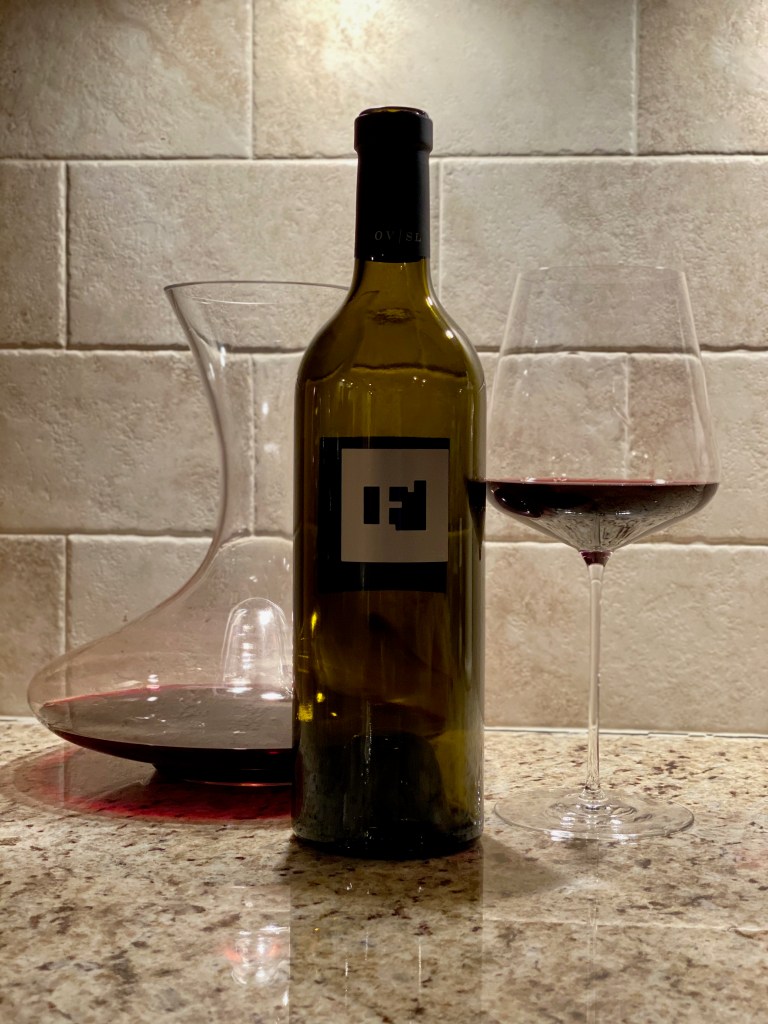
Today’s Wine: 2012 OV/SL

75% Cabernet Sauvignon, 9% Merlot, 8% Cabernet Franc, 8% Petit Verdot; 14.7% ABV

The 2012 OV/SL is an opaque medium to deep ruby color. I let this decant for about an hour before drinking. Once the wine opens up, the nose showcases aromas of blackberry, plum, graphite, tobacco, red meat, smoke, earth, chocolate, and oak. When this wine hits the palate, I get notes of blackberry, blueberry, black raspberry, cedar, cigar box, loamy earth, slight iron, green herbs, and forest floor. This wine is full-bodied with medium (+) acidity, medium tannins, and a long finish. 880 cases produced.

Price: $200 (but $250 direct from the winery). Certainly not a cheap bottle of wine, but everything I’ve tried from Futo is outstanding. If you can find this for a deal retail, it’s certainly worth trying. Pair this with steak.

The wine cellar at Futo.

Sweet Berry Wine!!

Supposed to spit it out…..but no way Jose am I spittin’ this stuff out, it tastes like fruit!

Dr. Steve Brule

Today’s Story: Las Jaras Wines

Las Jaras Wines was founded in 2014 by winemaker Joel Burt and Hollywood comedian/director Eric Wareheim. Joel Burt, a winemaker at Domaine Chandon, was growing tired of making wines in a cookie-cutter, corporate, and mass-produced manner when he met Eric and the two realized they shared a passion for fine wine. The duo started planning their own wine label where they could produce wines in homage of “the old days” (think 1970s Napa) and Las Jaras was born. Joel describes their Cabernet “like a Dunn from the 80s, but way more approachable” and each wine in the portfolio is made largely using similar traditional techniques.

To achieve this style of wine, Joel remains very hands-off throughout the winemaking process. Las Jaras sources their fruit from various old vine vineyards, though most comes from Mendocino County. All fruit is hand-harvested and each variety goes through separate winemaking processes, all being hand-sorted at the crusher. Though each variety is vinified differently to best express that variety’s unique character, the long story short here is that Joel doesn’t add sulfur, the wines ferment with only natural yeasts, and bottling is accomplished with no fining or filtration. Today will be my first bottle from Las Jaras (and hopefully not my last) as I can appreciate wines made in traditional fashion with lower SO2 and alcohol content to better express the terroir.

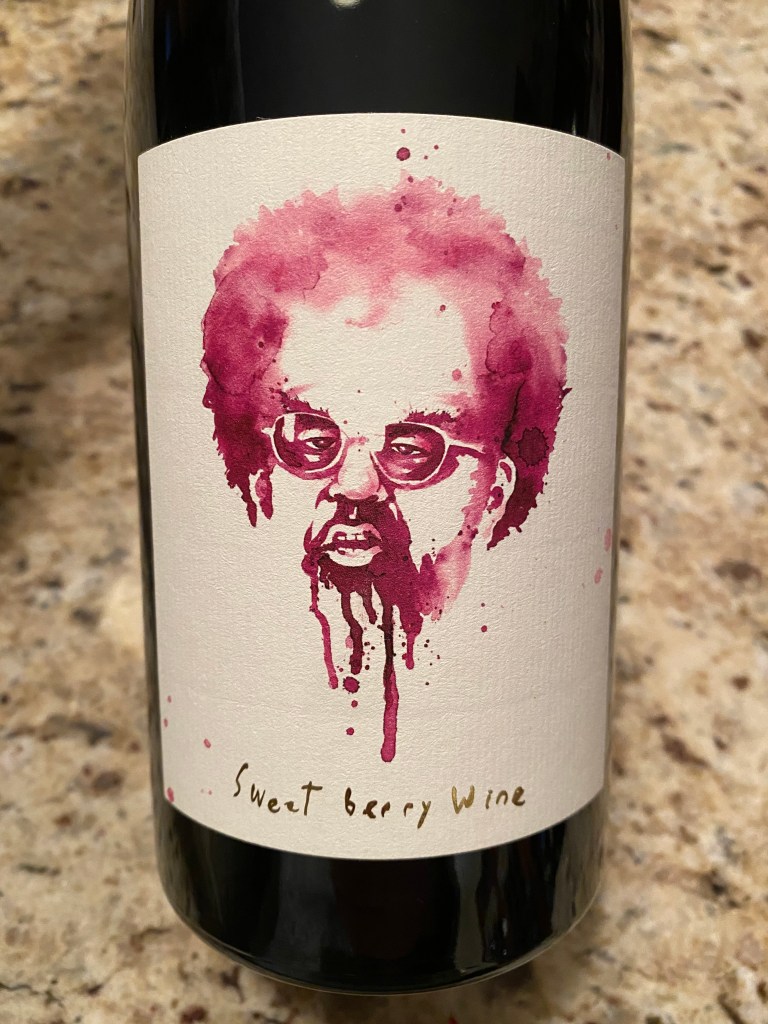
Today’s Wine: 2018 Sweet Berry Wine

54% Carignan, 28% Zinfandel, 12% Charbono, 3% Cabernet Sauvignon, 3% Valdiguie; 13% ABV

The 2018 Sweet Berry Wine is a beautiful medium purple in color and moderately opaque. This takes a little bit of time to open up, but once it does the nose showcases aromas of blueberry, raspberry, strawberry jam, licorice, sweet tobacco, cured meat, cinnamon, and violet. In the mouth, this Carignan-dominated blend shows notes of tart cherry, cranberry sauce, plum, wild underripe raspberry, baking spice, sweet tobacco, and green herbs. Overall both the nose and palate come off quite sweet, actually reminding me somewhat of the Martha Stoumen Zinfandel I reviewed not too long ago. The wine is medium-bodied with high acidity, low tannins (surprisingly), and a long finish.

Price: $35. All gimmicks aside, I think this is a great value particularly for those not familiar with a more “natural” way of making wine. I put “natural” in quotes because Joel Burt takes the word with a grain of salt when it comes up to describe his style, but it does fit. Pair this with honestly any type of food you want, but steer toward chicken, duck, pork, or beef brisket – and you can add barbecue to all of that minus the duck.

For a little comedy behind this wine, check out the video here. For a more serious note on the winemaking process for this bottling (they go into a lot of great detail) check out the fact sheet here.