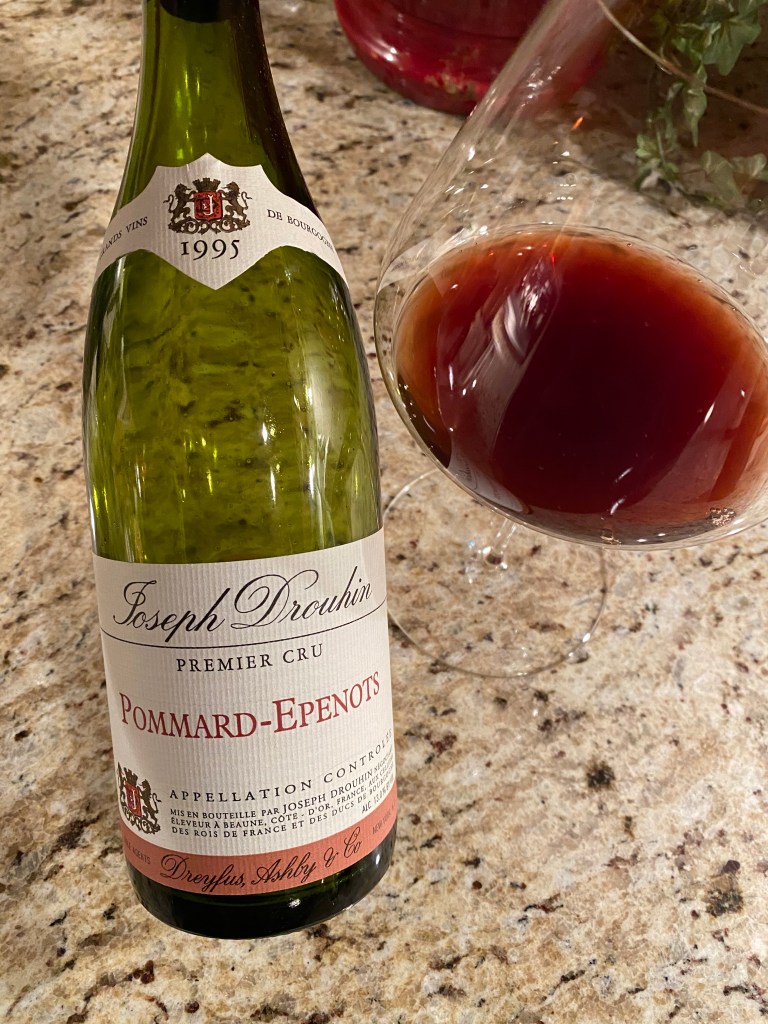
Refined, Aged Burgundy

Today’s Story: Joseph Drouhin

Joseph Drouhin is a historic producer in Burgundy that found its start in 1880. Joseph, a 22 year old from Chablis, moved to Beaune and started his own wine company with the aim of providing high quality wines. His son Maurice, however, shifted the focus to estate grape growing and winemaking by purchasing land in Clos des Mouches and Clos de Vougeot, amongst other appellations. Robert Drouhin, who succeeded Maurice in 1957, ties most with Joseph Drouhin’s state as it sits today. Robert acquired a great deal of vineyard land, including in Chablis, and was one of the first producers who stopped using pesticides and other chemicals in Burgundy. Today, Robert’s children Philippe, Véronique, Laurent, and Frédéric carry on the legacy of this great producer with the same founding principles of creating high quality, true to form wines at heart.

Today, Joseph Drouhin is one of the largest estates in Burgundy consisting of 78 hectares (193 acres) throughout Chablis, Côte de Nuits, Côte de Beaune, and Côte Chalonnaise. Most of the wines are of 1er Cru or Grand Cru status, with vineyards planted to both Pinot Noir and Chardonnay. In addition to their own vineyard land, Drouhin purchases some fruit from other established vineyard owners who they have longstanding relationships with. This allows them to produce a broader assortment of wines for distribution throughout the world.
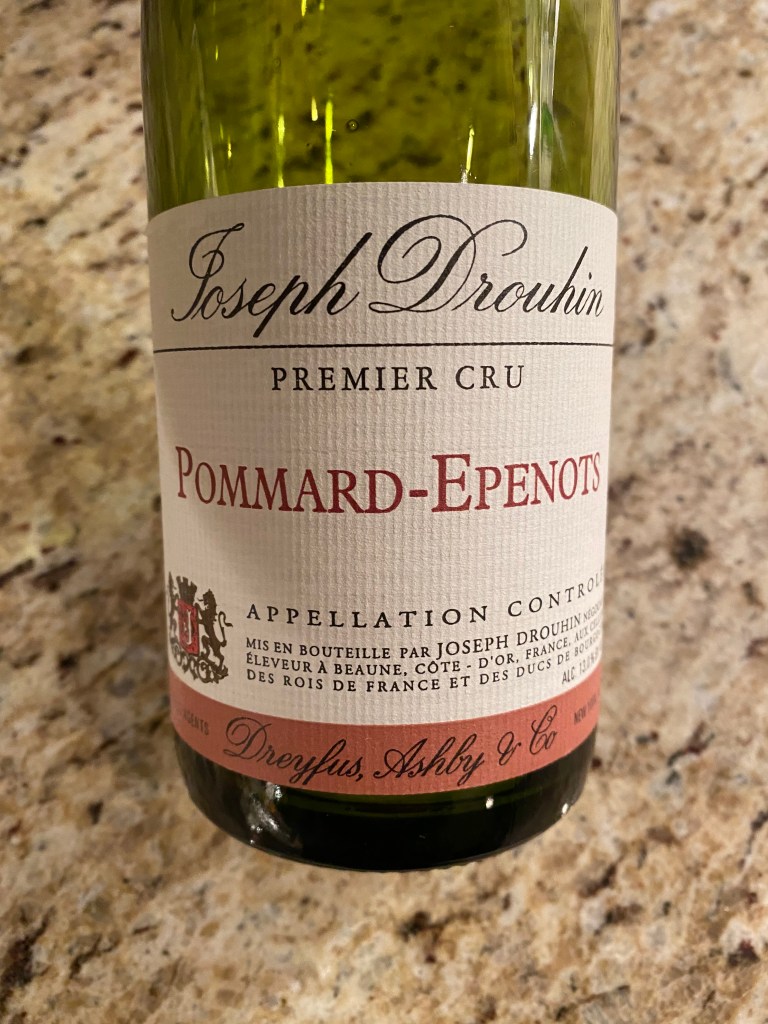
Today’s Wine: 1995 1er Cru Pommard-Epenots

100% Pinot Noir; 13% ABV

In appearance the wine is cloudy pale ruby turning garnet near the rim. This threw very fine sediment that snuck through the filter, however I did pour some through cheesecloth which cleared it up. On the nose, we get aromas of baked cherry, overripe cranberry, dried green herbs, sous bois, cedar, and tobacco. Once in the mouth, the wine showcases notes of tart cherry, red licorice, wet stone, smoked red meat, and green underbrush. Holding up remarkably well, this is medium-bodied with high acidity and fully integrated light tannins into a medium length finish.

Price: $150. Really cool experience finding and drinking aged Burgundy. Pair this with duck, lamb, or a burger.

Five Generations of Burgundy

Today’s Story: Albert Bichot

Domaines Albert Bichot traces its roots back to 1831 when Bernard Bichot started a wine trading business. Hippolyte, Bernard’s son, succeeded him and was the first family member to purchase vines in Volnay due to his belief that upstream control of the product is vital to his success as a merchant. This expansion of sorts prompted Albert Bichot, Hippolyte’s son and the first to bear the name, to set home base in Beaune in 1912.

As the family endeavor grew exponentially, the second Albert Bichot (born 1900) set an emphasis on international trade and travelled constantly throughout the world to introduce the family’s wines. During the second half of the 20th century, Albert’s sons Albert, Bernard, Bénigne, and Jean-Marc helped expand the domaine with this same mentality. For instance, they constructed a large cellar, bottling center, and winery to produce wine for distribution to every inhabited continent.

Still a family brand today, Albéric Bichot joined in the early 1990s and took over management responsibilities in 1996. Albéric’s main challenges thus far have been converting to organic viticulture in the Côte-d’Or vineyards, adhering and changing with global tastes, laws, and market trends, and increasing the world’s knowledge and respect for Burgundy wine. He dramatically expanded Albert Bichot’s vinification capacity again in 2010 and the company’s vineyards now total 6 estates throughout Burgundy.

Today’s Wine: 2014 Chassagne-Montrachet

100% Chardonnay; 13% ABV

I’ve had several wines, both white and red, from Albert Bichot and the quality to price ratio is always quite good. This easy-drinking Chassagne-Montrachet is pale yellow/straw in color with water white variation near the edges of the glass. On the nose are aromas of pear, peach, stone fruit, lemon citrus, cream, and white florals. Once in the mouth, flavors of pear, melon, pineapple, lemon zest, and white pepper abound. Full-bodied with vibrant medium (+) acidity, the wine finishes well-rounded with buttery notes.

Price: $55, great QPR for this wine. Pair this with chicken, fish, or crab.

Bit by the Burg Bug

Once you’re hooked on white Burgundy, there’s no going back.

Today’s Story: Etienne Sauzet

Domaine Etienne Sauzet found its origin in the early 20th century when Etienne inherited and purchased additional grape vines in the village of Puligny-Montrachet. A family endeavor throughout its history, the domaine has operated under four generations and became modernized under Etienne’s granddaughter, Jeanine Boillot, and her husband Gérard Boudot. The efforts by Jeanine and Gérard include improved vinification techniques and a transition to biodynamic farming. Currently, Jeanine’s daughter Emilie and her husband Benoît Riffault produce the wines.

Comprised of 15 hectares distributed on Puligny-Montrachet, Chassagne-Montrachet, and Cormot-le-Grand in the Hautes côtes de Beaune, the domaine produces an assortment of white wines. Like many producers, Sauzet offers a regional Borgogne but also produces Puligny-Montrachet and Chassagne-Montrachet villages, nine 1er Crus (including the one I am reviewing today), and four Grand Crus. Sauzet’s Grand Cru sites include Montrachet, Chevalier-Montrachet, Batard-Montrachet, and Bienvenues-Batard-Montrachet.

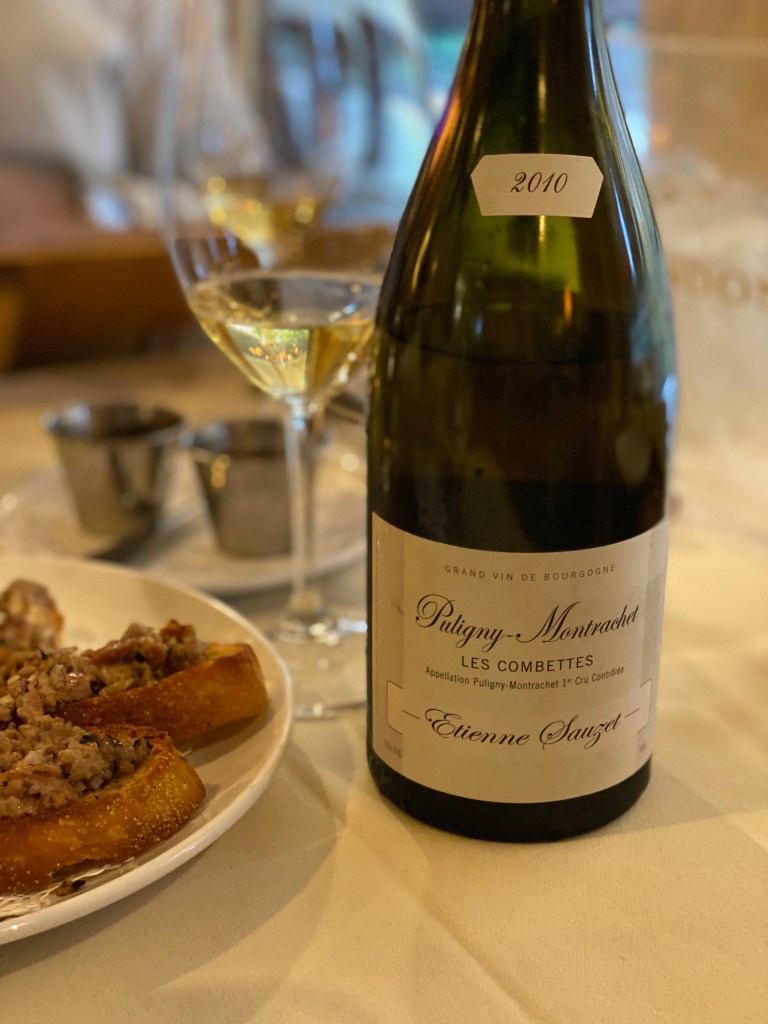
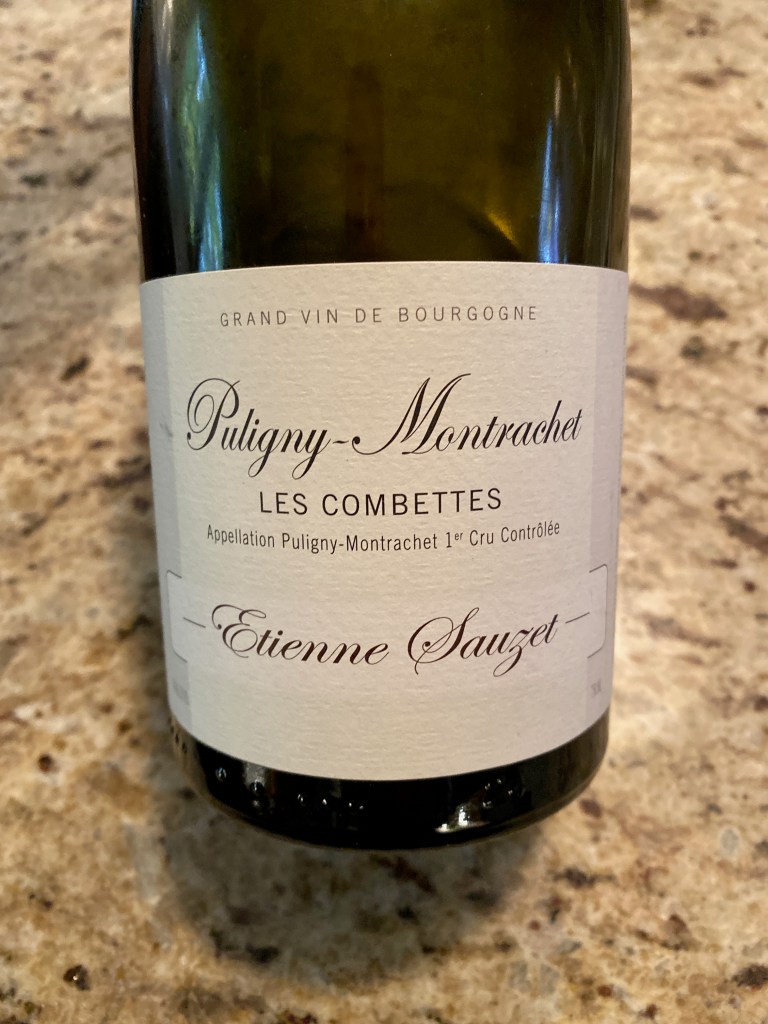
Today’s Wine: 2010 Puligny-Montrachet Les Combettes

100% Chardonnay; 13.5% ABV

When seeking out a white Burgundy to be the first wine for dinner with a good friend, I was very excited to find this bottle which happens to be my first from Etienne Sauzet. In appearance, this wine is a gorgeous, crystal-clear pale gold. As the wine opened up, enthralling aromas of pitted melon, honeysuckle, white florals, flakey vanilla pastry, Manchego cheese, white chocolate, and cotton candy (!) leap from the glass. My eyes, as well as my friend’s, nearly popped out every time we took a sniff. On the palate, we got flavors of stone fruit, lemon zest, baked green apple, white pepper, butter, and seaside minerality. Utterly complex and still way too young, this wine is full-bodied with mouthwatering high acidity that culminates into an oily yet luxurious mouthfeel. I will buy more to lay down.

Price: $160. This is an outstanding value for 1er Cru white Burgundy. Already drinking beautifully, the age-worthiness of this bottle makes it a staple in any cellar. Pair this with shellfish, particularly lobster. It even went well with our Italian sausage bruschetta.

Burgundian Beauty

Today’s Story: Domaine Leflaive

Domaine Leflaive is a very highly regarded winery located in Puligny-Montrachet, Côte de Beaune, Burgundy. While origins of the estate come as early as 1717 with Claude Leflaive, the winery as it is today seems to begin with Joseph Leflaive (1870-1953). Initially working as a naval engineer who helped develop the first French submarine, Joseph cared for his family’s vines in Puligny-Montrachet following his marriage. Thanks to phylloxera, many of the vines needed dramatic replanting and many of the produce at the time sold to wine merchants. Thus, in the 1920s, Joseph replanted the parcels of his estate and started selling wines under his own label.

When Joseph died in 1953, Domaine Leflaive came under the control of his four children (Jo, Vincent, Anne, and Jeanne) and the family desired to maintain the winery at the peak of excellence. Jo, an insurance underwriter by trade, took over the administrative and financial management of Domaine Leflaive while Vincent, an engineer who studied management and business, covered the vineyard, wines, and commercial side of the business. Over time, Domaine Leflaive produced some of the greatest white Burgundy wines and continues to be a family endeavor. In 1990, Vincent’s daughter Anne Claude became joint manager with Jo’s son Olivier and the two learned from Vincent until his death in 1993 and Anne Claude was named manager.

Much changed at the estate from the 1990s, though it is still run by the family. Today’s steward is Brice de La Morandiere, Anne Claude’s nephew and great-grandson of Joseph Leflaive. Brice’s largest contributions so far include the updating of historic buildings on the estate and enhancements to the winemaking process that include new corks to allow for prolonged aging of the Domaine’s wines.

Lastly, as a common thread, I will leave you with a brief conversation on the farming and winemaking practices of Domaine Leflaive. Leflaive practices biodynamic farming in an effort to understand and appreciate all natural phenomena that ultimately strengthen the immunity of their vines. They tend to their soil with the use of products made from vegetable, animal and mineral matter at certain points during the annual cycle, while working the land by tilling and scraping. Further, Leflaive practices organic cultivation of the vines. You can read more in-depth on their practices at https://www.leflaive.fr/en/the-spirit.

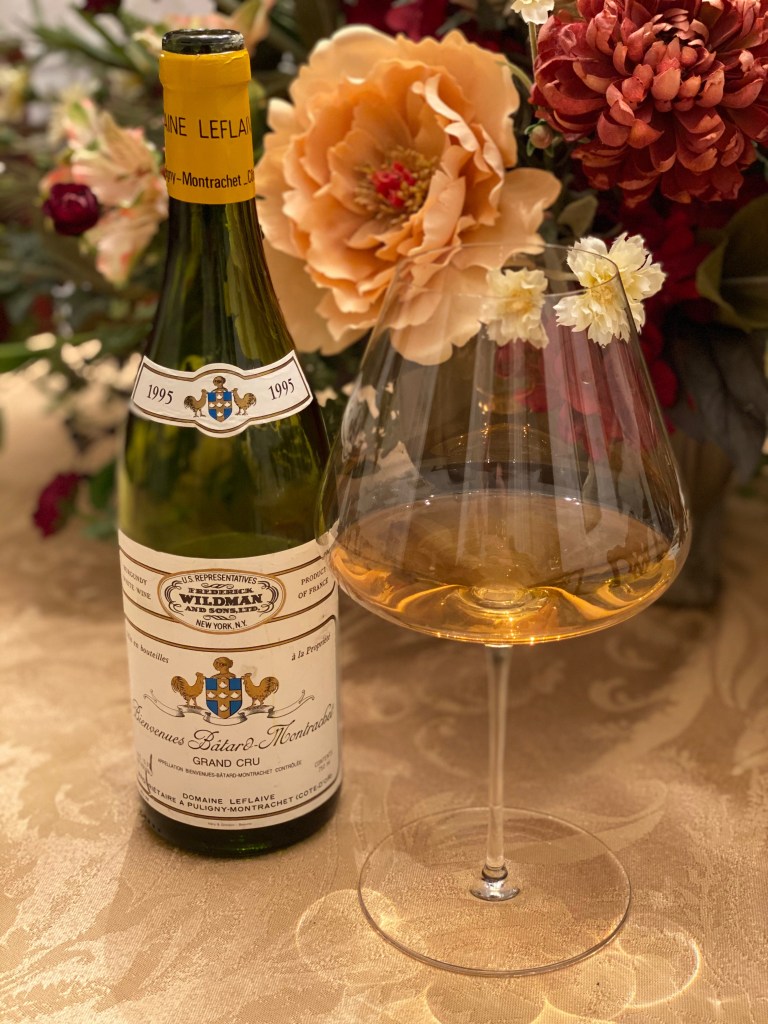
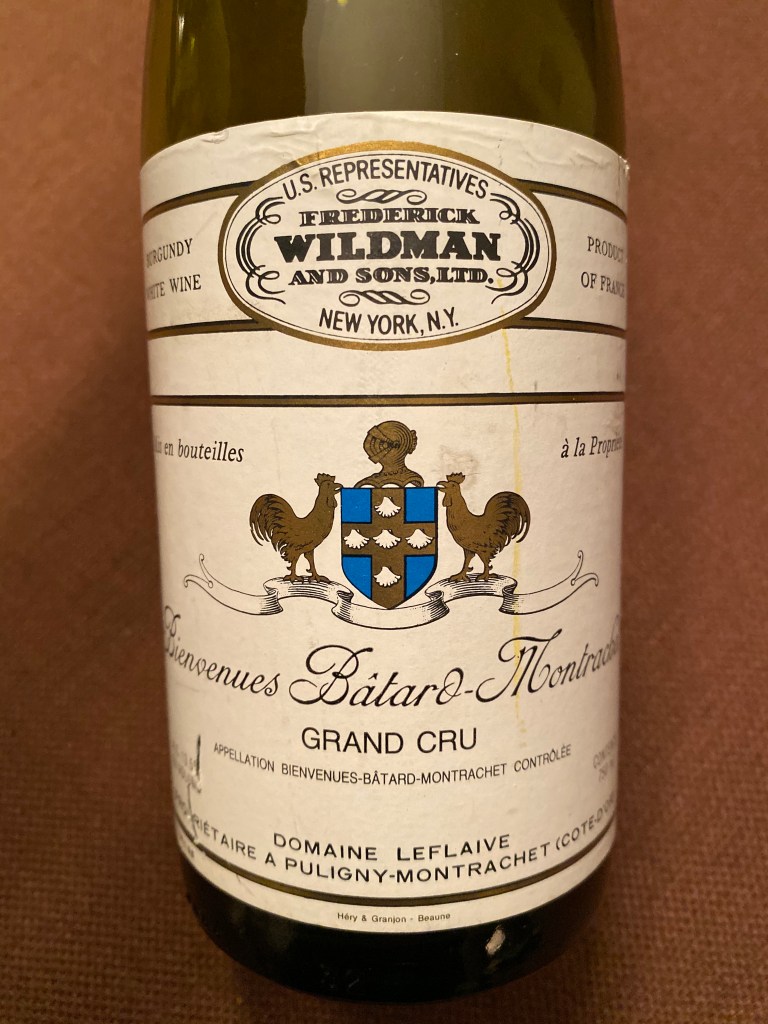
Today’s Wine: 1995 Bienvenues Bâtard-Montrachet

100% Chardonnay; 13.5% ABV

This was a “fingers crossed” type of bottle for a couple reasons. First, the cork on this bottle was slightly depressed (only 1-2mm or so) and was nearly soaked. I’ve seen this with wine before, so I gingerly used my Ah So wine opener to get the cork out and thankfully it was one solid piece and the seal seemed intact. Secondly, white Burgundy from the 1990s, particularly starting with the 1995 vintage, has a somewhat significant problem with premox (premature oxidation) which can ruin a relatively young wine. The wine can give off aromas and flavors like a Sherry, or worse, and become undrinkable while showing darker than expected or brown colors. Fortunately, this bottle had no premox and the slight depression of the cork turned out okay.

With that good news, our wine today shows a vibrant gold color. Once this opened in the glass, beautiful aromas of ripe pear, honeysuckle, cream, white florals, nuts, and white truffle leap outward. I could smell this wine all day. In the mouth, flavors of lemon citrus, golden apple skins, white pepper, spice, and minerality mingle in perfect balance. The wine is full-bodied with lip-smacking high acidity and a finish that goes on for easily 40 seconds. This bottle was truly a pleasant surprise, and for anyone who has one left I’d advise you to start drinking.

Price: $530. This is one of those bottles I drink very rarely, with the vintage coincidentally being my birth year. Pair with stone crab, mild fish, or a small plate of pear and mild cheeses.