Château Suduiraut traces its roots back to 1580 through the marriage of Nicole d’Allard to Léonard de Suduiraut. Though the estate was destroyed during the Fronde civil wars of the mid 1600s, the current château was rebuilt later on but still during the 17th century. During the late 18th century, the estate went to Jean Joseph Duroy, who was a nephew of the Suduiraut family, and it was renamed Cru du Roy. In 1992, AXA Millésimes acquired the estate and the company continues to focus on producing high quality Sauternes with traditional vineyard management and winemaking inspired by Suduiraut’s rich history.
The vineyards of Château Suduiraut total 91 hectares of which 90% is planted to Sémillon and 10% is planted to Sauvignon Blanc. The gravel and sandy clay composition of the soil proves poor for water retention and therefore the vines struggle, reaching deep for nutrients and focusing energy into smaller clusters of fruit. The soil acting in this way largely contributes to more concentrated and higher quality fruit. Come harvest, Château Suduiraut picks entirely by hand and sorts the grapes with great care due to noble rot (Botrytis Cinerea) as they become overripe. The great care and immense quality protocol requires up to five pickings during harvest season, oftentimes going vine by vine or bunch by bunch.
Today’s Wine: 2016 Sauternes
96% Sémillon, 4% Sauvignon Blanc; 14% ABV
The 2016 Sauternes is a beautiful, transparent deep gold in color. The captivating nose emits aromas of peach cobbler, apricot, orange marmalade, honey, savory herbs, florals, and vanilla. On the palate, I get notes of apricot, candied orange, pineapple, crème brûlée, caramel, ginger, and hazelnut. This wine is medium- to full-bodied with gorgeous medium (+) acidity and a long finish. While this drinks beautifully right now, it will certainly cellar nicely for at least another decade.
Price: $75. I think this is a pretty good value for Sauternes, and the $35 I paid for this half bottle was perfect both in price-point and for bottle size as a light after-dinner beverage. This is a gorgeous wine.
Château d’Yquem has a very long, mysterious history that traces its roots back to the 15th Century. One of the most interesting snippets of this history, for instance, is that the estate belonged to the King of England during the Middle Ages! In 1593, however, southwest France again came under control of the French crown by Charles VII and has remained as such since. It was also this year that the d’Yquem estate came under control of Jacques de Sauvage, a descendant of a local noble family. Though some winegrowing practices and late harvesting existed at this time, the Sauvage family did not start building the château for several more years and then began the long process of assembling land for the current estate plot by plot.
Jumping forward in time, it wasn’t until 1711 that the Sauvage family fully owned the estate under Léon de Sauvage d’Yquem. Furthermore, under the rule of Louis XIV, Château d’Yquem received noble status. The magnificent estate switched hands yet again, however, in 1785 when Françoise Joséphine de Sauvage d’Yquem married Count Louis Amédée de Lur-Saluces, a godson of Louis XV. Sadly, three years later in 1788, the Count died in a riding accident but his widow took over management of the estate and quickly displayed her acumen by sustaining and improving d’Yquem. One of the most notable practices at d’Yquem was established under Françoise Joséphine de Sauvage d’Yquem, for instance, which is picking over several passes (sometimes picking one grape at a time). Another notable feat under this young widow is the admiration noble figures around the globe felt toward d’Yquem, including Thomas Jefferson who reportedly purchased 250 bottles of the 1784 vintage for himself and additional bottles for George Washington.
Romain-Bertrand de Lur-Saluces, a grandson of Françoise Joséphine, took over the estate and helped guide it through seemingly endless successes in the second half of the 19th Century. For example, d’Yquem’s wines became a necessity for the rich and powerful throughout Europe, Russia, and Asia. In 1855, Château d’Yquem was awarded Premier Cru Supérieur in the Bordeaux Wine Official Classification of 1855, the only Sauternes awarded this level. Times changed, however, as they always do with estates of this age when World War I came and the château transitioned into a military hospital under Eugène de Lur-Saluces (a son of Romain-Bertrand). Eugène’s son Marquis Bertrand de Lur-Saluces took over the estate following the war (he had served in the trenches) and he is responsible for much of d’Yquem’s strength to this day. For instance, Marquis Bertrand fought relentlessly to save the estate during the Great Depression, helped determine many legal aspects of the Sauternes appellation as President of the Union des Crus Classés de la Gironde for forty years, and was a leading proponent of château bottling to guarantee authenticity. His death in 1968 changed the tides once again.
Though Bertrand was childless at the time of his death, he took precautions and named his nephew Alexandre de Lur-Saluces manager of Château d’Yquem. Alexandre struggled at first through difficult vintages, a crisis in the Bordeaux wine trade, and an inheritance tax that almost forced the estate to fail, though his efforts were saved with the exceptional 1975 vintage followed by several more during the 1980s. Alexandre managed the estate exceptionally well until 1996 when a family feud exploded over his brother’s decision to sell part of his 47% ownership stake, thus in turn requiring LVMH Moët Hennessy-Louis Vuitton to step in and purchase 55% of the estate. Though under new ownership, Alexandre remained manager of the estate until his retirement in 2004.
Though I could go on and on about d’Yquem’s terroir, vineyards, and winemaking practices I will leave it here with the history of Château d’Yquem. I encourage you to take a deeper dive on their website here to truly appreciate what goes into a bottle of this sacred juice.
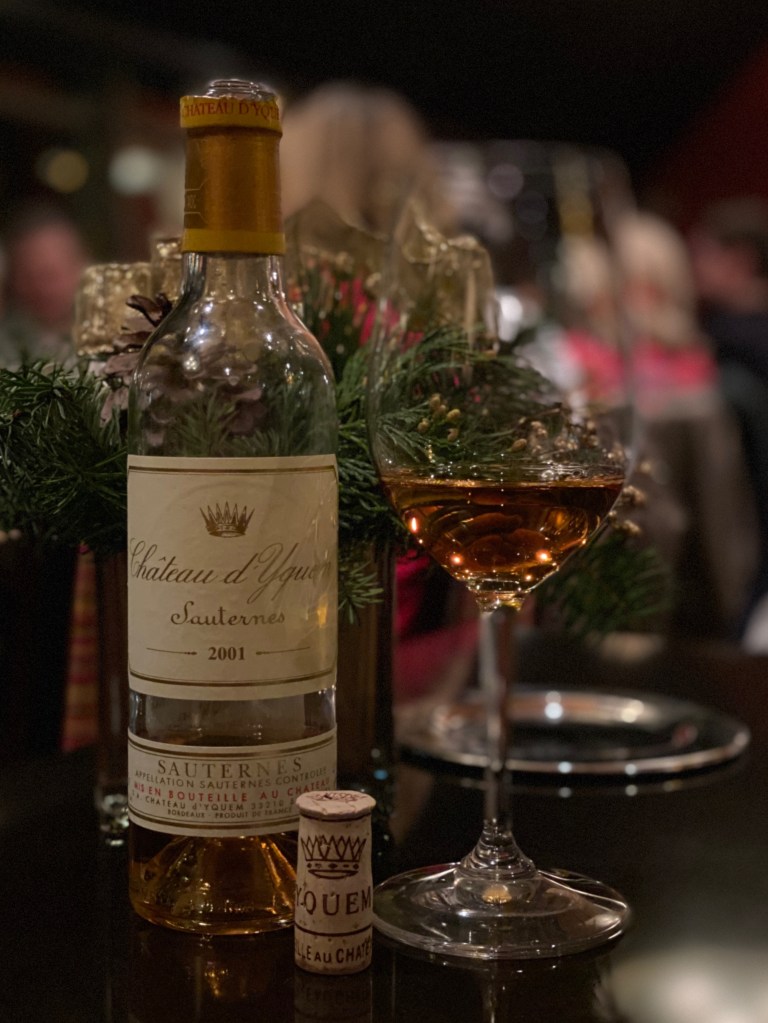
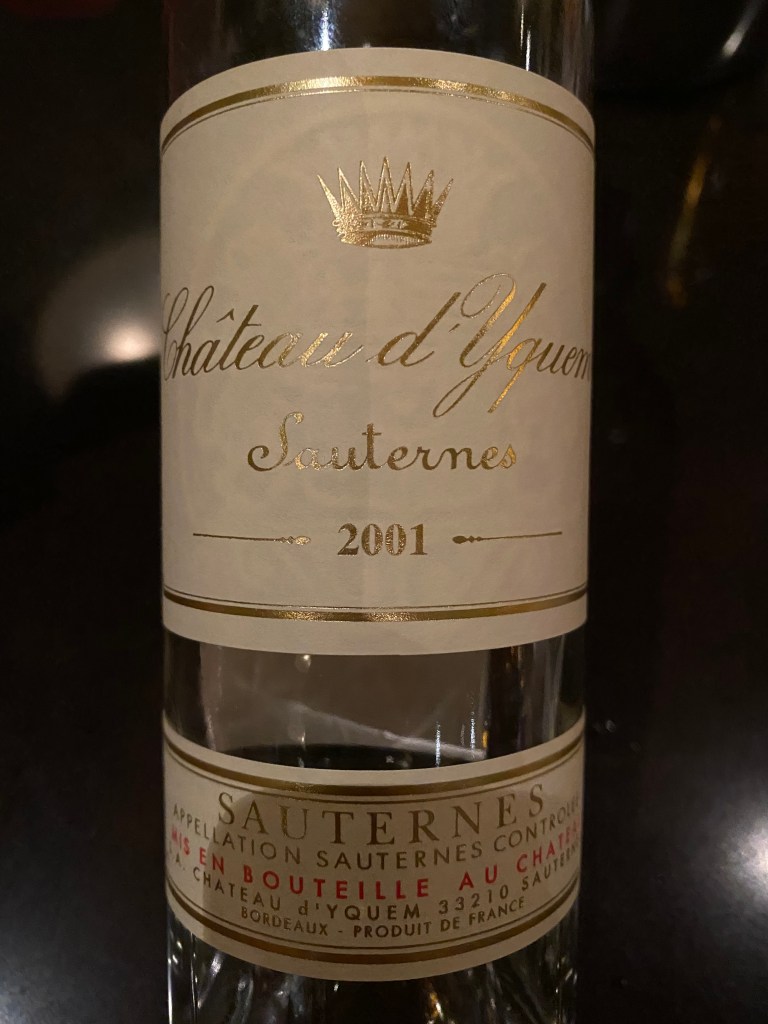
Today’s Wine: 2001 Château d’Yquem
80% Semillion, 20% Sauvignon Blanc; 13.5% ABV
The 2001 d’Yquem is vibrant gold in color while being fully transparent. The nose cannot be mistaken for anything but d’Yquem with aromas of baked golden apple, grilled pineapple, dried apricot, peach, honey, caramel, almond and hazelnut, white pepper, and white florals sewn together in elegant harmony. Once in the mouth, this wine showcases notes of orange peel, Dutch apple pie, creme brûlée, orange marmalade, honey, hazelnut, butter, and white lily flowers. The palate and its lip-smacking profile make it difficult for anyone to not savagely gulp this down. The wine is full-bodied with high acidity and a very long finish that sticks with you all night long.
Price: $450-650 for 750ml, $300-350 for 375ml. Somewhat of a funky price range on these bottles (depending where you are in the world) but nonetheless d’Yquem is reserved for a special occasion. Pair this with cheesecake, lemon tarts, custard, or savory cheeses.


 JB's Wine Talk