Great Value From a Historic Bordeaux 2nd Wine

Today’s Story: Château La Mission Haut-Brion

Château La Mission Haut-Brion is a highly regarded Bordeaux wine estate with history dating back to 1540. That year, merchant Arnaud de Lestonnac purchased the land that would become La Mission Haut-Brion and he married Marie, sister of Jean de Pontac of neighboring Château Haut-Brion. By the time of his death in 1548, the estate produced great wines and management fell to his son Pierre who set about enhancing the reputation further. A century later, in 1682, Pierre’s daughter Olive de Lestonnac (who had devoted her life to charitable works and had no children) gifted the estate by annuity in her will to the Lazarists of Bordeaux and La Mission became property of the Catholic Church.

The Lazarists quickly set about developing the vineyards further, with great emphasis on improving farming practices, quality of the wines, and reputation. By the early 1700s, La Mission produced 24 barrels of wine annually and, by the mid 1700s, became recognized by French nobility for the immense quality of these wines. The incredible improvement and quality under the Lazarists shifted hands, however, in 1792 when the property was confiscated by the state during the French Revolution. Businessman Martial-Victor Vaillant purchased the estate in auction, however his family’s ownership was short-lived when his daughter sold it to Célestin Coudrin-Chiapella in 1821. As its first American owner, Chiapella continued to improve La Mission and set about retiring there one day. Having come from New Orleans, the family also stressed the importance of trade and Old World/New World ties which catapulted the estate to high regard throughout France, the UK, and the US.

Château La Mission Haut-Brion shifted ownership again in 1919 when Frédéric Otto Woltner, another Bordeaux merchant, purchased it. The Woltner family helped bring the estate into the modern era, in part by implementing the use of stainless steel vats to better control fermentation and, since 1927, producing a white wine. Frédéric passed away in 1933 and passed the estate to his three children, with Henri leading management. During WWII, the family was forced to house German officers at the château but miraculously kept them from raiding the cellars by demanding respect from their “guests.” Following the war, the Woltner family regained complete control until Henri passed away in 1974.

With La Mission up for sale yet again in 1983, Domaine Clarence Dillon came in and purchased the estate through a very natural transition. The Dillon family immediately started improving the estate even further, beginning in the vineyards and progressing through renovations to construction of new buildings and cellars. Though the estate has lived through a somewhat tumultuous history due to ownership changes and wars, they released highly revered wines over the centuries known for quality and consistency that is largely unmatched anywhere in the world.

Château La Mission Haut-Brion consists of 29 hectares of vineyards in the Pessac-Léognan appellation. Situated on an elevated gravel terrace, the soil of La Mission is particularly suited for growing wine grapes with a subsoil of clay, sand, and limestone. Of the 29 hectares, 25 are planted to red varieties of Merlot, Cabernet Sauvignon, and Cabernet Franc; the remaining 4 hectares are planted to white varieties of Sémillon and Sauvignon Blanc. All fruit is harvested by hand and sorted before fermentation in steel vats. After two weeks, the wines are drained and transferred to new oak barrels for 20-24 months before ultimately moving to bottle and aging further.

To learn more about this great estate, run through their wines over the years, or view images, I encourage you to visit the website here (also the source of the information above).
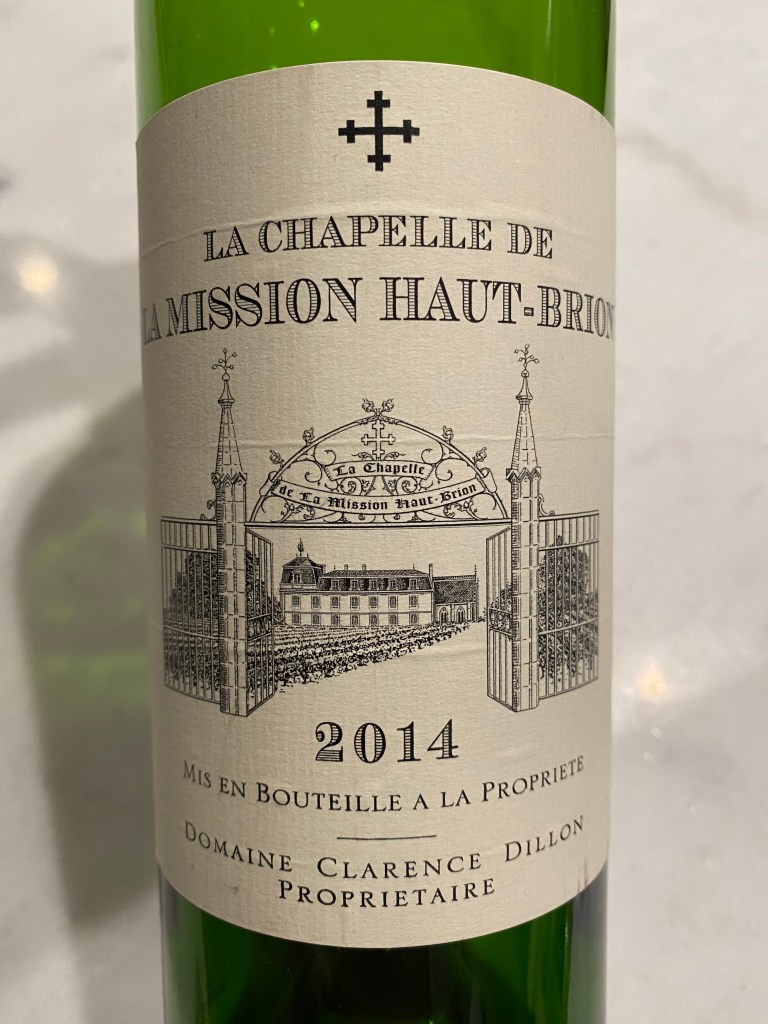
Today’s Wine: 2014 La Chapelle de La Mission Haut-Brion

45% Merlot, 31% Cabernet Franc, 24% Cabernet Sauvignon; 14% ABV

The 2014 La Chapelle de La Mission Haut-Brion is opaque deep ruby in color. I gave this about 3 hours to open up, and the nose showcases aromas of plum, blackcurrant, violet, tobacco, gravel, truffle, dried underbrush, pepper, and cedar. Once in the mouth, the wine displays notes of blackcurrant, black raspberry, fig, cigar box, smoke, forest floor, crushed rock, and bell pepper. The Cabernet Franc is quite evident in this one. The wine is medium- to full-bodied with medium (+) acidity, fine grained medium tannins, and a medium (+) length finish.

Price: $65. I think this is one of the better value Bordeaux wines, particularly for the second wine of an estate with as high stature as Château La Mission Haut-Brion. Coupled with the fact the 2014 vintage can be often overlooked, this is a very nice wine for its cost.

New Etna Rosso From Two Great Wine Families

Today’s Story: IDDA

IDDA was established in 2016 as a partnership between the Gaja family of Piedmont and the Graci family of Sicily. While the Gaja family is rightfully famous for their Barbaresco and Barolo, Angelo Gaja became incredibly interested in the history, culture, and terroir of Sicily and particularly Mt. Etna with the Etna wines being produced in recent years. After Angelo met Alberto Graci, whose family makes wines on the northern slopes of Mt. Etna, the two joined together to purchase vineyards on the southern slopes. With about 52 acres of vineyards today located between 2,000 and 2,600 feet elevation on this great volcano, IDDA cultivates Carricante, Nerello Mascalese, and Nerello Cappuccio with the first vintage being 2017.

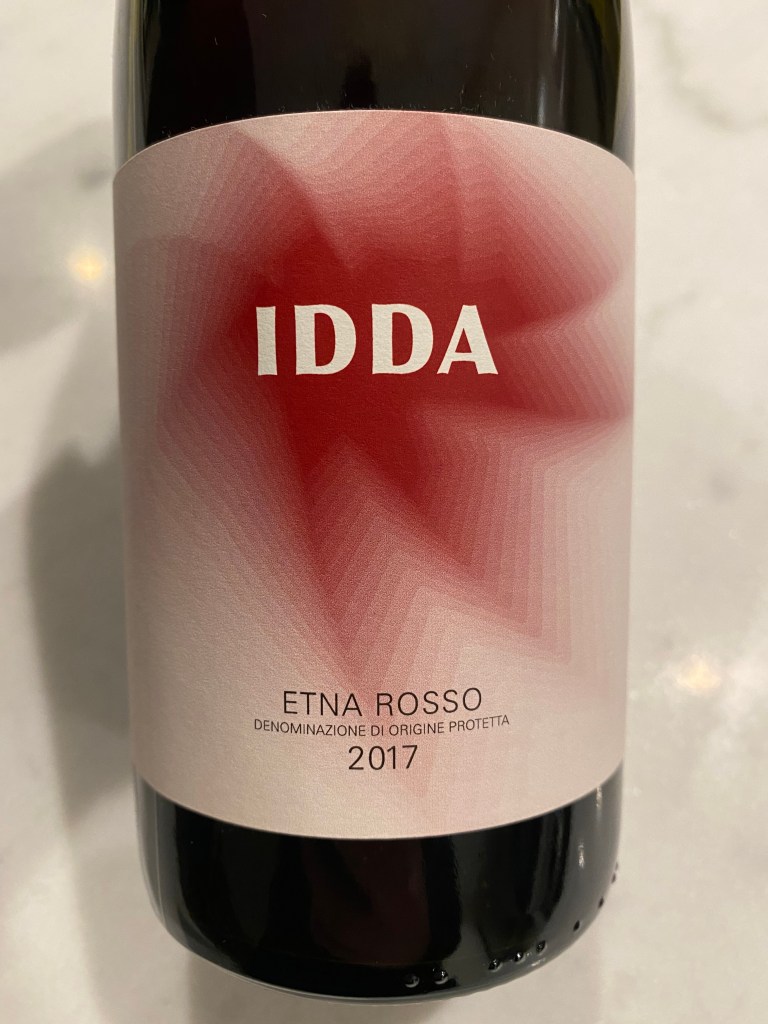
Today’s Wine: 2017 IDDA Etna Rosso

98% Nerello Mascalese, 2% Nerello Cappuccio; 14.5% ABV

The 2017 IDDA Etna Rosso is translucent deep garnet in color. Given some time to blossom in the glass, this wine opens to showcase a nose of strawberry, raspberry, bing cherry, leather, tomato paste, volcanic soil, bright mineral, and charred oak. There is some slight heat there too, which should become better integrated over time. On the palate, I get notes of tart cherry, stemmy strawberry, boysenberry, rose petal, anise, sweet tobacco, smoke, tilled rocky soil, ground green herbs, and basil. This is medium-bodied with high acidity, medium (+) tannins, and a long finish.

Price: $50. This is the inaugural vintage of this wine, and although young it is both approachable with air and immensely promising as this project comes into its own. I think this is priced very fairly given the apparent quality, and like similar Etna Rosso wines provides QPR that can be hard to find in the world.

The Promise of Ribera del Duero

Today’s Story: Dominio de Pingus Psi

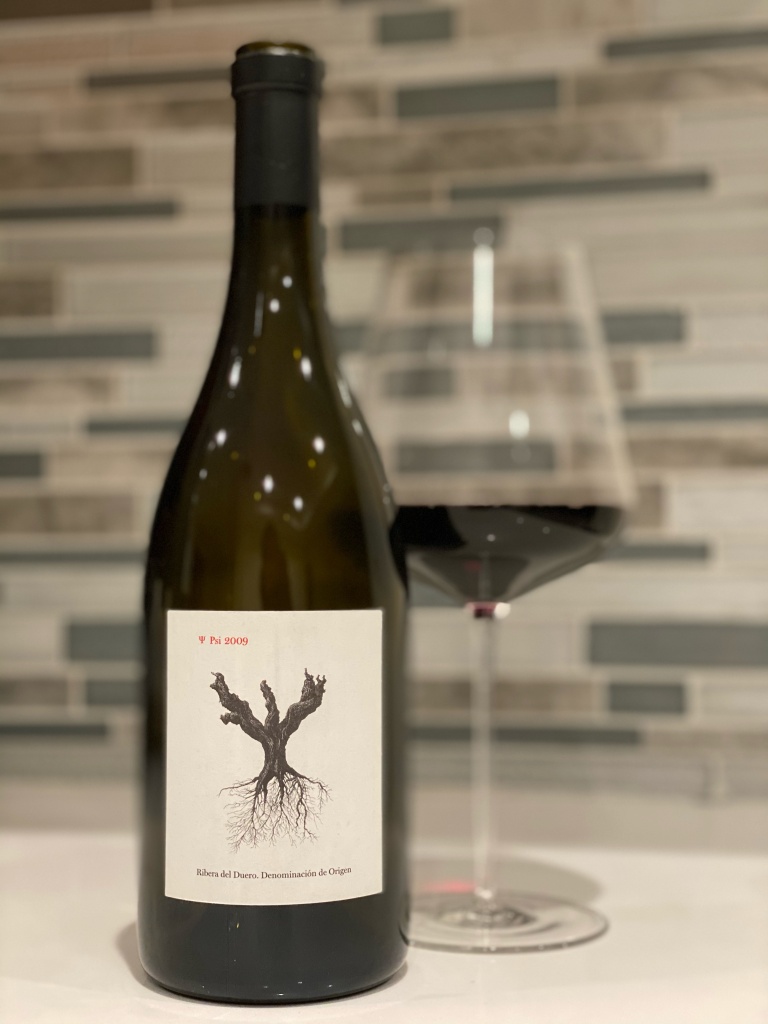
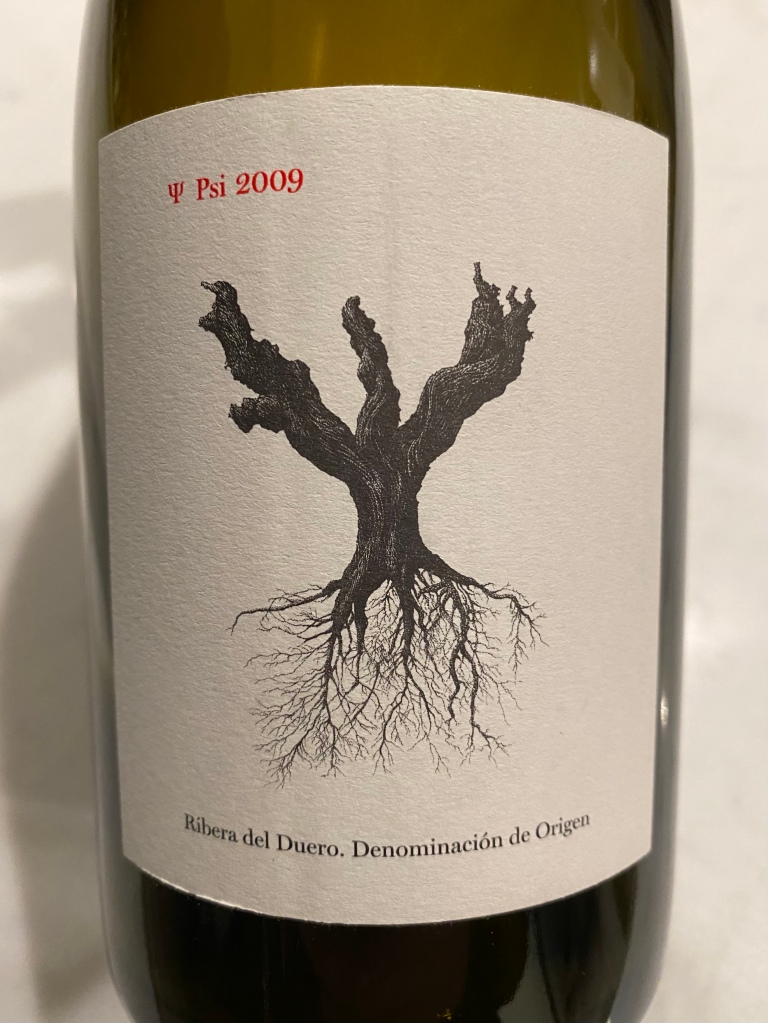
Psi was born out of passion by Peter Sisseck of Dominio de Pingus fame. While Pingus is arguably the pinnacle for the best that wines can be from Ribera del Duero and Spain overall, Peter established Psi to focus more on how old vines and improved farming practices could demonstrate the true overlooked potential of the region. Ribera del Duero has long been a source of “quantity over quality” mentality because the farmers are often paid by the ton and chemical use runs rampant. Peter, however, works with growers who he has helped shift to organic and biodynamic farming practices with emphasis on quality, purity of fruit, and expression of terroir. As quality of fruit improves, Peter pays his partner growers higher rates. The wines of Psi are then produced using more traditional winemaking techniques, with long macerations and rare use of new oak. Psi is no doubt an exciting development in Ribera del Duero, and it will be fun to see how the wines change and improve over time.

Today’s Wine: 2009 Psi Ribera del Duero

100% Tinto Fino (Tempranillo); 13.5% ABV

The 2009 Psi is opaque deep garnet in color with ruby hues. Once this opens up, the nose emits aromas of plum, black cherry, cola, cigar box, forest floor, spearmint, tilled rocky soil, and mineral. I will say it was fairly muted until given about 3 hours in the decanter. On the palate, which really steals the show here, I get notes of blackberry, cassis, black raspberry, tobacco, crushed rock, charred earth, green peppercorn, and mocha. This wine is medium-bodied with medium (+) acidity, high tannins, and a medium (+) length finish.

Price: $80 ($40-50 in Europe, but pretty hard to find). I think the $80 price tag here is a bit of a value stretch, but that is I think largely due to the fact this is very difficult to find and even more so with the age on it. If you find this closer to the $40 level (which I speculate is more of a release price here in the US) then it’s certainly worth a shot.

A Peek Into Château Latour Through Their Third Wine

Today’s Story: Château Latour

Château Latour is a First Growth wine estate located in Pauillac on the Left Bank of Bordeaux, with roots tracing back to 1331. Though not a wine estate from the outset, Château Latour gets its name from the fortified tower built there by Gaucelme de Castillon. Until the end of the 16th century, the estate was a jointly held lord’s domain rented out to farmers. Though the property was not entirely planted to vine at that time, they did produce wines and, without the necessary storage, consumed them each year. During the early 1700s, Château Latour came under ownership of Alexandre de Ségur and he (and later his son Nicolas-Alexandre) greatly expanded the family’s winegrowing holdings. By the middle of the 18th century, Château Latour actually became known for its wine and due to its quality became 20 times more expensive per bottle than the average Bordeaux wine at the time. It even became a favorite of Thomas Jefferson. Over time Latour has continued to produce exceptional and long-lived wines, with the current estate producing arguably some of the greatest wines in their history.

Today Château Latour consists of 92 hectares planted to vine, with 47 hectares of the best vineyards, known as l’Enclos, surrounding the Château. The vineyards are planted to 76% Cabernet Sauvignon, 22% Merlot, and 2% Cabernet Franc and Petit Verdot. The deep, nutrient-poor gravel soil of the estate is perfect for forcing the vines to struggle and dig deep to a clay sublayer for water. The estate transitioned gradually to full organic farming and became certified by Ecocert, with a large percentage of l’Enclos farmed adhering to biodynamic principles as well. Château Latour produces three wines, which include the Grand Vin (typically $750-800+ per bottle), a second wine Les Forts de Latour (typically $250-300+ per bottle), and a third wine Pauillac de Latour (typically $100 per bottle).

To learn more about this historic estate and its magnificent wines, check out the website here.

Today’s Wine: 2014 Pauillac de Château Latour

50% Cabernet Sauvignon, 43% Merlot, 7% Petit Verdot; 13% ABV

The 2014 Pauillac de Château Latour is opaque deep ruby in color with purple hues. A bit funky right out of the bottle, this needed 4 hours in the decanter to really come to life and I drank it over an additional 3-4 hours. The nose showcases aromas of cassis, blackberry, redcurrant, cigar box, graphite, scorched earth, lilac, dried green herbs, gravel, and milk chocolate. Once on the palate, the wine displays notes of black cherry, strawberry, plum, sweet tobacco, pencil shavings, smoke, eucalyptus, rocky earth, and a hint of bell pepper. Overall it’s somewhat medicinal in nature. The wine is medium-bodied with medium (+) acidity, medium dusty tannins, and a medium (+) length finish. Needs some cellar time to fully come around.

Price: $100. I would love to see this priced closer to $75 from a value perspective. The $100 price tag is in a very competitive range, and there are quite frankly a number of other wines that punch above this one at that price. Maybe this will get better with bottle age, we shall see.

Exclusive Napa Red From the Harlan Family

Today’s Story: The Napa Valley Reserve

The Napa Valley Reserve was established by H. William Harlan in 2000 and is a private members-only club located in St. Helena of the Napa Valley. While the vineyards are overseen by the Harlan Estate viticulture team and winemaking is spearheaded by Harlan Estate winemaker Bob Levy and winemaker Marco Gressi, members are involved in as much of the winemaking process as they desire. For instance, members are able to assist in pruning during the winter months, thinning during the summer months, and harvest in the fall which is accomplished entirely by hand. Members even get to help monitor the fermentation process, top up their barrels during aging, and can help determine a custom blend for their own wines, custom bottles, and custom labels. If you would like to join this exclusive club of about 600 members, prepare to pay upwards of $100,000 for entry after receiving the necessary invite.

I highly recommend visiting the website here, particularly for the pictures of this beautiful winery and its vineyards.

Today’s Wine: 2003 Napa Valley Reserve

Blend unknown; 14.5% ABV

The 2003 Napa Valley Reserve is opaque deep garnet in color with deep ruby hues in the bowl. This is a very complex wine, with the incredibly perfumed nose changing over time to reveal aromas of cassis, plum, black raspberry, fig, licorice, lavender, mild tobacco, truffle, dried rocky earth, eucalyptus, ground pepper, and cedar. The palate is equally complex, though not as vibrant, with notes of juicy red cherry, raspberry, blackberry, crème de cassis, pipe tobacco, wet volcanic earth, black truffle, green underbrush, coffee grounds, chocolate, pepper, and iron. This utterly elegant wine drinks like liquid silk and is medium-bodied with medium (+) acidity, refined and mature medium tannins, and a very long finish. Stunning.

Price: Technically not for resale, though you can sometimes find this in auction or at wine stores that source from private collectors. I’ve seen this 2003 anywhere from $150 to $700 per bottle. If you can find this closer to the low end of that price range, buy any of it you can. This has all the classic Harlan characteristics you find in Bond, Promontory, and Harlan Estate but at a much more accessible level if you’re lucky.

Burgundian Elegance From… New Zealand?

Today’s Story: Greywacke

Greywacke was established by Kevin and Kimberley Judd in 2009 in the Marlborough wine region of New Zealand. Though Greywacke itself is a young venture, Kevin is deeply rooted in the New Zealand wine world. After studying wine at Roseworthy College in Australia, he moved to New Zealand in 1983 to join Selaks Wines and later moved on to become the founding winemaker at Cloudy Bay. After 25 vintages leading Cloudy Bay, Kevin established Greywacke which is named for the layered sandstone and mudstone rocks that can be found throughout New Zealand. Greywacke’s fruit is sourced from vineyards in the central Wairau Plains and the Southern Valleys, while Kevin makes the wines themselves at Dog Point Winery in the lower Brancott Valley. Though Greywacke focuses on Pinot Noir and Sauvignon Blanc, they also release limited quantities of Chardonnay, Pinot Gris, Riesling, and Gewürztraminer.

To learn more about Greywacke and explore their range of wines, visit the website here (also the source of today’s information).

Today’s Wine: 2015 Chardonnay

100% Chardonnay; 14% ABV

The 2015 Chardonnay is transparent medium yellow in color with gold and slightly greenish hues. Given some time to blossom in the glass, the wine opens to display a nose of white peach, stone fruit, pineapple, matchstick, dill, lightly buttered popcorn, hazelnut, and vanilla. On the palate, we get notes of lemon zest, golden apple, crisp pear, white florals, slate, nuts, smoke, and brioche toast. This is a medium- to full-bodied Chardonnay with medium (+) acidity and a well-rounded mouthfeel leading into a long, mouthwatering finish. An absolutely gorgeous wine, and rather Burgundian in profile.

Price: $28 (typically closer to $40). At the price I paid, I’m very tempted to say this is perhaps the greatest value Chardonnay I’ve purchased to date. The purity and focus in this wine is outstanding for its price point (and well above it), while the Burgundian nature really makes me want to slip this into a blind tasting. Even at $40, this is certainly a wine I would add to my cellar.

Fun Santa Barbara County Syrah

Today’s Story: Black Sheep Finds

Black Sheep Finds (Holus Bolus and The Joy Fantastic) is a family owned and operated winery established by husband and wife Peter Hunken and Amy Christine in 2003 in Lompoc, California. Peter began his winemaking career in 2001 with Stolpman Vineyards, and also co-founded Piedrasassi where he remained until shifting all his attention to Black Sheep Finds in 2008. Amy has an impressive wine resume as well, earning the Master of Wine designation in 2013 and working with Kermit Lynch in Southern California.

Until 2015, Peter and Amy sourced all fruit for their wines from organically farmed vineyards in Santa Barbara County. In 2016, however, they completed the first harvest in their own estate vineyard named The Joy Fantastic which they began developing in 2014. The Joy Fantastic Vineyard is certified organic (CCOF) and consists of 5 acres planted to Syrah, Pinot Noir, and Chardonnay, though Black Sheep Finds does continue to work with select vineyard partners as well. The partners include Bien Nacido Vineyard (where they source Roussanne), Presqu’ile Vineyard (where they source small amounts of Syrah), and John Sebastiano Vineyard (where they source Syrah for Holus Bolus).

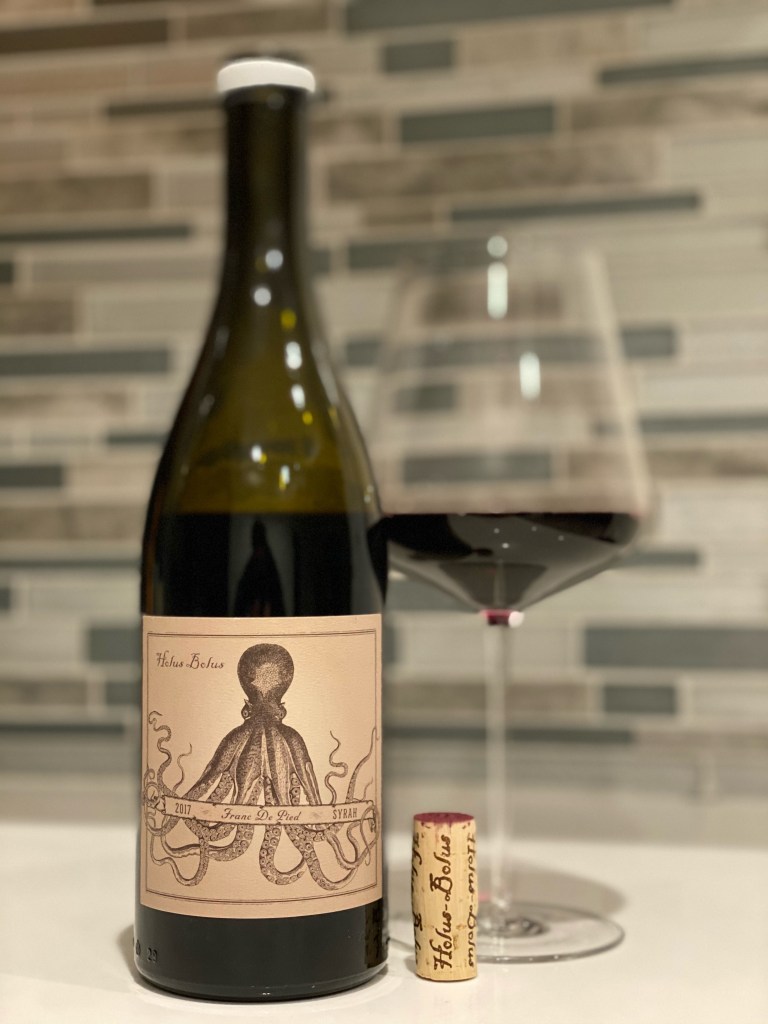
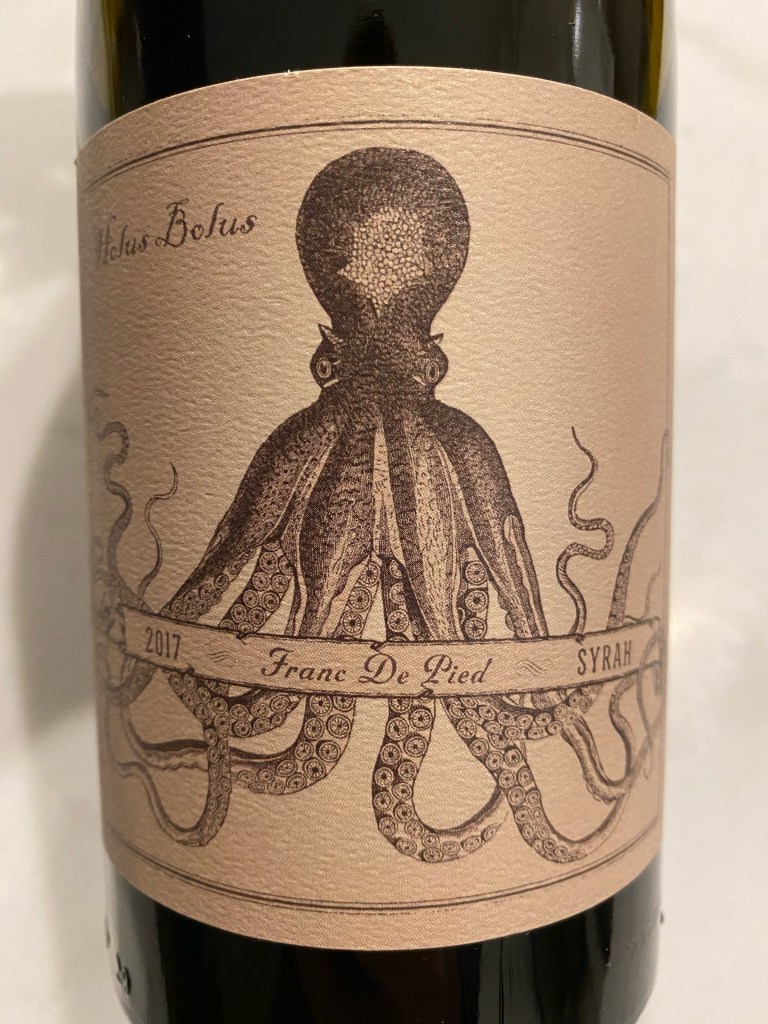
Today’s Wine: 2017 Holus Bolus Franc de Pied Syrah

100% Syrah; 13.5% ABV

The 2017 Franc de Pied Syrah is opaque medium to deep purple in color. Once this opens up, the nose showcases aromas of blueberry, black cherry, plum, violet, pine, pepper, underbrush, and light smoke. On the palate, I get notes of blackberry, black plum, forest floor, purple florals, cracked pepper, and gravel. A delightful wine overall, this is medium-bodied with medium acidity, medium tannins, and a medium length finish.

Price: $28 (averages closer to $40). For $28 I paid, I think this is a great value. It’s no doubt a young wine, but is certainly approachable right now and honestly I don’t think this will be incredibly long-lived. Even if found closer to $40, I think this is worthy of try.

Delicate and Pure Entry Level Champagne

Today’s Story: Billecart-Salmon

Billecart-Salmon is a family-run Champagne house established in 1818 in Mareuil-sur-Aÿ through the marriage of Nicolas François Billecart and Elisabeth Salmon. Nicolas François, who handled the commercial aspects of the new Champagne house, brought his brother-in-law Louis Salmon on board to make the wines. 200 years later, the 7th generation of the Billecart family manages the house with the 6th generation still very much involved. Together they cultivate 100 hectares of vineyards across 40 crus of Champagne and an area of 300 hectares, the majority of which sits around Epernay. Billecart’s signature style comes largely from their fermentation process, which is accomplished in stainless steel tanks at lower temperatures to prolong fermentation an coax out delicate aromas and purity of fruit. All vinification occurs cru by cru and variety by variety, allowing each to maintain the unique expressions of the varying terroir. The house’s wines rest in chalk cellars dating to the 17th and 19th centuries, with the NV bottlings enjoying 3-4 years in the cellar and the vintage bottlings enjoying 10 years.

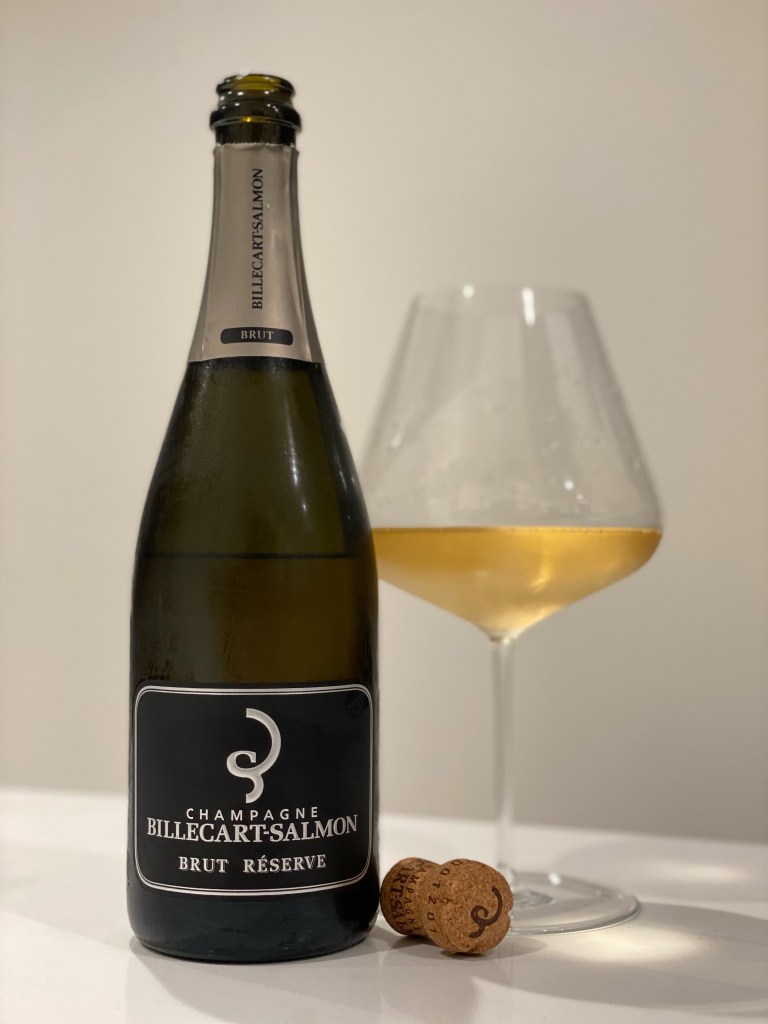
Today’s Wine: Champagne Brut Réserve

40% Pinot Meunier, 30% Pinot Noir, 30% Chardonnay; 12% ABV

The Champagne Brut Réserve is transparent gold in color with tiny bubbles. On the nose, I get aromas of yellow pear, golden apple, honeysuckle, toast, yeast, and chalk. There’s a delightful herbal earthiness there too. Once in the mouth, the wine showcases notes of crisp green apple, lemon citrus, stone fruit, honey, brioche, rose petal, and cream. This is medium-bodied with great effervescence and vibrant, mouthwatering acidity into a medium (+) length finish.

Price: $45. I think this is a great “entry level” Champagne from one of the larger, more recognizable houses. You can without a doubt find better values from growers, however you can’t go wrong with Billecart-Salmon in this price-point over some of the bigger names.

Delicious, Small Production Australian Shiraz

Today’s Story: Coriole Vineyards

Coriole Vineyards is a third generation family owned and operated winery established by Hugh and Molly Lloyd in 1967 in the McLaren Vale region of Australia. At that time Coriole consisted of 12 acres of vineyards with Shiraz vines dating back to 1919, and the Lloyd’s released their first “Claret” wine in 1969. Though Shiraz is undoubtedly one of the varieties McLaren Vale is known for, Coriole spiced things up over the years by planting Sangiovese in 1985 which makes up 10% of the land under vine. Coriole consists of 25 different vineyards, made up of 65% Shiraz, 10% Sangiovese, 5% Chenin, 5 % Cabernet Sauvignon, 5% Nero d’Avola, and the balance inclusive of Fiano, Grenache, Barbera, Mourvedre, and Montepulciano. The Lloyd family farms their vineyards adhering to organic practices and they are pending certification, while when it comes to winemaking itself they are largely traditional.

As the website is full of additional information, gorgeous pictures of the vineyards, and the full portfolio of wines, I encourage you to visit here.

Today’s Wine: 2016 Lloyd Reserve Shiraz

100% Shiraz; 14% ABV

The 2016 Lloyd Reserve Shiraz is opaque medium purple in color. Once this opens up, the nose showcases aromas of plum, blueberry, black cherry, cola, tobacco, graphite, cedar spill, tilled rocky soil, and cinnamon. On the palate, I get notes of spiced black plum, blackberry, black raspberry, black cherry, sweet tobacco, wet gravel, and light toasted oak. The purity of fruit here is striking. This is medium-bodied with medium (+) acidity, fine grained medium (+) tannins, and a long finish. 330 cases produced.

Price: $40 ($80 from the winery). I got this for an absolute steal and it’s worth every penny. This is a gorgeous, textbook modern Shiraz and even at $80 I would be tempted to give it a shot. I will certainly be buying more at $40!

Fantastic Riesling From Eden Valley’s Oldest Vineyard

Today’s Story: Pewsey Vale Vineyard

Pewsey Vale Vineyard was first established in the Eden Valley wine region of South Australia in 1847 by Joseph Gilbert. After arriving from England, Gilbert sourced his vines from Macarthur Vineyards at Camden in New South Wales which were originally sourced from Rheingu, Germany in 1837. Importantly, Pewsey Vale Vineyard is not only Eden Valley’s first ever planted grapevines, but the first successful recorded importation of the Riesling variety to Australia as a whole. Though the vineyard fell into disrepair during the global financial crisis of the late 1920s and 1930s, it was rediscovered in 1961 and vigneron Wyndham Hill Smith started revamping the site. Today, Pewsey Vale produces 4 bottlings of Riesling from this historic site.

The vineyard itself sits on average around 485 to 500 meters above sea level and is planted entirely to the Riesling variety. Difficult to manage due to its high altitude, rocks, and varying microclimates, the vineyard demands constant care from winemaker Louisa Rose and viticulturist Darrell Kruger. In 2013, the Contours block of the vineyard (where my wine today comes from) received organic certification, though Kruger farms it adhering to biodynamic practices.

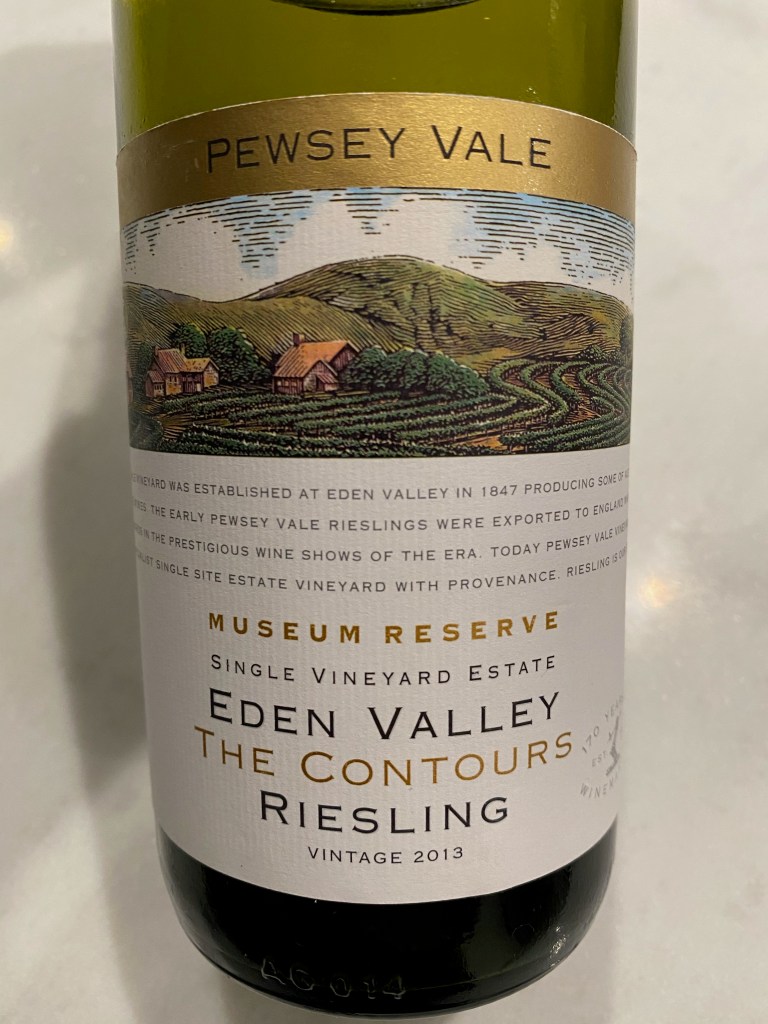
Today’s Wine: 2013 The Contours Museum Reserve Riesling

100% Riesling; 12% ABV

The 2013 Contours Museum Reserve Riesling is transparent medium straw in color with greenish-yellow hues around the rim of the glass. This is gorgeous on the nose, with aromas of lemon, lime, green apple, white florals, petrol, wet stone, and rubber. On the palate, I get notes of lime zest, grapefruit, underripe pear, lemongrass, honeysuckle, toast, and rocky mineral. This dry Riesling is light- to medium-bodied with vibrant high acidity and a long finish.

Price: $34. This is a very nice wine with only untapped potential with more bottle age, and one that I find to be a great value. Definitely give this a shot if you come across it.