Dunn Vineyards dates to 1979 when Randy and Lori Dunn purchased a 14 acre parcel in Angwin with about 5 acres planted to Cabernet Sauvignon. Though Randy worked as a winemaker in Rutherford for his day job, he spent the nights and weekends with Lori and their young son Mike farming their vines. The Dunn family also farmed Harry Frank’s adjacent vineyards and purchased the fruit resulting in a first harvest of 9 tons of fruit. With an additional purchase of 3 tons from Beatty Ranch, the Dunn’s were on their way to producing their first vintage. The family moved onto their property shortly thereafter with another young child, Jennifer, and Dunn Vineyards was officially bonded in 1981. After their second daughter, Kristina, was born, Randy was still working in Rutherford when the winery’s success picked up and encouraged him to leave his job in 1985 to move into a new family house and put all of their effort into Dunn Vineyards. By the late 1980s, Randy was consulting for other wineries, their wine was selling out, and the family needed to burrow into the mountain in 1989 to create more room for barrels. Mike returned in 1999 and three years later became a full-time employee at Dunn Vineyards and after Kristina graduated from Cal Poly with a degree in winemaking and viticulture she joined as well. Today, Kristina’s daughters play in the vineyards and Mike’s son helps bottle the wines, making it seem the family tradition at Dunn Vineyards is set to continue into three generations and beyond. Today, the family farms 42 acres of Cabernet Sauvignon high up on Howell Mountain and the resulting wines are elegant yet profound and built for cellaring.
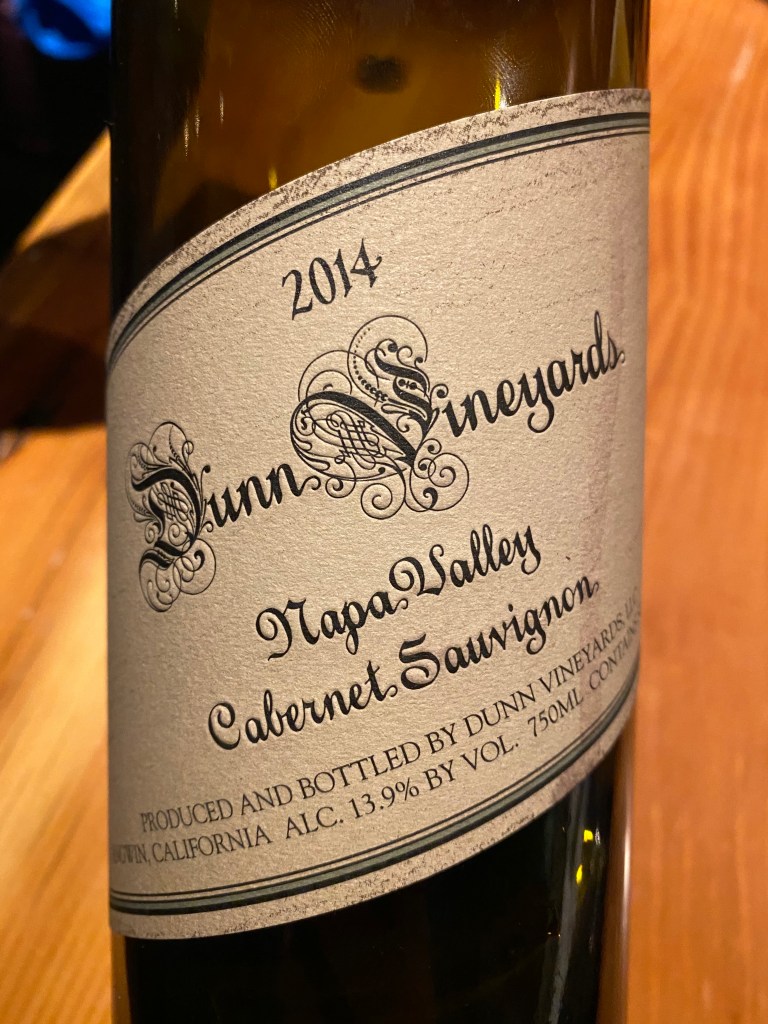
Today’s Wine: 2014 Napa Valley Cabernet Sauvignon
100% Cabernet Sauvignon; 13.9% ABV
The 2014 Napa Cab is opaque deep purple/ruby in color. Once this opens up, the nose showcases aromas of blackcurrant, blackberry, plum, black cherry, redcurrant, red licorice, cedar, tobacco, loamy earth, graphite, green herbs, and a touch of vanilla. On the palate, the wine displays notes of blackberry, crème de cassis, black cherry, black raspberry, charred earth, smoke, pencil shavings, chocolate, and oak. This wine is full-bodied with medium (+) acidity, grippy high tannins, and a medium (+) length finish.
Price: $90. Dunn always produces exceptional Cabernet Sauvignon and this is relatively a good value, however I would spend the extra money to buy their Howell Mountain bottling which is consistently one of my favorites. These wines are built for the long haul as well, as I’ve tasted them back to the 1980s and each was fantastic. Pair with filet mignon, roasted lamb, or pepper-crusted ahi tuna.
Thibault Liger-Belair Successeurs was established alongside Domaine Thibault Liger-Belair in 2001. Though the Liger-Belair family owned the domaine for 250 years, it certainly did not fall to Thibault in a linear path. In 1720, Claude Marey who was the mayor of Nuits-Saint-Georges and a vineyard owner established C. Marey wine house to sell his wines. Next, Claude’s son Claude Philibert Marey (also a mayor of Nuits-Saint-Georges) took over the family business until his death in 1804 when his youngest son Guillaume Felix Marey took over. In 1852, Guillaume Felix partnered with his nephew Comte Liger-Belair (who owned Grand Cru vineyards in Vosne-Romanée) to establish C. Marey et Comte Liger-Belair. The domaine passed through several generations, ultimately until 1892 when Vincent Liger-Belair took over and restructured it with work handled by three sharecroppers. After studying viticulture and oenology for six years, working for a Parisian communications firm, and starting an internet wine sales company, Vincent’s son Thibault transitioned to winemaking and took over the vines to establish his namesake domaine.
Thibault Liger-Belair harvested his first Nuits-Saint-Georges, Nuits-Saint-Georges Charmottes, and Vosne-Romanée Aux Reas in 2002 but quickly set his eyes upon expanding his portfolio. In 2003, Thibault ventured into Richebourg Grand Cru, Clos Vougeot Grand Cru, Vosne-Romanée Premier Cru Petits Monts, and Bourgogne Rouge, followed in 2009 by Beaujolais. While all of the domaine’s vineyards are certified organic by Ecocert, each appellation is cultivated and worked differently based on their unique soils and climates which Thibault takes great care to analyze. Through harvest and in the cellar, Thibault believes that his grapes need to be treated very delicately and with respect to produce the best wines. Regarding barrels, he selects between three coopers and requires a three year drying period before they are made and he almost never uses more than 50% new oak. Thibault’s wines are aged between 14 and 18 months depending on appellation without racking, and are bottled unfined and unfiltered.
Today’s Wine: 2015 Bourgogne Rouge Les Grands Chaillots
100% Pinot Noir; 13% ABV
The 2015 Bourgogne Rouge is moderately opaque pale ruby in color with rose variation near the rim of the glass. On the nose, I get aromas of cranberry, wild raspberry, cherry, rose petal, forest floor, faint barnyard, peppery spice, black tea leaf, rocky minerality, and a hint of oak. Once in the mouth, the wine showcases notes of dried strawberry, red cherry, blackberry, black raspberry, violet, tobacco, loamy soil, green underbrush, dry crushed rock, and pepper. This is medium-bodied with medium (+) acidity, medium dusty tannins, and a surprisingly long finish. 1/3 of the fruit comes from one of the domaine’s Nuits-Saint-Georges vineyards (0.8 ha planted in 1986) and 2/3 is purchased from growers in Marsannay, Côtes de Nuits, Beaune, and Ladoix Serrigny.
Price: $35. This is quite possibly the best value Bourgogne Rouge I’ve tried to date. From first smell you can tell this is a well-crafted wine and that first sip is profound. This is drinking well now with some air but certainly has the structure to where I’d hold off on my next bottle for at least 5 years. Pair this with seared duck breast, herb-roasted chicken, or mild goat cheese.
Churchill’s is a relatively young Port wine company, founded in 1981 by John Graham which made it the first to be established in 50 years. Though John comes from a long lineage of Port winemakers of Graham’s, he wanted to start his own venture to explore his own individual style of Port. Named for his wife, Churchill’s produces Port wines using as much natural fermentation as possible and as little fortification brandy as possible. In 1999, Churchill’s expanded into the production of Douro wines by acquiring Quinta da Gricha. All of Churchill’s wines are produced with Grade A (IVDP’s highest quality rating) native grapes and for Port are hand-sorted at the winery before being crushed and vinified in open granite fermentation tanks called lagares. Foot treading is utilized to provide a gentle maceration of the grapes and skins, and the traditional winemaking practices as a whole alongside minimal intervention results in dry, well-structured wines.
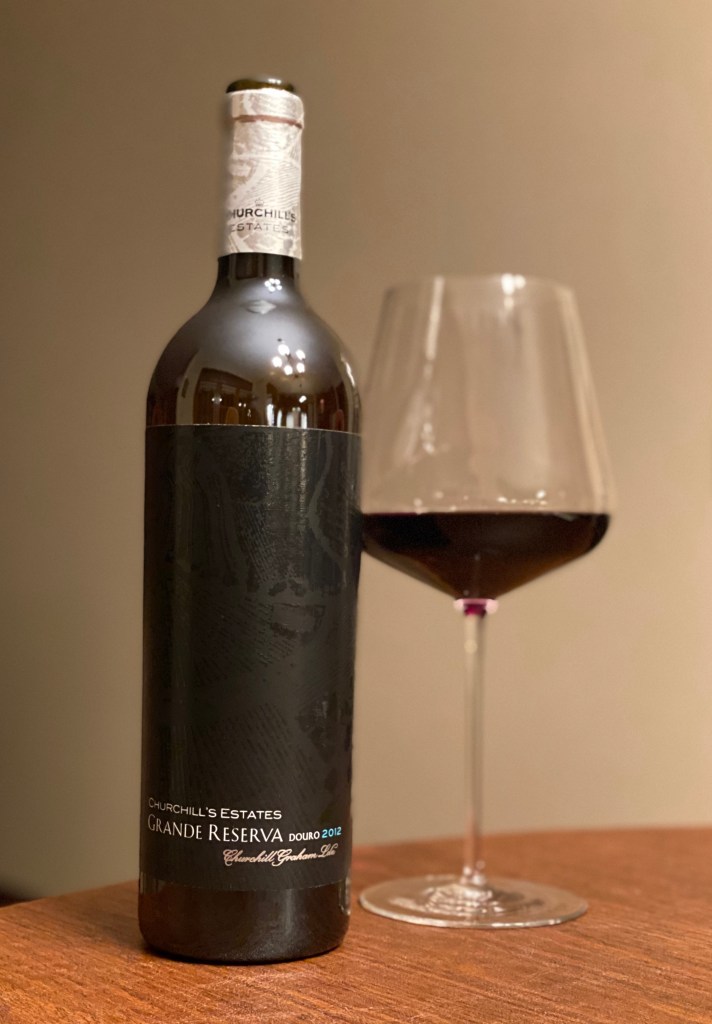
Today’s Wine: 2012 Grande Reserva Douro
Field blend of Touriga Nacional, Touriga Francesa, Tinta Roriz, Tinta Francisca, and Tinto Cão; 14% ABV
The 2012 Grande Reserva is slightly transparent and medium purple in color. Once this opens up, the nose showcases aromas of plum, stemmy blueberry, cherry cola, violet, sweet tobacco, rocky earth, wet slate, green vegetation, and black pepper. On the palate, I get notes of blackberry, blueberry, juicy black plum, black raspberry, cocoa, mint, damp loamy soil, iron, nutmeg, slate, and a hint of oak. The wine is full-bodied with medium (+) acidity, medium tannins, and a medium (+) length finish.
Price: $32. This is a really solid value from the Douro Valley that is drinking very nicely right now. Pair this with steak, a good burger, or game (particularly wild boar or venison).
Coume del Mas was established in 2001 by Philippe and Nathalie Gard and today encompasses roughly 15 hectares of vines on the steep slopes of Banyuls sur Mer. Though the Gards work an incredibly challenging terroir, they work almost entirely by hand and in close contact with their vines to glean an understanding of the varying soil and nuances it can impart into wine. Coume del Mas cannot reach their vines by tractor and a majority cannot be reached by plough horse, while both the rocky soil and extreme climate keep yields low (around 20 hl/Ha). Coume del Mas produces wines in two categories: Banyuls which are sweet wines fortified during fermentation, and dry wines namely with Grenache, Mourvèdre, and Carignan. Banyuls is one of the older appellations dating to 1936, whereas the appellations that source Coume del Mas dry wines date to 1971 for the reds and 2002 for the whites.
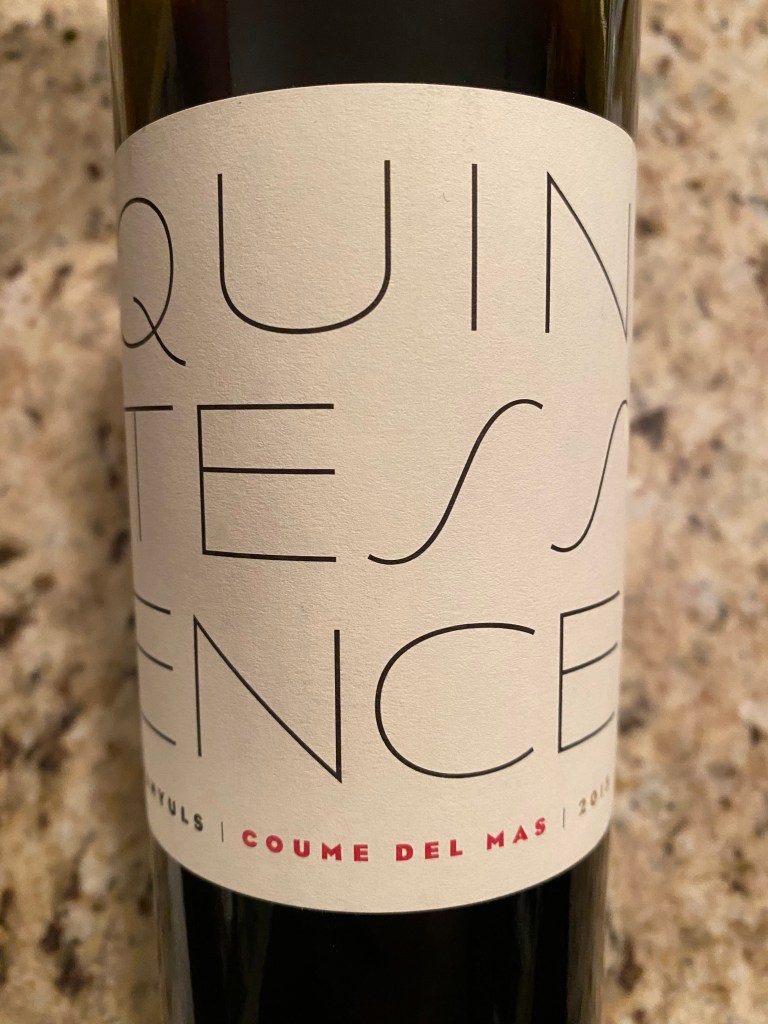
Today’s Wine: 2015 Quintessence Banyuls
100% Grenache Noir; 16.5% ABV
The 2015 Quintessence is moderately opaque and pale to medium purple in color. On the nose, this Banyuls showcases aromas of muddled strawberry, prunes, baked plum, black licorice, damp earth, cinnamon, eucalyptus, and a touch of oak. Once in the mouth, I get notes of stewed black raspberry, candied strawberry, cranberry sauce, jammy blackberry, dates, fig, saturated soil, chocolate, and purple florals. This wine is full-bodied with medium (+) acidity, medium (+) tannins, and a long finish dominated by inky black fruit. 250 cases produced.
Price: $50. This is what I paid for a 500ml bottle, though I am certain this is cheaper overseas if you can find it. This is a delicious sweet wine that is neither too sweet nor too syrupy to enjoy after a decadent meal, and an easy one to have multiple glasses of which can be difficult with something else like Port. Pair this with chocolate, raspberry tart, or mixed berries.
Guigal was established in 1946 by Etienne Guigal in Ampuis, a small village in the Côte-Rôtie appellation of the northern Rhône region in France. Etienne arrived in Côte-Rôtie at the age of 14 in 1924, and early in his career he helped develop Vidal-Fleury for 15 years before starting his namesake venture. His son, Marcel Guigal, took over management of the Guigal domain in 1961 when Etienne was struck with temporary but total blindness, and Marcel was joined by his wife Bernadette in 1973. As Marcel and Bernadette worked tirelessly to expand the family business (namely by purchasing Vidal-Fleury in the early 1980s and Château d’Ampuis in 1995), their son Philippe (born 1975) grew amongst the vines with expectations of one day joining the domain. Today, Philippe serves as Guigal’s oenologist alongside his wife Eve and the two strive to produce the greatest wines of the Rhône Valley.
Guigal has experienced significant expansion since their first acquisitions in the 1980s and 1990s, particularly in 2001 when they purchased the domains Jean-Louis Grippat and de Vallouit to not only strengthen their stature in Côte-Rôtie but expand into the Hermitage, Saint-Joseph, and Crozes-Hermitage appellations. In 2003, Guigal started producing their own wine barrels to not only learn more about the entire wine production process but control another facet of their business. Guigal expanded yet again in 2006 by purchasing Domaine de Bonserine, and made strides in 2017 by purchasing Château de Nalys in Châteauneuf-du-Pape to establish a foothold in southern Rhône.
Today’s Wine: 2004 Côte-Rôtie ‘La Turque’
93% Syrah, 7% Viognier; 13% ABV
The 2004 La Turque is mostly opaque and medium ruby in color. This requires at least an hour decant, but then the nose blossoms to emit aromas of plum, blackcurrant, bing cherry, licorice, cola, smoked game, loamy soil, white truffle, flint, cracked pepper, and oak. Once in the mouth, the wine showcases notes of ripe red cherry, redcurrant, candied raspberry, dried blueberry, forest floor, graphite, earthy mushroom, leather, smokey tobacco, dried green herbs, and mineral. This supple and elegant wine is medium-bodied with medium acidity, medium (-) tannins, and a long finish. 350 cases produced.
Price: $300. Though not one of the “greatest” vintages of La Turque, this is an exceptional wine drinking beautifully right now. I would say this has another five years left in its prime drinking window and could be a great introduction to Guigal’s “La La’s.” Pair this with wagyu filet mignon, grilled lamb, hare, or pheasant.
Maison Leroy was founded in 1868 by François Leroy who was a winemaker and vineyard owner at Auxey-Duresses as well as Meursault, Pommard, Chambertin, Musigny, Clos Vougeot, and Richebourg. Though François sold his wines through Comptoir des Proprietaires de la Cote-d’Or in Beaune, his desire of enlarging his business led to the foundation of Maison Leroy. When François’ son Joseph joined the business alongside his wife Louise Curteley, the two grew Auxey-Duresses by producing liquors and distilled alcohols alongside the wine and garnered significant critical acclaim during the late 1800s and early 1900s. Henri Leroy, son of Joseph and Louise, joined the Maison in 1919 and further extended the family business by creating a subsidiary to produce eaux-de-vie alcohol near Cognac. One of Henri’s great achievements in Burgundy, however, came through his friendship with Edmond Gaudin de Villaine whose wife and brother-in-law (Jacques Chambon) inherited Domaine de la Romanée-Conti in 1912. Though the domaine went up for sale during the financial crises of the 1920s, Henri convinced Edmond not to sell his ownership and later purchased Jacques’ half in 1942 to cement the de Villaine and Leroy families as equal owners of Domaine de la Romanée-Conti (DRC). Henri worked tirelessly at DRC for the following four decades until his death in 1980, having turned the domaine into one of the most famous in the world and a producer of today’s most expensive wines.
Lalou Bize-Leroy, Henri’s daughter, joined Maison Leroy in 1955 and became President-General Director in 1971. Lalou, or Madame Leroy, worked tirelessly to understand the diverse terroir of Burgundy’s vineyards and selects her purchased wine with intense scrutiny and demand for quality. Madame Leroy also accompanied her father Henri at DRC until his death and became Co-Gerante with Aubert de Villaine from 1974 to 1992. While Maison Leroy’s village wines truly drink on par with some of the great 1er Cru equivalents throughout Burgundy and the 1er Crus drink like Grand Crus, Madame Leroy founded Domaine Leroy in 1988 after Takashimaya, an owner of luxury department stores in Japan, purchased 1/3 of the company and funded the purchase of vineyards. Madame Leroy purchased the estates of Charles Noellat at Vosne-Romanée and Philippe-Rémy at Gevrey-Chambertin to get the domaine running and she immediately transitioned to biodynamic farming for all of her vines. While Maison Leroy wines typically start around $70 per bottle and go into the several hundreds of dollars, Domaine Leroy produces wines in the thousands of dollars per bottle up into the tens of thousands of dollars due to their immeasurable quality and rarity.
Though the following is a description of the winemaking practices at Domaine Leroy and not necessarily Maison Leroy, I think it is important to include because of the demonstration it shares of Madame Leroy’s strict winemaking and quality standards. Starting in her vineyards, Madame Leroy follows a strict set of guidelines which includes spreading “Maria Thun”-type compost and manure throughout the vineyards as needed while hand-tilling the soil. At Domaine Leroy, they do not replant vineyards but rather replant individual vines as needed using buds of sister vines in the same vineyards. Leroy practices the Guyot pruning method from mid-January to early April only when the moon is passing the constellations Sagittarius, Aries, Leo, and, if necessary, also Aquarius, Gemini, and Libra keeping with strict biodynamic practices. They also remove a selection of buds to keep yields lower, remove buds from the trunk of the rootstock, and remove excess buds growing between nodes but do not clip the end of vines to keep the last bud in tact. At harvest, Domaine Leroy selects all fruit carefully by hand and carries them to the winery in small baskets before they are double hand-sorted on a stationary table to guarantee selection of the healthiest grapes. Fermentation is accomplished in large wooden barrels without destemming or crushing the fruit to avoid oxidation and preserve natural yeasts on the grape skins. Fermentation is not rushed and the fruit goes through extended periods of maceration before the wine is pressed and sent into the first level of the cellar until malolactic fermentation is complete. Using only gravity, the wine is then poured off the lees into the lower second level of the cellar where wine is stored until it is bottled.
For the source of the information above and more, check out Leroy’s website here.
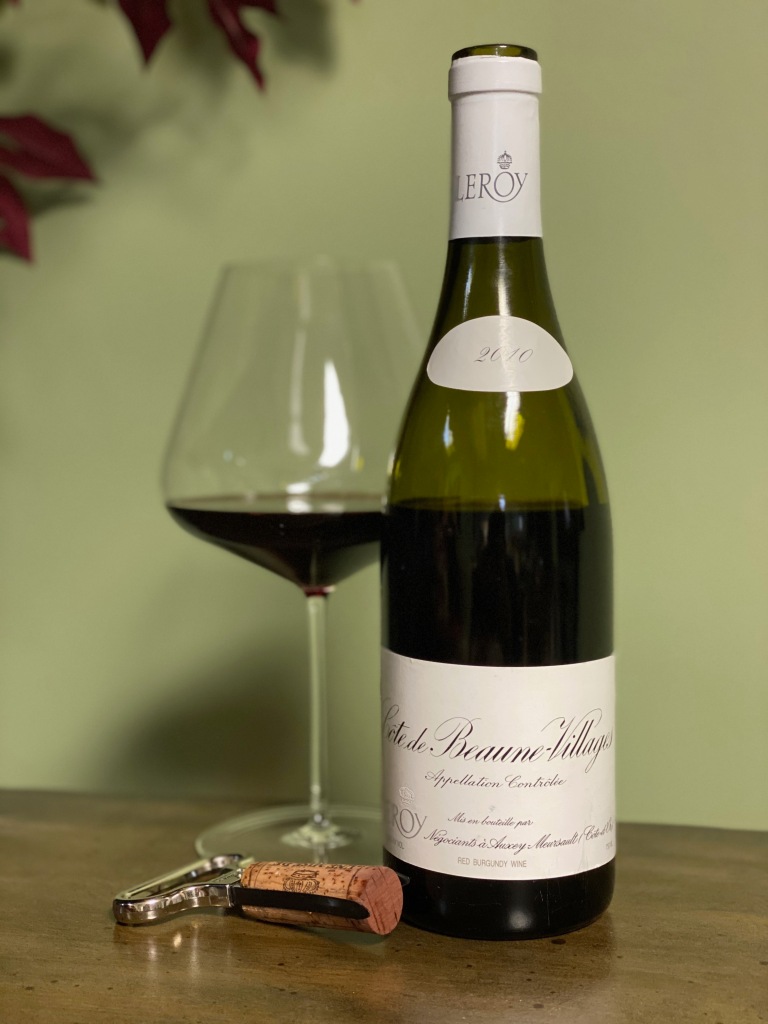
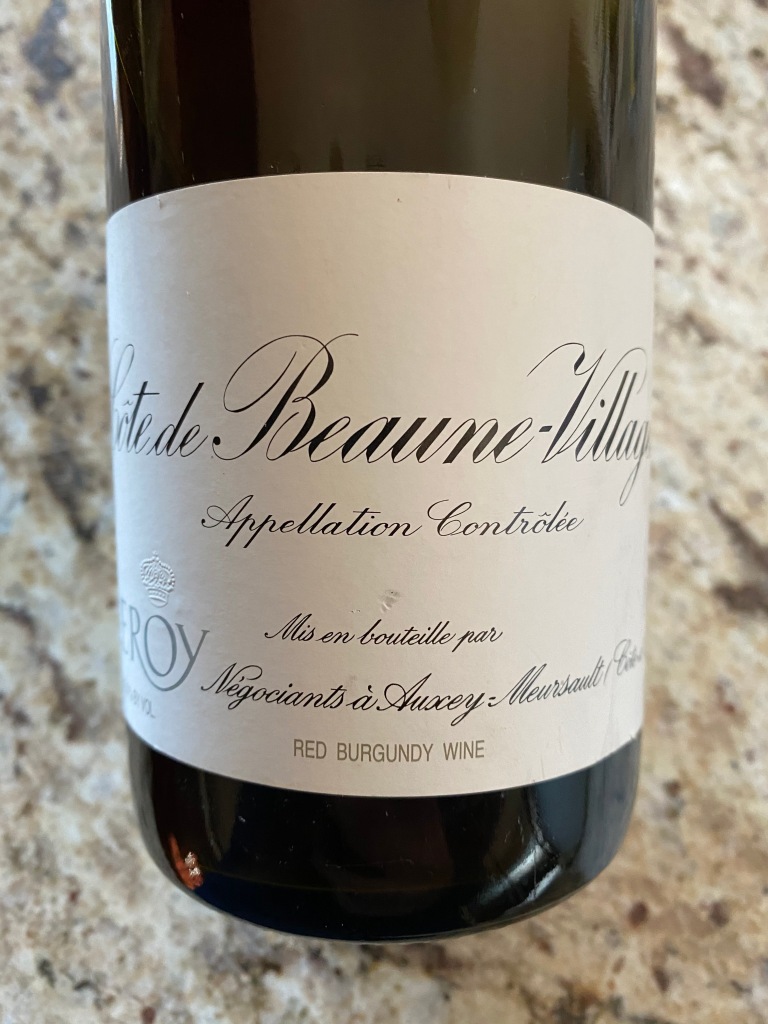
Today’s Wine: 2010 Côte de Beaune-Villages
100% Pinot Noir; 13% ABV
The 2010 Côte de Beaune-Villages is moderately transparent pale ruby in color with rose variation. I used my Ah-So opener on this bottle, as with almost every Leroy bottle the long corks are soaked and can often display mold on the top due to over-filling. On the nose, this wine showcases aromas of dried cranberry, dried cherry, and dusty wild strawberry but is dominated by worn leather, sous bois, tobacco, mushroom, wet rock, and underbrush. Once in the mouth, the wine displays notes of crushed raspberry, dried strawberry, rose, gamey meat, forest floor, truffle, dried green herbs, smoke, white pepper, and stone minerality. This is medium-bodied with medium acidity, medium (-) tannins, and a long finish filled with tilled soil and red cherry.
Price: $110 (though some stores sell this for $250). Every wine I’ve enjoyed from Maison Leroy is of incredible value and this bottling is no different. The strict selection process of Madame Lalou Bize-Leroy is palpable and every Burgundy lover should try something from Maison Leroy and, if one is supremely fortunate, from Domaine Leroy. Pair this with feathered game, salmon with roasted mushrooms, or mild goat cheeses.
Domaine de Courcel was founded roughly 400 years ago in the village of Pommard and is a family winery throughout its history. To this end, today the estate is managed by Anne Bommelaer and Marie de Courcel and its owners include three sisters and one brother who are descendants of the domaine’s founders. Production is somewhat limited at the domaine, with annual production numbers never rising above 30,000 bottles (2,500 cases). I previously wrote about them in Rustic, Terroir-Driven Burgundy when reviewing the 2009 Pommard 1er Cru Les Fremiers as well as in Outstanding Pommard from a Superb Vintage when reviewing the 2005 Pommard. For more about the domaine, you can check out either of those two prior posts.
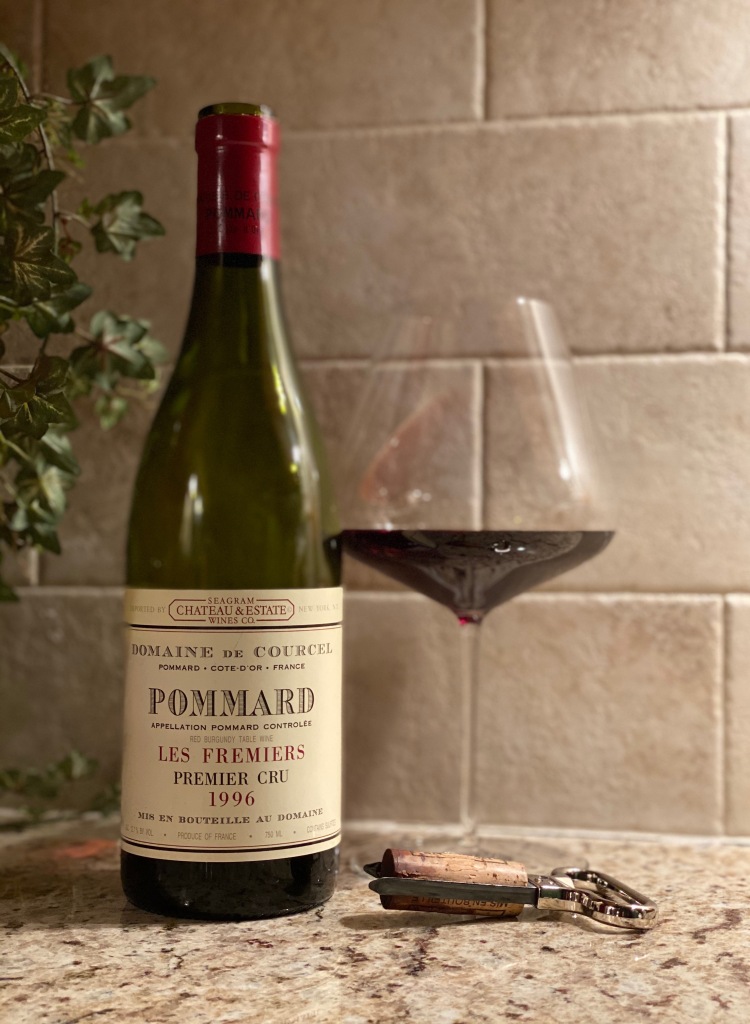
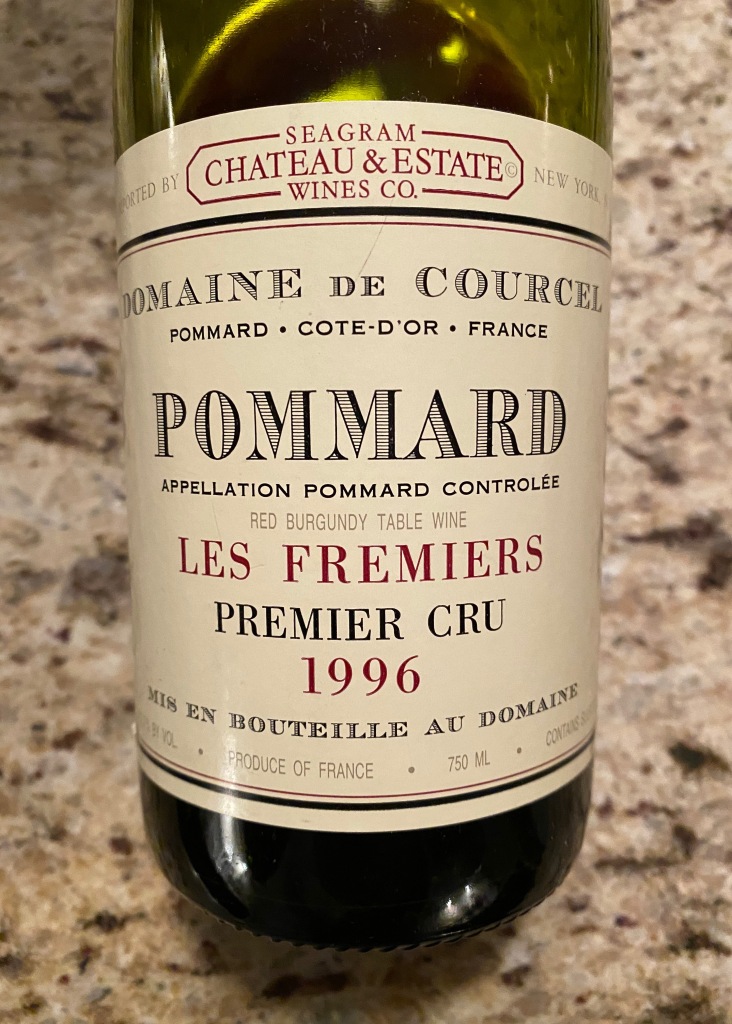
Today’s Wine: 1996 Pommard 1er Cru Les Fremiers
100% Pinot Noir; 12.7% ABV
The 1996 Les Fremiers is pale garnet in color and moderately transparent with some fine sediment that snuck through the filter. The nose emits aromas of muddled strawberry, black raspberry, cranberry, slight barnyard, aged saddle leather, forest floor, truffle, white pepper, dried herbs, and tar. On the palate, I get notes of stemmy strawberry, ripe cherry, dusty wild blueberry, tobacco, damp forest floor, dried underbrush, crushed rock, and mineral. This wine is medium-bodied with medium (+) acidity, medium tannins, and a medium (+) length finish.
Price: $220. This is not an inexpensive bottle of wine, though it is difficult to find aged Burgundy from notable producers that are nowadays. This wine still displays great fruit and structure which made it a very enjoyable bottle and I would happily purchase this again. Pair this with herb-roasted chicken, game birds, or filet mignon with black truffle.
John Anthony Vineyards was established by John Anthony Truchard and his wife Michele after he planted his own vineyards during the late 1990s and harvested his first vintage of Cabernet Sauvignon and Syrah in 2003. A second generation vintner, John learned a great deal about farming and winemaking at an early age working alongside his father at Truchard Vineyards. When he was in his early 20s, John started his own vineyard management company and farmed vineyards on nights and weekends before ultimately planting his own fruit and securing long-term leasing agreements to foster his dream of bottling his own wine. John selected Bordeaux, Burgundy, and Rhône clones when he planted his vineyards and the resulting wines are elegant and terroir-driven while each showcasing a unique place. John oversees the entire winemaking process from vineyard to cellar and bottles his wines into four distinct categories: AVA Series, Single Vineyard, Reserve, and The One. The wine I’m reviewing today falls into the Single Vineyard category, with other options being Crane Vineyard, Church Vineyard, and Coombsville District.
Note: John and Michele also started JaM Cellars in 2009 with the goal of producing affordable yet quality wines. They started with a bold, fruit-forward Cabernet Sauvignon priced under $20 but have since expanded the portfolio to include Butter Chardonnay, Toast Sparkling, and Candy Rosé.
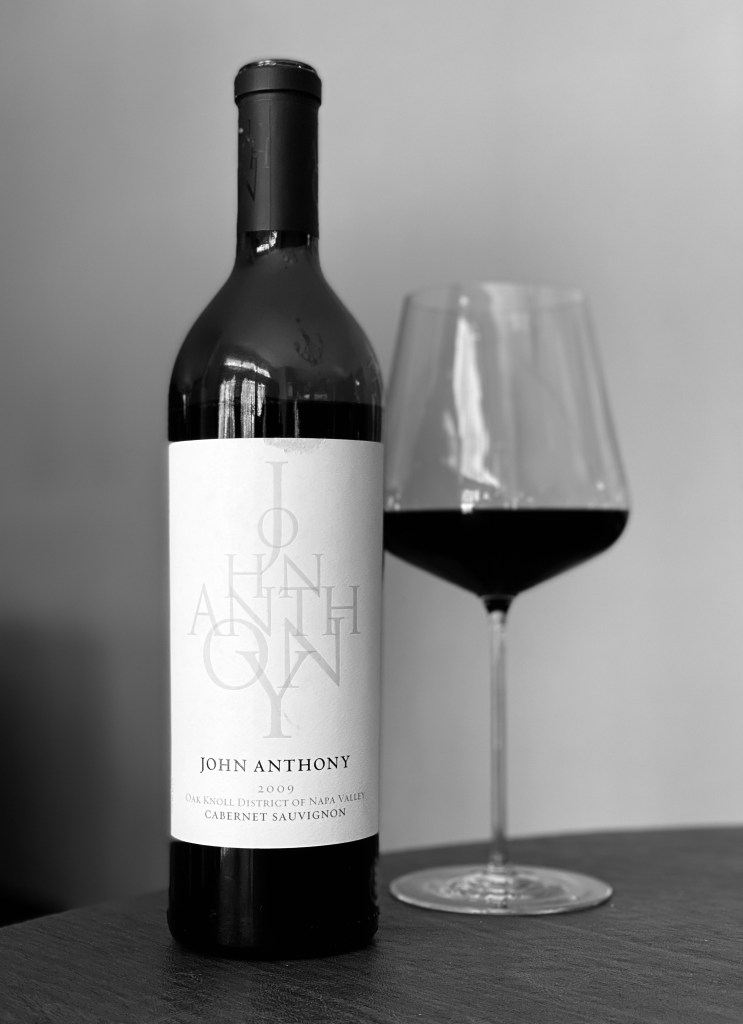
Today’s Wine: 2009 Oak Knoll District Cabernet Sauvignon
100% Cabernet Sauvignon; 15.2% ABV
The 2009 Oak Knoll Cabernet Sauvignon is opaque deep garnet in color with ruby hues and pale garnet variation near the rim of the glass. Once this opens up, the nose showcases aromas of ripe red cherry, dried raspberry, redcurrant, blueberry, cedar, chocolate, clay, musky tobacco, red licorice, and truffle. On the palate, I get notes of dusty blackberry, ripe blueberry, cherry, jammy plum, tobacco leaf, black tea, graphite, forest floor, green garden herbs, coffee, and oak. This wine is medium- to full-bodied with medium acidity, velvety and integrated medium (-) tannins, and a long finish dominated by notes of rose and licorice.
Price: $80 on release (the current vintage 2015 sells for $125 at the winery). This is drinking really well right now and it is not as jammy/fruit-forward as some of the wines from John Anthony I’ve had prior. I still think this fits into the people-pleasing camp but today’s typical Cab lover would enjoy this. Pair with filet mignon, herb-roasted lamb, or mature hard cheeses.
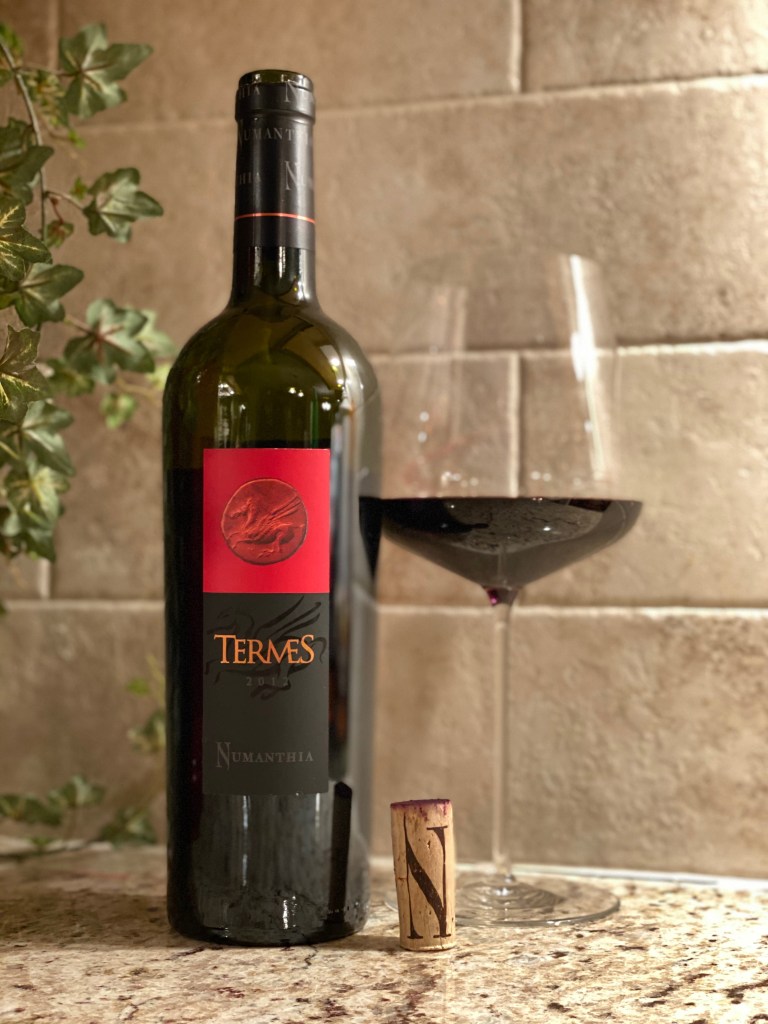
Numanthia is a somewhat young winery, founded in 1998 and located in Valdefinjas in the region of Castile and León in northwestern Spain. The winery is named for the ancient city of Numancia, one whose residents resisted Roman rule for 20 years before ultimately sacrificing their lives instead of surrendering to the invading army. Though Numanthia is slightly over two decades old, their vineyards were first planted centuries ago and have weathered the passing of time and even survived the phylloxera crisis throughout Europe during the 19th century. These vines are planted in sandy and rocky soil, causing them to struggle and stretch their roots up to five meters below the earth’s surface to reach water and nutrition. The vineyards are planted 100% to Tinta de Toro and are made up of more than 100 plots, with some vines dating over 120 years old, and all farming is manual and organic while removing the use of pesticides. There are three expressions of Tinta de Toro in the Numanthia portfolio, which includes the Termes, Numanthia, and Termanthia bottlings.
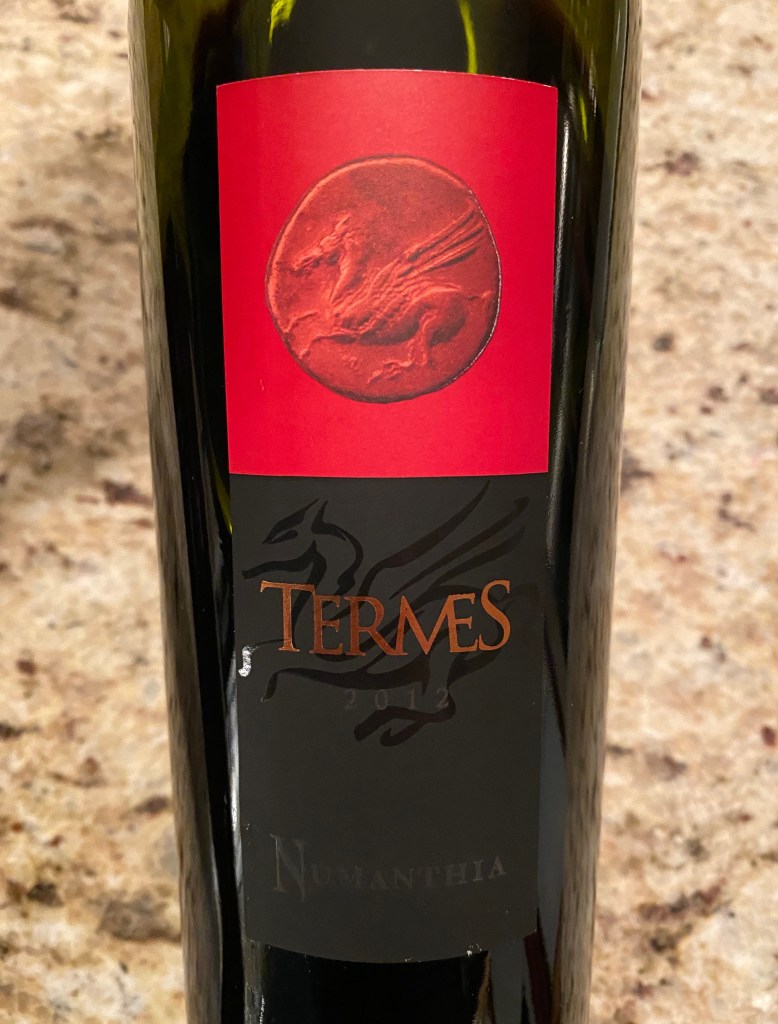
Today’s Wine: 2012 Termes
100% Tinta de Toro (aka Tempranillo); 15% ABV
The 2012 Termes is opaque medium to deep purple/ruby in color. This requires about 45 minutes to open up, but once it does the nose emits aromas of blackberry, cassis, spiced plum, black raspberry, anise, smoked game, tilled rocky soil, wet granite, dark chocolate, nail polish remover, and oak. On the palate, this wine showcases notes of black plum, blackberry jam, blueberry, black cherry, cola, licorice, sweet tobacco, leather, cracked pepper, loamy earth, and light vanilla. This is medium-bodied with medium acidity, medium (-) tannins, and a medium (+) length finish.
Price: $25. This is a really good value wine, especially since I’ve been able to find it multiple times on sale around $15! Even at $25 per bottle this drinks incredibly well with some bottle age and the high ABV actually goes mostly unnoticed. Pair this with pizza, barbecue pork ribs, steak tacos, or tomato sauce pasta.
Leviathan was founded in 2004 by renowned winemaker Andy Erickson. Andy’s goal with creating Leviathan was to create a unique red blend sourcing Cabernet Sauvignon, Syrah, Cabernet Franc, and Merlot from some of Northern California’s best vineyards and each year releasing a bottling of different blends. For those of you who are not familiar with Andy, his resume in California winemaking is extensive and includes stints at Screaming Eagle, Harlan Estate, and Staglin as well as consulting roles at Dalla Valle, Arietta, Dancing Hares Vineyard, Mayacamas, and Ovid. Andy also co-founded and co-owns Favia Wines with his wife Annie and together they are producing some of my favorite wines I’ve really come to love over the past several years.
The 2015 Leviathan is deep purple and almost black in color while being completely opaque like a starless night sky. Once this opens up, the nose emits aromas of blackberry, black plum, wild blueberry, redcurrant, black raspberry, graphite, dried tobacco, potting soil, black truffle, mocha, cinnamon, and cedar. On the palate, I get notes of black cherry, cassis, blackberry compote, black licorice, violet, worn leather, charred earth, smoke, green peppercorn, chocolate, and oak. This wine is full-bodied with medium (+) acidity, medium (+) grippy tannins, and a long finish dominated by dark chocolate and black fruit notes.
Price: $45. This is an outstanding value while its complexity and high quality are both mind-boggling but not shocking because this is after all an Andy Erickson wine. Pair this with steak au poivre, grilled lamb, or grilled portobello mushroom.










 JB's Wine Talk