Rare Riesling from Napa

Today’s Story: Palmaz Vineyards

Palmaz Vineyards, as it exists today, was founded in 1997 by Julio and Amalia Palmaz. Julio is a medical doctor by trade, credited with being a co-creator of the heart stent, though he and his wife Amalia always believed that close attention and care to their land can produce superior quality wines for generations to come.

Before I get too far, I’d like to take a step back to the origin of winemaking on their plot of land. In 1852, a man by the name of Henry Hagen moved to the West Coast in pursuit of Gold Rush treasures. Though he originally lived in San Francisco, in 1881 he purchased a plot of land at the southeastern edge of Napa Valley against Mount George and founded Cedar Knoll Vineyard and Winery. At that time a pioneer in Napa Valley, Hagen produced high-quality wines served throughout San Francisco high society and even won a silver medal for his brandy at the 1889 World’s Fair in Paris.

Fortunes changed, however, with Hagen’s death in 1895 and, as many wineries of the time experienced, the onset of Prohibition in 1919. With 450 acres of land in the hands of Hagen’s kin who didn’t share his passion for wine, winemaking ceased and the estate fell into disrepair.

Circling back to the Palmaz family, Julio and Amalia purchased, restored, and modernized the long-lost winery while building an estate totaling 600 acres with 64 acres under vine. One of the coolest features of the winery is their caves, which total 100,000 square feet and are listed as the largest in Napa Valley. The winery is built into an 18-story cavern behind Mount George, allowing for gravity-flow production of wine while also providing a naturally cool environment. The crowning achievement, in my opinion, of the Palmaz renovations is in their “fermentation dome” where the ceiling showcases high-tech data points and charts for easy monitoring of the wine during fermentation. This thing looks like it could control the Starship Enterprise so I highly suggest you take a look at pictures online and on their website here.
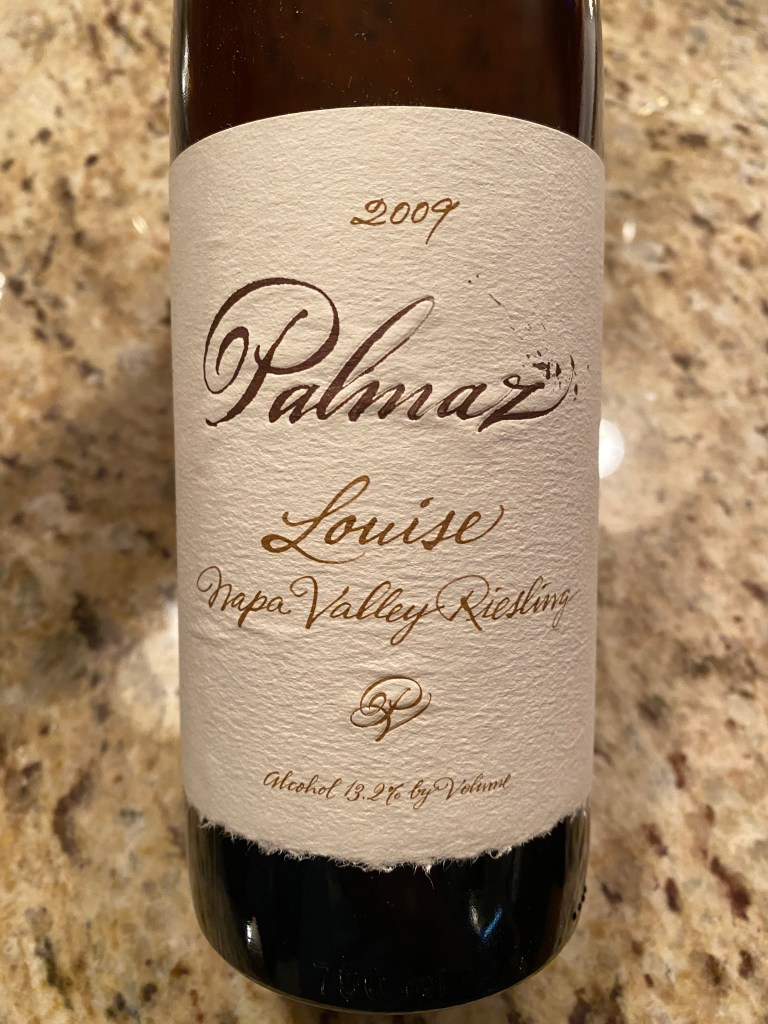
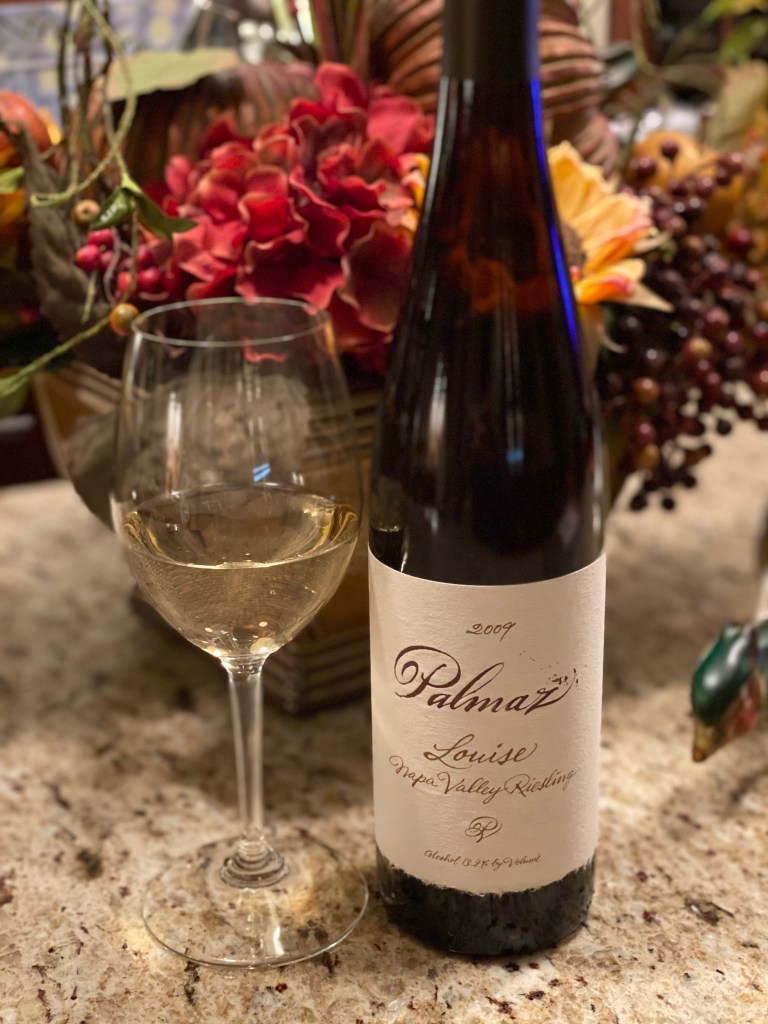
Today’s Wine: 2009 Louise Riesling

100% Riesling; 13.2% ABV

Palmaz is known for their Cabernet Sauvignon, particularly the Gaston which is produced from the best lots and only in certain vintages, several of which I’ve been able to enjoy. If you find a bottle of their Cabernet on a shelf, I suggest you give it a shot (though it is not cheap at about $130-150 per bottle). All this being said, I was unaware Palmaz produced a Riesling and I am excited to review it today.

Almost perfectly clear, this Riesling is pale straw/yellow in color with rim variation of water white. The nose is classic Riesling with aromas of petrol, green apple, and lime zest as well as pineapple, white florals, and slight nutty notes. Once in the mouth, this light- to medium-bodied white showcases notes of tangerine, peach, green apple, lemon peel, beeswax, and slight white spice. This is a creamy textured Riesling and not as dry as I prefer, showing medium acidity and a rounded medium length finish. 150 cases produced.

Price: $95. This is high in my opinion, though I think the rarity of this bottling plays into the price. I’d say skip this one and look toward Alsace or Mosel if you’re spending that kind of money. Pair this (like most Rieslings) with Chinese food, spicy Thai food, or even Tex-Mex.

Delightful Old Vine Garnacha

Today’s Story: Domaines Lupier

Domaines Lupier is a relatively new wine estate, founded in the 2000s by Enrique Basarte and Elisa Úcar. Enrique comes from a background in wine, having worked in vineyards throughout Spain following degrees in agronomical engineering and oenologist studies. Elisa studied economics and holds an MBA, though she also has more than a dozen years of experience in the wine business. Both equally passionate for winemaking in its entirety (the vines, terroir, and production of wine), Enrique and Elisa started rescuing small plots of Garnacha from very old vines to jumpstart their own project.

The efforts of tracking down and studying existing vines ultimately yielded the couple 27 parcels of Garnacha planted in different soils and microclimates ranging in elevation of 400-750 meters above sea level. Some of the vines they own even date back to 1903. This broad range of terroir and old age of the vines allows Domaines Lupier to showcase a true and brutally honest representation of the Garnacha variety and the land from which it comes.

Still a relatively small winery, Domaines Lupier produces two wines. Their El Terroir annual production sits around 30,000 bottles, while La Dama annual production sits around 4,000 bottles. In order to make and age their wine, Enrique and Elisa purchased and renovated an old manor house near their vineyards. They constructed a cellar to hold 50,000 bottles of wine, outfitted the winery with 3,500 and 5,500 liter vats, and updated the technology to modern standards. All of their wine is aged in French oak barrels under careful watch of both Enrique and Elisa.

Today’s Wine: 2011 La Dama

100% Garnacha; 14.5% ABV

This wine is moderately opaque and medium purple in color. This needed some time in the decanter to blossom, and once it did the nose emits aromas of plum, dried forest floor, mushroom, licorice, smoke, leather, and bitter chocolate. I also get a bit of heat out of the nose thanks to the alcohol content. Once in the mouth, the wine showcases notes of black and blue fruit, dried cranberry, black licorice, slight milk chocolate, loamy soil, crushed rock, and oak. Medium-bodied with medium acidity, medium tannins, and a medium (+) length finish. 353 cases produced.

Price: $60 (United States). I like the price-point on this bottle, it has a certain Old World charm to it that needs to be experienced. This is also one of the most unique Garnacha wines I’ve tried. Pair this with chicken or pork, though you could probably get away with smoked salmon as well.

Historic Estate on the Upswing?

Today’s Story: Domaine François Lamarche

While the Lamarche family origins place them in Vosne-Romanée as early as 1740, the domaine was founded in 1797. Over time, particularly through the end of the 19th century, the domaine grew in size under Henri Lamarche and his wife Marie Grivelet from Chambolle-Musigny. When their son Henri (born 1903) took over, he soon inherited La Grande Rue when he married Aline Demur in 1933. Then, in 1985, François took over the estate with the death of his father Henri and he and his wife Marie-Blanche currently lead winemaking and sales. Truly a family endeavor throughout its history, the domaine is also run by François’ sister Geneviève Lamarche (accounts), his daughter Nicole (viticulture), and Geneviève’s daughter Nathalie (sales).

Domaine François Lamarche owns some very enviable land within Vosne-Romanée. While the estate makes 14 different wines ranging from village to 1er Cru to Grand Cru, their most historic holding is the monopole La Grande Rue (one of 6 Grand Crus in Vosne-Romanée). La Grande Rue borders La Tâche and Romanée Conti (monopoles of Domaine de la Romanée-Conti) as well as La Romanée (a monopole of Comte Liger-Belair). While over time the wine from La Grande Rue has fallen under shadow of its neighbors (La Tâche sells for about $5,000 per bottle and Romanée Conti for $15,000+) Nicole Lamarche has been making viticultural changes in an effort to bring out elegance and terroir that have been missing from their wines.

More care seems to be going into the harvesting and winemaking processes with Nicole leading the charge, particularly with grapes being hand-harvested and sorted in the vineyards. Grapes are taken to the winery in small baskets to avoid premature crushing and oxidation where they are shaken and then hand sorted. Partially and sometimes totally destemmed, the grapes go into open vats made of stainless steel or wood and pressing is accomplished with a bladder press. Wine is bottled after being matured 14-20 months in French oak ranging from 30-50% new.

Fun Fact: The Grand Cru wines of Domaine François Lamarche are La Grande Rue, Clos-de-Vougeot, Grands-Échezeaux, and Échezeaux. Relative to their neighbors, these wines are still very, very reasonably priced and could be worth looking into if the changes being made to the winemaking process prove successful in achieving their goals.

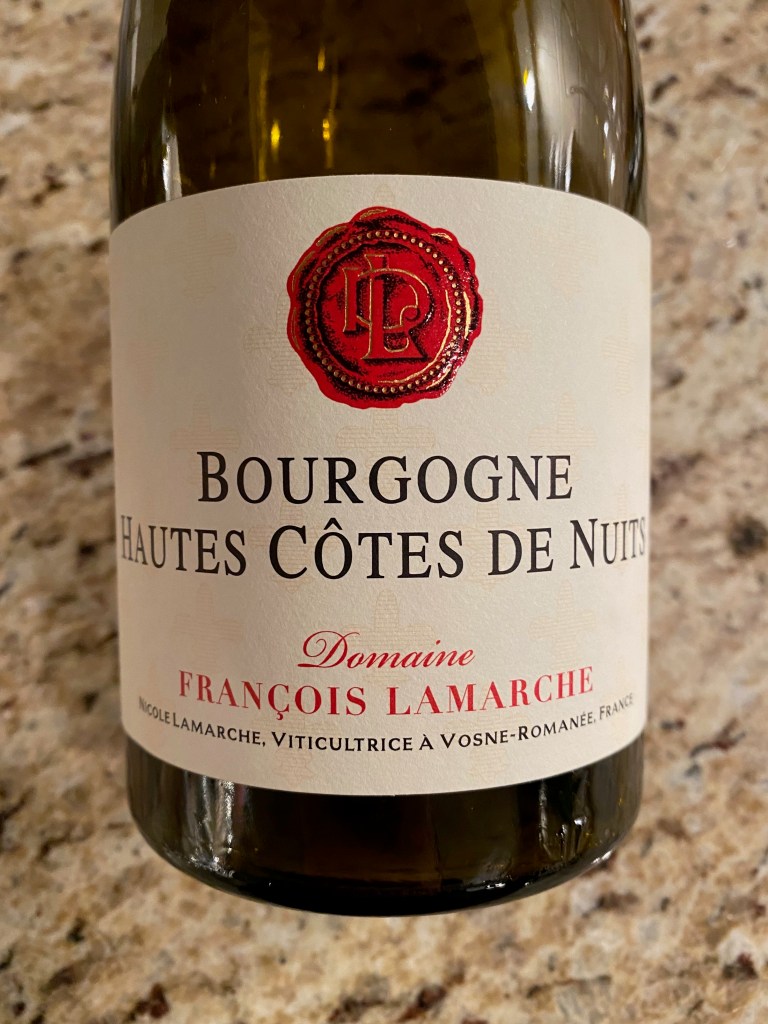
Today’s Wine: 2014 Bourgogne Hautes Côtes de Nuits

100% Pinot Noir; 12.5% ABV

I’ve wanted to try a wine from Domaine François Lamarche since they came onto my radar a month or so ago, and I figured it best to start with their entry level Bourgogne.

The wine is clear pale ruby in color. While the nose is very feminine, clean, and soft and took some time to open up, I get aromas of raspberry, strawberry, dried cranberry, rose petal, slight leather, and chalky earth. After this opened up a bit the nose added some characteristics of red meat as well. Once in the mouth, the palate showcases notes of ripe red cherry, strawberry, white pepper, slight baking spice, and chalk. This falls apart on the palate, especially by the mid-palate which is almost non-existent, and I found it quite disappointing after learning of the improvements the domaine is taking. Nonetheless, this is light- to medium-bodied with medium (+) acidity, light tannins, and a medium length finish. I remain curious to try the Lamarche higher-end offerings, particularly La Grande Rue.

Price: $35. For Burgundy, this is a good entry level price-point and I think controlling for its shortcomings it does deliver. This being said, I would suggest taking $35 and buying a bottle of Pinot from Oregon or a more established Bourgogne. Pair this with lamb, veal, or duck breast.

Historic Napa Cab

Today’s Story: Far Niente

Far Niente was founded in 1885 by a forty-niner of the California gold rush named John Benson. John constructed his winery just below the hillsides in western Oakville, and he had it designed by Hamden McIntyre who was behind the Christian Brothers winery (now the CIA at Greystone). Like several prominent wineries today, John built Far Niente to function as a gravity flow winery.

Though Far Niente was quite successful for its first few decades, during the onset of Prohibition in 1919 it was abandoned and fell into disrepair. It wasn’t until sixty years later in 1979 that a man by the name of Gil Nickel purchased the dilapidated winery and began a three year restoration project. Winemaking resumed once again in 1982 with the harvest of the estate’s first Cabernet Sauvignon as well as Chardonnay. To this day, Far Niente continues to only produce Cabernet Sauvignon and Chardonnay.

Switching gears a little bit, in addition to their Cabernet Sauvignon and Chardonnay bottlings you can find at many wine stores (and sometimes grocery stores), Far Niente releases a Cave Collection. Their Cave Collection wines make up an annual limited release of wines from the Far Niente library and are simply the Cabs and Chards put aside by the winery for further aging before release. You can tell the difference between a normal bottle and a Cave Collection by the black band added around the capsule. Their goal with the Cave Collection, which started in the late 1980s, is to provide collectors an opportunity to taste more mature wines without waiting years to age them themselves. This is a great way for wine enthusiasts and collectors to guarantee provenance of aged wine.

Today’s Wine: 2011 Cabernet Sauvignon Cave Collection

100% Cabernet Sauvignon; 13.7% ABV

I’ve had a lot of wine from Far Niente (including their family of wines Nickel & Nickel, EnRoute, Bella Union, and Dolce) but this bottle truly surprised me. Had I tasted this blind, I probably would’ve called it Left Bank Bordeaux. In appearance this is deep, opaque ruby. I opened this bottle for an hour, then decanted it for about another hour. The nose offers aromas of blackcurrant, crushed blackberry, forest floor, slight barnyard, purple florals, graphite, and mocha. Once in the mouth, I get flavors of blackberry, blueberry, cigar box, pencil shavings, damp earth, dark roast coffee grounds, and slight pepper. Full-bodied with medium (+) acidity, dusty and refined medium tannins, and a long finish with notes of blackberry and black cherry. With a very tough vintage for Napa in 2011, Far Niente killed it with this bottling.

Price: $240. A good bottle of wine for a special occasion (we opened this with family in town from out of state). Pair this with filet mignon or slow cooked short rib.

Howell Mountain Elegance

Today’s Story: Viader

Viader was founded in 1986 by Delia Viader (first commercial release in 1989) and is located on the slopes of Howell Mountain 1,300 feet above the Napa Valley floor. Delia was born in Argentina and came to the United States as a post-graduate student, and she holds a Doctorate in Philosophy from Sorbonne University in Paris and studied Business in the US at MIT. While Delia served as the founding winemaker of Viader, her son Alan later picked up the torch and acts as winemaker today. Alan started working in the vineyards at the age of 9 and pursued his passion for grape growing after high school by attending a program in Sonoma and attaining a Viticulture Management degree. In 2002 Alan became the vineyard manager at Viader and in 2006 the lead winemaker.

As winemaker, Alan is said to be more hands-on and an experimentalist. For instance, he tries a range of organic, biodynamic, and sustainable practices in farming the vineyards and producing wine, seeking to strike a balance to produce the highest quality wines possible. Additionally, Alan experiments in the cellars with different blends, yeasts, fermentations, and barrel options.

Viader produces relatively small quantities of wine across four bottlings. Their signature, the Viader Red Blend, is always a blend of Cabernet Sauvignon and Cabernet Franc and was 60% Cabernet Sauvignon and 40% Cabernet Franc in the 1989 inaugural release. They also have the Viader Black Label (a blend of Cabernet Sauvignon, Syrah, Cabernet Franc, and Merlot), Viader V (Cabernets Sauvignon and Petit Verdot), and DARE (Cabernet Franc).

Fun fact: For over a decade, Viader produced wines at Rombauer Vineyards prior to construction of their own winery. Back then, Rombauer functioned as a custom crush winery for many now-prominent Napa Valley vintners.

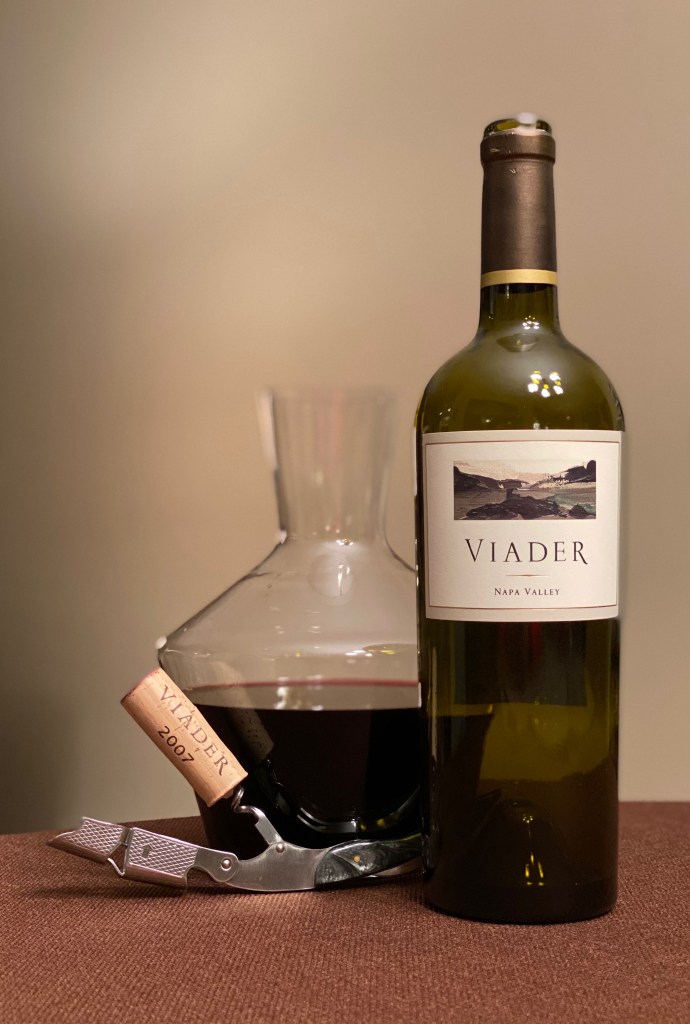
Today’s Wine: 2007 Viader Red Blend

71% Cabernet Sauvignon, 29% Cabernet Franc; 14.8% ABV

This wine is medium to deep ruby in color and almost completely opaque. I filtered and decanted this due to some fine sediment in the bottle, and the decanting helped a bit of the alcohol blow off the nose while bringing out some of the wine’s complexities. On the nose I get aromas of jammy blackberry, anise, cigar box, dark chocolate, vanilla, and oak. I can also notice the alcohol on the nose. Once in the mouth, the wine showcases flavors of chewy blackberry and blueberry, cola, cardamom, iron, dried earth, finely crushed rock, and green herbs. Overall a very silky wine, this is medium-bodied with medium (+) acidity and medium (+) tannins into a long finish with notes of sappy blackberry and plum. Still some time left for bottle aging, though I don’t see this getting any better from here.

Price: $100. I think there are better values out there at this price-point, whereas I could see this being more reasonably priced around the $70-75 mark. Pair this with beef in steak or burger form.

Stunningly Natural Zin

Today’s Story: Martha Stoumen Wines

Martha Stoumen Wines is a project dedicated to making natural wines in a patient, environmentally considerate manner. Following her study of traditional agricultural systems and Italian as an undergraduate, Martha worked the vineyards, olive orchard, and winery of a small farm and learning center in Tuscany. These experiences built her foundation as a grape grower due to her time spent mostly in the vineyards, something that would prove instrumental in how she would view winemaking back in the US.

Today, Martha herself leases and farms about half of the vineyards yielding fruit for her wines, while the other half are farmed by multi-generation farmers who share her philosophies. One of the most important words for Martha’s growing philosophy is “patience.” This includes composting rather than using fertilizers, not using insecticides but rather allowing nature to take its course, and working largely by hand. Martha also prunes her vines for a long life ahead rather than focusing on yields like many other producers nowadays.

During her winemaking process, Martha is as hands-off as possible. For example, fermentation is accomplished with only natural yeasts and bacteria present on the skins. She also allows for longer maceration and aging in pursuit of stability of her wines, rather than adding tannin, acid, or stabilization agents. For all of this above and more, I encourage you to visit her website here.

Today’s Wine: 2018 Zinfandel Venturi Vineyard

100% Zinfandel; 12.7% ABV

The wine is medium purple in appearance while being opaque and slightly hazy. Once this opened up a bit, the nose showcases aromas of plum, wild blueberry, perfumed lavender, charcuterie (especially an earthy prosciutto), wet slate, and slight baking spice. On the palate I get notes of jammy plum, black raspberry compote, allspice, black tea, and sweet tobacco. This wine is medium-bodied with high, lip-smacking acidity, medium (+) tannins, and a very long grippy finish. 462 cases produced.

Price: $38. This is most definitely worth a try. The wine is very true (an honest representation of California Zinfandel) and this is quite different from all of the Zins I have tried so far. Really cool wine to pair with bbq pork, bbq chicken, lamb, or even pizza and pasta.

Georgian Traditionalist

Today’s Story: Shalauri Cellars

Shalauri Cellars is a relatively new Georgian producer whose first vintage came in 2013 with releases of Mtsvane, Rkatsiteli, and Saperavi. Shalauri’s goal is to create artisanal wines by utilizing the traditional approach of fermentation and aging in Qvevri. For those not familiar with the Qvevri Method (I was not when I purchased this bottle), it is an 8,000 year-old process of winemaking wherein a massive clay jar (Qvevri) is buried underground to provide a naturally cool and even environment for fermentation and aging. Further, the Qvevri being surrounded by earth helps reinforce the jar which may otherwise break under pressure of the wine. One additional important note about Shalauri is that they are one of few wineries of their small scale bottle aging wine before releasing it commercially.

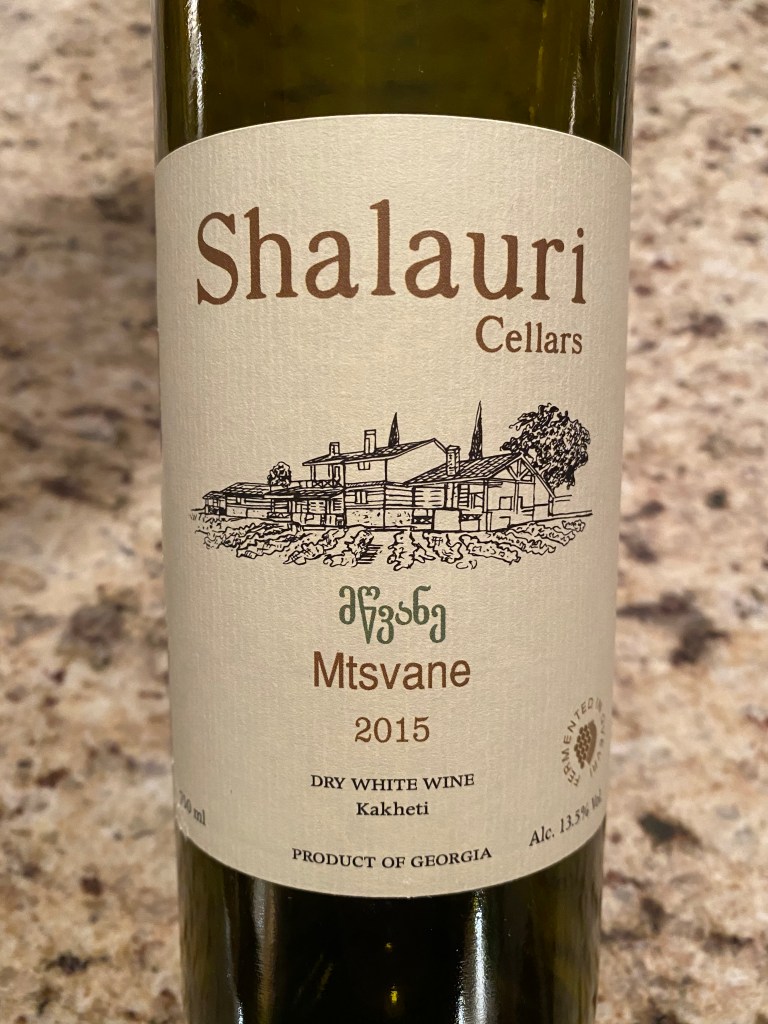
Today’s Wine: 2015 Mtsvane

100% Mtsvane; 13.5% ABV

When I asked for a bottle of wine that would be new to me, the owner of a local wine store steered me toward this Mtsvane. The wine is fermented and aged using the Qvevri Method, which I mentioned above, while seeing extended skin contact of six months. Further, the winemaker tries to interfere with the process as little as possible. I’ve had a few white wines from around the world that pick up tannin and body from prolonged skin contact, but this is my first from Georgia.

In appearance the wine is amber orange with deep yellow variation near the edges of the glass. This is also incredibly transparent, almost acting as a magnifying glass. The nose is somewhat muted, though is dominated by aromas of tangerine, orange zest, honey, marmalade, and hazelnut. Once in the mouth, the wine showcases notes of charred pineapple, crisp red apple, white peppery spice, slight lemon citrus, caramel, and almond. This wine is medium- to full-bodied with medium (+) acidity, medium tannins (thanks to the prolonged skin contact), and a long chewy finish.

Price: $28. I’ve had less expensive wines that achieve the “unusual” effect of tannin in a white wine, but this is very well done and is a cool experience from a country you might not know produces wine. Pair this with mature cow cheese, chicken, or pork. I drank this with a roasted apple cider pork loin.

Thank God Vineyard Leases End

Today’s Story: Domaine Cecile Tremblay

Domaine Cecile Tremblay has a very interesting history, partly because she did not start making wines until 2003 though her family owned vineyards for several generations. Cecile is the great-granddaughter of Edouard Jayer, uncle of the famed Henri Jayer (go Google some of his wines, and perhaps sell your car to buy a bottle). Cecile’s family inherited vineyards from Edouard, though the two generations before her leased out the land to other producers and did not make their own wine. In 2003, however, with the expiration of a lease on three hectares of vines Cecile started making wine under her own label with a plan for further growth. For instance, the Domaine owns roughly 10 hectares of vineyard land and while more of this becomes free from leasing agreements in 2021, Cecile rented or purchased land along the way in communes such as Gevrey-Chambertin.

When Cecile took over her family’s land for her own use, the vineyards were in no standing to produce high quality wines. The producers leasing the land, for instance, used too much fertilizer for Cecile’s taste and utilized herbicides instead of ploughing. Throughout her time thus far as a winemaker, Cecile transitioned to organic farming and many of her practices include biodynamic farming measures as well. During maintenance of her vineyards, Cecile ploughs the soil mechanically and with horses while using copper sulfate to prevent mildew and other fungi.

Similar to her views on caring for her vines, Cecile is very traditional in her winemaking process. She presses her grapes with an old-fashioned vertical press and her wines see only a moderate amount of new wood during fermentation and aging. All of this effort culminates into wines that are refined and elegant, though built for the long haul.

Today’s Wine: 2011 Chambolle-Musigny Les Cabottes

100% Pinot Noir; 13% ABV

This bottle was gifted to me by a great friend, and after opening it today I sure am happy that I recently purchased another one. Right out of the bottle I can tell this will be a bold Burgundy thanks to its medium to deep ruby (but mostly clear) color. The nose on this thing is sort of a roller coaster (of emotions) as I get aromas of black cherry, boysenberry, eucalyptus, mint, purple florals, ground coffee, tobacco leaf, and moist forest floor. This even took on notes of gravel/crushed rock as it sat in the glass. The palate continues this dark theme with notes of wild blackberry and blueberry, licorice, smoked red meat, crushed granite, mocha, and tobacco. Shockingly (for me) full-bodied, this wine shows high acidity, medium (+) tannins, and what seems like an immeasurably long finish. This is one of those wines that makes me want to smell the glass all day, and eat the glass when that last drop is gone.

Price: $110 (though I got lucky and the going rate online is about $300). I would buy this again in my sleep at $110 and I’d even buy it again at $300. This is an exceptional bottle from an “off vintage” and the complexity I get out of this wine is mind-boggling. This will also age gracefully for another 15+ years! Pair this with filet mignon, rabbit, quail, or duck…and if you can accompany these dishes with black truffle you’re in for a real treat.

A Modernist’s Nebbiolo

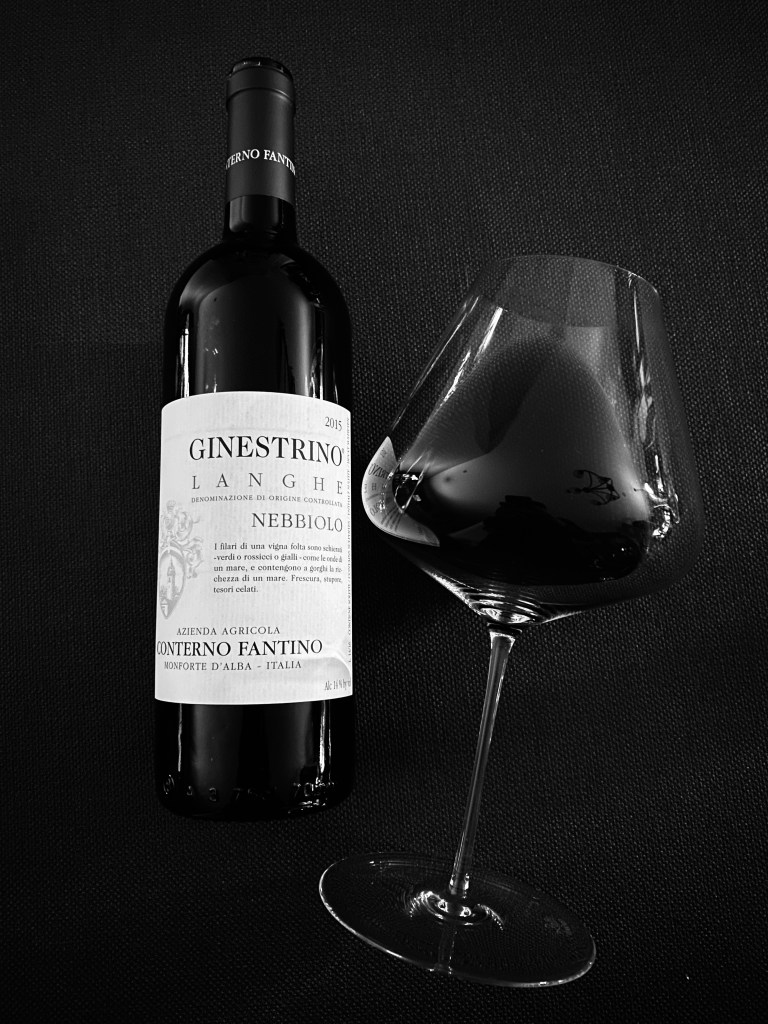
Today’s Story: Conterno Fantino

Founded in 1982 by Claudio Conterno and Guido Fantino, Conterno Fantino has grown into a somewhat large (~140,000 total bottles annually) producer of Nebbiolo, Barbera, Dolcetto, and Chardonnay. This being said, the winery employs only about 10 people at a given time including Alda, Fabio, and Elisa Fantino who joined over the years. During an expansion for the winery in 2008, Conterno Fantino implemented solar panels and a geothermal system to conserve energy in pursuit of their environmental impact goals, which I will delve into a bit more speaking about the winemaking process.

Throughout harvest and winemaking, Conterno Fantino employs methods such as manual picking of fruit, spontaneous fermentation from indigenous yeasts, and careful use of wood for aging the wine while minimizing sulfites. Taking a step back, the entire farming process is certified organic in an attempt to preserve the land’s biodiversity with a goal of environmental sustainability. All this being said, Conterno Fantino is a great example of modernist Italian winemaking, particularly for Barolo. Namely, Conterno Fantino ages their Barolo in French oak barriques after relatively short maceration and fermentation. While I am not reviewing one of their Barolos today, hopefully I will in the near future.

Today’s Wine: 2015 Langhe Nebbiolo Ginestrino

100% Nebbiolo; 14% ABV

I normally don’t pair Nebbiolo with spaghetti (I prefer a Sangiovese such as Chianti), however, when duty calls and this is what I can find, we drink it. The wine is clear, pale to medium ruby in color which is a bit lighter than most young Nebbiolo wines I’ve tried. Once this opens in a decanter, the nose showcases aromas of cherry, strawberry rhubarb, tomato sauce, tar, red licorice, and mixed green herbs. On the palate, we get notes of cherry, dried raspberry, gravel and slate, slightly smokey earth, and tobacco. Overall very easy drinking with not a whole lot to it, this wine is medium-bodied with medium (+) acidity and medium (surprisingly not medium (+) to high) tannins with a medium (+) length finish.

Price: $35. This is a good price-point for entry level, drinkable-while-young Nebbiolo. Though I am a staunch proponent of traditionalist winemaking, this wine could be a great entry for those not familiar with the Nebbiolo grape or Italian wine as a whole. The wine paired easily with red/meat sauce pasta, though would also go well with lightly peppered ribeye, prime rib, or smoked duck.

Must-Try Red from Greece

Today’s Story: Thymiopoulos Vineyards

For several generations, the Thymiopoulos family has owned vineyards in Naoussa, though they typically sold the fruit to other wineries without making their own wine. This changed, however, when Apostolos Thymiopoulos completed his oenology program at the University of Athens and returned to the family vineyards to produce a wine under his own label. Thymiopoulos Vineyards was born and their first wine released in 2004, becoming a successful bottling throughout both Greece and Europe as a whole.

Like many producers in the Old World, Apostolos farms his vineyards in a very traditional manner. He limits or does away with chemical use and many of his practices fall under biodynamic farming norms. Apparently, Apostolos even borrows his neighbors’ cows to mow the grass after harvest in the vineyards (source). Apostolos owns several dozen vineyards, and in order to help care for them all he enlists people from his village with vineyard experience for help. This allows him to foster a unique bond within his community, as well as provides him the opportunity to know each vineyard like the back of his hand.

Today’s Wine: 2016 Rapsani Terra Petra

50% Xinomavro, 35% Krassato, 15% Stavroto; 13.5% ABV

This wine came recommended to me thanks to one of the owners of a local wine store. In appearance, the wine is a clear, pale ruby color. The nose on this wine is an absolute thing of beauty, one so aromatic and crisp I felt like I got slapped in the face (but in a good way). Right out of the gates I got aromas of cherry, strawberry jam, very clean florals reminiscent of red rose and white wildflower, cedar, leather, mild and slightly sweet tobacco, and a hint of cinnamon. In the mouth, the wine showcases notes of sour cherry, wild strawberry, home-garden-grown cherry tomatoes, rocky-soil-esque minerality, faint vanilla, and a touch of oak. The wine is overall very dry and is medium-bodied with mouthwatering high acidity, medium tannins, and a very long finish. This is drinking beautifully (and is one of my favorite wines in recent past) but I really want to try it again in three years.

Price: $35. I’ve only had a couple Greek wines so far, but this is a screaming value. The nuances and absolute shock I received from the profoundly beautiful bouquet of aromas says it all. Pair this with chicken, pork, or cheese-based pastas.