Rarity From Nuits Saint Georges

Today’s Story: Domaine de l’Arlot

Domaine de l’Arlot is a historic and well-regarded wine estate located in Nuits St. Georges within the Côte de Nuits subregion of Burgundy, France. Though its roots trace back to the 18th century and owner Jean-Charles Vienot, its more recent history begins in 1891 when the domain was purchased and expanded by wine merchant Jules Belin. Domaine de l’Arlot remained in the Belin family until early 1987, and then was purchased by the French investment company of AXA Millésimes. Around the same time, Jean-Pierre de Smet came on board after spending eight years with Jacques Seysses of Domaine Dujac and he is largely credited with the winemaking philosophy at the domain of minimal intervention. Though Jean-Pierre retired in 2007, this philosophy remained largely intact and today de l’Arlot is run by technical director and Burgundy native Géraldine Godot.

Domaine de l’Arlot today consists of 14 hectares (35 acres) of vineyards planted 95% to Pinot Noir and only 5% to Chardonnay. Average vine age is about 50 years, however the property does maintain some vines aged 70+ years. de l’Arlot farms their vineyards adhering to biodynamic viticulture, a transition that started in 2003 following several years of organic viticulture. A couple of the most prized plots are monopoles of the domain, the 1er Cru vineyards of Clos des Forêts Saint Georges and Clos de l’Arlot.

In terms of winemaking style, Géraldine practices a minimal intervention and “less is more” mentality. Fruit is hand-harvested and every motion within the winery and cellar is accomplished by the use of gravity. The wines ferment spontaneously with only native yeasts, seeing minimal pumpovers and punchdowns by foot. For aging, Géraldine uses less new oak than what was previously used over the domain’s history, which in turn provides a more transparent and true-to-variety and terroir expression. New oak percentages and length of aging vary by vintage and bottling, however the end goal never wavers of producing terroir-driven wines.
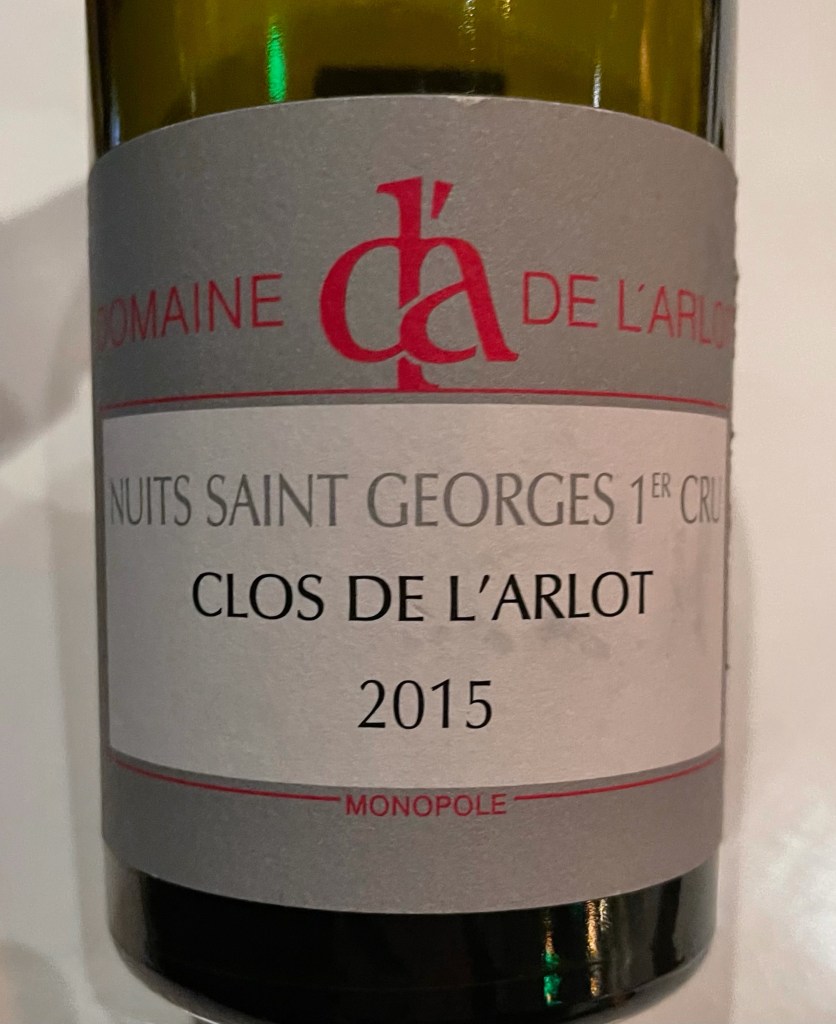
Today’s Wine: 2015 Nuits Saint Georges 1er Cru Clos de l’Arlot

100% Chardonnay; 13.5% ABV

The 2015 Nuits Saint Georges 1er Cru Clos de l’Arlot is pale golden straw in color. Given some time to blossom in the glass, the wine opens with aromas of medium (+) intensity and the nose showcases notes of lemon, green apple, white florals, flint, wet river stone, mild green herbs, and chalky mineral. Meanwhile the flavors are also of medium (+) intensity, with the palate showcasing notes of green apple, lemon pith, white peach, floral blossom, dried green herbs, and wet stone. This dry white is medium- to full-bodied with high acidity, medium alcohol, and a medium (+) length finish. Very good right now, but I would love to see if this adds complexities perhaps with a few more years of bottle age.

Price: $120. I think there are better values out there, however I think the pricing here is partly due to the great reputation of the producer as well as how rare white wines are from Nuits Saint Georges. As one of their rarest and top bottlings, I can see why this is priced the way it is.

Beautifully Mature Bordeaux

Today’s Story: Château Léoville Las Cases

Château Léoville Las Cases is a historical Bordeaux estate ranked as a Second Growth (Deuxième Cru) in the Bordeaux Wine Official Classification of 1855. It is located in the appellation of Saint-Julien on the Left Bank. Though the estate used to be much larger and is one of the oldest in the Médoc, it was split up between 1826 and 1840 as a result of the French Revolution and came into the Las Cases family as 3/5 the size of the original estate. Luckily for the family, however, their land made up the heart of the domain and therefore consists of the original terroir back to the 17th century. Las Cases was managed by the same family through the 19th century, moving by inheritance through Pierre Jean, Adolphe, and Gabriel de Las Cases until Théophile Skawinski bought a stake in 1900 to become the manager. Today, Jean-Hubert Delon is the sole owner with the family coming in during the mid-20th century.

The estate today consists of 98 hectares (242 acres) of vineyards planted to roughly 66% Cabernet Sauvignon, 24% Merlot, 9% Cabernet Franc, and 1% Petit Verdot. The soil is classic Left Bank, made up of gravel over gravelly sand and gravelly clay subsoils. The heart of the property is the 55 hectare (136 acre) Grand Clos, where vines average an age of 52 years and farming is nearly 100% organic. The Grand Clos is walled-in and borders Château Latour to the north as well.

Winemaking is largely traditional at Léoville Las Cases, beginning with manual harvest and moving to fermentation in temperature-controlled wood, concrete, or stainless steel vats of varying size and age. Malolactic fermentation occurs in vat, and then the wines are blended before moving into French oak barrels for 18-20 months of aging. Come bottling, the wines are fined using egg whites and production of the Grand Vin is around 15,000 to 16,700 cases depending on vintage.

I previously wrote about two wines from Léoville Las Cases, first the 1986 vintage in a side-by-side with a 1986 Château Pichon Longueville Comtesse de Lalande and then the 1990 vintage in early 2020.

Today’s Wine: 1961 Château Léoville Las Cases

Cabernet Sauvignon dominant Bordeaux blend; I presume around 12-13% ABV

The 1961 Château Léoville Las Cases is medium garnet in color and not really showing any signs of bricking. We served this as a pop-and-pour, and it really only took 10 minutes or so in the glass to open up and show beautifully. The aromas are of medium (+) intensity, with the gorgeous nose showcasing notes of dried cherry, dried cranberry, pencil shavings, dried violet, graphite, cigar box, forest floor, truffle, eucalyptus, and a hint of cinnamon. Meanwhile the flavors are of medium intensity and the palate displays notes of baked black cherry, dried plum, prune, cigar tobacco, truffle, graphite, and charred green herbs. This dry red is medium-bodied with medium acidity, light and fully matured tannins, medium alcohol, and a medium (+) length finish. The wine is in remarkable shape given its age and quite honestly there seems to be a window of a few more years to drink this.

Price: $800. This is more of an experience wine than anything, as I’ve never had a 1961 Bordeaux and neither had my tasting companions. So while I don’t want to discuss “value” because it seems subjective for a wine like this, I will state the obvious that provenance is key here and this bottle was superb while making for an incredible tasting experience.

Delicious Northern Rhône Syrah That’s Light on Its Feet

Today’s Story: Domaine Vincent Paris

Domaine Vincent Paris was established in 1997 with 1 hectare of inherited vines in Cornas of the northern Rhône Valley in France. Vincent studied enology for four years before working alongside his uncle, famed Cornas vigneron Robert Michel, and ultimately desired autonomy with his own wines. Vincent set about planting vines in St. Joseph and Cornas, ultimately acquiring La Geynale in 2007 and farming a total of 8 hectares today. Vincent farms 1.5 hectares of Saint Joseph, 6 of Cornas, and 0.5 of Vin de Pays with meticulous attention and refuses to use insecticide or chemical fertilizers while limiting treatments. Vincent severely prunes his vines (to only 4 bunches per vine) which helps produce concentrated, high quality berries and cuts down on green harvests. In the cellar, Vincent destems his fruit to varying levels and ferments the wines naturally after cold maceration at relatively lower temperatures. The wines spend 3 months in vats and then a year in oak barrels that are never new but rather 2-8 years old in an effort to not mask terroir, before they are ultimately bottled with light fining but no filtration.

I previously wrote about the 2017 Cornas Granit 30 from Domaine Vincent Paris, so feel free to revisit those tasting notes if you care to explore another wine from the portfolio.

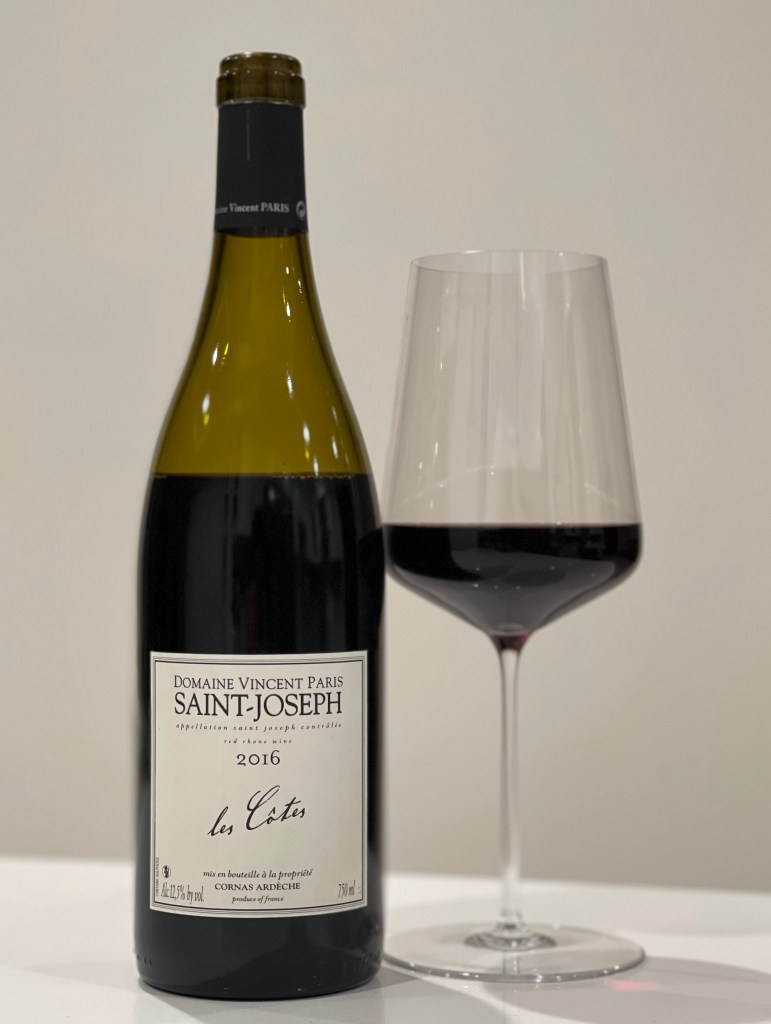
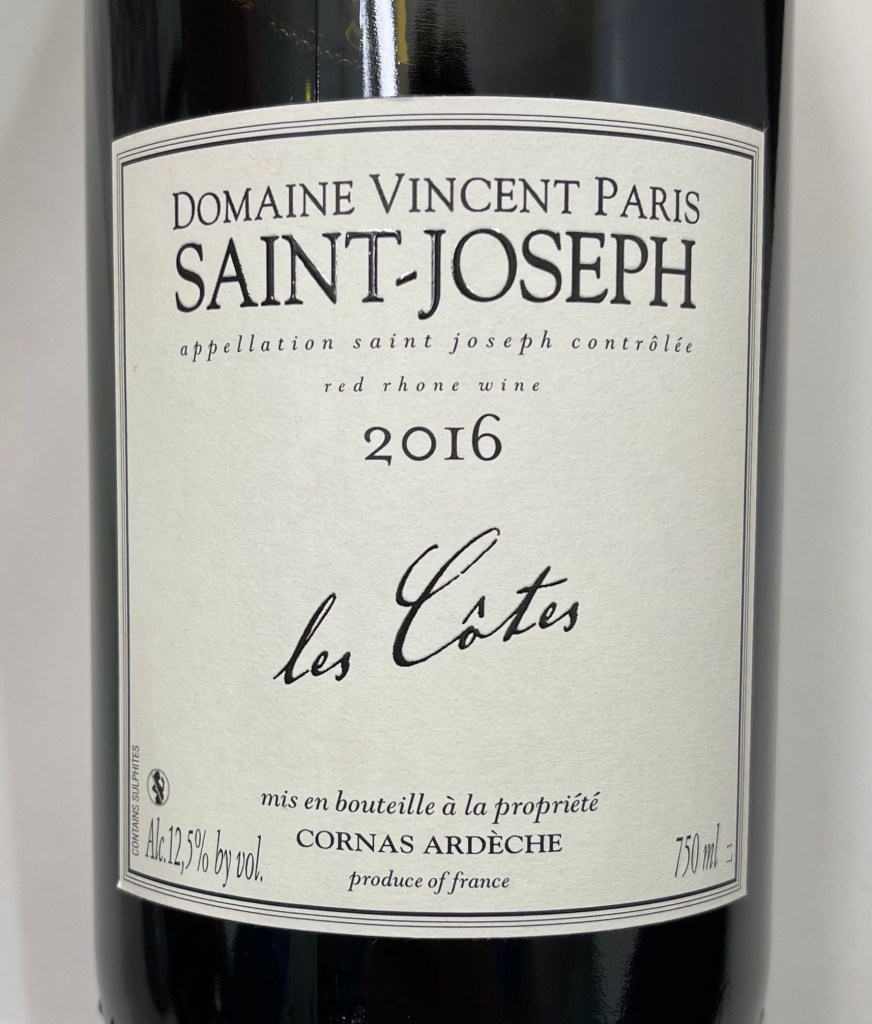
Today’s Wine: 2016 Saint-Joseph Les Côtes

100% Syrah; 12.5% ABV

The 2016 Saint-Joseph Les Côtes is medium purple in color. This was another Coravin pour for me, so I simply let this open up in the glass for about 30 minutes. The aromas are of pronounced intensity, and the nose showcases notes of plum, blueberry, violet, bacon fat, scorched earth, dried garden herbs, coffee grounds, and smoke. Meanwhile the flavors are also of pronounced intensity, with the palate displaying notes of blackberry, blueberry, black plum, smoked game, sweet tobacco, dried herbs, cracked pepper, and chocolate. This dry red is light- to medium-bodied with high acidity, low tannins, medium alcohol, and a long finish. The 2016 Les Côtes doesn’t drink like your typical Syrah but it is both incredibly accessible and fun to drink.

Price: $34. I’m very impressed by the value of this wine, as the aromas and flavors are so true to variety and showcase the terroir beautifully but this is rather light on its feet. Nothing sticks out of place here, with the finesse being rather impressive for the price.

Historic Pomerol Estate Showcasing the Promise of the Underrated 2014 Vintage

Today’s Story: Château L’Évangile

Château L’Évangile is a historic Bordeaux wine estate located in the appellation of Pomerol on the Right Bank of Bordeaux. L’Évangile traces its roots back to the year 1741 when it first popped up in the land registry under the name Fazilleau, and it was owned by the Léglise family from Libourne. By the turn of the 19th century, the estate was fairly close to its current configuration and consisted of 13 hectares (32 acres) of vineyards. In 1862, Paul Chaperon purchased L’Évangile (as it was known by this time) and he built the reputation of the estate to greater heights and constructed the château in 1874. By 1900, L’Évangile was widely considered the third-best wine of Pomerol behind Vieux Château Certan and Château Pétrus. Chaperon’s descendants, the powerful Ducasse family, continued to run the estate until 1990 when it was purchased by Domaines Barons de Rothschild who own Château Lafite Rothschild on the Left Bank amongst other highly-regarded properties.

Today Château L’Évangile consists of 22 hectares of vineyards planted in prime sandy clay and gravel soils on the plateau of Pomerol. The property borders Château Pétrus to the north and Château Cheval Blanc to the south, so one can say they are in good company. L’Évangile’s vineyards are planted to about 80% Merlot and 20% Cabernet Franc, though there is now a small plot of Cabernet Sauvignon that was blended into the wine for the first time in 2019. The vines at L’Évangile average about 30 years of age, and the estate started shifting to organic viticulture in 2018 before ultimately becoming certified organic in 2021.

In the cellar, all plots are vinified separately in vats with traditional pump overs and controlled maceration. The goal by the end of fermentation is to try to determine which plots/vats ultimately make it into the Grand Vin and which may end up in the second wine called Blason de L’Évangile. The Grand Vin ages for 18 months in 70% new French oak barrels, and total production of the Grand Vin and Blason de L’Évangile averages about 5,000 cases per vintage.

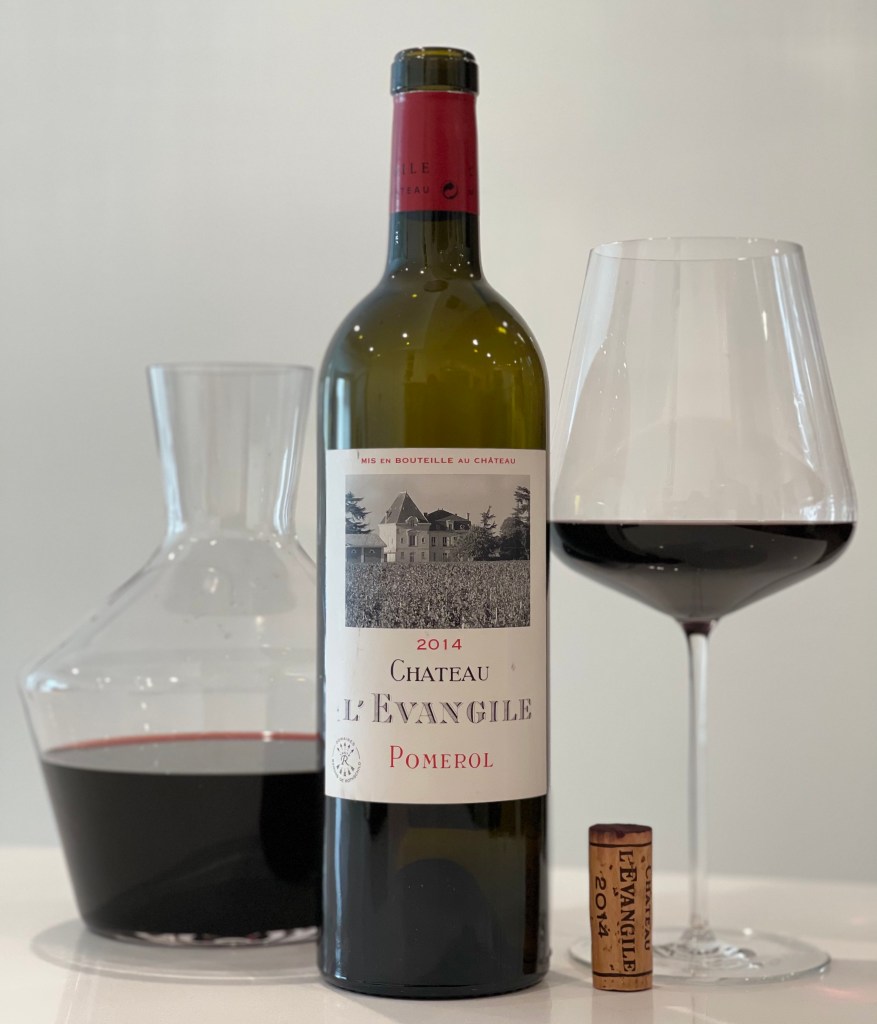
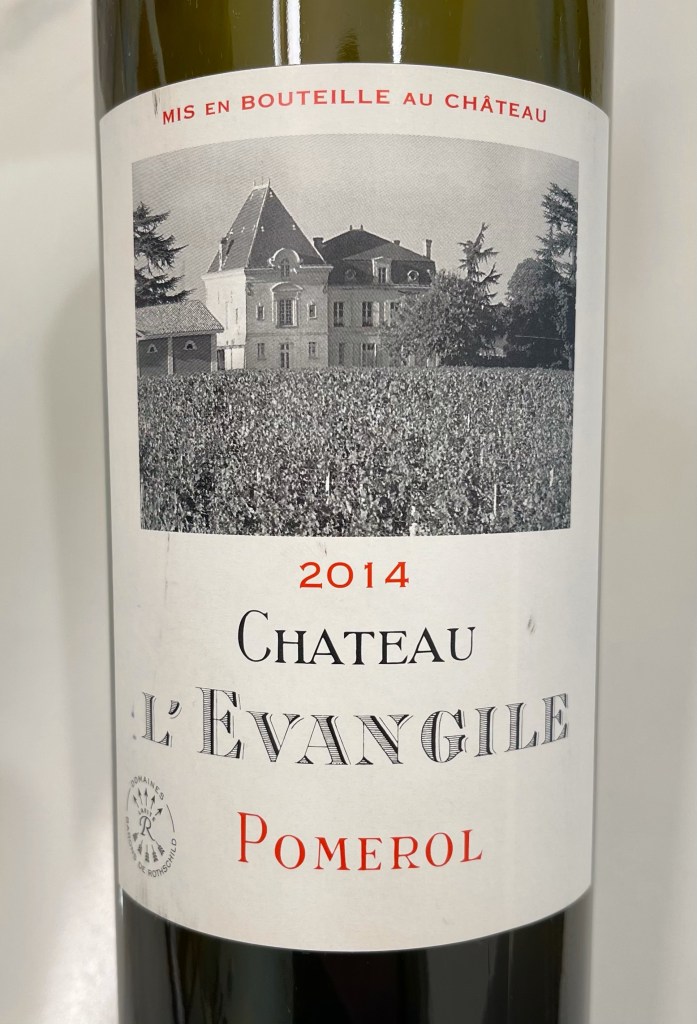
Today’s Wine: 2014 Château L’Évangile

82% Merlot, 18% Cabernet Franc; 14% ABV

The 2014 Château L’Évangile is deep ruby in color. Given my first taste and a check-in after 2 hours, I decided to decant this for a full 4-5 hours as it was rather shy. Once it opens up, the aromas are of medium intensity and the nose showcases notes of black cherry, spiced plum, cigar box, new leather, black truffle, clay, cinnamon, and toasted oak. The flavors are also of medium intensity, and the palate displays notes of blackberry, cassis, plum, black licorice, tobacco, scorched earth, sage, chocolate, and oaky spice. This dry red is medium- to full-bodied with medium (+) acidity, medium (+) but refined tannins, high alcohol, and a long finish.

Price: $160 (I paid $143). On a relative basis, this wine offers considerable value compared to stronger vintages like 2015 and 2016 which for this bottling are priced closer to the $260-300 range. This wine also shows incredible promise for the future, as I think it needs probably 3-5 more years of cellaring and should drink well for a couple decades beyond that.

Another Solid Value From the 2014 Vintage in Bordeaux

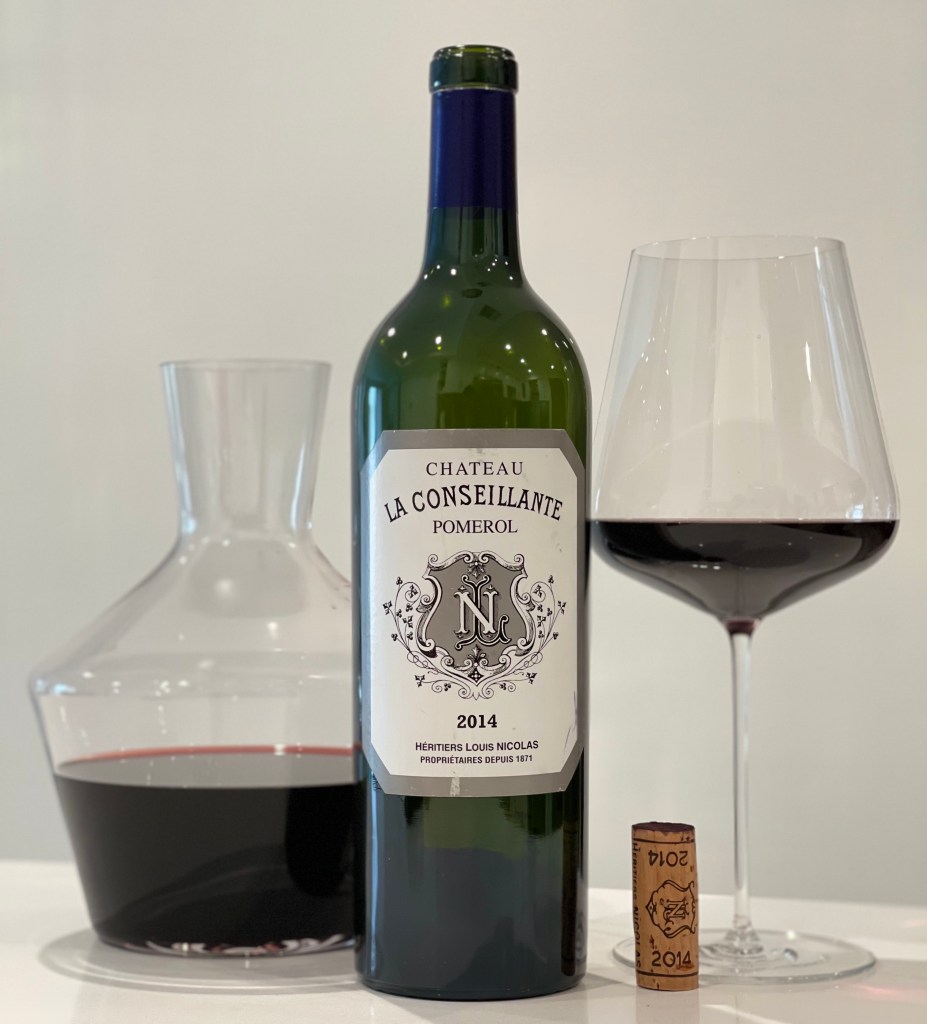
Today’s Story: Château La Conseillante

Château La Conseillante is a historical family-owned wine estate located in the Pomerol appellation on the Right Bank of Bordeaux. The estate traces its roots back to the mid-18th century under the management of Catherine Conseillan where it gets its name, and they produced wines at least as early as 1756 which makes Conseillante one of the oldest estates in Pomerol. Though ownership changed hands a couple times after the passing of Catherine Conseillan, the Nicolas family purchased the estate in 1871 and they run it to this day now in their fifth generation. The original label on the wines dates back to 1871 as well, and it showcases the iconic shield and silver border of the estate. The purple capsule even dates to 1871, when it was chosen to represent the color of the wine, aromas (namely violet) often found in the wine, and so the bottles would stand out in cellars.

Château La Conseillante consists of 12 hectares (30 acres), the same size as when the Nicolas family purchased it, and the vineyards are planted to about 80% Merlot and 20% Cabernet Franc. Though these vines are in a single vineyard block, they are broken up into 18 different parcels which are vinified separately in the modern winery. All fruit is harvested by hand from yield-controlled vines and then rigorously sorted to ensure only the highest quality fruit makes it into the winery. Once in vats, the fruit goes through cold pre-fermentation maceration for two to four days and then alcoholic fermentation for about a week and one to two weeks of maceration. Free-run wine is run off and any remaining fruit is gently pressed separately to produce “press wine” that is aged separately and only included in the final blend if of utmost quality standards. The Grand Vin ages in 50-80% new oak barrels depending on vintage and this typically lasts around 18 months. The wine is then bottled fined with egg whites but unfiltered.

In addition to the Grand Vin, Château La Conseillante released a second wine called Duo de Conseillante beginning with the 2007 vintage. Total production is about 4,500 cases of wine per vintage, with about 80% of that being the Grand Vin. To explore the estate further, you can visit their website here.

Today’s Wine: 2014 Château La Conseillante

78% Merlot, 22% Cabernet Franc; 13% ABV

The 2014 Château La Conseillante is deep ruby in color with hues of deep garnet. I decanted this for 3-4 hours which seemed to put it in a good spot at this point in its life. The aromas are of medium intensity but the nose is fairly complex, showcasing aromas of blackcurrant, black plum, black cherry, violet, cigar box, a hint of black truffle, grilled herbs, pepper, and a touch of oaky spice. Meanwhile the flavors are also of medium intensity and the palate displays notes of plum, crème de cassis, black cherry, anise, tobacco, dried green herbs, coffee grounds, and chocolate. This dry red is full-bodied with medium (+) acidity, medium (+) but silky tannins, medium alcohol, and a medium (+) length finish.

Price: $125 (I paid $107). While not the greatest 2014 Pomerol I’ve tried so far, this is certainly a solid value wine for Bordeaux. The “good not great” 2014 vintage proves once again that it deserves attention and considering the 2015 and 2016 vintages of this wine sell for closer to $200 and $250, respectively, this 2014 is certainly worth trying.

Unmatched Elegance in Gevrey-Chambertin

Today’s Story: Domaine Fourrier

Domaine Fourrier is a family wine estate located in Gevrey-Chambertin of Burgundy’s Côte de Nuits. Previously named Pernot-Fourrier, the domain was established by Fernand Pernot during the 1930s/1940s who, since he had no spouse or children, brought in his nephew Jean-Claude Fourrier for help. Jean-Claude took over the domain in 1969 and Fourrier was one of the first in the region to export their wines to the US. Coupled with very highly-regarded land holdings, Fourrier commanded a great reputation and the wines were very high-quality. During the late 1980s, however, Fourrier went through a “dumb phase” of sorts until being rejuvenated by Jean-Claude’s son, Jean-Marie Fourrier, who took over in 1994. Jean-Marie was a pupil of the great Henri Jayer, and brought Domaine Fourrier to preeminent status with wines of elegance and finesse not often found in Gevrey-Chambertin. Jean-Marie remains at the helm today alongside his wife Vicki and sister Isabelle.

Domaine Fourrier consists of about 9 hectares (22 acres) of vineyards planted predominantly in Gevrey-Chambertin, augmented by small plots in Chambolle-Musigny, Morey-Saint-Denis, and Vougeot. Fourrier’s vines typically fall in the 50 to 70 year-old average range, and only their own cuttings are used to replace failing or dying vines. With a strict belief that vines need lengthy periods to fully grow and mature, Jean-Marie never produces wines from his vines aged younger than 30 years and instead sells this fruit to négociants in the region. With his belief that terroir is of utmost importance, Jean-Marie farms his vineyards without the addition of chemical fertilizers and only uses herbicides or pesticides when absolutely necessary if the vines or harvest are in danger.

Come harvest, fruit is hand-picked and sorted in the vineyard before being transferred into small baskets to take to the winery. Jean-Marie’s winemaking philosophy is minimal intervention, and the wines ferment separately by vineyard using only native yeasts and no sulfur additions. Fourrier’s wines age with minimal amounts of new oak (typically no more than 20%) to preserve the delicacy of the aromas and flavors, and remain in contact with their lees for anywhere from 16-20 months depending on vintage and bottling. All the wines are bottled unfined and unfiltered, with minimal or no SO2 added. Taking from his training with Henri Jayer, Jean-Marie aims to make all of his wines the truest sense of terroir possible while offering an elegance and balance that are often unmatched.

Today’s Wine: 2016 Gevrey-Chambertin Aux Echezeaux Vieille Vigne

100% Pinot Noir; 13% ABV

The 2016 Gevrey-Chambertin Aux Echezeaux is pale to medium ruby in color. This requires a good 45 minutes to an hour to open up in the glass due to its youth, but once it does this is already a gorgeous wine. The aromas are of medium (+) intensity, with the nose showcasing notes of black cherry, strawberry, leather, forest floor, savory green herbs, and gravel. The flavors are also of medium (+) intensity, and the palate displays notes of tart cherry, strawberry, black raspberry, tobacco, leather, charred herbs, and peppery spice. This dry red Burgundy is medium-bodied with medium (+) acidity, medium (-) tannins, medium alcohol, and a medium (+) length finish. While already very elegant and enjoyable, this has decades of life ahead of it.

Price: $110. This is very reasonably priced in my opinion given a red Burgundy of this quality level. Burgundy prices have gone to sky-high levels over the years, and finding one around this price-point especially from a producer like Fourrier makes for an easy decision.

Complex Loire Valley Cabernet Franc That Continues to Impress

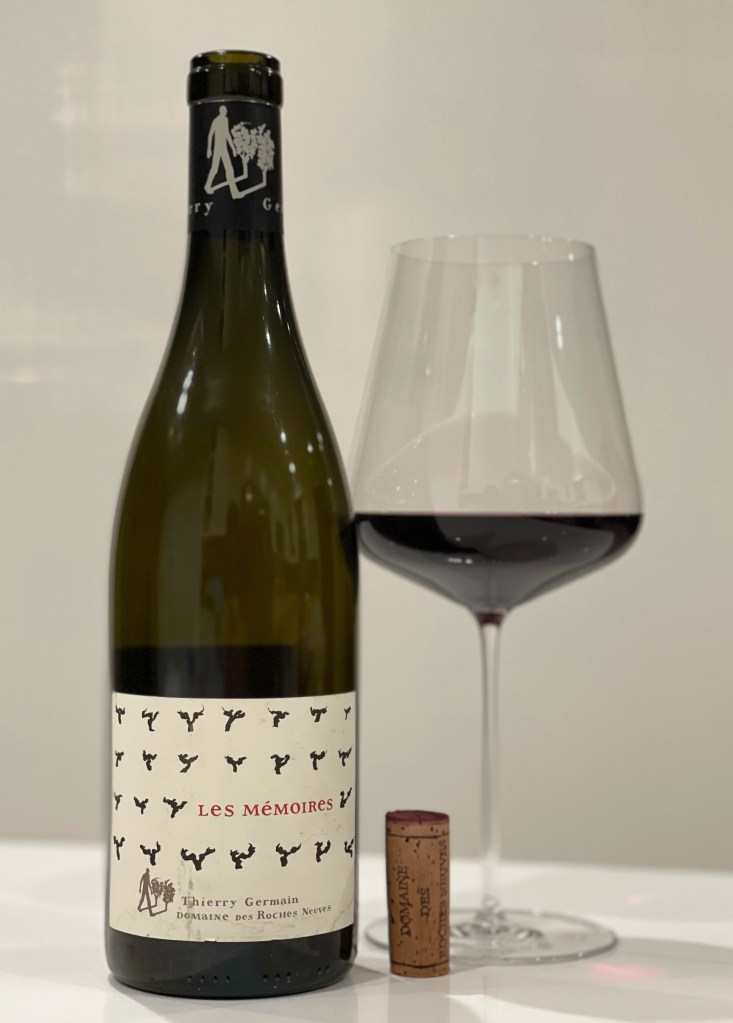
Today’s Story: Domaine des Roches Neuves

Domaine des Roches Neuves was founded in 1992 by Thierry Germain following his move to the Loire Valley from his native Bordeaux. At 23 years old, Thierry soon met Charly Foucault from Clos Rougeard who would become an inspiration behind some of his winemaking practices. Thierry converted his domain to biodynamic viticulture, as well as being certified organic, in an effort to let his vines guide him rather than play a heavier hand that removes truth and transparency from terroir to bottle. This practice helps Thierry’s wines showcase vibrant ripe fruits (thanks in addition to relatively early harvesting) with incredible purity while avoiding rustic vegetal notes. Also, his red wines do not typically have high tannin but rather integrated, soft tannins conducive to drinkability.

When harvesting his fruit, Thierry practices very traditional methods such as hand harvesting and hand sorting at the winery. Further, all of his wines are fermented with natural yeasts in no new oak barrels or tanks. For the wine I am reviewing today, grapes are 100% de-stemmed and fermented in conical tanks. There is a great overview of Thierry’s history and practices here, as well as an overview of his wine portfolio. The domaine’s website also contains fact sheets and an overview of the history and people here.

I reviewed the 2015 Les Mémoires way back in early November 2019, and given the positive experience I decided to check in on the 2016 vintage today.

Today’s Wine: 2016 Les Mémoires

100% Cabernet Franc; 12.5% ABV

The 2016 Les Mémoires is deep ruby in color. I used my Coravin to pour a glass on night one but pulled the cork the following night, allowing this to open up in the glass over time. The aromas are of medium intensity, with the nose showcasing notes of black raspberry, blackcurrant, green bell pepper, violets, cigar box, gravel, scorched earth, wild herbs, and stony mineral. Flavors are also of medium intensity, and the palate displays notes of strawberry, raspberry, brambleberry, tobacco, cracked pepper, grilled green herbs, a hint of chocolate, and crushed rock minerality. This dry red is medium-bodied with medium (+) acidity, medium (+) but refined tannins, medium alcohol, and a medium (+) length finish. Fruit for this wine comes from vines planted in 1904, which I think greatly adds to the complexity at such a young age. Given 3-5 more years in the cellar, this will only become more impressive and drink well for probably 5-10 years after that.

Price: $65 (less expensive in Europe). Though not inexpensive, I think this offers very solid value. The quality is incredibly high, while the balance, complexity, and power in this wine greatly impress me. Certainly my favorite Loire Valley red I’ve had up to this point, perhaps sharing the stage with the 2015 vintage of the same wine.

Value Grand Cru Chablis

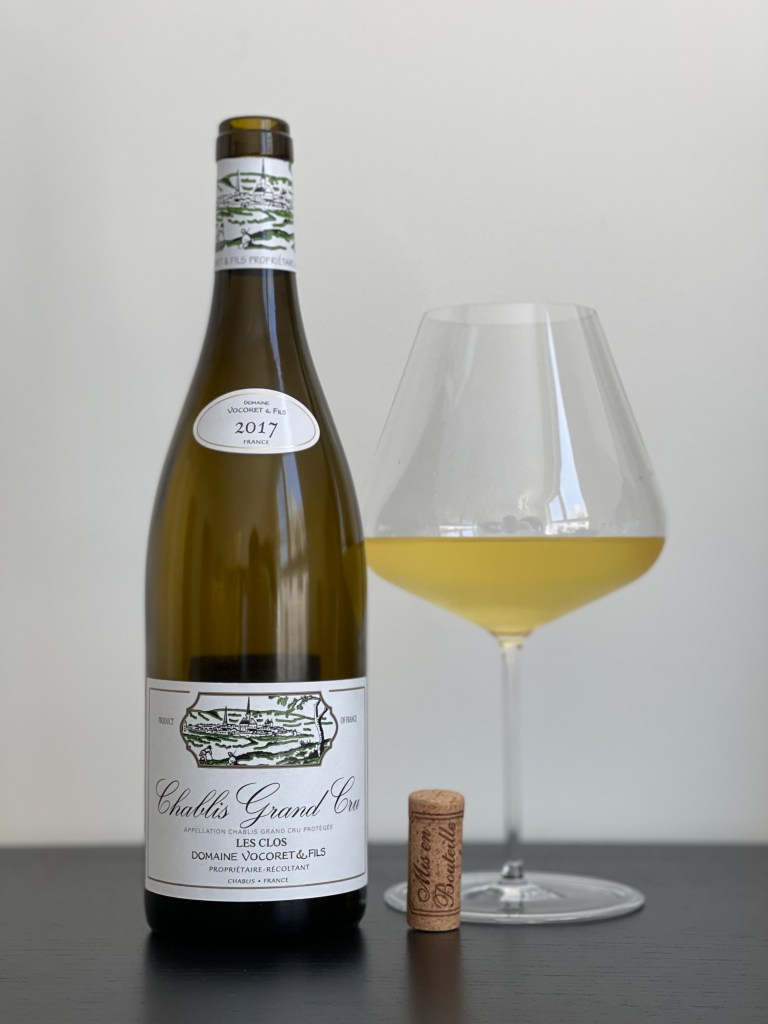
Today’s Story: Domaine Vocoret et Fils

Domaine Vocoret et Fils is a family-owned and operated domain, established in Chablis in 1870 by Edouard Vocoret. Today Domaine Vocoret is under guide of the fourth generation of the family, and their holdings are quite impressive at around 40 hectares of sustainably-farmed vineyards. Of these holdings, roughly 16 hectares are Village level, 17 hectares are 1er Cru, and 4 hectares are the Grand Crus of Les Clos, Blanchot, Valmur, and Vaudésir with the balance Petit Chablis. Though Vocoret invested in modern and high quality winemaking equipment, the production of their wines remains very traditional for Chablis. Grapes are hand-sorted before heading to the pneumatic press, and after fermentation the wines head into stainless steel for aging to preserve their fresh fruit and vibrancy (though the 1er and Grand Crus do see some new oak which is becoming more popular in Chablis today).

Today’s Wine: 2017 Chablis Grand Cru Les Clos

100% Chardonnay; 13% ABV

The 2017 Chablis Grand Cru Les Clos is medium yellow in color. The aromas are of medium intensity, with the nose showcasing notes of lemon zest, white peach, mango, white floral blossom, flint, chalk, and almond. Flavors on the palate are also of medium intensity, with the wine displaying notes of green apple, lemon, white peach, mild green herbs, wet stone, a hint of smoke, and mineral. This dry white is medium- to full-bodied with high acidity, medium alcohol, and a long finish. A very precise and youthful white Burgundy that should develop nicely over the years to come.

Price: $90. While I would like more intensity out of this wine, it offers very solid value for Chablis especially at the Grand Cru level. It’s precise and well-balanced already, but I’m looking forward to revisiting this as it adds complexity over the future.

Beautiful but Youthful 2014 Bordeaux With Decades of Life Ahead

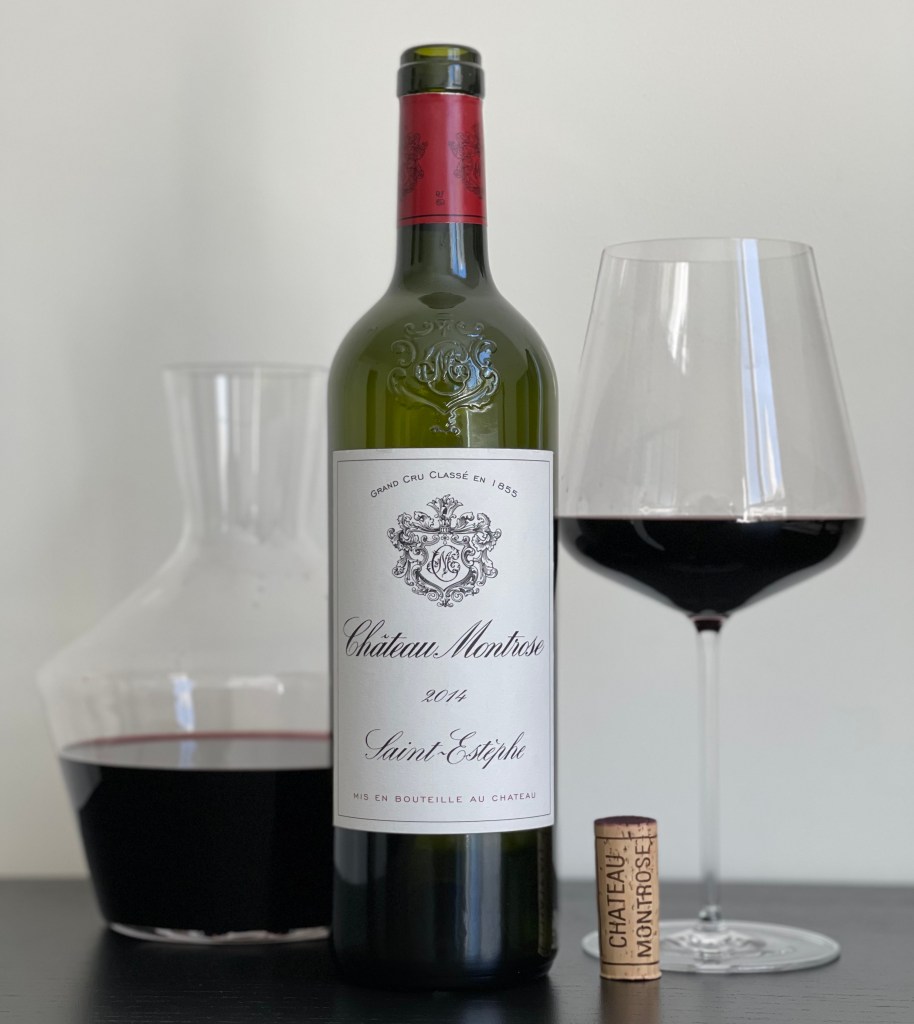
Today’s Story: Château Montrose

Château Montrose is a historical Bordeaux wine estate located in Saint-Estèphe on Bordeaux’s Left Bank. The estate was established in 1815 by Etienne Théodore Dumoulin on a patch of land his family purchased from Nicolas Alexandre de Ségur, but it was largely forgotten. At the time of Etienne’s death in 1861, the estate spanned 95 hectares though his heirs sold it in 1866 to factory owner Mathieu Dollfus who quickly redeveloped and modernized the buildings and winery with the best technology of the time. One of Mathieu’s most interesting achievements, in my opinion, was the construction of a windmill to pump water aboveground and flood the estate which ultimately saved much of the vineyards from phylloxera. After Mathieu passed away in 1886, the estate fell to the Charmolüe family who, from 1896 to 2006, guided Château Montrose through wars and financial crises while crafting some of the best vintages and providing stability. Martin and Olivier Bouygues acquired the estate in 2006 and engaged in a massive renovation project, propelling Château Montrose to ever increasing heights for decades down the road. Montrose, one of fourteen Deuxièmes Crus (Second Growths) in the Bordeaux Wine Official Classification of 1855, produces world-class wines and even placed third with their 1970 vintage in the Judgment of Paris in 1976.

I previously wrote about Château Montrose when I reviewed the 2016 La Dame de Montrose and the 2012 Château Montrose, so feel free to revisit those tasting notes if you would like to compare them to today’s wine.

Today’s Wine: 2014 Château Montrose

61% Cabernet Sauvignon, 30% Merlot, 8% Cabernet Franc, 1% Petit Verdot; 13.5% ABV

The 2014 Château Montrose is deep ruby in color and completely opaque. This is incredibly tight, so I decanted it for 10 hours and drank it over the following two hours. Even when I checked in at the five hour mark it was still pretty tight. Aromas are of pronounced intensity and patience is rewarded, however, as the nose showcases aromas of crème de cassis, wild blackberry, spiced black plum, cigar box, pencil shavings, crushed violet and lavender, scorched earth, graphite, eucalyptus, cedar, and a touch of oaky spice. Flavors are also of pronounced intensity, with the palate displaying notes of blackberry, black plum, blackcurrant, tobacco, anise, graphite, iron, charred green herbs, chocolate, and vanilla. This dry red is full-bodied with high acidity, high but tightly-knit tannins, medium alcohol, and a long finish. I suggest cellaring this for another 5 years or so, then drink over the following two decades. Very tense and precise.

Price: $150. Though not inexpensive, this bottle offers solid value in my opinion especially compared to stronger vintages like 2015 and 2016 that push closer to or above $200. This is another example of the underrated 2014 vintage showing incredibly well, though patience will be strongly rewarded with this one.

Killer Bourgogne From a Rising Star Micro-Négociant

Today’s Story: Chanterêves

Chanterêves is a very small domain and négociant located in Savigny-lès-Beaune of Burgundy’s Côte de Beaune, and it was established in 2010 by the husband and wife team of Tomoko Kuriyama and Guillaume Bott. Tomoko was born in Japan, but cut her teeth making wines in the Rheingau wine region of Germany after graduating with an engineering degree in oenology & viticulture from Geisenheim University. Guillaume, on the other hand, is a native of Burgundy and began his wine career with Domaine Etienne Sauzet in Puligny-Montrachet before moving to Domaine Simon Bize in Savigny-lès-Beaune.

Though Tomoko and Guillaume now own about 5 hectares (~12 acres) of their own vineyards, they continue to purchase small quantities of organic fruit from vineyards throughout Burgundy. All of their owned fruit is also farmed organically, though they utilize biodynamic principles as well but are not certified. Working with the classic Burgundian varieties of Pinot Noir, Chardonnay, and Aligoté, Tomoko and Guillaume practice minimal intervention winemaking with large percentages of whole cluster fermentation, only native yeasts, and very low SO2 additions. The wines age largely in used oak barrels with very little new oak, and SO2 is added only if necessary during aging and prior to bottling. The reds are bottled unfined and unfiltered, while the whites are bottled unfined but with occasional light filtration.

Today’s Wine: 2018 Bourgogne Hautes Côtes de Beaune Paris l’Hopital

100% Pinot Noir; 13% ABV

The 2018 Bourgogne Hautes Côtes de Beaune Paris l’Hopital is pale to medium ruby in color. This really opens up nicely in the glass over 45 minutes or so, showcasing aromas of medium intensity. The nose displays notes of dried cherry, black raspberry, red rose, leather, crushed rock, and underbrush. There’s a gorgeous stream of minerality on the nose as well, and overall it’s downright pretty and pure. Meanwhile the flavors are also of medium intensity, with the palate showing notes of black cherry, stemmy strawberry, cranberry, dried green herbs, and crushed rock minerality. This dry red is medium-bodied with high acidity, medium tannins, medium alcohol, and a medium (+) length finish. Certainly young and therefore not too complex yet, but this is so unbelievably pure it’s nearly crazy.

Price: $46 (less in Europe). This offers incredible value for red Burgundy, and is well worth seeking out. The purity, freshness, and mineral backbone paired with this wine’s elegance and honest representation of its terroir is truly impressive, especially for the price.