Domaine Vincent Pinard is a family-owned wine estate located in Bué in the heart of the Sancerre region in France’s Loire Valley. Though the estate has been in the Pinard family for generations, the current iteration was established in 1996 and is currently in the hands of brothers Florent and Clémente who took over from their father Vincent. The Pinard family owns 17 hectares (42 acres) of vineyards planted to Sauvignon Blanc and Pinot Noir, with their portfolio consisting of six Sauvignon Blanc bottlings, three Pinot Noir bottlings, and a rosé made from Pinot Noir. Florent and Clémente practice organic viticulture and are transitioning to biodynamic practices, remaining as natural as possible in the vineyards without the use of herbicides, pesticides, or anti-rot treatments. The vines see rigorous pruning to limit yields, and most of the work in the vineyards is done completely by hand (including harvest). Minimal intervention is also the name of the game in the cellar, where the wines ferment with indigenous yeasts and with no winemaking additions. Depending on vintage and cuvée, Florent and Clémente use a combination of stainless steel and old oak barrels to preserve the variety characteristics and showcase the terroir.
Today’s Wine: 2017 Harmonie Sancerre
100% Sauvignon Blanc; 13% ABV
The 2017 Harmonie is pale yellow in color. With aromas of pronounced intensity, the nose showcases notes of lemon peel, grapefruit, passionfruit, honeysuckle, raw asparagus, freshly cut grass, and wet river stone. Meanwhile flavors are of medium (+) intensity, with the palate displaying notes of honeydew, white peach, fresh pineapple, white floral blossom, limestone, and mild green herbs. This dry white is medium-bodied with high acidity, medium alcohol, and a medium (+) length finish.
Price: $52. I think this is pretty fairly priced given its quality, intensity, and complexity at this stage, however there are better values in the $30-35 range for sure. I’d be curious to see how this develops with another couple years of bottle age, but right now this is a very elegant and precise take on Sauvignon Blanc.
Domaine Edmond Vatan is a miniscule but highly regarded producer situated in the small town of Chavignol in the Sancerre appellation of France’s Loire Valley. The vineyards consist only of one hectare (2.5 acres) and are planted to the Sauvignon Blanc variety as is required for white wines in the appellation. Vatan’s vines, planted on the steepest slopes with optimal sun exposure, are low-yielding and severely pruned to maximize quality and intensity. Vatan also uses minimal additives/treatments in the vineyards, harvests later than his neighbors, and vinifies the wines adhering to very traditional methods in old oak barrels. The wines are racked only once and then bottled without fining or filtration. Since 2008, Edmond’s daughter Anne took over production following his semi-retirement during the early 2000s, though he is still involved as a guide and teacher. Production is incredibly limited, with about 500 cases total produced each vintage.
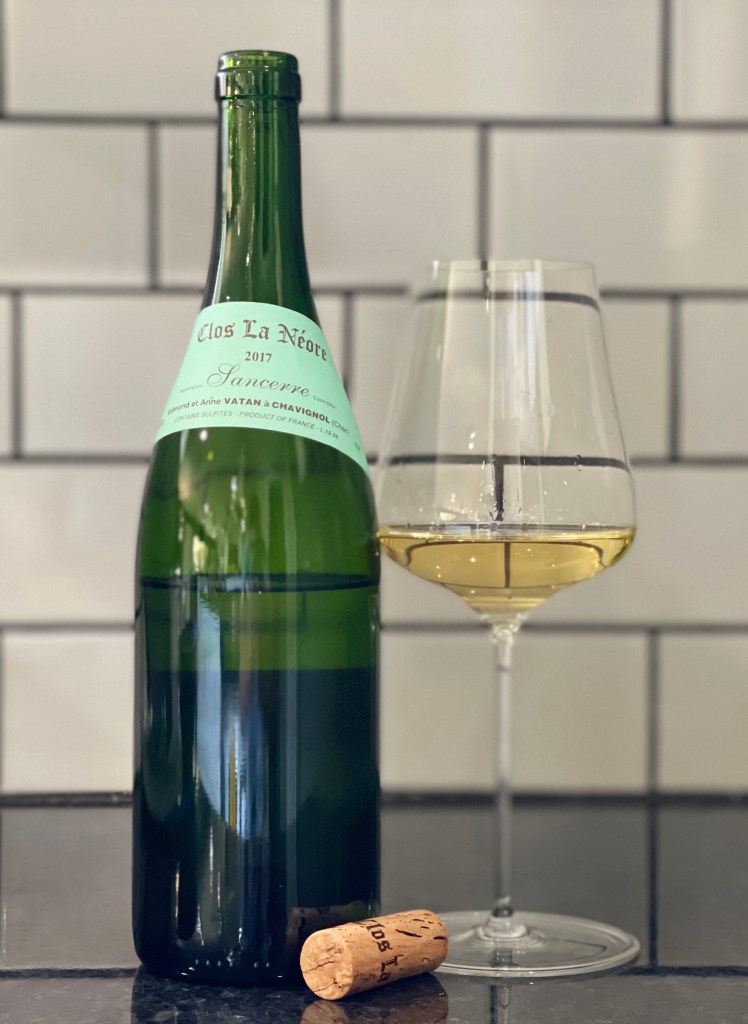
Today’s Wine: 2017 Clos La Néore Sancerre
100% Sauvignon Blanc; 14% ABV
The 2017 Clos La Néore is pale yellow in color. This is a baby by preposterous standards, so at this stage it needs several hours to open up. Only by the end of the day did this start opening up, and I wish we had the restraint to hold it into a second day. The aromas are of pronounced intensity, showcasing notes of lemon and lime zest, white peach, freshly cut grass, wet river stone, and saline mineral. Meanwhile the flavors are also of pronounced intensity, with the palate displaying notes of meyer lemon, tropical citrus, lychee, pineapple, chopped grass, wet slate, and crushed rock mineral. This dry Sauvignon Blanc is medium- to full-bodied with racy high acidity, high alcohol, and a long finish. Very, very good, but just way too young.
Price: $275 (shared by a friend who paid $200). I can’t call this a good value, but I can see what the hype is after this gets several hours of air. This is certainly an excellent representation of the Sauvignon Blanc variety, and one that has the ability to age for decades. But is it a necessary purchase given the price? Probably not.
Domaine Vincent Dancer is a small, rising star estate located in the village of Chassagne-Montrachet in Burgundy, France. Established by Vincent Dancer, the domain consists of about 5-6 hectares under vine and was the first certified organic producer in Chassagne-Montrachet. Vincent is originally from Alsace, and though he studied engineering in school he picked up a passion for wine along the way. After some urging from his father, Vincent spent time in Burgundy to learn viticulture and oenology before taking over small acreage of family vines in 1996. Known as a quiet and humble winemaker, Vincent quietly expanded his vineyards and today has holdings in Chassagne-Montrachet, Meursault, Puligny-Montrachet, Pommard, and Beaune. A staunch proponent of hands-off winemaking, Vincent hand-harvests his fruit from fairly low yielding vineyards and refrains from adding any commercial yeasts, enzymes, or acid adjustments during natural fermentation. He also resists bâtonnage, the practice of stirring the lees which is practiced by many producers in Chassagne-Montrachet to add flavors, aromas, and texture to the wine. The wines are bottled unfined and unfiltered, with common descriptors of “tense,” “precise,” and “graceful.” Total production is I believe still under 2,000 cases annually, and not a lot of Vincent’s wines make their way to the US.
I previously wrote about Vincent Dancer when I reviewed the 2018 Bourgogne Blanc, which is a wonderful entry-level wine for the domain.
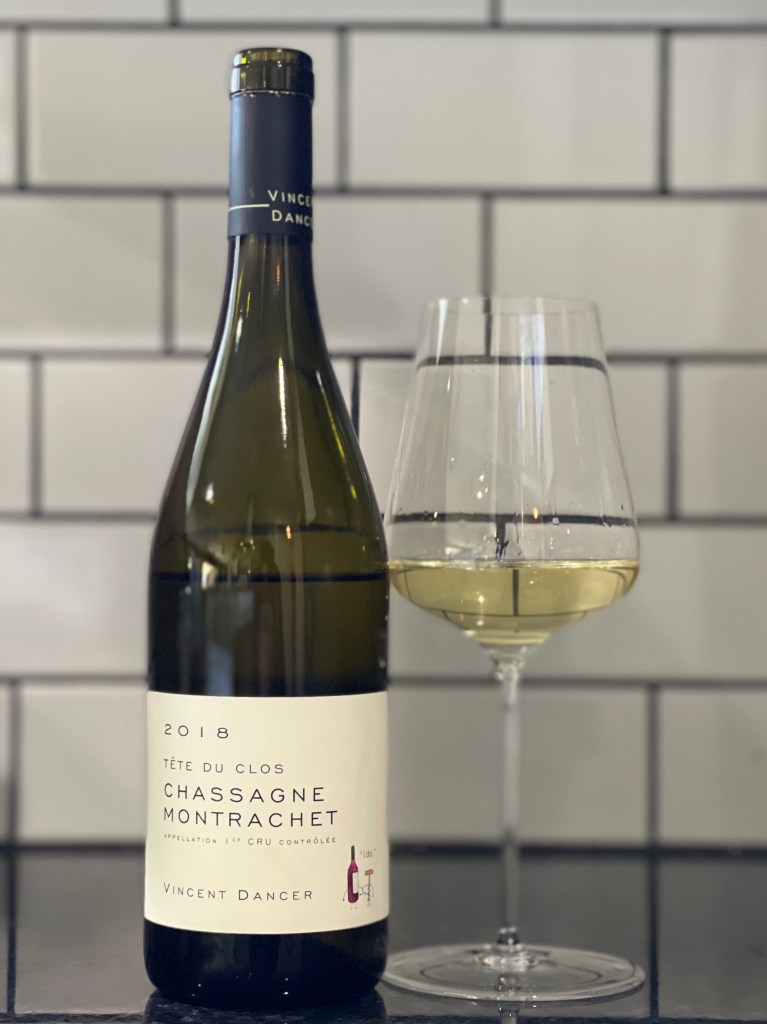
Today’s Wine: 2018 Vincent Dancer Chassagne Montrachet 1er Cru Tête du Clos
100% Chardonnay; 13% ABV
The 2018 Tête du Clos is pale yellow/gold in color. This needs about an hour and a half to two hours to really open up at this young stage, but the nose blossoms into aromas of pronounced intensity. The nose showcases aromas of lemon, crisp golden apple, white floral blossom, flint, wet river stone, a touch of smoke, freshly-baked bread, and saline mineral. Meanwhile the palate is also of pronounced intensity, showcasing notes of crisp pear, lemon zest, yellow apple, honeysuckle, almond, mild dried green herbs, wet stone, and crushed rock mineral. This dry white is full-bodied with high acidity, medium alcohol, and a very long finish. This is outstanding already, but I’ll wait probably five years before opening my next bottle. Very tense and precise.
Price: $175 (I paid $160). By no means an inexpensive white Burgundy, however I think this is absolutely worth the price and I would wager these prices rise further in the years to come. Vincent Dancer is making some of the greatest white Burgundy right now from the wines I’ve tasted, and these should be a must-try for any white Burgundy lover.
Château Mouton Rothschild is a historic and highly regarded wine estate located in the Pauillac appellation on the Left Bank of Bordeaux. It is one of five First Growths in Bordeaux, however it did not achieve this status in the original Bordeaux Wine Official Classification of 1855 and instead received the status in 1973 after significant lobbying by Baron Philippe de Rothschild. The estate traces its roots back to the year 1720, when it took its name of Château Brane Mouton from Joseph de Brane when he purchased the estate from Nicolas-Alexandre de Segur. The estate was producing world-class wines during the 18th and 19th centuries, ultimately shifting hands when Baron Nathaniel de Rothschild purchased Brane Mouton in 1853 in a somewhat run-down state. Baron Nathaniel replanted the vineyards and changed the estate’s name, so Château Mouton Rothschild was born.
Though the Rothschild family owned the estate, Baron Nathaniel was part of the English branch of the family and never really traveled to or became involved in the estate. The modern era of the estate actually began in 1922, when Baron Nathaniel’s grandson Baron Philippe de Rothschild, then 20 years old, took over the estate and devoted his life to it. Baron Philippe wasted no time in improving the status of Mouton, becoming the first owner in Bordeaux to insist that all his wine should be bottled at the estate to maintain the highest quality standards and control from the vineyards to the finished product. This was at a time when many producers sold their wines to négociants in barrel for them to bottle, so it was already a revolutionary idea. With all bottling done at Mouton beginning in 1924, Baron Philippe built the now-famous Grand Chai in 1926 for necessary added storage. This Grand Chai is a popular and awe-inspiring stop on a visit to Mouton, as it is 100 meters long, beautifully designed, and home to 1,000 oak barrels on a single level.
Another important contribution Baron Philippe made to Mouton is the tie into art. Beginning with the 1945 vintage, the labels of the Grand Vin change each vintage and feature artwork created by world-renowned artists specifically for the Mouton bottles. For example, a couple of my favorite artists including Picasso and Warhol were featured in the past and add a unique, fun, and eye-catching aspect to the estate’s wines.
When Baron Philippe passed away in 1988, his daughter Baroness Philippine de Rothschild inherited the Mouton estate and left her acting career to pick up after her father’s passion. With her children Camille, Philippe, and Julien, the Baroness not only expanded the reach of the estate but also oversaw still-increasing quality and a stronger tie into the world of the arts. She also oversaw a renovation of the château, and a new vat room came into function in 2012 with a marriage of traditional and technological progress.
The Mouton estate today consists of 90 hectares (222 acres) of vines, planted to roughly 81% Cabernet Sauvignon, 15% Merlot, 3% Cabernet Franc, and 1% Petit Verdot. The vineyards lie on deep, gravelly soil which provides optimal growing conditions and the average vine age is 44 years. All harvesting occurs entirely by hand, with the fruit destemmed and sorted again at the winery before being gravity fed into the fermentation vats. The majority of these vats are made of oak, with a decent percentage left to stainless steel as well. All aging occurs in new oak barrels for about 20 months.
The 1988 Château Mouton Rothschild is deep garnet in color, not really showing any signs of bricking. I drank this as a pop-and-pour, which seemed to be the best bet as this didn’t really change too much over time in the glass. The aromas are of medium intensity, showcasing notes of cassis, cigar box, graphite, green bell pepper, olive, forest floor, coffee grounds, and cedar. Meanwhile the wine’s flavors are also of medium intensity, displaying notes of dried blackcurrant, tobacco, mocha, mushroom, dried green herbs, and cracked pepper. This is a dry red that is medium-bodied with medium acidity, medium (-) tannins, medium alcohol, and a medium length finish. Though I still get some nice notes on this, it is certainly over the hill with the tertiary notes dominating and the structure showing the test of time. I think drinking this 5 years ago would’ve been the correct timing.
Price: $550 (shared by a friend who paid $450). The value proposition of these wines is often less than stellar, for one because there are incredible values for half the price and two with wines of this age provenance becomes key. This bottle I would say was in very good condition and of excellent provenance, however you may get luckier in your tasting if you have an immaculate bottle. Nonetheless, consider drinking up.
Maison Trimbach is one of the most notable winemakers in Alsace, established in 1626 by Jean Trimbach. Today Trimbach is under the guidance of Hubert Trimbach and his nephews Jean and Pierre, rounding out 12 generations of family ownership and shared knowledge. Pierre’s daughter Anne, the oldest of the 13th generation, also now works in the family business. Though Trimbach’s world recognition greatly expanded in 1898 when Frédéric Emile Trimbach earned the highest marks at the International Wine Fair in Brussels, Trimbach is largely famous for the legendary Clos Sainte Hune vineyard. Located in the Rosacker Grand Cru vineyard, Clos Ste Hune has belonged to the Trimbach family for over two centuries and produces some of the most exquisite Alsatian Riesling in existence.
The Trimbach estate consists of 40 hectares (about 100 acres) encompassing 50 parcels across six villages that include Bergheim, Ribeauvillé, and Hunawihr. Trimbach also operates as a négociant business to produce additional non-estate wines. All of Trimbach’s winegrowing practices are sustainable and they try to preserve the natural environment of the vineyards. Trimbach practices close pruning and soil tilling while encouraging moderate yields and rigorous fruit selection come harvest which is accomplished entirely by hand. When the grapes are gently crushed at the winery, juices flow via gravity and Pierre vinifies and matures the wines adhering to centuries of tradition with both finesse and focus on the terroir. After being bottled each spring, the wines are released by maturity with some spending 5 to 7 years in the cellars to achieve balance before release.
I previously wrote about Trimbach when I reviewed their 2016 Gewurztraminer, so feel free to check that out if you missed it!
Today’s Wine: 2014 Clos Ste Hune
100% Riesling; 14.5% ABV
The 2014 Clos Ste Hune is pale yellow in color with greenish hints. Aromas are of pronounced intensity and laser-focused, with the nose showcasing lemon, crisp green apple, tropical citrus, white peach, honeysuckle, petrol, a hint of smoke, and crushed rock mineral. Meanwhile flavors on the palate are also of pronounced intensity, displaying notes of green apple, lemon zest, pineapple, white peach, white florals, petrol, mild smoke, and saline mineral. This Riesling is bone dry and full-bodied with razor-sharp high acidity, high alcohol, and a long finish. Outstanding with a long, long life ahead but this is already showing incredible precision and balance.
Price: $300. This is another wine with a value proposition that’s difficult to discuss, simply because there are better “values” out there for significantly less money. That being said though, these wines are truly legendary and perhaps the greatest Riesling the Alsace region has to offer. It’s certainly the best Riesling I’ve had to date, by a mile.
Krug is a highly regarded Champagne house established in Reims, France in 1843 by Joseph Krug. Krug has maintained a reputation throughout its entire existence of producing incredibly high quality wines, being unique to this day as the first and only house to create only prestige Champagnes every year since its establishment. Krug’s most widely produced Champagne, the Grande Cuvée, is the house’s most popular and a blending of more than 120 wines to craft the best expression of time and place each vintage. The house produces several other wines, including a non-vintage Rosé, vintage Krug, a vintage single-vineyard Blanc de Blanc called Clos du Mesnil, a vintage single-vineyard Blanc de Noir called Clos d’Ambonnay, and Krug Collection back-vintage wines. Though the house is now owned with a majority by LVMH, the Krug family remains actively involved with sixth-generation Olivier Krug today.
The NV Grande Cuvée 168ème Édition is pale gold in color with lively bubbles. The aromas are of medium intensity, showcasing yellow apple, pear, white blossom, brioche, slight reduction, and chalky mineral. Meanwhile the palate is also of medium intensity, displaying notes of crisp green apple, white peach, white florals, almond, brioche, and honey. This dry Champagne is medium-bodied with high acidity, medium alcohol, and a medium (+) length finish.
Price: $170. I wouldn’t go so far as to say this is a great value, but that’s simply because there are so many grower Champagne’s out there that come in at half or less than half the price and drink just as well. Krug is, however, probably my favorite Champagne in this price range and this 168ème Édition is a great bottling based on the 2012 vintage. Krug is consistently exceptional and every Champagne lover needs to try some at least once.
Louis Jadot is a very large and prominent wine producer in the Burgundy wine region of France, established in Beaune in 1859 by Louis Henri Denis Jadot. Though the house owns fairly extensive acreage of their own vineyards, they also purchase high quality fruit throughout Burgundy and offer an incredibly extensive portfolio of wines ranging from Bourgogne and Beaujolais through to some of the great 1er Cru and Grand Cru wines across the Côte d’Or and up to Chablis. Though production is high with both the domaine holdings and négociant business, Louis Jadot is an important example that quality does not have to suffer. The winemaking team blends tradition with technology in the cellar, producing wines with as little intervention as possible given their scale and using restrained amounts of new oak depending on vintage conditions.
Today’s Wine: 2017 Chablis 1er Cru Fourchaume
100% Chardonnay; 13% ABV
The 2017 Chablis 1er Cru Fourchaume is pale gold in color. Given some time to open up in the glass, this wine blossoms into beautifully expressive aromas with pronounced intensity. The nose showcases aromas of crisp underripe pear, lemon, white peach, white florals, flint, gunsmoke, and wet river stone. Meanwhile the palate is also of pronounced intensity, displaying notes of tart green apple, lemon zest, white peach, honeysuckle, flint, a hint of smoke, dill, and saline mineral. This dry white is medium-bodied with racy high acidity, medium alcohol, and a long finish.
Price: $50. I think this is very, very good value. The intensity and precision in this wine are very impressive, while the flavor profile and complexity at a young age promote promise for the future with the coupled high acidity. Many people say Fourchaume is as close as you can get to a Grand Cru without being one, and it shows.
Domaine Faury is a family-owned and operated Northern Rhône wine estate, established in 1979 by Philippe Faury. Though Philippe’s father, Jean, settled the family in the tiny hamlet of Ribaudy in the hills of Chavanay, his wine production was somewhat limited and often sold in bulk to locals alongside peaches, cherries, and apricots. When Philippe took over, however, he transitioned the estate to focus entirely on wine production and grew the 2.5 hectare holdings over time into the 17 hectares the Faury family owns today. In 2006, Philippe’s son Lionel took over management of the estate and the two work side-by-side crafting traditionally made and terroir-centric wines. Dedicated largely to Syrah with smaller plantings of Viognier, Marsanne, and Roussanne, Domaine Faury owns vineyards in the appellations of Côte-Rôtie, Condrieu, and Saint-Joseph as well as IGP Collines Rhodaniennes.
Lionel seeks to produce wines with a true sense of place while also showcasing the signature characteristics of each variety. Winemaking is therefore rather minimally invasive, starting with gentle crushing and temperature-controlled fermentations onto pigéage (punch downs) by foot rather than machine or tools. To preserve the more delicate and floral aromas of his wines while offering an accompanying freshness, Lionel eschews the overt use of new oak and instead opts for a combination of very large old barrels such as demi-muids and foudres. Attention to detail and an artisanal approach to winemaking is palpable in these wines, and production is capped at around 7,000 cases per vintage.
Today’s Wine: 2017 Côte-Rôtie Emporium
+/- 98% Syrah, +/- 2% Viognier; 13% ABV
The 2019 Côte Rôtie Emporium is medium purple in color. I decanted this for an hour and drank it over the following two hours, with it only becoming more impressively nuanced over time. The aromas are of pronounced intensity, showcasing notes of blueberry, black cherry, blackberry, violet, sweet tobacco, smoked game, crushed rock, graphite, black pepper, and roasted coffee. Meanwhile the palate is of medium (+) intensity, displaying flavors of brambly blackberry, blueberry, plum, black olive, blue and purple florals, charred green herbs, iron, a hint of smoke, and mild baking spice. This dry red is medium-bodied with medium (+) acidity, medium but refined and silky tannins, medium alcohol, and a long finish.
Price: $100. While this may not be the best “value” of Northern Rhône, I struggle to recall a wine I’ve had that has been this spot-on of a representation of the variety and the region. This is a gorgeous, gorgeous wine with elegance, finesse, and a magnificent perfume already at such a young age.
Domaine Méo-Camuzet is a very highly regarded domain in the Côte-d’Or of Burgundy, situated in the heart of the prized Vosne-Romanée appellation. The domain was established by Étienne Camuzet, a political figure who represented the Côte-d’Or as mayor of Vosne-Romanée and an MP in Paris. Étienne purchased the Château du Clos de Vougeot in 1920, but due to his political commitments did not live there or farm the vineyards and instead leased it out to tenant farmers. Though he sold the château in late 1944 (it was heavily damaged during the war), 20 hectares of vineyards went up for sale and he retained 3 hectares for himself. Upon Étienne’s death in 1946, the holdings passed to his daughter Maria Noirot and she kept the tenant farming system in place. Having no heirs of her own, with Maria’s death in 1959 the domain passed to her nephew Jean Méo who was in General de Gaulle’s cabinet. Jean Méo took over the domain with help from his parents, but kept to the tenant farming system with the legendary Henri Jayer being one of them. In 1981, the domain was named Domaine Méo-Camuzet, domain bottling and labelling commenced with the 1983 vintage, and Jean Méo proposed passing the reins onto his son Jean-Nicolas in 1984.
Jean-Nicolas took several years to pick up the task, immersing himself in the domain in 1989 following education at the University of Burgundy to study oenology. He also studied at the University of Pennsylvania to build his business acumen. As he was nearing retirement in 1988, Henri Jayer agreed to coach Jean-Nicolas alongside Christian Faurois, a son of another highly regarded tenant farmer. As Jean-Nicolas learned, grew, and experimented with new techniques at the domain, the Méo-Camuzet wines gained great appreciation around the world, particularly in the American markets where Jean-Nicolas used his business savvy to his advantage. By 2008, all tenant farmers had retired and Jean-Nicolas took complete management responsibility over the vineyards. As he struggled to keep up with demand, he and his sisters established the Méo-Camuzet Frère & Soeurs négociant business to expand their portfolio into wider and more accessible bottlings. Today, Jean-Nicolas runs Méo-Camuzet with his wife Nathalie and they have three children who will perhaps one day carry on the family legacy. Christian Faurois remains a right-hand-man as well.
Domaine Méo-Camuzet today consists of 14 hectares of vineyards which include holdings in a range of villages, 1er Crus, and several Grand Crus. Practically all viticulture is organic, though the domain does not seek certification so in their most difficult vineyards or vintages they can react prudently if needed. For instance, some of their sites that are difficult to farm may need small amounts of occasional herbicide or anti-rot treatments. Harvesting is completed entirely by hand, and sorting first occurs at the vineyard level where fruit deemed below quality standards is dropped to the ground. Fruit is sorted again and destemmed at the winery, before fermentation begins in concrete vats with temperature control only ensuring the temperature doesn’t cross over the critical 95 degree Fahrenheit level. The wines mature in new oak barrels, ranging from about 50% new for the lower level wines up to 100% new for the Grand Crus. Come bottling, the wines see no fining or filtration.
The 2018 Bourgogne Côte-d’Or Cuvée Étienne Camuzet is pale to medium ruby in color and transparent. This took a good hour to open up in the glass, eventually showing aromas of medium intensity. The nose showcases notes of ripe red cherry, cranberry, black raspberry, red rose petal, leather, dried herbs, crushed rock minerality, and a hint baking spice. Meanwhile the flavors on the palate are also of medium intensity, displaying notes of black cherry, red plum, crunchy cranberry, brambly black raspberry, anise, tobacco, cola, stony mineral, clove, and a touch of smoke. This dry red is light- to medium-bodied with medium acidity, medium (-) tannins, medium alcohol, and a long finish. Overall pretty complex for its youth and very well-balanced. Purity and freshness of fruit here is gorgeous, as is the minerality.
Price: $65 ($40-50 in Europe). Given where the pricing of Burgundy has headed, I think this is actually pretty decent value. I certainly think this drinks about the regional Bourgogne level, and should only improve with several more years of bottle age.
Château Haut-Bailly is a historic Bordeaux wine estate, established during the 1530s by the Goyanèche and Daitze families in the Left Bank appellation of Pessac-Léognan. Haut-Bailly remained in the Daitze family until 1630, when it was purchased by Firmin Le Bailly and Nicolas de Leuvarde who were two wealthy Parisian bankers. It was Firmin Le Bailly who provided the estate with its name, still in use to this day. The Le Bailly family invested significantly in the improvement of the estate and its wines, passing it from generation to generation until 1736 when Thomas Barton came along. Barton, who was an Irishman, used his business savvy and connections to trumpet the quality of Haut-Bailly wines and helped spread them to England and Ireland where they became highly regarded. In 1872, Alcide Bellot des Minières purchased the Haut-Bailly estate and constructed the château which remains to this day. des Minières was also a gifted winemaker, adhering to precise and science-backed philosophies that further improved the wines and, in pricing terms, put them up with Château Lafite Rothschild, Château Latour, Château Margaux, and Château Haut-Brion. Unfortunately, phylloxera took its toll on the estate during the very late 1800s and Haut-Bailly entered the 20th century under a sense of turmoil.
During the first half of the 20th century, Haut-Bailly changed hands multiple times, new and questionable winemaking practices occurred, and the reputation faltered. In 1955, however, Belgian négociant Daniel Sanders purchased the estate and commenced a renaissance for both quality and reputation. Daniel and his son Jean renovated the vineyards and the winery, while also increasing the rigorous quality standards set in place to select fruit for the Grand Vin. By this point Haut-Bailly was a classified Cru Classé in the Classification of Graves in 1953 and 1959, and the wines certainly lived up to it. During the 1970s, however, the wines did take a slight dip once again as Daniel remained reluctant in his old age to give up control to his son Jean. With Daniel’s death in 1980, however, Jean fully took the helm and resumed the rise in quality. Haut-Bailly shifted into the hands of its current owners in 1988, when American banker Robert G. Wilmers purchased the estate. Jean Sanders remained on the team which later included fourth generation Véronique Sanders in a general manager capacity. Though Robert unfortunately passed away in 2017, Haut-Bailly remains in his family’s care with the same dedication and passion to this great and historic estate.
Château Haut-Bailly today consists of 30 hectares of vineyards situated in prime sandy and gravelly soils in the heart of the Pessac-Léognan appellation. The vineyards are planted to 60% Cabernet Sauvignon, 34% Merlot, 3% Petit Verdot, and 3% Cabernet Franc, with the plots undulating and at times reaching 20 meters higher than other plots around them. Haut-Bailly also maintains 4 hectares of century-old vines planted by Alcide Bellot des Minières, and while largely planted to Cabernet Sauvignon these special vineyards have plots of Carmenère, Merlot, Cabernet Franc, Malbec, and Petit Verdot as well.
Harvest and winemaking at Haut-Bailly follow the philosophy of gentleness and minimal intervention. All plots are harvested individually by hand so fruit is picked at optimal ripeness for each variety. After initial sorting in the vineyards, the fruit is destemmed and sorted by hand again before transferring directly into vats for fermentation. Each plot is vinified separately as well, allowing the winemaking team a plethora of blending options to showcase the varieties and terroir in the best sense possible vintage to vintage. Following time in concrete vats, the wines age in French oak barrels for 16-18 months before they are bottled.
To view the source of the information above, please check out the Château Haut-Bailly website here. You can also view pictures of the estate and peruse their portfolio which interestingly includes a Rosé.
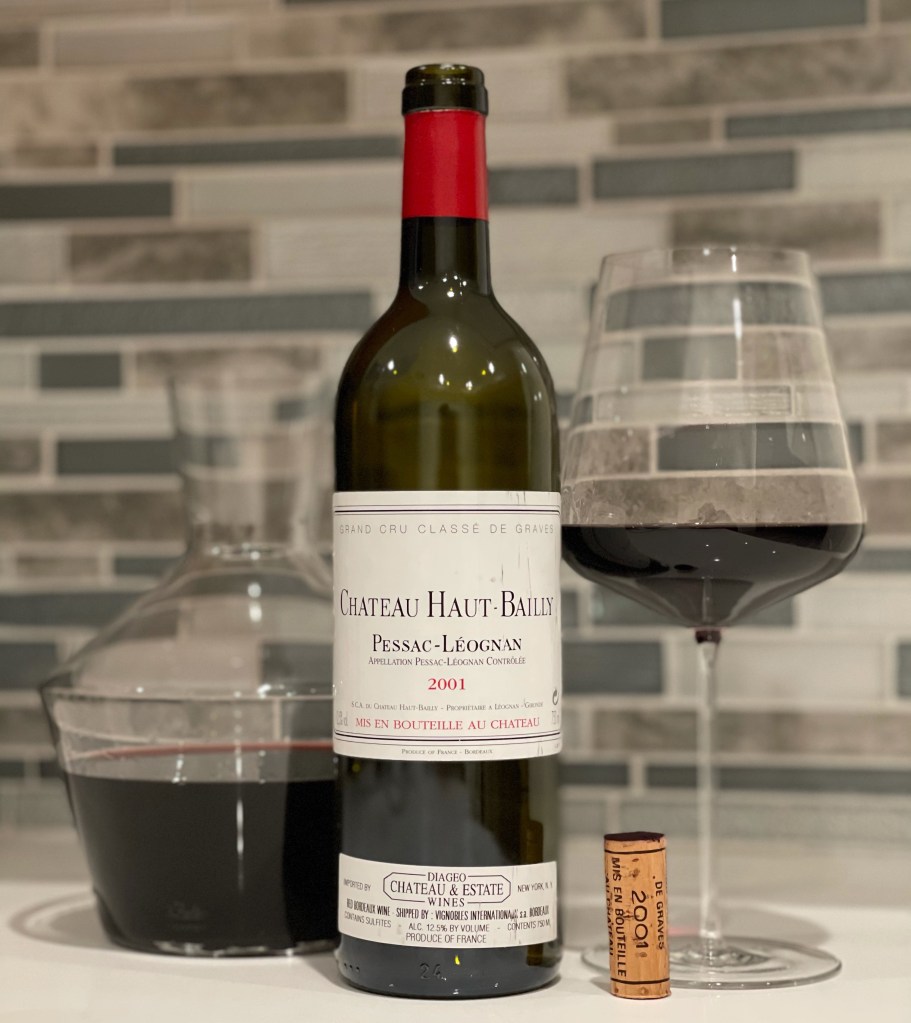
Today’s Wine: 2001 Château Haut-Bailly
65% Cabernet Sauvignon, 35% Merlot; 12.5% ABV
The 2001 Château Haut-Bailly is opaque deep ruby in color with deep garnet variation at the rim. This required a good 1.5 to 2 hours to decant, but it blossomed beautifully. The nose is of pronounced intensity, showcasing classic aromas of crème de cassis, redcurrant, violet, cigar box, black truffle, scorched earth, graphite, pencil shavings, black pepper, gravel, and a touch of vanilla. Meanwhile on the palate I get flavors of pronounced intensity including blackberry, black plum, cassis, licorice, violet, dried tobacco, mushroom, a hint of green bell pepper, dried green herbs, clove, and charred cedar. This dry red is medium- to full-bodied with medium (+) acidity, high but very fine-grained and luxurious tannins, medium alcohol, and a long finish. Gorgeous right now but certainly has the stuffing to develop further for at least another decade.
Price: $120. 2001 is a sleeper vintage in Bordeaux, and selection can sometimes be difficult. However, this 2001 Haut-Bailly is firing on all cylinders and offers very solid value in my opinion given its complexity, performance, age, and promise for the future. Well done.






 JB's Wine Talk