Finding Value in Fifth Growth Bordeaux

Today’s Story: Château d’Armailhac

Château d’Armailhac is a historic Fifth Growth Bordeaux estate located in Pauillac. Though the estate traces its roots to at least 1680 and brothers Dominique and Guilhem Armailhacq, the first solid record of vines on the property came later in 1750 and included 15 to 16 hectares of vineyards. By the end of the 1700s, the estate (called Mouton d’Armailhacq) benefited from the rapid growth of vineyards in the Médoc and grew to 52 hectares under vine, though the wines were not very highly regarded. The team spent the next several decades working tirelessly on improving the quality of the wines and were ultimately rewarded with higher prices and classification as a Fifth Growth in the Bordeaux Wine Official Classification of 1855. Later, in 1931, Baron Philippe de Rothschild became a minority owner in the estate and took full ownership in 1933. Château d’Armailhac is tightly woven together with Château Mouton Rothschild, with the former holding all technical and agricultural equipment for both estates in their outbuildings. In 1956 the estate was renamed Mouton Baron Philippe, then Mouton Baronne Philippe, and finally Château d’Armailhac in 1989 when Baroness Philippine de Rothschild elected to restore the estate’s original name.

Today, Château d’Armailhac’s vineyards total 70 hectares in northern Pauillac and they are planted to roughly 52% Cabernet Sauvignon, 36% Merlot, 10% Cabernet Franc, and 2% Petit Verdot. The estate’s vineyards are made up of the appellation’s famous deep gravelly soil which is perfect for producing wines of character and elegance. Come harvest, the process begins when the same team of Château Mouton Rothschild deems the fruit ready and all picking is done completely by hand. Each variety and each parcel moves to the winery separately, the grapes are entirely destemmed, and young vine fruit is vinified separately from old vine fruit. The wines age in 25% new oak barrels, with some coming from the Grand Chai of Château Mouton Rothschild, and they are run off every three months until fining with egg whites. Each vintage is only bottled when the winemakers and cellar master deem the wine is ready, so there is no strict formula or timeline for barrel aging.

Previously, I wrote about Château d’Armailhac when I reviewed the 1978 Château Mouton Baronne Philippe. If you care to read about how these wines can age, I encourage you to check out the tasting notes at the link above.
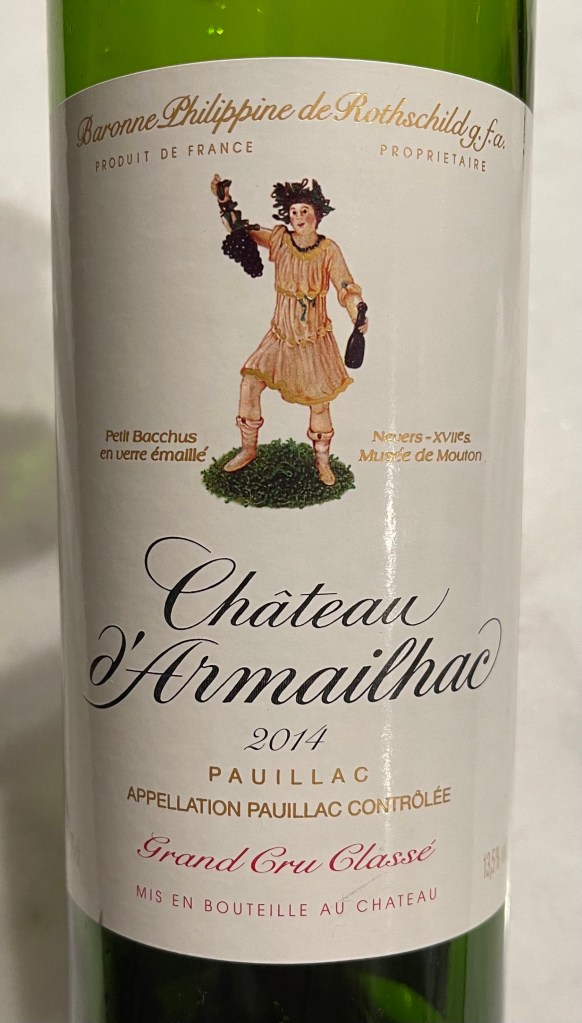
Today’s Wine: 2014 Château d’Armailhac

50% Cabernet Sauvignon, 36% Merlot, 12% Cabernet Franc, 2% Petit Verdot; 13.5% ABV

The 2014 Château d’Armailhac is opaque deep ruby in color, showcasing its youth. When I first pulled the cork, I was nervous this wine was an off bottle showcasing some pronounced nutty and oaky characteristics. However, given three hours to decant my worries were unwarranted and the wine blossomed beautifully. On the nose, which is of medium intensity, I get aromas of crème de cassis, redcurrant, black plum, violet, leather, graphite, cigar box, black pepper, clove, and cedar. Meanwhile the palate, which is deeper and more pronounced in intensity, showcases notes of redcurrant, blackcurrant, black cherry, red plum, licorice, tobacco, dried green herbs, green pepper, vanilla, and clove. This dry red is full-bodied with high acidity, high tannins, medium alcohol, and a long finish.

Price: $60 (I paid 49). I think this wine offers decent value for Pauillac and the greater Left Bank, especially at the sub-$50 price I found it for. While I would like a bit more intensity out of the nose, I still get all the classic Pauillac aromas and the overall balance of the wine is quite good. 2014 Bordeaux is really starting to show well, and I think this is a great effort from d’Armailhac.
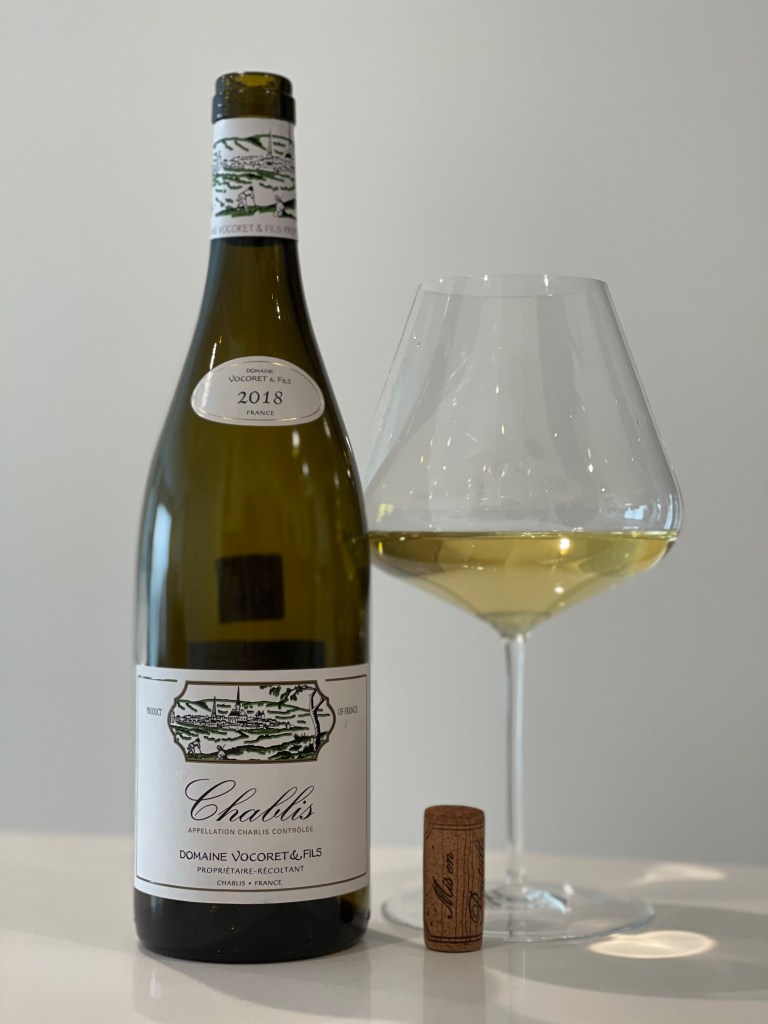
Family-Made Chablis at an Excellent Value

Today’s Story: Domaine Vocoret et Fils

Domaine Vocoret et Fils is a family-owned and operated domain, established in Chablis in 1870 by Edouard Vocoret. Today Domaine Vocoret is under guide of the fourth generation of the family, and their holdings are quite impressive at around 40 hectares of sustainably-farmed vineyards. Of these holdings, roughly 16 hectares are Village level, 17 hectares are 1er Cru, and 4 hectares are the Grand Crus of Les Clos, Blanchot, Valmur, and Vaudésir with the balance Petit Chablis. Though Vocoret invested in modern and high quality winemaking equipment, the production of their wines remains very traditional for Chablis. Grapes are hand-sorted before heading to the pneumatic press, and after fermentation the wines head into stainless steel for aging to preserve their fresh fruit and vibrancy (though the 1er and Grand Crus do see some new oak which is becoming more popular in Chablis today).

Today’s Wine: 2018 Chablis

100% Chardonnay; 12.5% ABV

The 2018 Chablis is transparent pale gold in color. Given some time to blossom in the glass, the aromas are of pronounced intensity with the nose showcasing notes of crisp green apple, lemon, unripe pear, white florals, flint, gunsmoke, wet river stone, and dill. Meanwhile on the palate, which is of medium intensity, I get notes of green apple, lime zest, quince, white peach, chalk, dried green herbs, and white pepper. This dry Chablis is medium-bodied with medium (+) acidity, medium alcohol, and a long finish.

Price: $25. This offers very, very good value for Chablis and Chardonnay as a whole. There is a beautiful and crisp purity of fruit here for its young age and price-point, and the lip-smacking acidity is gorgeous. I’m excited to try more of the Vocoret wines in the near future.

Historic Pomerol Estate Showcasing Solid Value in an “OK” Vintage

Today’s Story: Château Certan de May

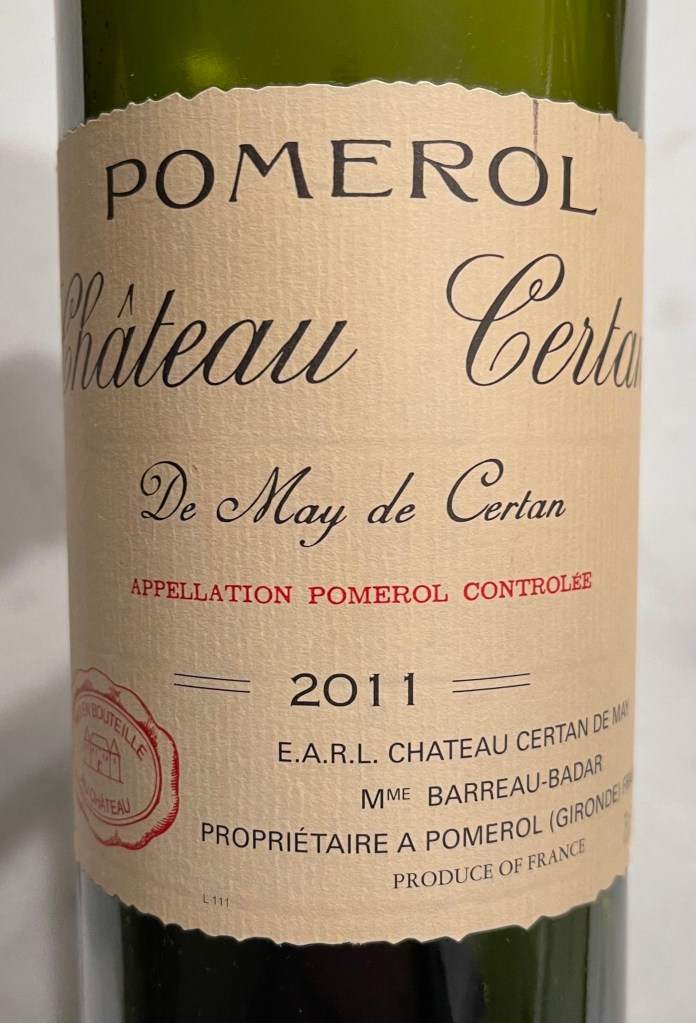
Château Certan de May (fully Château Certan de May de Certan) is a relatively small but historic wine estate situated in the Right Bank appellation of Pomerol in Bordeaux. The estate was established by the de May (Demay) family, who were Scottish settlers in France during the Middle Ages and received the land by royal decree during the 16th century. It wasn’t until the 18th century, however, that the de May family started producing wines which were well-regarded and products of this excellent terroir. To provide you an idea, the estate once included what is now Vieux Château Certan and Château Certan-Giraud but was divided up following the French Revolution. When the last member of the de May family passed away in 1925, the estate passed to the Barreau-Badar family and they own it to this day under Jean-Luc Barreau.

Relatively small in size, Château Certan de May consists of 5.5 hectares of vineyard land planted to 70% Merlot, 25% Cabernet Franc, and 5% Cabernet Sauvignon with an average vine age of 35 years. The vineyard soils are made up of clay and deep gravel, in turn yielding grapes and wines that are powerful and structured, yet elegant and complex. All of the fruit is hand-harvested and the winemaking style is quite traditional before the wines age in 60-80% new oak barrels for 16-20 months. From the mid to late 1980s until the mid to late 2000s, quality was hit or miss but has been drastically improved since then. Annual production sits around 2,000 cases per vintage, and pricing generally isn’t too “terrible” relative to many other wines in the appellation.

Today’s Wine: 2011 Château Certan de May

Merlot dominant proprietary blend (vineyards planted to 70% Merlot, 25% Cabernet Franc, and 5% Cabernet Sauvignon); 13% ABV

The 2011 Château Certan de May is opaque medium ruby in color. This certainly requires decanting, and I found it showing beautifully around the three hour mark and it only got better from there. The aromas are of medium intensity and include blackcurrant, black raspberry, plum, anise, violets, cigar box, forest floor, black truffle, grilled green herbs, and crushed rock. Meanwhile the flavors on the palate are of medium intensity and showcase black cherry, plum, blackcurrant, dried tobacco, earthy mushroom, chocolate, cola, cracked pepper, green herbs, and cedar. This dry red is medium- to full-bodied with medium acidity, medium tannins, and a long finish.

Price: $80. I was pleasantly surprised with this bottle, and I believe it offers very solid value given the “ok” vintage. For instance, the incredible 2009 and 2010 vintages sell for closer to $120 or $130. This is a very strong effort.

Entry Level to a Northern Rhône God

Today’s Story: Domaine Jean-Louis Chave

Domaine Jean-Louis Chave is one of, if not the most, highly regarded northern Rhône domains and it was established by the Chave family in 1481. Still family-owned and operated to this day, Domaine JL Chave produces arguably some of the greatest Hermitage and Saint-Joseph wines on the market. Though initially winemakers in the Saint-Joseph appellation, the Chave family started buying vineyards in the Hermitage appellation during the mid-1800s and moved there entirely by the end of the 19th century as phylloxera ravaged their vineyards in Saint-Joseph. The domain revitalized these holdings, however, during the early 1990s when 16th generation Jean-Louis joined his father Gérard and replanted the vineyards there. Today, the domain is one of the largest landowners on the Hill of Hermitage with about 14.5 hectares planted to vine, though the Saint-Joseph bottlings are nothing to snooze over.

Jean-Louis and Gérard are staunch traditionalists from the way they farm their vineyards to the way they make their wines. In the vineyards this means unyielding attention to detail, very small yields, and full ripeness. In the cellar, they typically destem the grapes before fermentation in stainless steel, cement vats, or old open-top French barrels then age the wines for around 18 months in minimal new oak. The entire process is minimally invasive and all wines are bottled unfiltered following blending.

With this in mind, however, their skill is seemingly most appreciated in the way that they blend the wines into the final Hermitage bottling. The domain never bottles single-vineyard wines, even though they own 14 different parcels across 9 vineyards and the quality of these individual vineyards or lieux dits can be immaculate. Instead, Jean-Louis and Gérard start every vintage from “scratch” and vinify every lot separately before blending them together into the final wine. Each vintage the percentage from each lot will vary, and each vintage the wines will show a unique charm. The Hermitage bottling is 100% Syrah, which is planted on about 10 hectares of the Chave family’s total 14.5. Chave also produces an Hermitage Blanc made of 80-85% Marsanne and 15-20% Roussanne, with the fruit sourced from the remaining 4.5 hectares or so. Tying into today’s post, Chave also makes a Saint-Joseph bottling from their vines in that appellation and it is 100% Syrah.

At the end of the day, when you see a bottle with the name Jean-Louis Chave on it you can expect a concentrated, elegant, finessed, and complex wine built for the ages. The Chave Hermitage typically needs 15 years to really start coming together in the bottle, though this depends on vintage and the great ones can go for 50+ years. Expect to pay around $80 for the Saint-Joseph, $250-300+ for the Hermitage Blanc, $350-400+ for the Hermitage Rouge, or $5,000-10,000+ for the ultra-rare Cuvée Cathelin which has been produced only a handful of times in miniscule quantities from the greatest vintages.

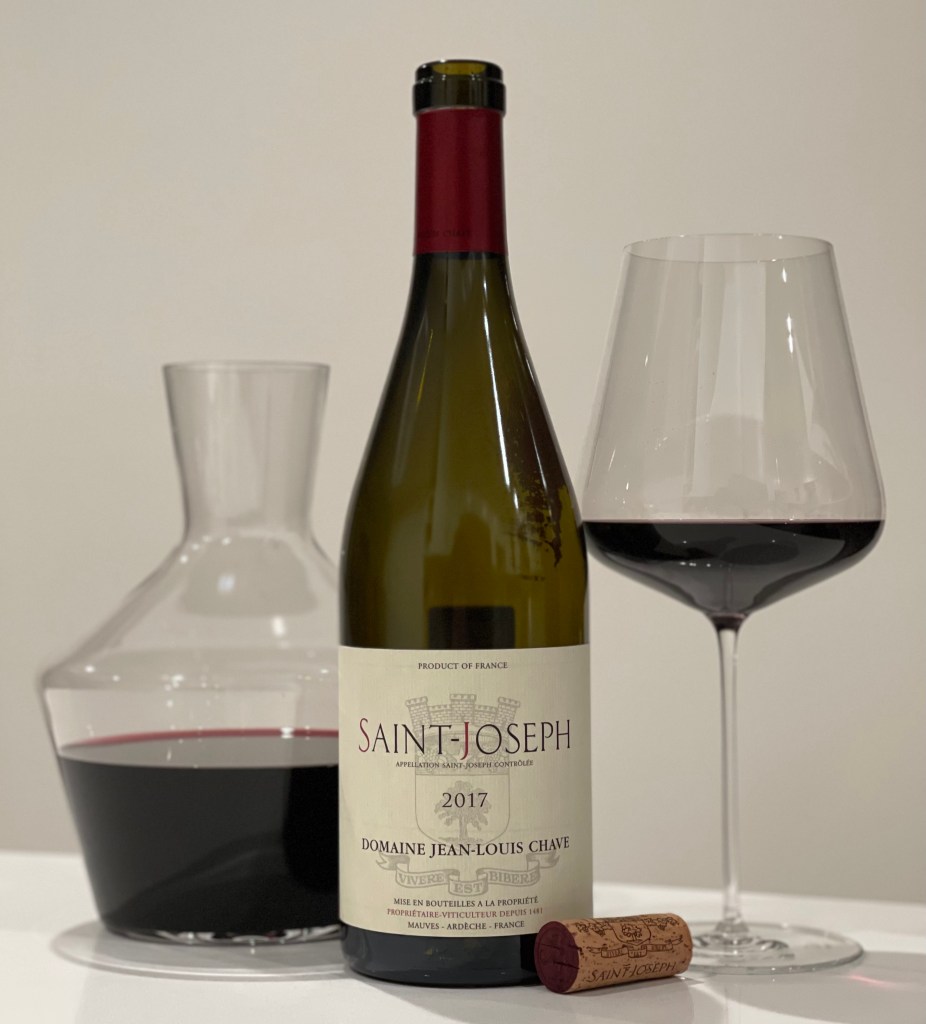
Today’s Wine: 2017 Saint-Joseph

100% Syrah; 14.5% ABV

The 2017 Saint-Joseph is opaque deep purple in color, clearly demonstrating its youth. I decanted this for two hours and drank it over the following two hours, which at this stage is quite advantageous. Aromas are of medium intensity with black plum, blackberry, blueberry, black cherry, licorice, violet, black pepper, smoke, chocolate, and cedar. Meanwhile on the palate I get medium (+) intensity with notes of blackberry, black plum, blueberry, black raspberry, anise, sweet tobacco, rocky earth, dried green herbs, black pepper, clove, charred cedar, and smoke. I am quite honestly surprised how much depth there is here at such a young age. This dry red is full-bodied with medium (+) acidity, high tannins, high alcohol, and a long finish. Given several more years to better integrate the tannins and alcohol, I think this will be a rockstar.

Price: $80. I’ve had several vintages of this wine (fortunately some older than this bottle) but the one constant that remains is that I believe this is a very solid value. Given some time to age, these become beautifully balanced wines that showcase their terroir with remarkable depth and complexity. Plus they’re a great “middle-ground” in the Chave portfolio! If you include his JL Chave Sélection négociant wines, that is…

Deliciously Pure Champagne From a Unique House

Today’s Story: Champagne Leclerc Briant

Champagne Leclerc Briant is a unique Champagne house established in 1872 by Lucien Leclerc in the village of Cumières. In 1955, however, the house moved to Épernay following Bertrand Leclerc’s marriage to Jacqueline Briant and they formed the négociant business Champagne Leclerc Briant. Leclerc Briant helped push the boundaries in Champagne, becoming one of the first houses to adopt organic viticulture during the 1960s and bottle single-vineyard Champagnes during the 1970s. Under Pascal, Bertrand and Jacqueline’s son, Leclerc Briant started dabbling with biodynamic viticulture during the 1980s and they became Demeter biodynamic certified in 2003. Unfortunately, Pascal passed away in 2010 far too soon and Leclerc Briant fell into tough times and faced extinction for a couple years, selling off the majority of their vineyards. In 2012, however, an American couple Mark Nunelly and Denise Dupré purchased the house alongside Champagne native Frédéric Zeimett and oenologist Hervé Jestin and the team has brought Leclerc Briant back to greatness.

Leclerc Briant consists of a very small 0.6 hectare vineyard called La Croisette, which is adjacent to the winery in Épernay. They also own roughly 9.6 hectares across various 1er and Grand Cru vineyards, though they source small amounts of Pinot Noir from the Aube and have long-term purchase agreements with other vignerons who own organically or biodynamically farmed vineyards. In the cellars, Jestin practices a non-invasive style of winemaking and sees himself as an observer and guide rather than a heavy hander. The wines all go through spontaneous fermentation and vinify in INOX tank, terracotta egg, or French oak barrel before malolactic fermentation is allowed to happen naturally. After at least nine months in barrel, the wines experience extended aging in the cellars and dosage levels are minimal or at times nonexistent at all to allow the wines to showcase themselves in pure form. All the wines are then bottled unfined and unfiltered.

To view the range of wines from Leclerc Briant, visit the website here. There are truly some unique bottlings, including one that ages submerged 60 meters in the Atlantic Ocean!

Today’s Wine: 2009 Extra Brut Champagne

40% Pinot Noir, 40% Chardonnay, 20% Pinot Meunier; 12% ABV

The 2009 Extra Brut Champagne is transparent medium to deep gold in color. On the nose, I get aromas of lemon, green apple, honeysuckle, brioche, almond, chalk, and lees characteristics such as cheese rind and baked bread. Meanwhile the palate is drop-dead gorgeous with notes of green apple, crisp golden pear, lemon zest, white florals, toast, cheese rind, roasted nuts, cream, and saline mineral. This is light- to medium-bodied with vibrant medium (+) acidity and a long finish. Disgorged in June 2017. Dosage 4 g/L.

Price: $80. I actually think this is a very solid value for vintage Champagne. The precision and vibrancy of the wine is remarkable and this is all around a beautifully pure expression of the terroir. Highly recommended.

Exquisite Loire Valley Cabernet Franc

Today’s Story: Domaine de la Chevalerie

Domaine de la Chevalerie is a small family-owned estate and winery established in 1640 by the Caslot family. Located in the village of Restigné within the Loire Valley, the domain consists of about 33 hectares of vineyards planted entirely to Cabernet Franc. A true family affair, the domain is run by siblings Stéphanie and Emmanuel who joined their father Pierre in the early 2000s. Pierre’s first task he set upon his children was to convert the entire domain to organic viticulture and winemaking, which they received certification for in 2008. By 2012, the domain transitioned entirely to biodynamics and received the Demeter certification. Though Pierre unfortunately passed away in 2014, Stéphanie and Emmanuel carry on the legacy aided by their younger sister Laurie who joined in 2018.

In their goal to produce terroir-driven wines that showcase a true sense of place, the Caslot family goes further than biodynamics alone and practices a minimally invasive winemaking style. All fruit is hand-harvested into small baskets before being sorted, destemmed, and sorted again. The grapes are not crushed, but instead transfer into vat by gravity to begin fermentation with only indigenous yeasts. After fermentation, the wines move to demi-muids and large 400 to 500 liter neutral barrels for aging. They add minimal SO2 and generally bottle the wines unfined and unfiltered.

To explore the family’s vineyard holdings, portfolio of wines, or read more I recommend visiting their website here.

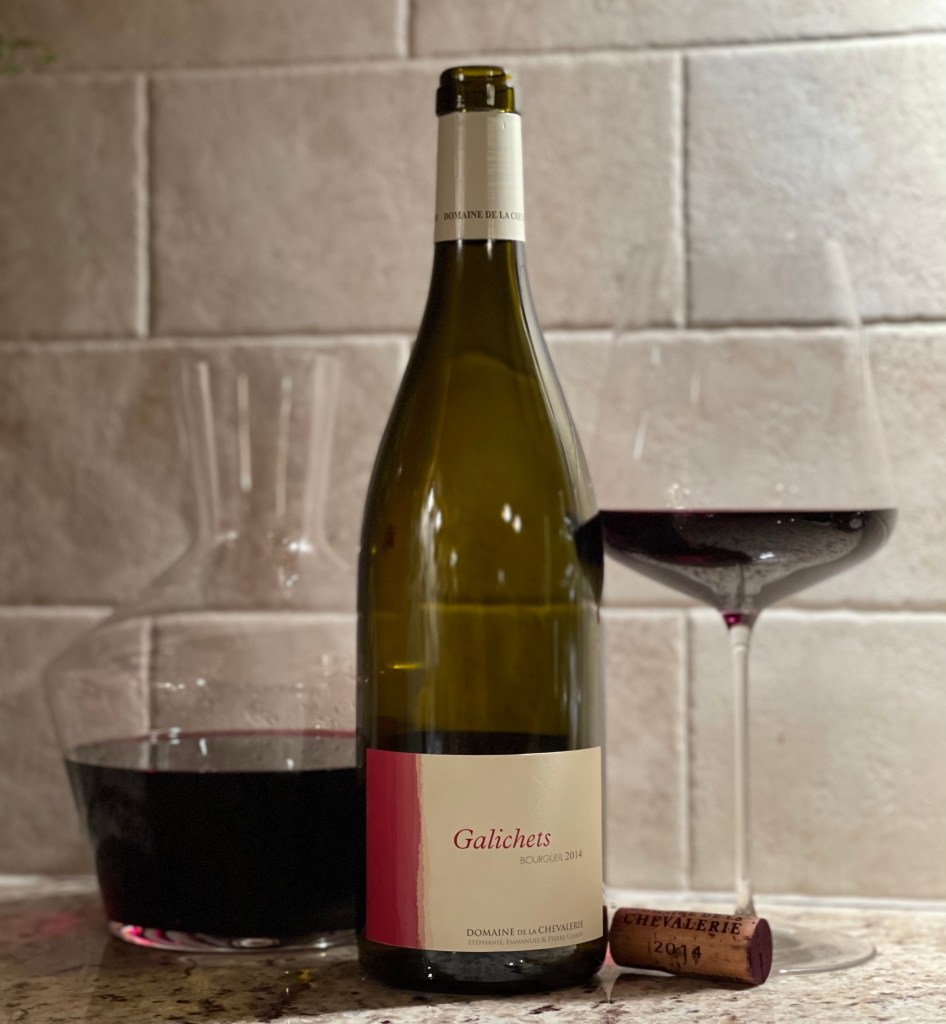
Today’s Wine: 2014 Bourgueil Galichets

100% Cabernet Franc; 13% ABV

The 2014 Bourgueil Galichets is medium ruby in color and nearly opaque. This is an absolutely gorgeous wine out of the bottle, but really needs 45 minutes to an hour of decanting to truly open up and shine. On the nose, I get pronounced aromas of redcurrant, bing cherry, strawberry, black raspberry, slight barnyard, tilled earth, crushed rock, mild chili pepper, and dried underbrush. Meanwhile the palate showcases notes of crunchy cranberry, stemmy strawberry, raspberry, cigar tobacco, scorched earth, gravel, charred bell pepper, and crushed rock minerality. This dry red is medium-bodied with medium (+) acidity, fine-grained medium (+) tannins, and a medium (+) length finish.

Price: $30 (might be able to find this closer to $25). This is an outstanding bottle of wine, particularly given its price-point, balance, and complexity. A very solid value play here, and definitely worth seeking out.

Delicate and Elegant Chambolle-Musigny With a Long Life Ahead

Today’s Story: Domaine Cecile Tremblay

Domaine Cecile Tremblay has a very interesting history, partly because she did not start making wines until 2003 though her family owned vineyards for several generations. Cecile is the great-granddaughter of Edouard Jayer, uncle of the famed Henri Jayer (go Google some of his wines, and perhaps sell your car to buy a bottle). Cecile’s family inherited vineyards from Edouard, though the two generations before her leased out the land to other producers and did not make their own wine. In 2003, however, with the expiration of a lease on three hectares of vines Cecile started making wine under her own label with a plan for further growth. For instance, the Domaine owns roughly 10 hectares of vineyard land and while more of this becomes free from leasing agreements in 2021, Cecile rented or purchased land along the way in communes such as Gevrey-Chambertin.

When Cecile took over her family’s land for her own use, the vineyards were in no standing to produce high quality wines. The producers leasing the land, for instance, used too much fertilizer for Cecile’s taste and utilized herbicides instead of ploughing. Throughout her time thus far as a winemaker, Cecile transitioned to organic farming and many of her practices include biodynamic farming measures as well. During maintenance of her vineyards, Cecile ploughs the soil mechanically and with horses while using copper sulfate to prevent mildew and other fungi.

Similar to her views on caring for her vines, Cecile is very traditional in her winemaking process. She presses her grapes with an old-fashioned vertical press and her wines see only a moderate amount of new wood during fermentation and aging. All of this effort culminates into wines that are refined and elegant, though built for the long haul.

I previously reviewed the 2011 Chambolle-Musigny Les Cabottes and 2011 Vosne-Romanée, so feel free to revisit those tasting notes if you want a more side-by-side picture.

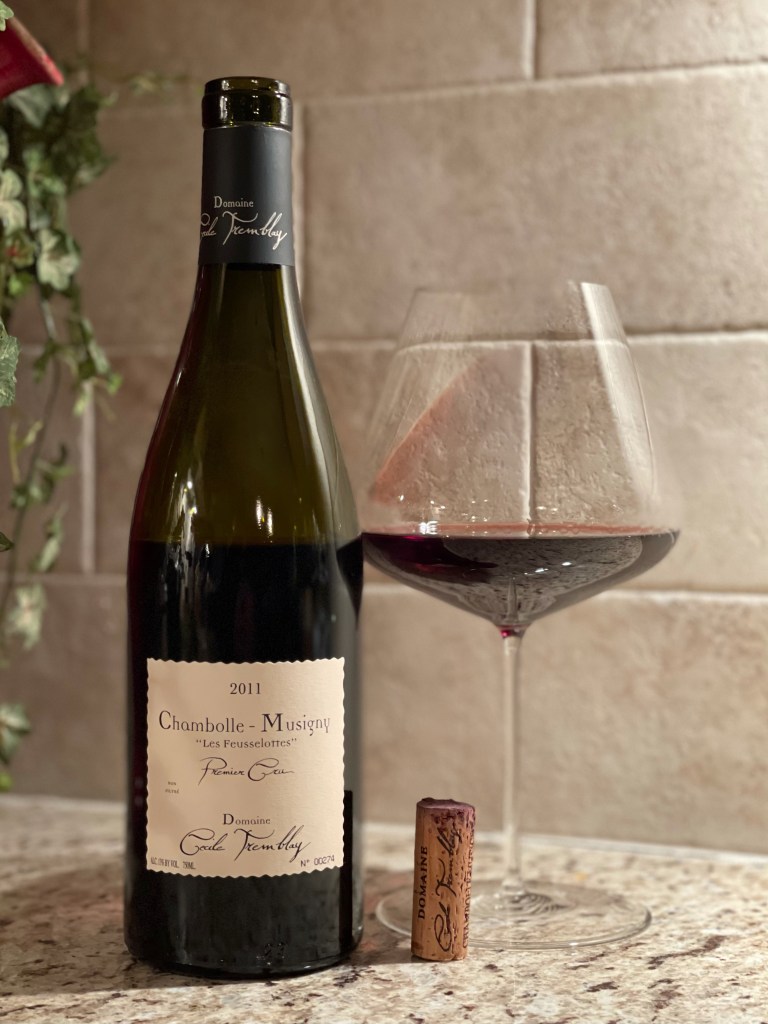
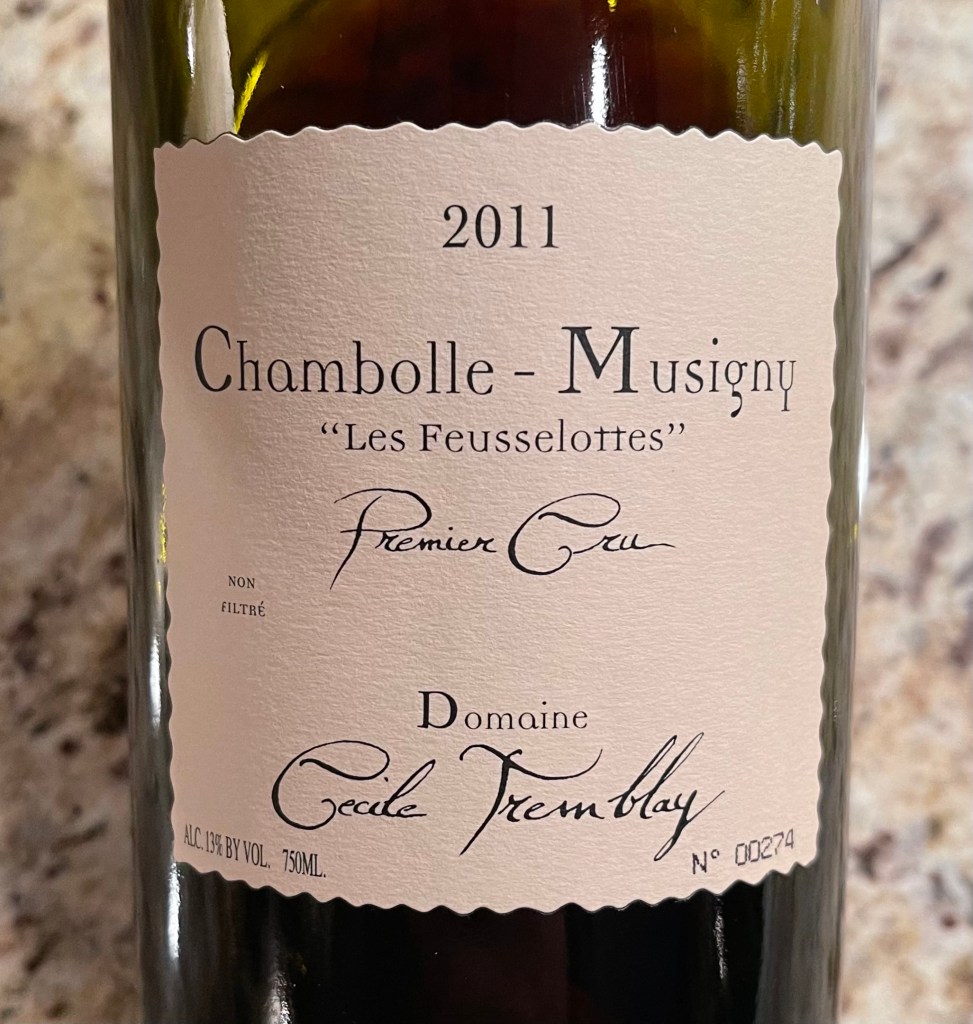
Today’s Wine: 2011 Chambolle-Musigny 1er Cru Les Feusselottes

100% Pinot Noir; 13% ABV

The 2011 Chambolle-Musigny 1er Cru Les Feusselottes is translucent pale ruby in color with garnet hues. I didn’t decant this, but the wine took a full 1-2 hours to really open up. The very delicate and feminine nose showcases aromas of black raspberry, strawberry, cherry, a hint of plum, red and purple florals, leather, delicate grilled herbs, and gravel. Meanwhile on the palate I get notes of cranberry, cherry, black raspberry, boysenberry, violets, sweet tobacco, savory green herbs, and rocky mineral. This is light- to medium-bodied with medium (+) acidity, refined medium tannins, and a long finish. Similar to Tremblay’s other 2011s, I do not get the green notes prevalent for the vintage. This is a beautifully elegant wine and it has a long life ahead of it.

Price: $480 (I paid $160). The price of these wines has really skyrocketed over the past several years, and unfortunately these are at a price-point where it is difficult to discuss value. While these are phenomenal, there are better values out there. I’m nonetheless glad to have snagged a good deal of her wines from $90 to $160 depending on bottling.

A Very Solid Value Play for Pauillac

Today’s Story: Château Haut-Bages Libéral

Château Haut-Bages Libéral is a Fifth Growth (Cinquième Cru) Bordeaux wine estate located in the Left Bank appellation of Pauillac. Established by the Libéral family who were négociants and vineyard owners in the early 1700s, Haut-Bages Libéral is named for its position on the Bages plateau and in homage to its founding family. The Libéral family created a solid reputation for their wines, ultimately earning classification as a Fifth Growth in the Bordeaux Wine Official Classification of 1855. Though the estate fell to a lower quality and state of somewhat disrepair during the wars and financial crises of the early 1900s, the Cruse family (owners of Château Pontet-Canet at the time) purchased Haut-Bages Libéral in 1960. The Cruse family engaged in widespread replanting of the vineyards and started to improve quality once again, though they sold the estate to the Villars-Merlaut family in 1982. Haut-Bages Libéral reached new heights under the Villars-Merlaut family, and Claire Villars-Lurton continues to run the estate today.

Today, Château Haut-Bages Libéral consists of about 30 hectares of vineyards planted to 70% Cabernet Sauvignon and 30% Merlot. The holdings are in great company within Pauillac, with the larger vineyard area neighboring Château Latour and a smaller vineyard area neighboring Château Pichon Baron. There is a third holding situated more inland as well. Haut-Bages Libéral practices organic viticulture as they work toward certification, though they include many biodynamic practices with an eventual goal of achieving biodynamic certification as well. Château Haut-Bages Libéral produces roughly 10,000 cases of wine per vintage, including the Grand Vin and their second wine (labeled as either Le Pauillac de Haut-Bages Libéral, La Chapelle de Bages, or La Fleur de Haut-Bages Libéral).

Today’s Wine: 2005 Château Haut-Bages Libéral

70% Cabernet Sauvignon, 30% Merlot; 13% ABV

The 2005 Château Haut-Bages Libéral is translucent deep ruby in color, which is still rather youthful and showing absolutely no bricking at this point. After about an hour decanting, this blossomed to showcase classic Pauillac aromas of blackcurrant, black cherry, redcurrant, pencil shavings, cigar box, tilled earth, mushroom, gravel, green herbs, and cedar spill. Meanwhile on the palate I get notes of blackberry, crème de cassis, black cherry, tobacco, graphite, eucalyptus, black truffle, cracked pepper, and iron. This is medium- to full-bodied with medium (+) acidity, medium (+) tannins, and a long finish. Drinks beautifully right now, but has the ability to go for at least another 5 years.

Price: $80 (paid $60 a few years ago). This was a very nice value surprise, especially having paid $60 for it a few years ago. It doesn’t have the power or depth like some of the higher-end 2005 Pauillac I’ve enjoyed, but it’s a very solid wine.

Outstanding Bordeaux Blanc From a Sauternes Legend

Today’s Story: Château d’Yquem

Château d’Yquem is a very special estate, one whose Sauternes are coveted the world over and whose wines are some of my favorites to have tasted. I previously wrote about the 2001 Château d’Yquem, and am excited to return with their Y (Ygrec) bottling today.

Château d’Yquem has a very long, mysterious history that traces its roots back to the 15th Century. One of the most interesting snippets of this history, for instance, is that the estate belonged to the King of England during the Middle Ages! In 1593, however, southwest France again came under control of the French crown by Charles VII and has remained as such since. It was also this year that the d’Yquem estate came under control of Jacques de Sauvage, a descendant of a local noble family. Though some winegrowing practices and late harvesting existed at this time, the Sauvage family did not start building the château for several more years and then began the long process of assembling land for the current estate plot by plot.

Jumping forward in time, it wasn’t until 1711 that the Sauvage family fully owned the estate under Léon de Sauvage d’Yquem. Furthermore, under the rule of Louis XIV, Château d’Yquem received noble status. The magnificent estate switched hands yet again, however, in 1785 when Françoise Joséphine de Sauvage d’Yquem married Count Louis Amédée de Lur-Saluces, a godson of Louis XV. Sadly, three years later in 1788, the Count died in a riding accident but his widow took over management of the estate and quickly displayed her acumen by sustaining and improving d’Yquem. One of the most notable practices at d’Yquem was established under Françoise Joséphine de Sauvage d’Yquem, for instance, which is picking over several passes (sometimes picking one grape at a time). Another notable feat under this young widow is the admiration noble figures around the globe felt toward d’Yquem, including Thomas Jefferson who reportedly purchased 250 bottles of the 1784 vintage for himself and additional bottles for George Washington.

Romain-Bertrand de Lur-Saluces, a grandson of Françoise Joséphine, took over the estate and helped guide it through seemingly endless successes in the second half of the 19th Century. For example, d’Yquem’s wines became a necessity for the rich and powerful throughout Europe, Russia, and Asia. In 1855, Château d’Yquem was awarded Premier Cru Supérieur in the Bordeaux Wine Official Classification of 1855, the only Sauternes awarded this level. Times changed, however, as they always do with estates of this age when World War I came and the château transitioned into a military hospital under Eugène de Lur-Saluces (a son of Romain-Bertrand). Eugène’s son Marquis Bertrand de Lur-Saluces took over the estate following the war (he had served in the trenches) and he is responsible for much of d’Yquem’s strength to this day. For instance, Marquis Bertrand fought relentlessly to save the estate during the Great Depression, helped determine many legal aspects of the Sauternes appellation as President of the Union des Crus Classés de la Gironde for forty years, and was a leading proponent of château bottling to guarantee authenticity. His death in 1968 changed the tides once again.

Though Bertrand was childless at the time of his death, he took precautions and named his nephew Alexandre de Lur-Saluces manager of Château d’Yquem. Alexandre struggled at first through difficult vintages, a crisis in the Bordeaux wine trade, and an inheritance tax that almost forced the estate to fail, though his efforts were saved with the exceptional 1975 vintage followed by several more during the 1980s. Alexandre managed the estate exceptionally well until 1996 when a family feud exploded over his brother’s decision to sell part of his 47% ownership stake, thus in turn requiring LVMH Moët Hennessy-Louis Vuitton to step in and purchase 55% of the estate. Though under new ownership, Alexandre remained manager of the estate until his retirement in 2004.

Though I could go on and on about d’Yquem’s terroir, vineyards, and winemaking practices I will leave it here with the history of Château d’Yquem. I encourage you to take a deeper dive on their website here to truly appreciate what goes into a bottle of this sacred juice.

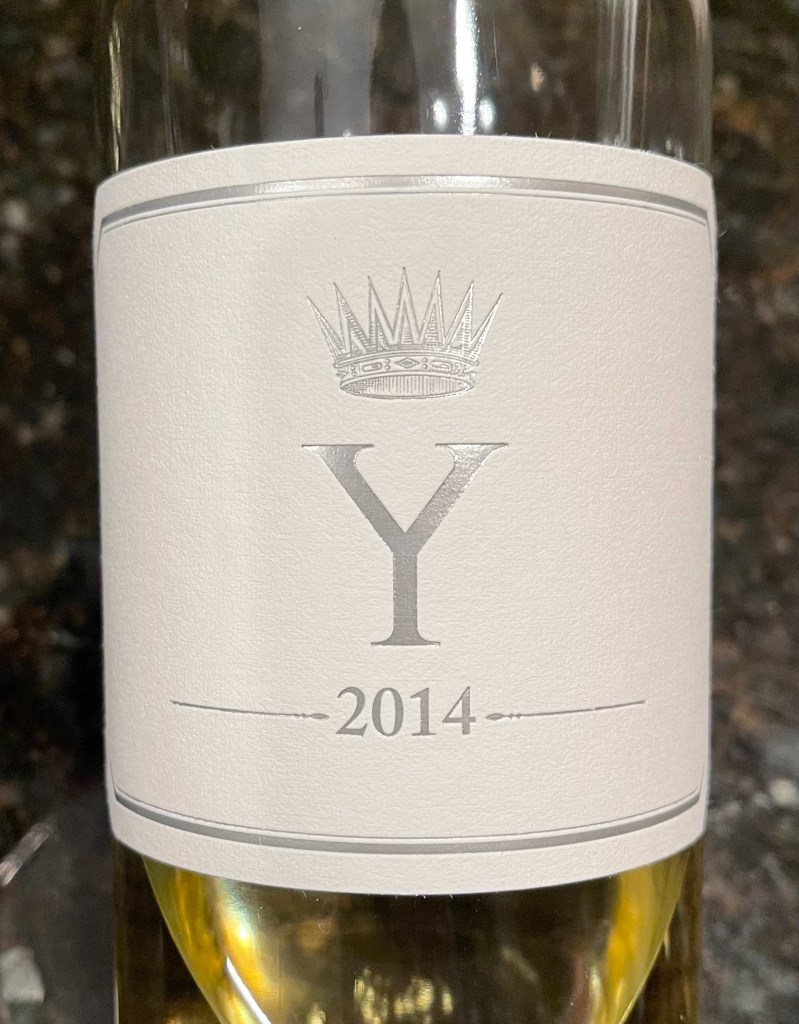
Today’s Wine: 2014 Y (Ygrec) d’Yquem

75% Sauvignon Blanc, 25% Sémillon; 14% ABV

The 2014 Y d’Yquem is transparent pale yellow in color with hues of straw and water white. This absolutely sings out of the bottle, dominated by a nose of white peach, tangerine, apricot, gooseberry, tropical citrus, honeysuckle, freshly cut grass, and beeswax. Meanwhile, on the palate, I get notes of pineapple, grapefruit, peach, lime, cantaloupe, white pepper, white florals, and wet stone. This is medium-bodied with mouthwatering high acidity and a velvety smooth mouthfeel into a long, seductive finish capped off with a touch of caramel (perhaps from the used d’Yquem barrels). Very hard to not gulp this down.

Price: $145. Though very expensive for a white wine, this is a great value in my eyes compared to the top-tier Bordeaux Blancs and other Sauvignon Blancs I’ve tried. This offers incredible depth, opulence, lip-smacking drinkability, and age-ability that is tough to beat.

The King’s Wine

Today’s Story: Château Lafite Rothschild

Château Lafite Rothschild is a world-renowned First Growth Bordeaux wine estate located in the left bank appellation of Pauillac. Though the winemaking prowess of Lafite came centuries later, the estate traces its roots to the year 1234 under ownership of Gombaud de Lafite and is labeled as a medieval fief during the 14th century. Though vines certainly existed on the property by the 17th century, it was Jacques de Ségur who is credited with planting the vineyards in the 1670s and 1680s and setting Lafite on its way to producing highly regarded wines. By the early 18th century, Lafite’s wines found a loyal following in the London market and, during the 1730s, became a darling of Prime Minister Robert Walpole. During that time, Jacques’ son Nicolas-Alexandre de Ségur improved the winemaking process and enhanced the quality and prestige of Lafite as he marketed it in France to the court of Versailles. By the mid-1700s, Lafite became known as “the King’s Wine” and found its place among the royal and aristocratic families of France.

Though Lafite was arguably the pinnacle of Bordeaux winemaking at the time, even becoming a darling of Thomas Jefferson following a later visit in 1787, the estate experienced some difficulties with changing ownership for a number of reasons. First, Alexandre de Ségur did not have any sons so he divided his estate (which included Château Latour) amongst four daughters. His grandson, Count Nicolas Marie Alexandre de Ségur, inherited Lafite but he was forced to sell to relative Nicolas Pierre de Pichard in 1784 due to financial difficulties. This ownership, however, was also short-lived because Nicolas Pierre was executed as part of the Reign of Terror in 1794 during the French Revolution. Lafite fell into public ownership for a few years, until Dutchman Jean de Witt purchased it in 1797 and set off a string of changing ownerships until Baron James de Rothschild purchased Lafite in 1868.

Though the end of the 1800s and first half of the 1900s were quite turbulent for Lafite, the Rothschild family maintained ownership of the estate and brought it back to prominence after World War II. This period included the phylloxera and mildew crises, WWI, the Great Depression, and occupation by German forces during WWII which saw ransacking of the cellars and theft of historical bottles of Lafite. When Baron Elie de Rothschild regained control at the end of 1945, Lafite was once again on the path to greatness with fantastic vintages in 1945, 1947, and 1949. As Baron Elie restored the vineyards and buildings, improved farming methods, and opened the winery to new markets including the United States, Lafite prospered and continues to do so to this day.

The vineyards of Château Lafite Rothschild today consist of 112 hectares planted in the classic, well-draining, deep gravel soils of Pauillac (though this includes 4.5 hectares in Saint Estèphe). They are planted to Cabernet Sauvignon (70%), Merlot (25%), Cabernet Franc (3%), and Petit Verdot (2%) with an average vine age of 39 years. For the Grand Vin, however, they do not use fruit from vines younger than 10 years old so the average vine age for the Grand Vin is closer to 45 years. Lafite practices traditional viticulture based on strict yield control and manual harvests, and they use little to no chemical fertilizers and are transitioning to organic viticulture. Vines are typically re-planted when they reach an age of about 80 years.

In the cellar, Lafite practices traditional vinification methods and ferments their wines separately plot by plot. Some of the fermentation occurs in traditional large oak vats, while some occurs in stainless steel vats before the wines are tasted and drawn off into wine vats. Malolactic fermentation then occurs before the wine is transferred into barrels by batch. Blending occurs after the first racking of these barrels, and then the wines age for 18-20 months. The wines are fined with egg whites and then bottled.

Today’s 1st Wine: 1981 Château Lafite Rothschild

Bordeaux Blend (no details on Lafite’s website); 12% ABV

The 1981 Lafite is translucent medium to deep garnet in color. Keeping with the cellar master’s practices at Lafite, I double decanted this and served it 3 hours later. The nose is rather feminine and took some time to open up, showcasing aromas of redcurrant, licorice, cigar box, pencil shavings, tilled earth, earthy mushroom, graphite, gravel, and cedar. Meanwhile the palate is certainly still kicking, offering notes of blackcurrant, redcurrant, violets, tobacco, forest floor, black truffle, cracked black pepper, graphite, and cedar. This is very well-balanced and medium-bodied with medium (+) acidity, well-integrated medium (-) tannins, and a medium (+) length finish. I don’t see this improving, so drink up if you have any.

Price: $750 (though we acquired it years ago for much less). It is always a special occasion to drink a bottle of Lafite, and the pricing is certainly justifiable based on how perfectly balanced and complex these wines can be. This bottling, however, seems to be past its prime and I wouldn’t suggest spending the money on it at this point.

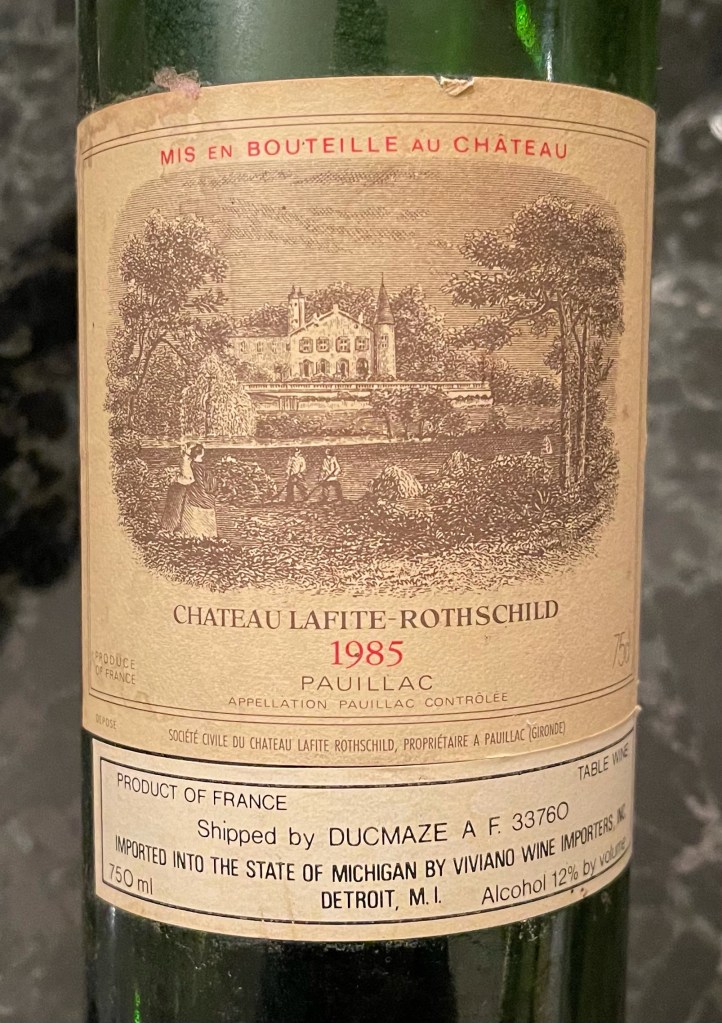
Today’s 2nd Wine: 1985 Château Lafite Rothschild

65% Cabernet Sauvignon, 25% Merlot, 10% Cabernet Franc; 12% ABV

The 1985 Lafite is translucent deep garnet in color, definitely a shade deeper than the 1981. I also double decanted this 3 hours before serving and it really came alive in the glass. The nose showcases classic aromas of blackcurrant, black cherry, black raspberry, lavender, cigar box, forest floor, black truffle, graphite, wet gravel, and grilled herbs. Meanwhile on the palate I get notes of cassis, redcurrant, dried plum, violets, tobacco, pencil shavings, scorched earth, black truffle, graphite, underbrush, and crushed rock minerality. This is medium-bodied with medium (+) acidity, dusty medium (-) tannins, and a long finish. Impeccably balanced with much more power than the 1981 vintage (no shock) tasted side-by-side.

Price: $985 (though we acquired it years ago for much less). This is perhaps the best vintage of Lafite I’ve tasted to date, and while the near four-digit price tag is seemingly outrageous I think it’s worth it for a special occasion.

The Winner Is…

This should come as no shock, but the 1985 absolutely steals the show here. The 1981 vintage is certainly alive and kicking, but is very feminine and I think past its peak in the plateau phase or start of the declining phase. The 1985 is showing its Comet Vintage pedigree, still offering incredible power and a structure that suggests there is still plenty of time to enjoy this bottling. Both wines are incredibly well-balanced and an absolute pleasure to drink, but the 1985 is simply the more perfectly wrapped package.