I wrote about the 2003 Dom Pérignon Brut Champagne yesterday, so I will save you the duplicate history lesson and jump right into today’s tasting notes for the 2002 vintage. If you missed yesterday’s post though, feel free to give it a quick read. At the very least you can compare consecutive vintage tasting notes!
Today’s Wine: 2002 Dom Pérignon Brut Champagne
Typically about 50% Pinot Noir and 50% Chardonnay (exact blend unknown); 12.5% ABV
The 2002 Dom Pérignon Brut Champagne is transparent deep gold in color. I drank this over the course of a couple hours, and it only got bigger and bigger with air. The nose is stupidly complex, showcasing aromas of lemon curd, green apple, pear, honeysuckle, jasmine, incense, chalk, saline mineral, brioche, vanilla cream, butter, and almond. Meanwhile the palate is equally as mind-boggling, displaying notes of crisp green apple skins, peach, apricot, stone fruit, white florals, white truffle, chalk, limestone, white smoke, dill, caramel, butterscotch, and hazelnut. This is medium- to full-bodied with a creamy mouthfeel and razor sharp high acidity into an endlessly long finish.
Price: $270 (paid $180 a few years ago). This is in a very, very special place right now and provided one of those unique drinking experiences where a wine makes me tear up. Though there are no doubt better “value” brands out there, this 2002 is worth its price.
Dom Pérignon is a very famous Champagne produced as the prestige cuvée of Champagne house Moët & Chandon. Though the first vintage was 1921 and it first released to the market in 1936, Dom Pérignon takes its name from Benedictine monk Dom Pierre Pérignon (1638-1715) who became cellar master in the Abbey of Hautvillers. Though Dom Pierre did not “invent” sparkling Champagne (as many myths state), he was instrumental in quality control at a time when weak Champagne bottles were prone to explosion due to refermentation in the bottle as the wines aged. Some of his contributions included the use of blending to improve quality of the wine, perfecting the process of pressing white wine from black grapes, introducing corks instead of wood, and strengthening the glass of bottles to minimize time bombs in the cellar.
Originally, Dom Pérignon was bottled using vintage Moët & Chandon Champagne transferred to their new, specially designed Dom bottles so it was essentially an oenothèque. This ended with the 1943 vintage, however, and Dom was produced entirely separately for the next released vintage of 1947 and beyond. Why the gap you might ask? Well, Dom Pérignon is only produced as a vintage Champagne when the quality is high enough, so this Champagne has only been produced in 44 vintages from 1921 to 2010. Wildly enough, Dom Pérignon only released more than two vintages in a row three times until 2004 when vintages of 2005 and 2006 mark the first time ever five vintages were made consecutively (2002-2006).
Dom Pérignon is always a blend of Pinot Noir and Chardonnay, forgetting the third permitted grape of Pinot Meunier included in many other Champagnes. Across vintages, the Chef de Cave at Dom Pérignon sticks to roughly 50% Pinot Noir and 50% Chardonnay, however they maintain the flexibility of blending up to a maximum 60% for one variety depending on vintage conditions. I would be remiss, though, if I forget to mention that in one vintage (1970) they went over and the blend was 65% Chardonnay and 35% Pinot Noir. This is the only time one variety accounted for more than 60% of the blend. All grapes are sourced from Grand Cru Champagne vineyards, save for one historical 1er Cru vineyard at Hautvillers which keeps the wine from being labeled as a Grand Cru Champagne.
Today’s Wine: 2003 Dom Pérignon Brut Champagne
60% Pinot Noir, 40% Chardonnay; 12.5% ABV
The 2003 Dom Pérignon Brut Champagne is transparent deep gold in color with delicate effervescence. The nose is still gorgeous, offering up aromas of golden delicious apple, pear, honeysuckle, white lily, white truffle, brioche, white pepper, and vanilla cream. However, unfortunately the palate seems fairly advanced and displays notes of green apple skins, canned golden pear, white florals, almond, caramel, toffee, and hazelnut. This wine falls apart on the palate, proving rather disappointing compared to the last several bottles of 2003 I’ve enjoyed that showed the prowess of the producer in a tough vintage. This is light-bodied with medium (+) acidity and a moderately dry but medium (-) length finish.
Price: $250 (paid $170 several years ago). I had high hopes for this bottle, largely since we held it for a number of years and also since the prior 3 bottles of 2003 I enjoyed were fantastic. I’d say skip this if you come across it (though it could be an off bottle), and put the money toward 2002 or a more recent vintage like 2008.
Domaine Roulot is a renowned Burgundy wine estate situated in the village of Meursault in the Côte de Beaune sub-region. Though Roulot’s history dates back to at least 1830 when Guillaume Roulot registered as a vigneron, the modern domaine traces its roots more directly to a 1930 founding and growing success following WWII under Guy Roulot. Guy came into some vineyard property through his marriage to Geneviève Coche, though he quickly set about purchasing additional vineyard parcels of village and 1er Cru classifications. Unique at the time, Guy vinified and bottled his wines by single vineyard, also mastering the lieu-dit practice of bottling a named vineyard without its own “legal” classification within the larger village. Guy made some of the greatest white Burgundy at the time, even later having his 1973 Meursault Charmes place second for the white wines at the Judgment of Paris in 1976. Sadly, Guy passed away suddenly and far too soon in 1982 and left his domaine in a precarious situation since his son Jean-Marc was in Paris studying acting. Though Domaine Roulot had several winemakers come in until Jean-Marc returned home, it wasn’t until 1989 when he fully took the reigns.
Shortly after taking over, Jean-Marc transitioned fully to organic viticulture and he has not used any herbicides since. Further, any treatments used in the vineyards ensure minimal if any impact on the natural microbial life amongst the vines. In the cellar, Jean-Marc crafts wines based on a philosophy that they should be what he likes to drink, not necessarily what the “modern palate” likes to drink. While many of the wines of Meursault can be rich and concentrated, Roulot’s wines are often described as chiseled, linear, precise, restrained, tense, and transparent. He achieves these descriptors through incredibly rigorous harvesting, very gentle pressing of the fruit, indigenous yeast fermentation, barrel aging for 12 months on lees followed by 6 months in stainless steel, and modest use of new oak of between 10% and 30%. Roulot even minimizes stirring the lees (and mainly does it in vintages of higher acidity), which is a practice more common with producers who like adding richness to the wines.
Today’s Wine: 2017 Bourgogne Blanc
100% Chardonnay; 13.2% ABV
The 2017 Bourgogne Blanc is transparent pale gold/straw yellow in color with water white variation around the rim of the glass. I decanted this for 2 hours due to its youth, and to be honest it probably could’ve decanted for longer. Once open, the nose showcases aromas of peach, green apple, apricot, white florals, matchstick, flint, wet river stone, dill, and almond. Meanwhile on the palate I get notes of golden pear, lemon zest, green apple skins, white peach, honeysuckle, crushed rock, light green herbs, flint, and hazelnut. This very linear and precise Bourgogne Blanc is medium- to full-bodied with gorgeous high acidity into a long finish. Not as intense as I was expecting, but give this at least 4-5 more years of cellaring before touching it.
Price: $90. This is no doubt a fantastic Bourgogne Blanc, and though I opened it young I think there are better values out there. If you can find this closer to $65-70 (and I know a few locations are still priced that way) I would be more intrigued. We shall see if I am proven wrong with more bottle age.
Maison Nicolas Potel was established in 1997 as a négociant business by Nicolas Potel following the passing of his father Gérard Potel of Domaine de la Pousse d’Or. Thanks to his father’s influence and respect within Burgundy for helping to improve quality, ripeness, and concentration in the region’s wines, Nicolas was able to access some of the great 1er and Grand Crus of the Côte de Nuits and Côte de Beaune. For example, Roumier, Lafon, and Jean-Marc Boillot (all who looked up to Gérard) sold Nicolas fruit to help jumpstart his namesake venture. By 2002, Nicolas was making wines from 50 different appellations. Shortly thereafter, however, Nicolas ran into cash flow issues during the global economic uncertainty and sold his Maison (including naming rights) to the Cottin brothers of négociant Labouré-Roi in 2004. Nicolas stayed on until 2009 when tensions boiled over, with the Cottin brothers saying his side projects competed with Maison Nicolas Potel and Nicolas saying they disagreed with his philosophy of quality over quantity. Though Nicolas moved on and established Domaine de Bellene with his own vineyards, Maison Nicolas Potel continues making wines under his name to this day.
A traditionalist and staunch proponent of quality over quantity, Nicolas worked with 35+ year old vines whose growers often practice organic or biodynamic viticulture. In the cellar, he practiced minimally invasive winemaking which included pressing with a vertical wine press, maturing the wines for 12-16 months on the lees without racking, and adding minimal SO2. All told, Nicolas adapted each wine to the vintage but at his core wanted to make wines as naturally as possible so they could express each terroir in the truest sense. Though this philosophy remains at Maison Nicolas Potel after he left, the wines bearing Nicolas’ name naturally don’t seem to be the same.
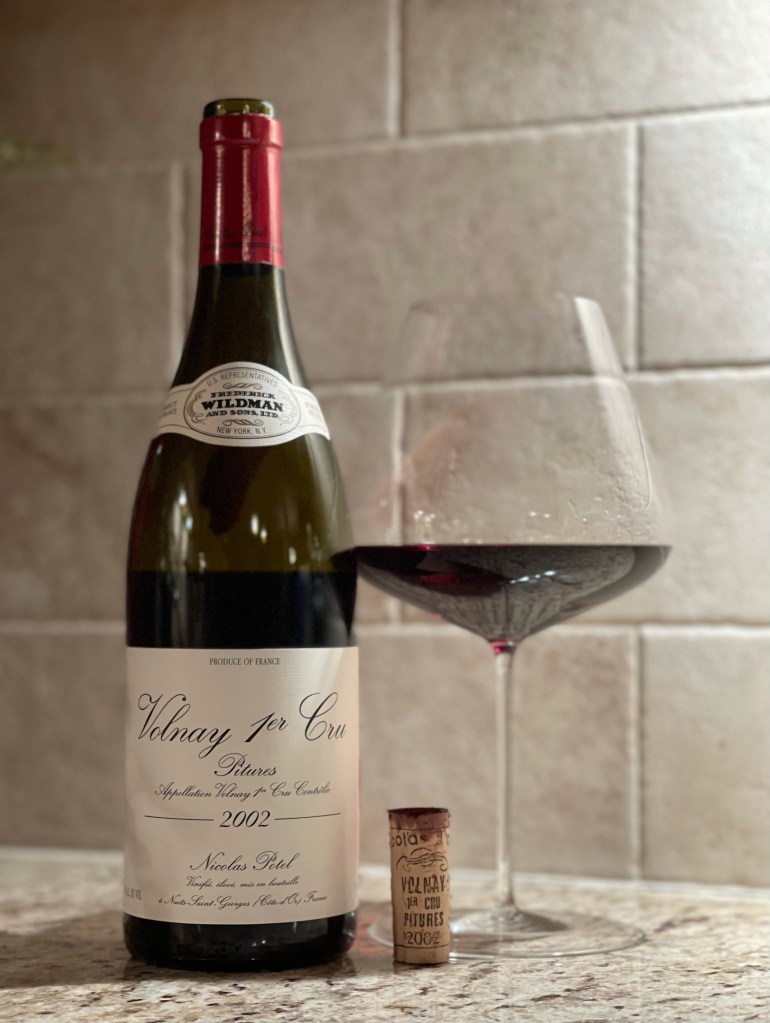
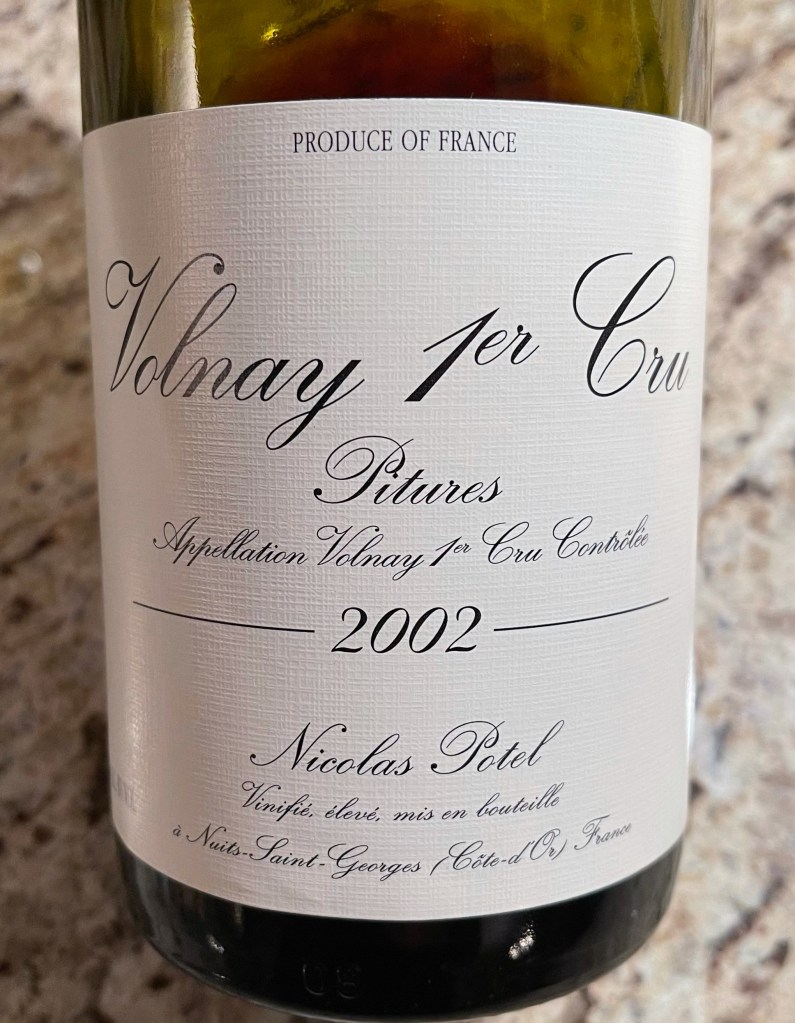
Today’s Wine: 2002 Volnay 1er Cru Pitures
100% Pinot Noir; 13% ABV
The 2002 Volnay 1er Cru Pitures is translucent medium garnet in color with slight bricking (though not too bad). This needed about an hour to blossom in the glass, helping to lift the fading nose to showcase aromas of forest floor, earthy mushroom, leather, grilled green herbs, and gravel followed by red fruits of cherry, raspberry, and strawberry all on their way out the door. The fruit is slightly more alive on the palate but is certainly still fading, displaying notes of tart red cherry, black raspberry, cranberry, truffle, tobacco, leather, loamy earth, garden herbs, and slight smoke. This is light-bodied with medium acidity, medium (-) tannins, and a medium length finish (shorter than I’d like, but that’s the age). There’s still decent structure here, but overall the fruit is fading fast. Drink up if you have any.
Price: $130 (looks like it used to be $70 when last priced on wine-searcher in 2017). I think at its peak drinking window this would’ve been a fantastic bottle for the price. However, given how advanced this is now I would pass on it if you come across it.
Though the Gouges family has deep-rooted history in grape farming going back 400 years, Henri Gouges didn’t form his domaine until 1920. When he no longer liked the idea of selling his fruit to négociants, Henri started producing, bottling, and selling his own wine in an effort to make higher quality wines. By 1933 this transition was fully complete and the domaine existed in similar fashion to its current status. A family endeavor throughout its history, Domaine Henri Gouges passed from Henri to his sons Marcel and Michel, then to Pierre and Christian, and finally to cousins Gregory and Antoine Gouges who manage the domaine today.
Undivided since its founding as a domaine, Henri Gouges today sits at roughly 36 acres of vineyards. Several of their holdings include Nuits St. Georges 1er Crus, though Henri Gouges does produce village wines as well. Though the winery and vineyards have been updated over time (including the use of organic viticulture and transition to a gravity flow winery), the domaine’s goal is to produce wines that truly represent and express the terroir. The harvest is carefully inspected and all fruit is completely destemmed, while vinification begins in lined cement vats for approximately 15 days depending on wine and vintage. Once fermentation is complete, the wine is transferred to small oak barrels (typically 25% new) and each is fined with egg whites before light filtration and into the bottle.
Today’s Wine: 1996 Nuits-St-Georges 1er Cru Clos des Porrets – St. Georges
100% Pinot Noir; 13% ABV
The 1996 Clos des Porrets – St. Georges is translucent medium ruby in color and actually almost deep garnet. This was great as a pop-and-pour, with the nose filled with aromas of barnyard, mint, menthol, forest floor, truffle, stemmy underbrush, black olive, and mineral followed up by black cherry, black raspberry, and red florals. The palate is nice as well, but starts to fall apart on the mid-palate with notes of stemmy strawberry, black cherry, cola, rose, sous bois, earthy mushroom, granite, and mineral. The nose steals the show with this bottling. This is light- to medium-bodied with medium (+) acidity, medium tannins, and a medium (+) length finish.
Price: $140 (shared by a good friend who paid $180). I think if the palate was firing on all cylinders, this would be a great value Burgundy. The nose is profound and decidedly the star act, though perhaps this could be a slightly off bottle since the last enjoyed by my friend was said to be exquisite.
Charles Heidsieck is a well-known Champagne house established by Charles-Camille Heidsieck in 1851 in Reims when he was 29 years old. The grand-nephew of Florens-Louis Heidsieck who established the Champagne Heidsieck et Cie House, Charles grew up amongst the vines and became well-educated alongside a passion for fine Champagne. Quickly recognizing the untapped potential of the Champagne trade in America, Charles traveled to the country in 1852 and won the adoration of New York, titans of business, and the South for his Champagne. He even picked up the nickname Champagne Charlie (of which there is a song and movie titled) along the way thanks to his charm and astute business acumen.
With the success of his Champagne in America, Belgium, and England (amongst France of course), Charles made the audacious purchase of the breathtaking 3rd century chalk cellars known as the Crayères in 1867. Robbed of any light and noise 30 meters below ground, the Crayères can house millions of bottles of Champagne in perfect storage conditions where they age for the minimum four years but at times surpass 40 years. At minimum I suggest you take a look at pictures of these majestic cellars here, which are classified as an UNESCO World Heritage site.
One of the “smaller” top-tier and well-known Champagne houses, Charles Heidsieck consists of about 60 hectares of vines divided between the Marne and Aube departments. These vineyards are all farmed adhering to sustainable viticulture, and they are certified High Environmental Value. The house also holds long-term contracts with winegrowers and cooperatives from whom they purchase extra fruit. In the cellars, a large number of reserve wines have been set aside to provide blending capability into the non-vintage bottlings where, for example, the Brut Réserve consists of about 40% reserve wines with an average age of 10 years.
Today’s Wine: 2008 Brut Millésimé
60% Pinot Noir, 40% Chardonnay; 12% ABV
The 2008 Brut Millésimé is transparent but very vibrant medium gold in color, showcasing beautifully delicate effervescence as well. While this no doubt needs time in the cellar (maybe revisit in 5 years?), the nose displays enticing aromas of ripe pear, golden apple, lemon zest, honeysuckle, crushed rock, brioche, vanilla cream, and almond. The palate is much more tight at this stage, characterized by notes of green apple skins, lemon, lime zest, pineapple, chalk, hazelnut, and lees. This is medium- to full-bodied with racy high acidity and a very tight, precise, and linear attack into a long, long finish.
Price: $100 (though I’ve seen this priced closer to $85-90). I think this is an exquisite Champagne and certainly one I would buy multiple bottles of to cellar. This is a fantastic showing in a fantastic vintage, and I could easily see this bottling appreciating as it falls on more peoples’ radars.
I previously wrote about Guigal when I reviewed the 2004 Côte-Rôtie ‘La Turque’ this past February, and I am returning to review the same wine from a younger vintage today.
Guigal was established in 1946 by Etienne Guigal in Ampuis, a small village in the Côte-Rôtie appellation of the northern Rhône region in France. Etienne arrived in Côte-Rôtie at the age of 14 in 1924, and early in his career he helped develop Vidal-Fleury for 15 years before starting his namesake venture. His son, Marcel Guigal, took over management of the Guigal domain in 1961 when Etienne was struck with temporary but total blindness, and Marcel was joined by his wife Bernadette in 1973. As Marcel and Bernadette worked tirelessly to expand the family business (namely by purchasing Vidal-Fleury in the early 1980s and Château d’Ampuis in 1995), their son Philippe (born 1975) grew amongst the vines with expectations of one day joining the domain. Today, Philippe serves as Guigal’s oenologist alongside his wife Eve and the two strive to produce the greatest wines of the Rhône Valley.
Guigal has experienced significant expansion since their first acquisitions in the 1980s and 1990s, particularly in 2001 when they purchased the domains Jean-Louis Grippat and de Vallouit to not only strengthen their stature in Côte-Rôtie but expand into the Hermitage, Saint-Joseph, and Crozes-Hermitage appellations. In 2003, Guigal started producing their own wine barrels to not only learn more about the entire wine production process but control another facet of their business. Guigal expanded yet again in 2006 by purchasing Domaine de Bonserine, and made strides in 2017 by purchasing Château de Nalys in Châteauneuf-du-Pape to establish a foothold in southern Rhône.
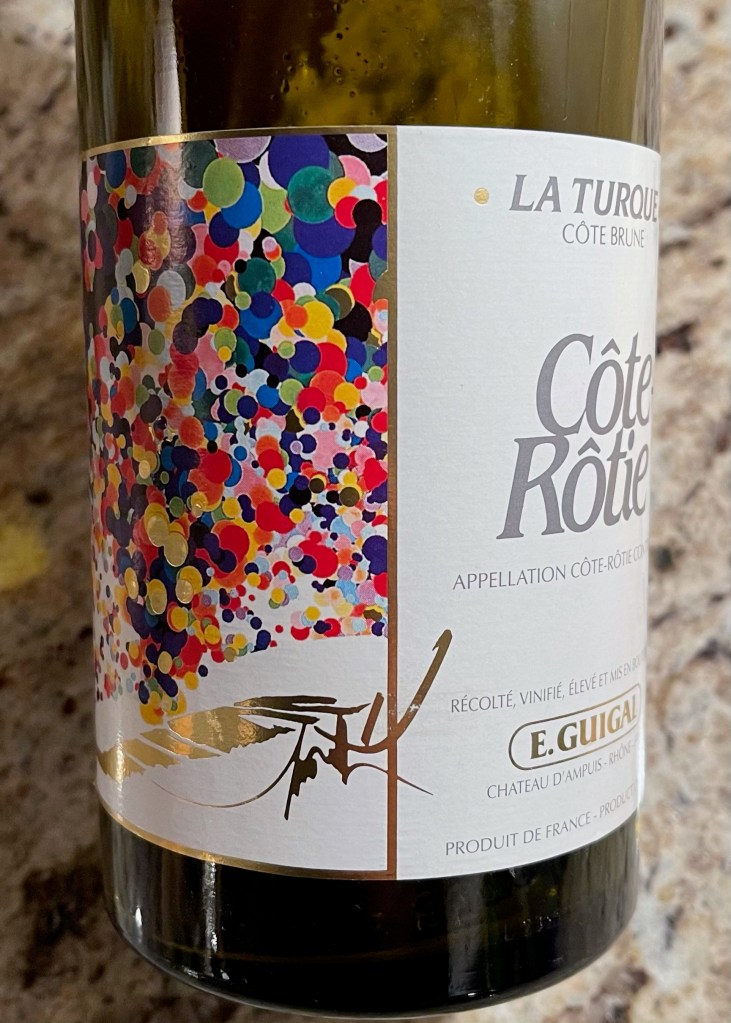
Today’s Wine: 2011 Côte-Rôtie ‘La Turque’
93% Syrah, 7% Viognier; 13% ABV
The 2011 La Turque is translucent deep ruby in color. I decanted this for 4-6 hours and it does need more time in the cellar (I’d say 5-7 years or so), but it’s very hard to resist right now. The nose showcases aromas of black cherry, blackberry, plum, bacon fat, maple syrup, smoked game, black olive, cracked black pepper, clove, vanilla, coffee grounds, and oak. Meanwhile the palate displays notes of blueberry, blackberry, plum, black cherry, smoke, barbecue braised beef, bacon fat, toffee, mocha, gravel, and lightly charred oak. This is medium- to full-bodied with high acidity, fine-grained but high tannins, and a very long finish.
Price: $400 average online (I paid $325). At this price point I find it difficult to call any wine a “great value,” however I think this La Turque is absolutely worth its price. I will certainly try to buy more if I come across it again.
Domaine Georges Roumier originated in 1924, however most of their production at that time sold to wine merchants. This changed though, in 1945, when Georges Roumier started bottling wine at the domaine. I’m thankful Roumier made this change, as I’m sure many throughout the wine world are, because the reputation of this domaine has soared higher and Roumier sits as one of the upper-echelon producers in Chambolle-Musigny, Morey-Saint-Denis, and Corton-Charlemagne.
Christophe Roumier and his father Jean-Marie became partners in 1981 to manage the domaine, which as it currently stands covers 11.52 hectares in some of Burgundy’s premier appellations. Christophe has been instrumental in the continued rise of Roumier’s wines, immeasurably due to his very strict and dedicated care for the vines and winemaking process. Christophe produces 11 different bottlings ranging from the village level to Grand Cru, each wine made with this same rigor to produce high-quality, luxurious, profound, and always delicious wines.
All of Roumier’s fruit is hand-harvested and sorted, the village wines are typically made with destemmed fruit (the rest of the wines vary), punchdowns occur during fermentation, all yeasts are natural, and minimal new oak is used for aging (Christophe says he never goes above 30%). I’d love to dive deeper into the farming and winemaking practices, but I believe this Decanter article does an incredible job and suggest you read it if you’re interested in learning more.
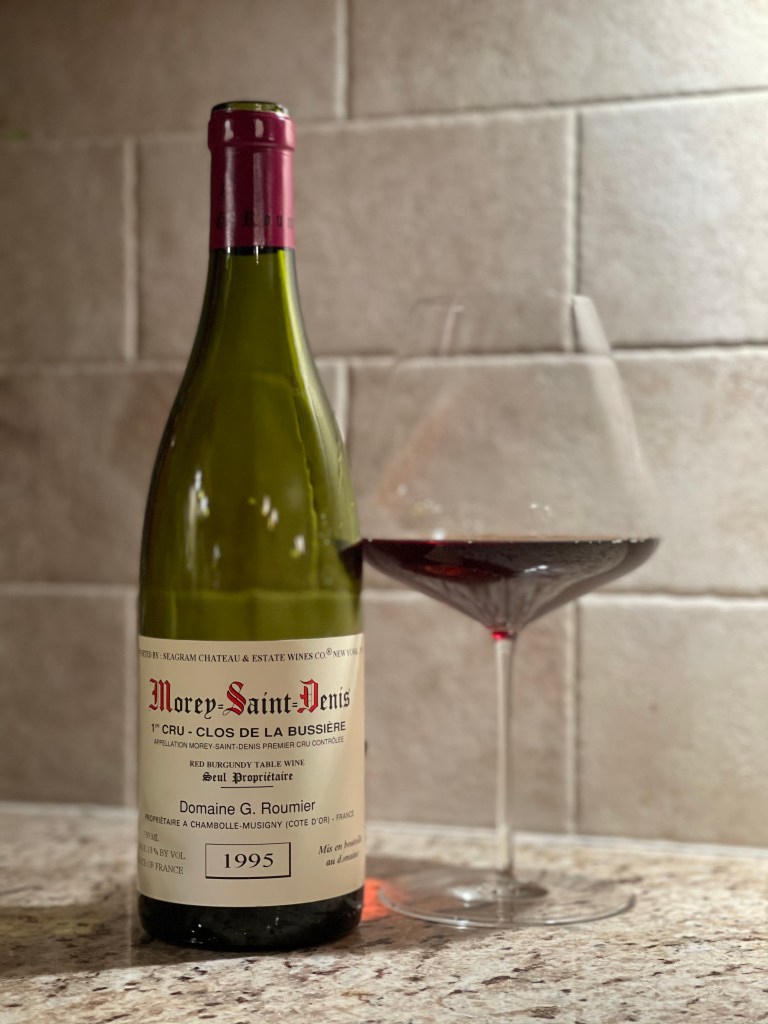
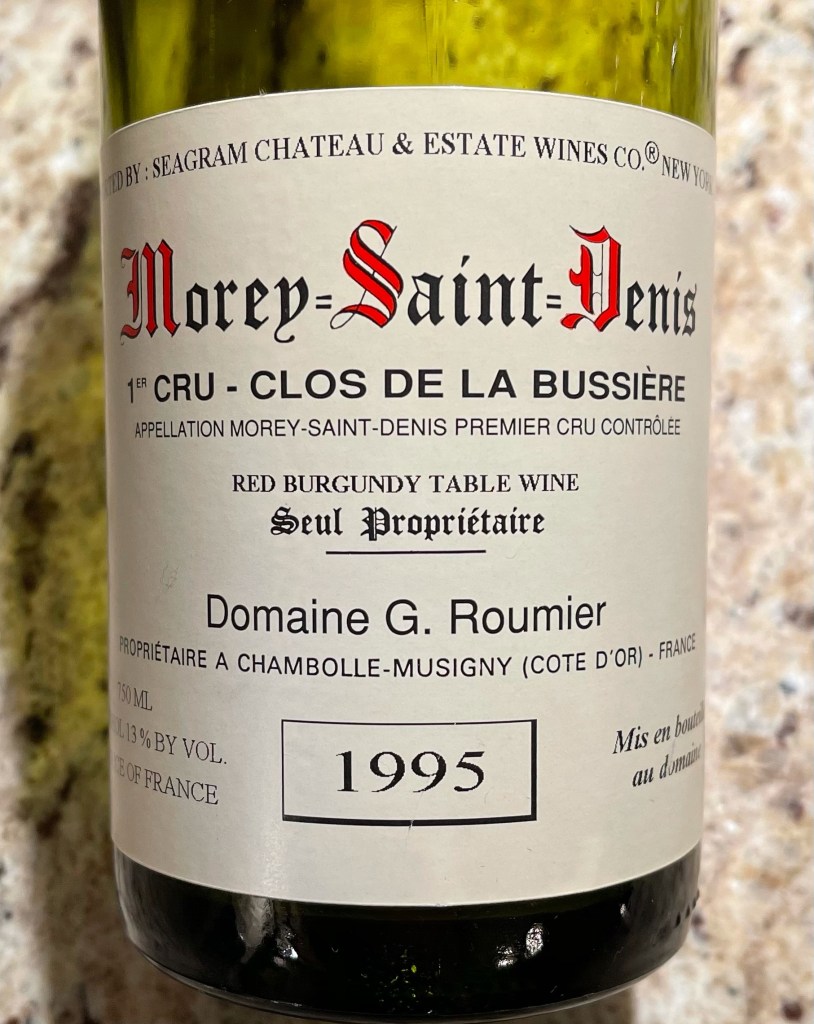
Today’s Wine: 1995 Morey-Saint-Denis 1er Cru Clos de la Bussière
100% Pinot Noir; 13% ABV
The 1995 Clos de la Bussière is transparent pale to medium garnet in color with slight bricking around the edges of the glass. This took about 45 minutes to blossom, and I decanted it to remove some sediment and cork that broke off in the bottle. The beautifully tertiary and well-integrated nose showcases aromas of black raspberry, black cherry, rose petal, dried red licorice, forest floor, mild green herbs, and prominent black truffle. Meanwhile on the palate, I get notes of black cherry, dried cranberry, underbrush, black truffle, sous bois, wet gravel, and pepper. This is light-bodied with still lively medium (+) acidity, medium (-) tannins, and a long finish. Absolutely gorgeous aged Burgundy that is perfectly balanced and perfectly aged, with the structure still a tour de force.
Price: $700 (I paid $315). I never turn down an opportunity to taste Roumier, particularly one with this much age and especially the provenance of having one owner before me. If you don’t like old wines that are dominated by forest floor and truffle, this certainly wouldn’t be for you. But for me, it’s well worth the $315 paid.
Today’s Story: Château Pichon Longueville Comtesse de Lalande
I previously (and somewhat recently) wrote about Château Pichon Longueville Comtesse de Lalande and have reviewed the 1966, 1986, 2003, and 2008 vintages on this blog. Though I’ve tasted a number of other vintages including 1979, 1996, 2005, and 2014, the 1989 vintage remained elusive…until today.
Château Pichon Longueville Comtesse de Lalande is a Second Growth (Deuxième Cru) estate based on the Bordeaux Wine Official Classification of 1855. Pichon Lalande is considered by many to be a classic example of Pauillac, known for its deep, concentrated layers of ripe fruit accompanied by notes of cassis, tobacco, and earth.
With nothing short of a somewhat tumultuous history, Pichon Lalande’s ownership changed hands over the years and earned its name when the founder’s daughter Therese received it as a dowry for her marriage to Jacques de Pichon Longueville. During the 18th century, the estate was dominated by women (Therese de Rauzan, Germaine de Lajus, and Marie Branda de Terrefort) throughout the winemaking process until Baron Joseph de Pichon Longueville took over for his mother. In 1850, with his death, the estate split between his two sons and three daughters and ultimately resulted in the division of Comtesse de Lalande and Pichon Baron.
With no familial heirs, Edouard Miailhe and Louis Miailhe purchased Pichon Lalande following WWI. Edouard’s daughter, May-Eliane de Lencquesaing, took over management in 1978 and became a prominent ambassador for Bordeaux wines while dramatically increasing quality of her estate. One of her major endeavors, and possibly most famous, was growing the size of Pichon Lalande from 40 hectares of vines to 89. In 2007, however, May-Eliane sold a majority stake of the estate to the Rouzaud family, owners of Roederer Champagne, and management changes as well as renovations took place.
Today’s Wine: 1989 Château Pichon Longueville Comtesse de Lalande
The 1989 Pichon Lalande is translucent deep ruby in color with deep garnet hues. There’s absolutely no bricking either, which is fantastic. We served this as a pop and pour and let it develop in the glass, with the nose showcasing aromas of blackcurrant, blackberry, pencil shavings, tobacco, forest floor, cedar, graphite, green pepper, and eucalyptus. Meanwhile on the palate, I get notes of redcurrant, cassis, blackberry, black cherry, cigar box, scorched earth, green underbrush, bell pepper, gravel, and clove. This is medium-bodied with medium (+) acidity, medium tannins, and a long finish. Beautifully balanced and not showing any signs of its age yet.
Price: $300 (but this was shared by a good friend). Though not nearly an inexpensive bottle of wine, if you can verify provenance and find a bottle with a great fill level, I would give this a shot. Pichon Lalande has outperformed with each of the 9 vintages I’ve tried and oftentimes these drink like the First Growths. Great value.
I previously wrote about the fantastic Domaine Cecile Tremblay in November, 2019 with the 2011 Chambolle-Musigny Les Cabottes. As these wines are fantastic and prices have skyrocketed since I started buying them, I am excited to try her Vosne-Romanée today.
Domaine Cecile Tremblay has a very interesting history, partly because she did not start making wines until 2003 though her family owned vineyards for several generations. Cecile is the great-granddaughter of Edouard Jayer, uncle of the famed Henri Jayer (go Google some of his wines, and perhaps sell your car to buy a bottle). Cecile’s family inherited vineyards from Edouard, though the two generations before her leased out the land to other producers and did not make their own wine. In 2003, however, with the expiration of a lease on three hectares of vines Cecile started making wine under her own label with a plan for further growth. For instance, the Domaine owns roughly 10 hectares of vineyard land and while more of this becomes free from leasing agreements in 2021, Cecile rented or purchased land along the way in communes such as Gevrey-Chambertin.
When Cecile took over her family’s land for her own use, the vineyards were in no standing to produce high quality wines. The producers leasing the land, for instance, used too much fertilizer for Cecile’s taste and utilized herbicides instead of ploughing. Throughout her time thus far as a winemaker, Cecile transitioned to organic farming and many of her practices include biodynamic farming measures as well. During maintenance of her vineyards, Cecile ploughs the soil mechanically and with horses while using copper sulfate to prevent mildew and other fungi.
Similar to her views on caring for her vines, Cecile is very traditional in her winemaking process. She presses her grapes with an old-fashioned vertical press and her wines see only a moderate amount of new wood during fermentation and aging. All of this effort culminates into wines that are refined and elegant, though built for the long haul.
Today’s Wine: 2011 Vosne-Romanée
100% Pinot Noir; 13% ABV
The 2011 Vosne-Romanée is pale to medium ruby in color and translucent. Given some time to blossom in the glass, this opens to showcase a nose of black raspberry, strawberry, cherry, pine, leather, tilled earth, mint, eucalyptus, cinnamon, and a hint of baking spice. Meanwhile on the palate, I get notes of black cherry, plum, cranberry, tobacco, green herbs, gravel, and truffle. This is medium-bodied with high acidity, medium (-) tannins, and a long finish. This was much less complex compared to her Chambolle-Musigny bottling I reviewed last year, though it is very well-balanced and enjoyable to drink.
Price: $460 (but this was shared by a good friend who paid $120). While no doubt a delicious wine, I can’t see this being worth the $460 I see it going for nowadays online. For my very fortunate friend who spent $120, however, I’d say it’s worth that price.






 JB's Wine Talk