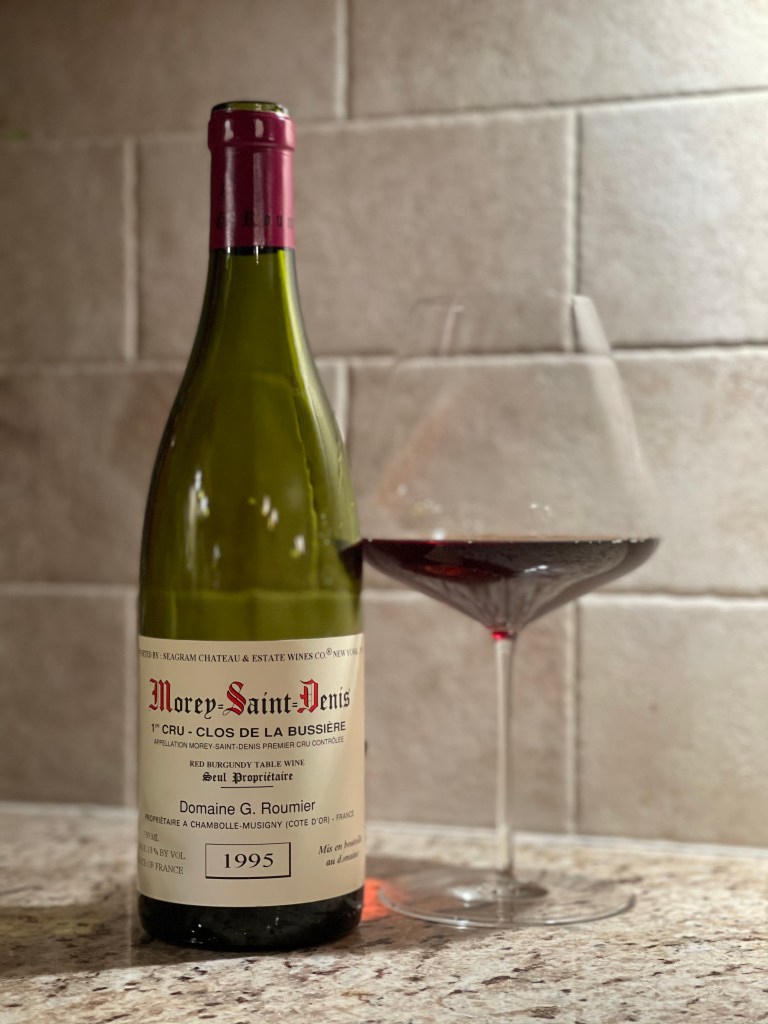
Beautifully Aged Morey-Saint-Denis

Today’s Story: Domaine G. Roumier

I previously wrote about Domaine G. Roumier when I reviewed a much younger 2014 Morey-Saint-Denis 1er Cru Clos de la Bussière back in November, 2019.

Domaine Georges Roumier originated in 1924, however most of their production at that time sold to wine merchants. This changed though, in 1945, when Georges Roumier started bottling wine at the domaine. I’m thankful Roumier made this change, as I’m sure many throughout the wine world are, because the reputation of this domaine has soared higher and Roumier sits as one of the upper-echelon producers in Chambolle-Musigny, Morey-Saint-Denis, and Corton-Charlemagne.

Christophe Roumier and his father Jean-Marie became partners in 1981 to manage the domaine, which as it currently stands covers 11.52 hectares in some of Burgundy’s premier appellations. Christophe has been instrumental in the continued rise of Roumier’s wines, immeasurably due to his very strict and dedicated care for the vines and winemaking process. Christophe produces 11 different bottlings ranging from the village level to Grand Cru, each wine made with this same rigor to produce high-quality, luxurious, profound, and always delicious wines.

All of Roumier’s fruit is hand-harvested and sorted, the village wines are typically made with destemmed fruit (the rest of the wines vary), punchdowns occur during fermentation, all yeasts are natural, and minimal new oak is used for aging (Christophe says he never goes above 30%). I’d love to dive deeper into the farming and winemaking practices, but I believe this Decanter article does an incredible job and suggest you read it if you’re interested in learning more.
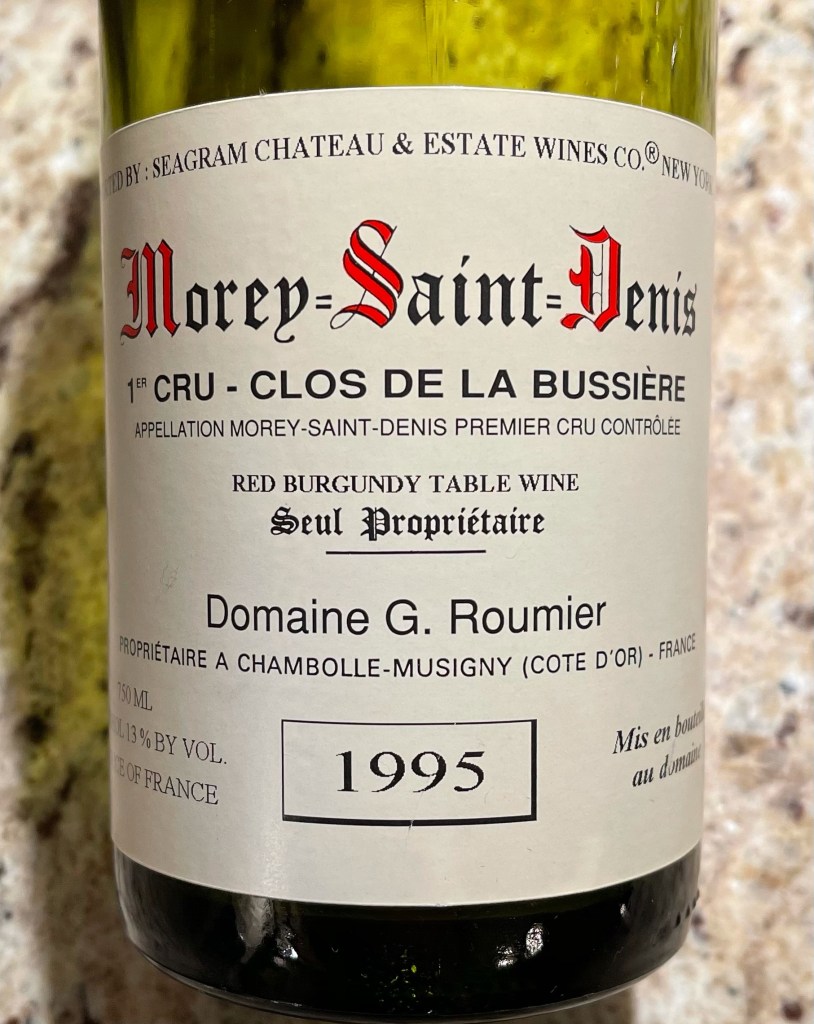
Today’s Wine: 1995 Morey-Saint-Denis 1er Cru Clos de la Bussière

100% Pinot Noir; 13% ABV

The 1995 Clos de la Bussière is transparent pale to medium garnet in color with slight bricking around the edges of the glass. This took about 45 minutes to blossom, and I decanted it to remove some sediment and cork that broke off in the bottle. The beautifully tertiary and well-integrated nose showcases aromas of black raspberry, black cherry, rose petal, dried red licorice, forest floor, mild green herbs, and prominent black truffle. Meanwhile on the palate, I get notes of black cherry, dried cranberry, underbrush, black truffle, sous bois, wet gravel, and pepper. This is light-bodied with still lively medium (+) acidity, medium (-) tannins, and a long finish. Absolutely gorgeous aged Burgundy that is perfectly balanced and perfectly aged, with the structure still a tour de force.

Price: $700 (I paid $315). I never turn down an opportunity to taste Roumier, particularly one with this much age and especially the provenance of having one owner before me. If you don’t like old wines that are dominated by forest floor and truffle, this certainly wouldn’t be for you. But for me, it’s well worth the $315 paid.

Balanced and Easy-Drinking Vosne-Romanée

Today’s Story: Domaine Cecile Tremblay

I previously wrote about the fantastic Domaine Cecile Tremblay in November, 2019 with the 2011 Chambolle-Musigny Les Cabottes. As these wines are fantastic and prices have skyrocketed since I started buying them, I am excited to try her Vosne-Romanée today.

Domaine Cecile Tremblay has a very interesting history, partly because she did not start making wines until 2003 though her family owned vineyards for several generations. Cecile is the great-granddaughter of Edouard Jayer, uncle of the famed Henri Jayer (go Google some of his wines, and perhaps sell your car to buy a bottle). Cecile’s family inherited vineyards from Edouard, though the two generations before her leased out the land to other producers and did not make their own wine. In 2003, however, with the expiration of a lease on three hectares of vines Cecile started making wine under her own label with a plan for further growth. For instance, the Domaine owns roughly 10 hectares of vineyard land and while more of this becomes free from leasing agreements in 2021, Cecile rented or purchased land along the way in communes such as Gevrey-Chambertin.

When Cecile took over her family’s land for her own use, the vineyards were in no standing to produce high quality wines. The producers leasing the land, for instance, used too much fertilizer for Cecile’s taste and utilized herbicides instead of ploughing. Throughout her time thus far as a winemaker, Cecile transitioned to organic farming and many of her practices include biodynamic farming measures as well. During maintenance of her vineyards, Cecile ploughs the soil mechanically and with horses while using copper sulfate to prevent mildew and other fungi.

Similar to her views on caring for her vines, Cecile is very traditional in her winemaking process. She presses her grapes with an old-fashioned vertical press and her wines see only a moderate amount of new wood during fermentation and aging. All of this effort culminates into wines that are refined and elegant, though built for the long haul.

Today’s Wine: 2011 Vosne-Romanée

100% Pinot Noir; 13% ABV

The 2011 Vosne-Romanée is pale to medium ruby in color and translucent. Given some time to blossom in the glass, this opens to showcase a nose of black raspberry, strawberry, cherry, pine, leather, tilled earth, mint, eucalyptus, cinnamon, and a hint of baking spice. Meanwhile on the palate, I get notes of black cherry, plum, cranberry, tobacco, green herbs, gravel, and truffle. This is medium-bodied with high acidity, medium (-) tannins, and a long finish. This was much less complex compared to her Chambolle-Musigny bottling I reviewed last year, though it is very well-balanced and enjoyable to drink.

Price: $460 (but this was shared by a good friend who paid $120). While no doubt a delicious wine, I can’t see this being worth the $460 I see it going for nowadays online. For my very fortunate friend who spent $120, however, I’d say it’s worth that price.

Fun Still Red From a Legendary Champagne Producer in Bouzy

Today’s Story: Champagne Paul Bara

Champagne Paul Bara is a small, family run Champagne house established in 1860 in the village of Bouzy in the Montagne de Reims wine region of France. Though initially the property consisted of a farm and a cellar with some vines, Paul Bara was the first of the family to sell Champagne under his name during the 1950s. In 1965, the family transformed a barn into their own press room and winery and set their sights on greater heights. 10 years later, in 1975, Paul Bara began exporting Champagne to the United States and was one of the first houses to do so. As he neared retirement, Paul’s daughter and sixth generation Chantale started helping to produce the wines and run the business before co-running the business in 1986 and later taking over. Since 2018, Chantale’s sister Evelyne Dauvergne began taking on more responsibilities as well.

Champagne Paul Bara consists of 11 hectares of all Grand Cru vineyards in Bouzy, with about 9.5 hectares planted to Pinot Noir and the remaining 1.5 planted to Chardonnay. The vines are rather low yielding and the family practices sustainable viticulture with a major focus on clean farming and biodiversity in the vineyards. All fruit is hand-harvested and hand-sorted, with winemaking in the cellar sticking to more traditional methods and only using first press juice. During aging, the wines rest in the impressive century-old chalk cellars dug by hand 11 meters below the surface of the earth. Total production is around 7,500 cases per year.

To learn more about Champagne Paul Bara and view pictures of the estate, check out their website here.

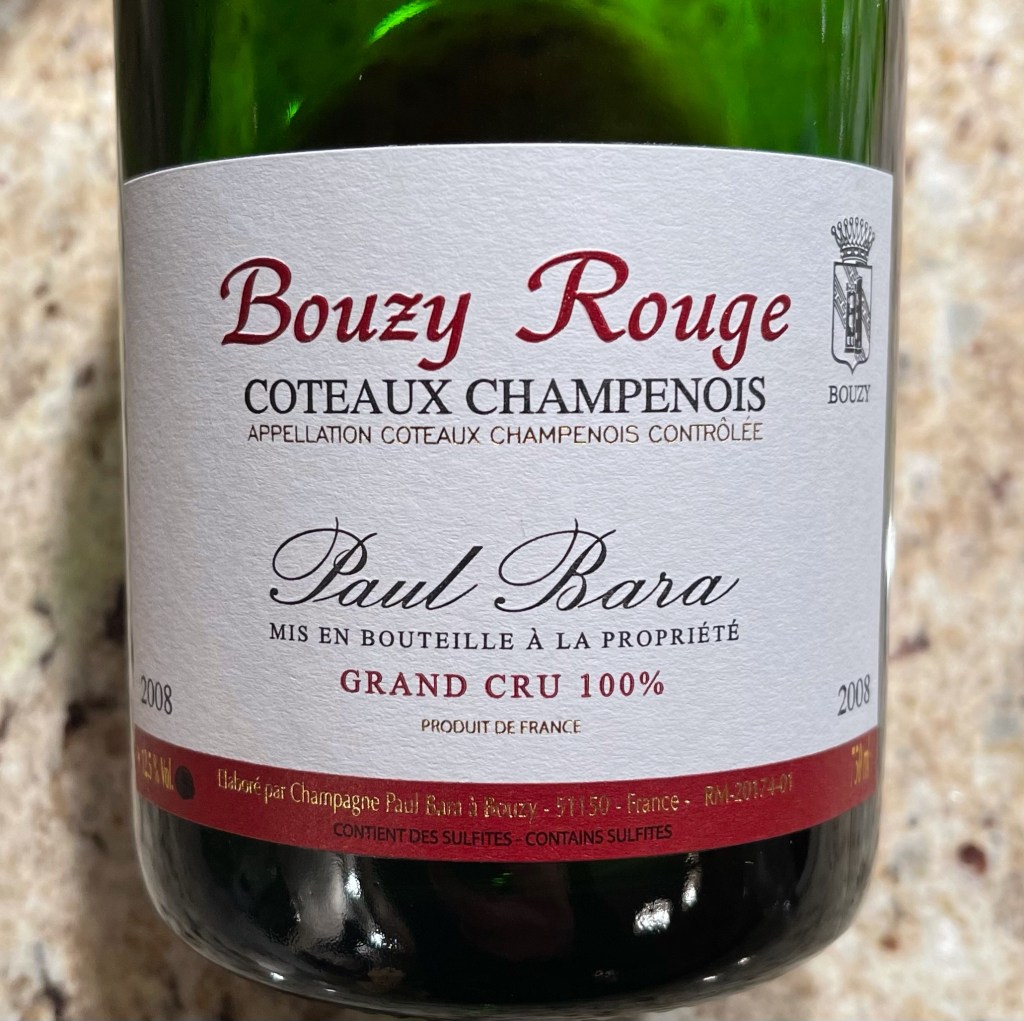
Today’s Wine: 2008 Bouzy Rouge Coteaux Champenois Grand Cru

100% Pinot Noir; 12.5% ABV

The 2008 Bouzy Rouge Coteaux Champenois Grand Cru is translucent pale to medium ruby in color. Given some time to blossom in the glass, the nose showcases aromas of black cherry, cranberry, black raspberry, olive, forest floor, underbrush, and crushed rock. Meanwhile, the palate displays notes of ripe sweet cherry, stemmy strawberry, rose, sous bois, light grilled herbs, mild peppery spice, stony mineral, and a hint of smoke. This is light-bodied with medium (+) acidity, light tannins, and a medium (+) finish.

Price: $55. This is certainly a fun wine, being a still Pinot Noir from a Champagne house known for their incredible quality and Grand Cru holdings, but I don’t think it has the complexities or depth to live up to the price. Nonetheless, it was an easy-drinking and tasty wine.

Biodynamic New Zealand Pinot Noir With an Old World Flair

Today’s Story: Quartz Reef Wines

Quartz Reef is a relatively small winery established in Bendigo in the Central Otago region of New Zealand. The winery is named for its vineyards being planted on the largest quartz deposit in New Zealand, with the vines planted in 1998 and their first Pinot Noir bottled in 2001. Quartz Reef is known for their Pinot Noir, Pinot Gris, and Methode Traditionnelle, however winemaker Rudi Bauer crafts small amounts of Chardonnay and Grüner Veltliner as well. In 2007, Quartz Reef started transitioning to biodynamic viticulture and today is one of only six New Zealand wineries certified biodynamic by Demeter. Rudi makes all his wines following traditional methods through minimal intervention in the cellar, attempting to showcase the fruit and terroir in the most natural way possible while marrying Old World and New World characteristics.

To learn more and view photos of the estate (and the winemaking puppies), visit the Quartz Reef website here.

Today’s Wine: 2017 Bendigo Estate Pinot Noir

100% Pinot Noir; 14% ABV

The 2017 Bendigo Estate Pinot Noir is pale to medium ruby in color and almost opaque. I let this blossom in the glass for about 30-45 minutes, with the incredibly Burgundian nose showcasing aromas of black cherry, plum, black raspberry, leather, smoked game meat, barnyard, forest floor, gravel, and light oak. The palate kicks off with a very similar fruit profile to the nose with black cherry, plum, and brambly strawberry before branching into notes of violet, tobacco, damp loamy soil, green peppercorn, black tea leaf, underbrush, baking spice (like allspice or clove), and oak. This is light- to medium-bodied with medium acidity, medium (-) and somewhat dusty tannins, and a medium (+) length finish.

Price: $40 average (I paid $30). Very strong value here, particularly if you can find it for around $30 like I did. This is my second time having this wine and it is as impressive as the first. While no doubt young and starting to enter its drinking window, this is both incredibly approachable and capable of going another 5-7 years. Great Old World experience with this wine and a beautiful representation of the terroir.

Valiant Effort in a Tough Vintage for Burgundy

Today’s Story: Domaine Jean Grivot

I wrote about Domaine Jean Grivot back in March when I reviewed the 2016 Nuits-St-Georges Les Charmois, though I figured it could be fun checking in on another bottling as one of my Thanksgiving wines.

Domaine Jean Grivot is a relatively small family owned and operated Burgundian estate now under guide of the fifth generation Étienne Grivot, his wife Marielle, and their children Mathilde and Hubert. Étienne took over the domaine from his father Jean Grivot in 1987, and Jean had taken over from his father following his death in 1955. The majority of the domaine’s vineyards are located in Vosne-Romanée, however over time their growth to 15.5 hectares stretches across 22 appellations in additional villages of Vougeot, Chambolle-Musigny, and Nuits-Saint-Georges. The domaine’s holdings include notable Grand Cru vineyards in Clos de Vougeot, Echézeaux, and Richebourg, as well as 8 Premier Crus including Les Beaux Monts and Suchots in Vosne-Romanée. Their vineyards are farmed organically founded in a desire for minimal impact on the environment and removal of chemicals in the vineyards. In Richebourg, Echézeaux, Beau Monts, and Suchots, the domaine even uses a horse to plough the vineyards in an effort to minimize impact on the soil. Harvest is accomplished by hand and the grapes are 95-100% destemmed before beginning fermentation using only natural yeasts. Unlike other winemakers in Burgundy, Grivot does not like punch downs before fermentation begins but rather pumps over the wines after fermentation is complete and before they spend 15 months in barrels.

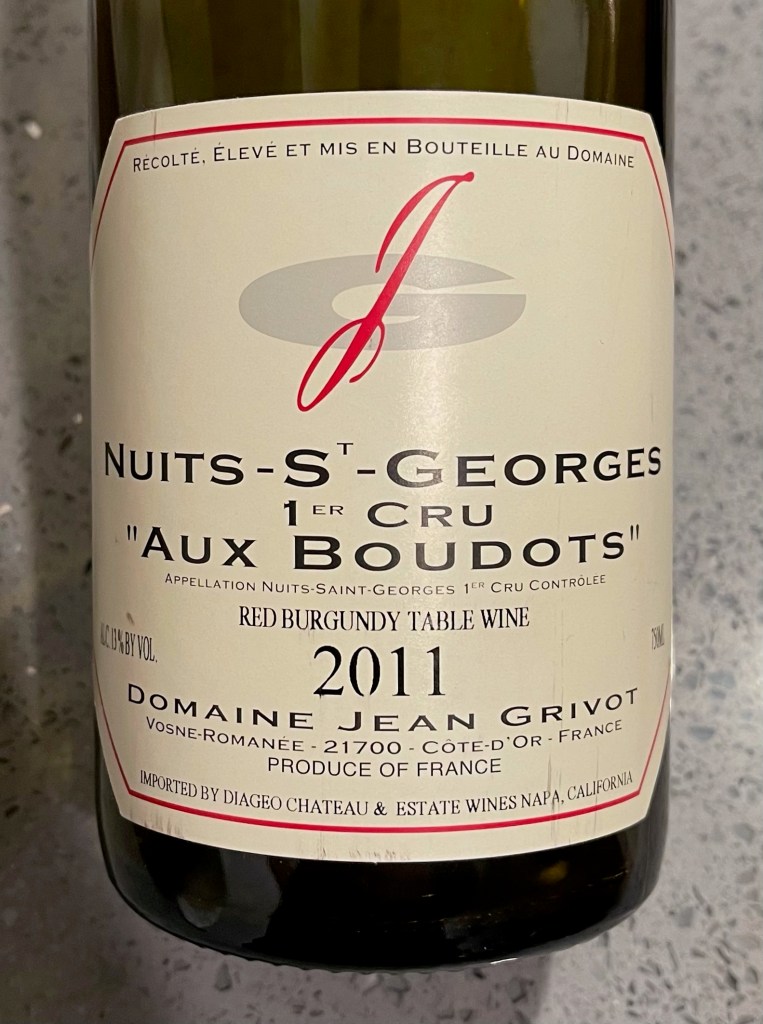
Today’s Wine: 2011 Nuits-St-Georges 1er Cru Aux Boudots

100% Pinot Noir; 13% ABV

The 2011 Aux Boudots is translucent pale to medium ruby in color. I let this slow ox for about 30-45 minutes before further air time in the glass, helping the wine express aromas of black cherry, dried cranberry, dried tobacco leaf, dry tilled earth, underbrush, gravel, and green pepper. Once in the mouth, this showcases notes of black raspberry, black cherry, spiced plum, tobacco, leather, forest floor, rocky mineral, pepper, and dried green herbs. This is a delightful wine from a difficult vintage, and it is medium-bodied with medium acidity, medium (-) dusty tannins, and a medium (+) length finish.

Price: $200 (can find it closer to $160 in some locations). While no doubt a wonderful bottle of wine, I struggle to call this great “value” because while Burgundy prices have gone through the roof lately there are still some great options around this price from stronger vintages. If you can find it closer to $160, then by all means give it a try.

Great Value From a Rising Star in Gevrey-Chambertin

Today’s Story: Domaine Duroché

Domaine Duroché is a family owned and operated wine estate located in the Gevrey-Chambertin village in Burgundy. The Duroché family owns roughly 8.25 hectares of vineyards in Gevrey-Chambertin, producing wines that begin with both Bourgogne Rouge and Blanc before climbing through several village and 1er Cru bottlings to their Grand Cru sites of Charmes, Griottes, Latricieres, and Clos de Beze. Though the family has been bottling their wines since 1933, the quality of the domaine catapulted to new heights under the current leadership of fifth generation Pierre Duroché. Though Pierre is a relatively young winemaker in Gevrey, he refrains from being too heavy handed and seeks to create wines of elegance and finesse as compared to some of his neighbors favoring a bigger, bolder, and oakier style. Pierre and his family farm the vineyards using as few chemicals as possible (relying only on some sulfur or copper for treatments), and all fruit is hand-harvested and sorted before fermentation using only native yeasts. New oak usage varies by level of wine but always remains as minimal as possible, and the wines are bottled without fining or filtration. Beginning with the 2017 vintage, Pierre and his wife Marianne purchase fruit from her family to supply their new Vosne-Romanée Village and Echezeaux Grand Cru bottlings.

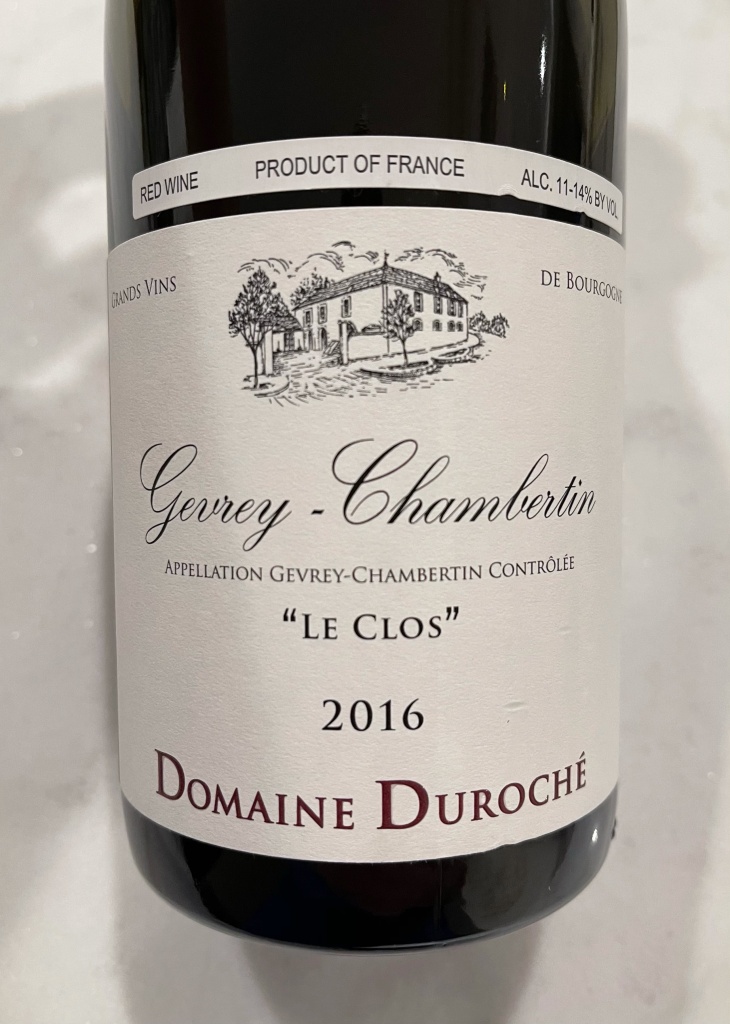
Today’s Wine: 2016 Gevrey-Chambertin Le Clos

100% Pinot Noir; 13% ABV

The 2016 Gevrey-Chambertin Le Clos is pale to medium ruby in color and slightly translucent. I let this slow ox in the bottle for a while before letting it open up in the glass, blossoming into a nose of black cherry, dried strawberry, boysenberry, charred earth, eucalyptus, crushed rock, stony mineral, and light oak. Still fairly tight on the palate, this took some time to open up and showcase notes of cherry, stemmy strawberry, raspberry, red and blue florals, leather, rocky earth, and mineral. The wine is light- to medium-bodied with medium (+) acidity, medium (-) tannins, and a long finish. Gorgeous Gevrey minerality with this one, but it does need probably at least 5 years of cellaring to come into its own.

Price: $65. I think this is a very good value red Burgundy, though I don’t necessarily think it will remain this fairly priced for long. Pierre Duroché is certainly a rising star in Gevrey-Chambertin and I would highly recommend picking some of this up if you come across it.

Legendary Sonoma Coast Pinot Noir

Today’s Story: Kistler Vineyards

Kistler Vineyards is a small family-owned and operated winery established in 1978 by Steve Kistler and Mark Bixler in California’s Sonoma County. Founded on the belief that California could produce Burgundy-style Chardonnay representative of each unique vineyard site, Kistler works with a single Chardonnay clone planted across 15 vineyards to produce 11 single-vineyard bottlings. In addition to Chardonnay, Kistler produces small amounts of Pinot Noir using two heritage selections sourced from a Grand Cru site in Burgundy. Kistler farms their vineyards quite meticulously, with both the Chardonnay and Pinot Noir clones highly limited in yield in order to produce fruit of intense depth, contrentration, and focus. In pursuing wines of character and place, the winemaking team at Kistler ferments using only native yeasts with no machination of the fruit while being as minimally invasive as possible. At bottling, the wines are bottled unfined and unfiltered.

Today’s Wine: 2012 Cuvée Natalie Pinot Noir

100% Pinot Noir; 14.1% ABV

The 2012 Cuvée Natalie Pinot Noir is pale ruby in color and almost opaque. I let the wine slow ox for about 45 minutes before letting it blossom in the glass, opening up to reveal aromas of bing cherry, pomegranate, black raspberry, licorice, red florals, leather, dried earth, savory herbs, and mild cinnamon. Once on the palate, this showcases notes of baked strawberry, cherry, raspberry, plum, rose, sweet tobacco, forest floor, underbrush, white pepper, and mild oaky spice. This silky and elegant Pinot is light- to medium-bodied with high acidity, medium (-) tannins, and a long finish. 1,065 cases produced.

Price: $150 (though you might be able to find it closer to $130). As much as I hate to say it, I think this bottling is a bit overpriced. While undoubtedly delicious, there are simply too many Pinot Noirs out there that punch well above this in terms of value. $150 is a very, very expensive California Pinot and at that price point I’d be more apt to poke around Burgundy or buy 2-3 bottles of a more value-oriented wine.

Top Notch Pinot From a Historic Cali Vineyard

Today’s Story: Chanin Wine Co.

I previously wrote about Chanin back in April and May when I reviewed the 2014 Duvarita Vineyard Pinot Noir and 2015 Bien Nacido Vineyard Chardonnay. However, the Bien Nacido Pinot has been on my radar for some time and I am excited to taste it today.

Chanin Wine Co. was established in 2007 by winemaker Gavin Chanin, and his goal is to produce single vineyard Pinot Noir and Chardonnay from Santa Barbara County. Gavin selected the vineyards to source his fruit based on their organic (or at minimum sustainable) farming practices while also seeking older vines. The current vineyard selections include Sanford & Benedict in the Sta. Rita Hills, Los Alamos between the Santa Maria and Santa Ynez Valleys, Bien Nacido in the Santa Maria Valley, and Duvarita just west of the Sta. Rita Hills. Gavin eschews higher alcohol levels in his wines to foster balance and finesse, while practicing gentle winemaking methods and avoiding additives such as commercial yeasts, bacteria, and enzymes. All of Chanin’s wines are bottled unfiltered and the labels feature his own artwork.

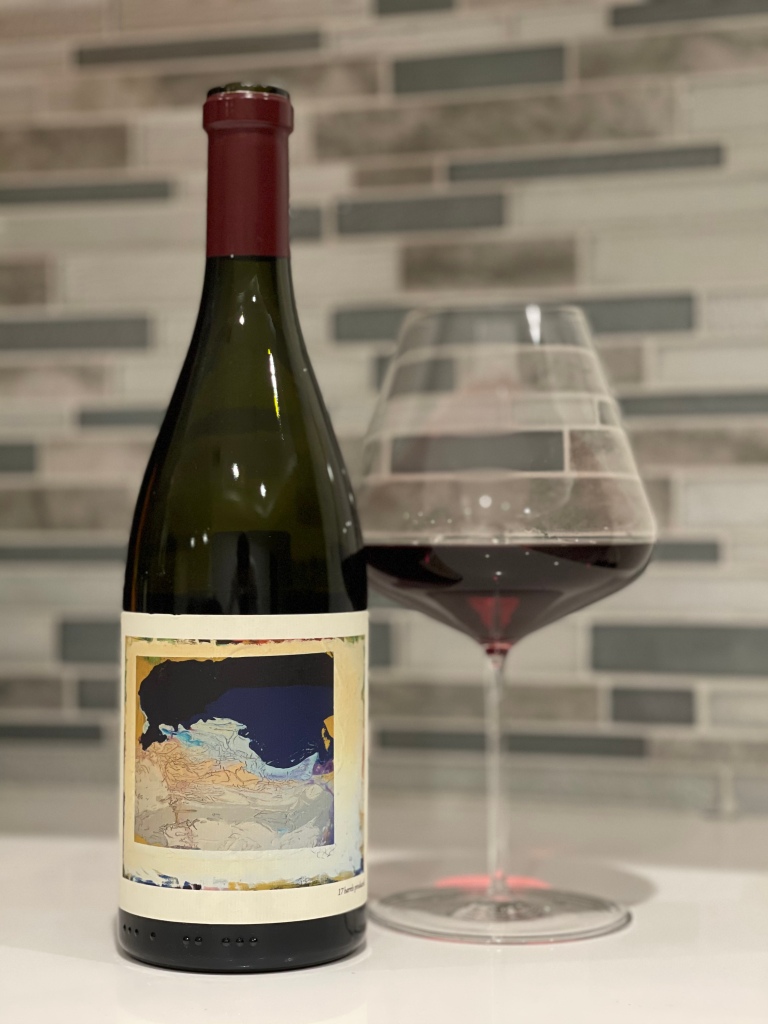
Today’s Wine: 2015 Bien Nacido Vineyard Pinot Noir

100% Pinot Noir; 13% ABV

The 2015 Bien Nacido Vineyard Pinot Noir is translucent pale ruby in color. Once this opens up, the nose showcases aromas of baked cherry, black raspberry, brambly strawberry, rose, forest floor, dried green herbs, and mint. Meanwhile on the palate, I get notes of ripe red cherry, crunchy cranberry, boysenberry, sweet tobacco, sous bois, underbrush, and cinnamon. This is light- to medium-bodied with medium (+) acidity, medium (-) tannins, and a medium (+) length finish. 17 barrels produced.

Price: $55. I’d call this wine very appropriately priced, with an inclination to say it punches above its price due to the gorgeous purity of fruit, balance, and elegance. While distinctly Californian thanks to the ripe fruit character, the Burgundian flair and more traditional winemaking help this shine versus the competitors.

Sky-High Quality From a Regional Pinot Noir

Today’s Story: Paul Hobbs Winery

Paul Hobbs Winery was founded in 1991 by Paul Hobbs with his initial release of Chardonnay, Pinot Noir, and Cabernet Sauvignon from purchased fruit. I previously wrote about Paul and his winery’s history in The Steve Jobs of Wine when I reviewed the 2015 Katherine Lindsay Estate Pinot Noir, but I will recycle it here for ease…

Paul grew up in upstate New York on a working family farm and orchard, so one could say agriculture was in his blood from an early age. Though Paul helped plant, harvest, and sell crops at nearby farmers’ markets before school each morning, his first foray into wine was helping his father achieve his dream of replanting some of the apples, peaches, and nuts in their orchards to wine grapes.

When it came time for Paul to go to college, his father encouraged him to study viticulture and enology but instead Paul followed in his great-grandfather’s footsteps by studying medicine and graduated with a BS in Chemistry from Notre Dame. His father’s persistence paid off, however, and Paul moved to California after graduation and studied viticulture and enology at UC Davis where he received his Master of Science three years later. Fresh off his new degree, Paul was hired by Robert Mondavi for his advanced knowledge of oak aging and he was quickly promoted to the inaugural Opus One winemaking team. Following his experiences at Robert Mondavi and Opus One, Paul joined Simi Winery as their winemaker before beginning consulting roles for Peter Michael, Lewis Cellars, Bodegas Catena, and soon other wineries around the world.

Throughout these experiences with wine, Paul Hobbs crafted a dream of his own to produce vineyard designated wines under his own name. In 1991, Paul spoke with Larry Hyde in Napa and Richard Dinner in Sonoma about purchasing some of their fruit, and the resulting 5 tons of fruit from each vineyard culminated in the first Chardonnay, Pinot Noir, and Cabernet Franc of Paul Hobbs Winery. Paul’s dreams entered their next phase in 1998, however, when he purchased his family’s first estate vineyard and established the Katherine Lindsay Estate (named after his great-grandmother) in Sebastopol, CA. The first vintage of this wine came with the 2003 harvest, and today Paul Hobbs consists of seven estate vineyards in some of the preeminent Californian regions for Chardonnay, Pinot Noir, and Cabernet Sauvignon.

Paul Hobbs practices sustainable farming in caring for his vineyards and a minimalist approach in producing his wines. To sustain the integrity of his fruit and each vineyard block, Paul demands a constant flow of communication and knowledge from the vineyards to the cellar. When it comes time for harvest, all Paul Hobbs fruit is hand-harvested using hand sheers to keep the fruit in pristine condition. During the winemaking process, all wine is fermented using only native yeasts that originate in the vineyards and the cellar and the wine is aged in finely grained French oak barrels. With his finished product, Paul bottles the wine unfined and unfiltered in an effort to display the purity of the fruit and the place of each wine with elegance and transparency.

Fun fact: Paul Hobbs is widely known as “the Steve Jobs of wine” thanks to his “ardent exactitude” and immensely high demands for quality.

Today’s Wine: 2016 Sonoma Coast Pinot Noir

100% Pinot Noir; 14.1% ABV

The 2016 Sonoma Coast Pinot Noir is opaque medium ruby in color with purple hues. Given about 45 minutes to open up, the nose showcases aromas of brooding wild blueberry, dark cherry, plum, red licorice, dry charred earth, saturated gravel, hickory smoke, cinnamon, and oak. On the palate, I get notes of tart red cherry, black raspberry, pomegranate, blackberry liquor, scorched earth, slate and clay, dried cooking herbs, and cola. This is medium-bodied with medium (+) acidity, medium (-) tannins, and a long finish. Overall pretty ripe and somewhat opulent, this will only improve with a few more years of cellaring.

Price: $60. I will say there are better “value” Pinot Noir bottlings out there, but I do think this is a great entry opportunity into the Paul Hobbs portfolio and is remarkable in terms of quality and ripeness of fruit for a regional wine.

Opulent Pinot Noir From One of California’s Most Famous Vineyards

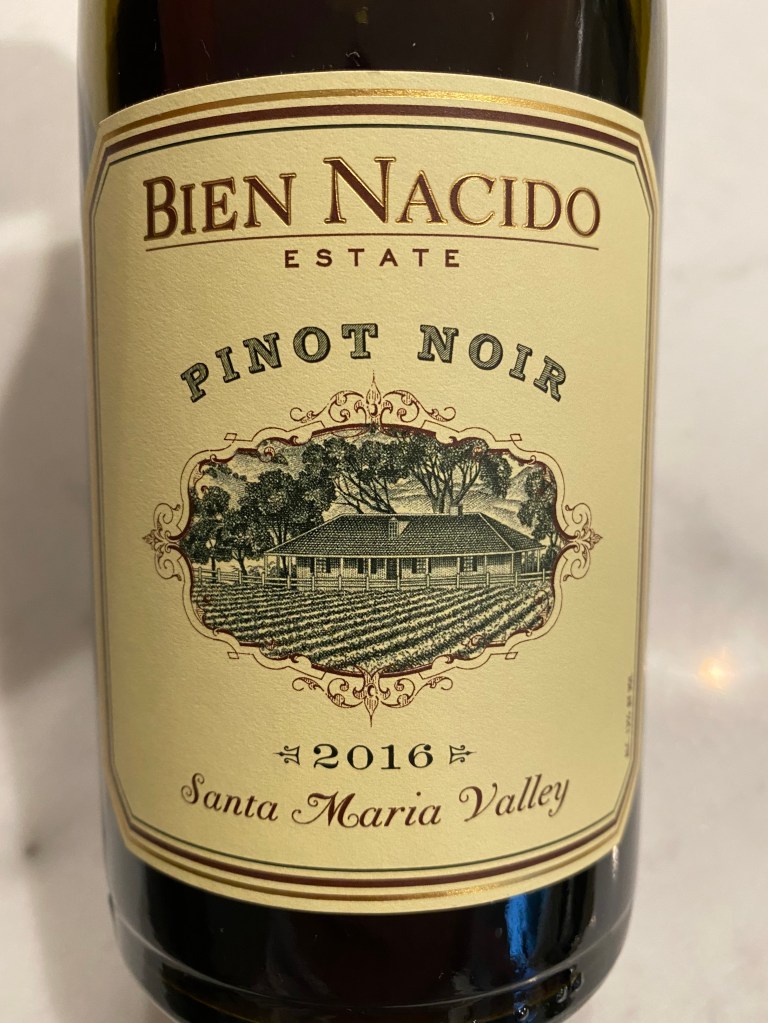
Today’s Story: Bien Nacido Vineyards

Bien Nacido Vineyards traces its history to 1969 when brothers Bob and Steve Miller (whose family had been farming in California since 1871) acquired what they thought was an ideal plot of land to plant vineyards. Bien Nacido, as the vineyard was named, was planted by 1973 (the first vintage) and consisted of about 300 acres of Pinot Noir and Chardonnay. Though the estate’s vineyards have grown dramatically over the years and now include varieties of Syrah, Merlot, Viognier, and others, it is the initial 300 acres that demonstrated the immense promise of winemaking in the Santa Maria Valley. Situated at high elevations and not far from the Pacific Ocean, Bien Nacido is one of the most famous and revered vineyards in California winemaking for Pinot Noir and Chardonnay. In addition to Bien Nacido Vineyards crafting estate wines, there are a number of producers each leasing their own rows or blocks and crafting wines from this historic land.

I would be remiss, however, if I did not discuss the history of the Bien Nacido land before it was planted to vineyards. In 1837, the land was actually part of one of the first Spanish land grants where two square leagues went to Tomas Olivera. Tomas named his land Rancho Tepusquet after a nearby creek, and later sold the property in 1855 to his son-in-law Don Juan Pacifico Ontiveros who built a home on it. Alongside his wife, Don Juan raised horses and some livestock, planted grains, and produced small amounts of wine from grapes they planted. Though the vineyards of Bien Nacido today surround Don Juan’s home, the initial estate planted by the Miller brothers in 1969 sprung from grazing lands.

Today’s Wine: 2016 Estate Pinot Noir

100% Pinot Noir; 13% ABV

The 2016 Estate Pinot Noir is medium ruby in color and mostly opaque. Given 30 minutes or so to open up in the glass, the wine showcases a nose of black cherry, black raspberry, red and purple florals, dried tobacco, forest floor, underbrush, baking spice, and pepper. Moving onto the palate, I get notes of cranberry, pomegranate, wild strawberry, leather, loamy earth, game, crushed rock, green herbs, and iron. This is medium-bodied with medium (+) acidity, light tannins, and a medium (+) length finish. 415 cases produced.

Price: $50. I think this is right around fairly priced, but on a value perspective it doesn’t blow me away. The wine offers everything I love in California Pinot Noir (lower ABV, solid depth, and Burgundian feel), but there are some less expensive options that achieve the same. Pair with herb-roasted chicken, duck breast, or turkey sausage and mild blue cheese.