The 2014 Les Clos is gorgeous deep gold in color and transparent. I let this open up in the glass for about 45 minutes to an hour and the nose showcases aromas of lemon citrus, white peach, stone fruit, golden apple, white florals, saline minerality, brioche toast, toasted almond, and marine limestone. On the palate, I get notes of golden pear, lemon, orange zest, green apple skins, brine, white lily, honey, beeswax, and chalk. This beauty is full-bodied with mouthwatering high acidity and a plush, well-rounded mouthfeel into a long finish. An incredibly precise and intense wine, I recommend giving this another 7-10 years in the bottle to add additional complexities.
Price: $80 (though this seems difficult to find online and my CellarTracker gives it a value of $100). This is an absolutely beautiful value for Grand Cru Chablis, drinking like one of the best that I’ve had. If you are able to find this for $100 or less, you cannot pass it up. Pair this with shellfish, foie gras, or spaghetti carbonara.
Beaumont Family Wines, as the name implies, is a small family owned and operated winery established in 1974 by Jayne and Raoul Beaumont in Bot River, South Africa. Though the farm was originally established in the 1700s by the Dutch East India Company and is home to the region’s oldest wine cellar, its wine business did not start until the 1940s and halted during the late 1960s. When Jayne and Raoul replanted some of the vineyards and started producing their wines, they established the goal of producing small quantities of high quality wines including Chenin Blanc, Pinotage, Syrah, Mourvèdre, and various blends. All of the wines are crafted to showcase the terroir, so Beaumont practices minimal intervention and traditional winemaking methods including the use of natural yeasts for fermentation and old open concrete fermenters.
For more about Beaumont Family Wines or to browse their portfolio, check out the website here!
Today’s Wine: 2016 Pinotage
100% Pinotage; 14% ABV
The 2016 Pinotage is opaque deep ruby in color and produces moderate staining on the glass. Once this opens up, the nose showcases aromas of blackberry, wild blueberry, juicy black plum, smoked game, sweet tobacco, menthol, rocky mineral, and mixed nuts. On the palate, I get notes of black cherry, jammy blackberry, fig, muddled strawberry, black raspberry, licorice, dried rocky soil, mocha, and smoke. This is medium- to full-bodied with high acidity, medium tannins, and a long finish. 60 barrels produced.
Price: $33. This is a great price-point for the wine and is fairly accessible for those who want to explore South Africa’s signature variety. A cross between Pinot Noir and Cinsault, Pinotage is a fun variety to try for those who like Pinot Noir or want to expand their horizons. Pair this with venison, smoked duck, or a meat lover pizza.
Mount Eden Vineyards was established in 1945 in the Santa Cruz Mountain Appellation of California, with a focus of crafting small lots of Cabernet Sauvignon, Chardonnay, and Pinot Noir. Located at an elevation of 2,000 feet above the Santa Clara Valley floor, Mount Eden Vineyards is widely considered one of the first “boutique” California wineries and remains true to this philosophy today. Mount Eden believes every bottle is an expression of their terroir and thus winemaker Jeffrey Patterson spends most of his time in the vineyards connecting to his fruit and vines and centering his efforts on producing quality (not high-quantity) fruit. Part of Jeffrey’s focus in the vineyards is also making sure that this land will produce quality fruit for generations to come, so he feels deeply connected to the need to care for his vineyards. In the cellar, Jeffrey practices minimal intervention and all fruit is handled gently before going through fermentation using only natural yeasts. For more on the history of this wonderful winery, check out their website here.
Today’s Wine: 2015 Pinot Noir
100% Pinot Noir; 13.5% ABV
The 2015 Pinot Noir is pale ruby in color and moderately opaque. This is incredibly young and needs a couple hours to open up, but once it does the nose showcases aromas of cherry, black raspberry, black olive, mint, freshly ground green herbs, pine, charred cedar, leather, rocky earth, and incense. Once on the palate, the wine displays notes of tart cherry, dried strawberry, boysenberry, crunchy cranberry, red licorice, rose petal, sweet tobacco, scorched earth, underbrush, rocky minerality, and exotic spice. This is medium-bodied with an incredibly elegant and velvety mouthfeel, vibrant medium (+) acidity, medium (-) tannins, and a long finish. 936 cases produced.
Price: $65. This is an incredibly high-quality Pinot Noir that drinks on par or better than many $100 Pinot Noirs I’ve enjoyed. The one thing to keep in mind, though, is you need to be patient with this and give it at least another 5-7 years of bottle age. Pair this with rack of lamb, herb grilled pork chops, or eggplant parmigiana.
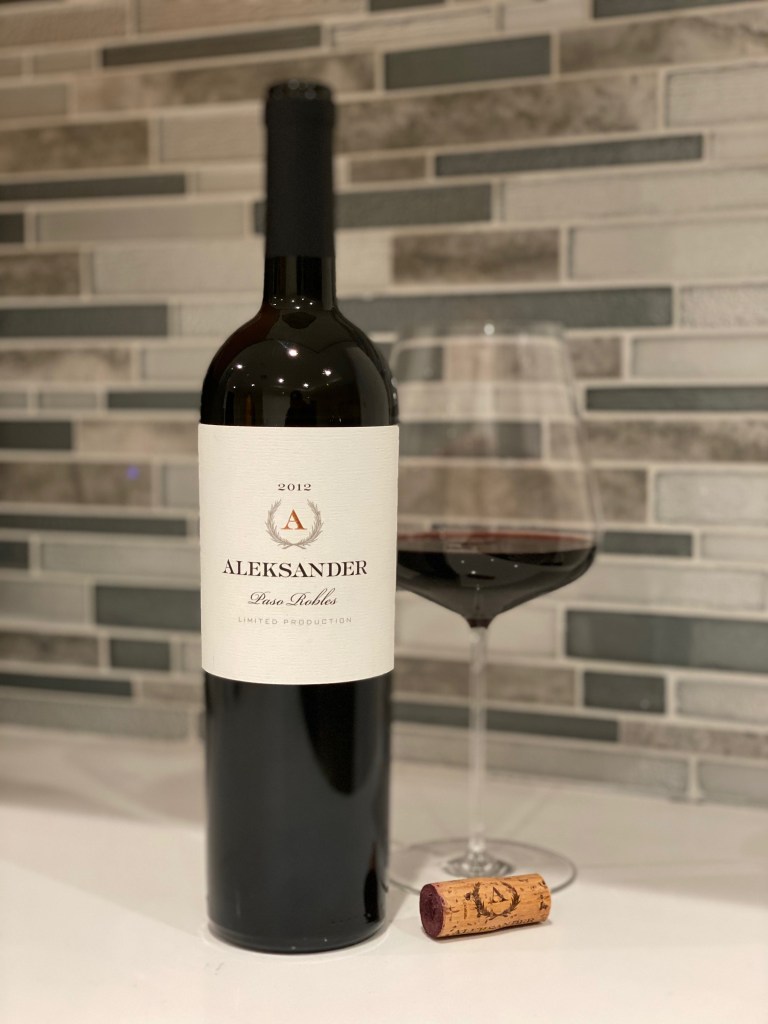
Aleksander is a small, family-owned boutique winery established by NBA player Sasha Vujacic and his family when his parents Goran and Ksenija discovered their property in 2009. On what became S&G Estate, a 30 acre property in Paso Robles complete with estate vineyards and its own winery, Aleksander produces Merlot-dominant Bordeaux blends in a “White Label” bottling and a “Reserve” bottling. Aleksander ages their wines in a mix of French, Serbian, and Eastern European oak barrels with the White Label wines calling them home for a minimum of 18 months and the Reserve wines a minimum of 24 months. All wines are aged in the bottles a minimum of 10 months before release.
The 2012 Aleksander is opaque deep ruby in color with deep purple hues in the bowl. Once this opens up, the nose showcases aromas of blackberry, blueberry, plum, black cherry, redcurrant, violet, loamy soil, wet slate, cigar box, chocolate, and oaky spice. On the palate, I get notes of cassis, anise, blackberry, baked cherry, worn leather, wet gravel, charred earth, ground coffee, dark chocolate, baking spice, and oak. This wine is medium- to full-bodied with high acidity, medium (+) tannins, and a medium (+) length finish.
Price: $70. This is a very solid wine, though it is certainly toward the higher end of price-point I’ve paid for Paso Robles Bordeaux blends. That being said, I think this does stand up to a lot of the Napa wines in this price range and this, while being restrained in ABV and not a jammy fruit bomb, should have broad appeal. Pair this with roasted duck breast, filet mignon, or herb-grilled pork.
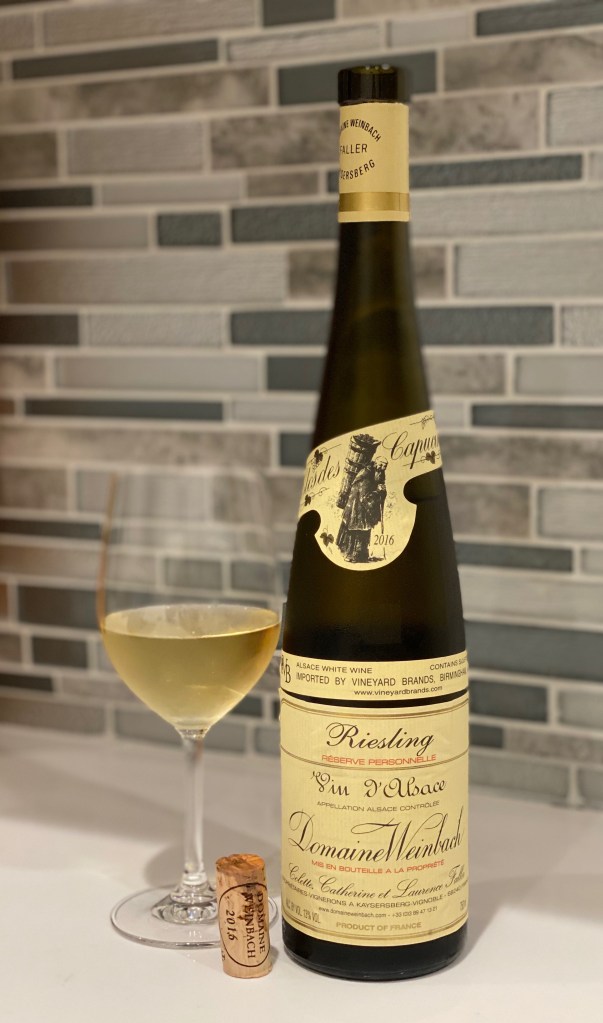
Domaine Weinbach was established in 1612 by Capuchin friars and is named for the stream meandering through the property. Located at the foot of a hill called Schlossberg in Alsace, France, the property has been planted to vine since as early as the 9th century and the vineyards are surrounded by ancient walls named Clos des Capucins. During the French Revolution, the domaine sold as national property though came into the Faller family when two brothers acquired it in 1898. Domaine Weinbach remains in the family today and passed to Théo who expanded and improved the winery; then Colette (Théo’s wife), Catherine, and Laurence; and finally to Eddy and Théo who currently work alongside their mother Catherine. The domaine now totals 28 hectares which, since 2005, are entirely farmed according to biodynamic principles. All harvesting is accomplished by hand, and minimal intervention takes priority in the cellar.
Today’s Wine: 2016 Riesling Réserve Personnelle
100% Riesling; 13% ABV
The 2016 Réserve Personnelle is transparent and medium straw in color with water-white near the rim. On the nose, I get aromas of melon, lemon citrus, stone fruit, green apple, honeysuckle, petrol, saline minerality, and vanilla. Once in the mouth, the wine showcases notes of white peach, pear, pineapple, apricot, white florals, petrol, crushed rock, mineral, cream, and straw. This is medium- to full-bodied with high acidity and a long, mouthwatering finish.
Price: $30. This is a great entry price to explore Alsatian Riesling, which alongside Mosel, Germany produces some of my favorite wines with the variety. Pair this with smoked whitefish, Thai food, or charcuterie with goat cheese.
d’Arenberg (known as Bundarra at the time) was established in 1912 by Joseph Osborn in McLaren Vale after he sold his stable of prize winning race horses to purchase the property. They planted their first vineyards to 8 acres of Shiraz, though only 4 acres survived, and Joseph and his son Frank harvested their first vintage in 1913 and sold the fruit for £20 per ton. In 1927, Frank’s brother-in-law encouraged him to produce his own wine and, after studying winemaking at Ryecroft, he produced his first red table wine and port labeled Bundarra Vineyards by F. E. Osborn & Sons in 1928.
During WWII, Frank’s health deteriorated and he halted wine production in 1942 until his son d’Arry left school at the age of 16 to work at the family winery. d’Arry oversaw several great technological advances, including the use of McLaren Vale’s first rubber-tired tractor in 1946 and electricity in 1951. Several years later, d’Arry established his own wine label named for his late mother and adorned it with the family crest and signature red stripe. In 1965, the Bailey family who owned a well-established winery in Glenrowen, Victoria named Bundarra challenged d’Arry’s use of Bundarra so d’Arry decided to drop the name from his vineyard and wines.
Over the next couple years, d’Arenberg expanded with a second tasting room to accommodate increasing numbers of visitors and installed their own bottling line. During the 1970s, d’Arenberg rose to new heights by winning several awards for their 1967 Burgundy which proceeded accolades by their Rhine Riesling and Port. In 1984, d’Arry’s son Chester Osborn took over as chief winemaker and set about restoring traditional winemaking methods such as foot treading and basket pressing while eliminating fertilizer and minimizing irrigation in the vineyards to reduce yields. In 1988, d’Arenberg exported their Shiraz and Shiraz Grenache blend wines to Europe for the first time which marked another milestone in the brand’s global acceptance.
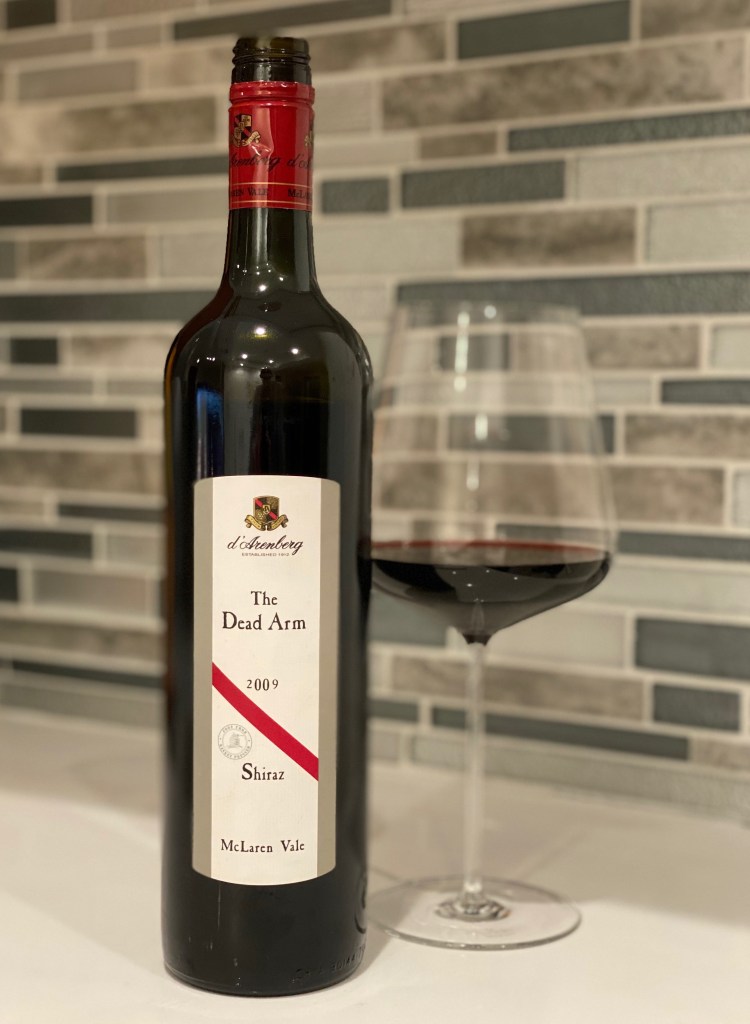
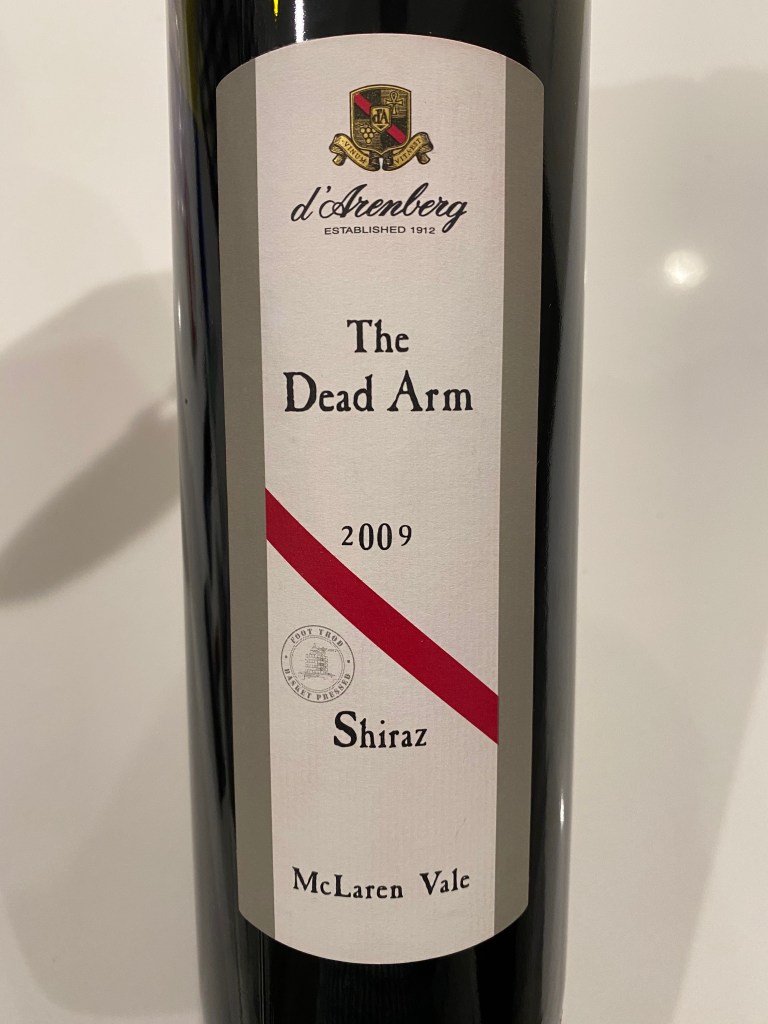
A man striving to reach new heights, Chester became one of the first to plant white Rhône varieties in McLaren Vale in 1995/1996 with 10 acres of Marsanne, 9 acres of Roussanne, and 14 acres of Viognier. Since then, Chester racked up an impressive resume of awards and trophies for both himself and the d’Arenberg winery. One of their highly awarded wines, The Dead Arm Shiraz, is what I am reviewing today and it was first released in 1993. Dead Arm is caused by the fungus Eutypa lata and affects old vines by slowly reducing one half (or arm) of the vine to dead wood. At most wineries, these vines are pruned, replanted, or abandoned but d’Arenberg sustains these low yielding vines to produce powerful and concentrated wines. The fruit for this wine is kept separate throughout the winemaking process and given extra care before being passed through a gentle roll crusher in small batches before foot treading and basket pressing. Primary and secondary fermentation is accomplished in used French and old American oak barriques and the wine is aged for 20 months on lees. Chester and his team select the best barrels for final blending and this is bottled with no fining or filtration.
Today’s Wine: 2009 The Dead Arm Shiraz
100% Shiraz/Syrah; 14.5% ABV
The 2009 Dead Arm is deep garnet in color and completely opaque. This demands an hour-plus to open up, but once it does the nose showcases aromas of blackberry, baked black cherry, redcurrant, licorice, smoke, chocolate, coffee, forest floor, underbrush, and charred red meat. Once on the palate, the wine offers notes of blackcurrant, juicy plum, cherry, tobacco, loamy soil, black pepper, wet crushed rock, mocha, tar, and oak. This is full-bodied with high acidity, medium (+) tannins, and a long finish dominated by flavors of dark berries and char. The wine is powerful yet balanced with the structure to go at least another 5 years.
Price: $60 (though slightly cheaper overseas). This is an outstanding value that drinks like some of the “higher end” Shiraz out of Australia. Pair this with herb-roasted leg of lamb, barbecue spareribs, or strong hard cheeses.
Château Montrose is a historical Bordeaux wine estate located in Saint-Estèphe and established in 1815 by Etienne Théodore Dumoulin on a patch of land his family purchased from Nicolas Alexandre de Ségur but largely forgot. At the time of Etienne’s death in 1861, the estate spanned 95 hectares though his heirs sold it in 1866 to factory owner Mathieu Dollfus who quickly redeveloped and modernized the buildings and winery with the best technology of the time. One of Mathieu’s most interesting achievements, in my opinion, is the construction of a windmill to pump water aboveground and flood the estate which ultimately saved much of the vineyards from phylloxera. After Mathieu passed away in 1886, the estate fell to the Charmolüe family who, from 1896 to 2006, guided Château Montrose through wars and financial crises while crafting some of the best vintages and providing stability. Martin and Olivier Bouygues acquired the estate in 2006 and engaged in a massive renovation project, propelling Château Montrose to ever increasing heights for decades down the road. Montrose, one of fourteen Deuxièmes Crus (Second Growths) in the Bordeaux Wine Official Classification of 1855, produces world-class wines and even placed third with their 1970 vintage in the Judgment of Paris in 1976.
To learn more about this great estate, check out their website here. In particular, I recommend checking out the “From Vine to Wine” section!
The 2016 La Dame de Montrose is opaque deep ruby and nearly black at its core with purple hues. I decanted this for 6 hours (wanted a preview of my Grand Vins still in hiding) and it needed every second of it. On the nose, I get aromas of blackberry, crème de cassis, black plum, pencil shavings, cigar box, finely crushed rock, dried earth, chocolate, black pepper, and oak. Once in the mouth, the wine showcases notes of blackcurrant, blueberry, cherry, redcurrant, graphite, loamy soil, slate, tobacco, spice box, and toasted oak. This is full-bodied with medium (+) acidity, high tannins, and a long finish. The wine is incredibly promising, and makes me excited to try the Grand Vin in 15 years.
Price: $50 (though you can find steals closer to $40). This is an absolute rockstar for value from the utterly incredible 2016 vintage, though you will have to be patient. Pair this with steak, grilled leg of lamb, or a high-end burger.
Paolo Scavino was founded by Lorenzo Scavino and his son Paolo in 1921 in Castiglione Falletto within the Barolo region of Italy. Throughout its history, Paolo Scavino remains a family endeavor born on traditions of farming and today Enrico Scavino (3rd generation) and his daughters Enrica and Elisa (4th generation) operate the estate. Enrico is nearly 70 years into his work at the winery (he started in 1951 at the age of 10) and he has been instrumental in expending the estate’s holdings to include some of the greatest crus in all of Piedmont. With 30 hectares of vineyards across 20 crus in Castiglione Falletto, Barolo, La Morra, Novello, Serralunga d’Alba, Verduno, and Roddi, Paolo Scavino grows the traditional grapes of Nebbiolo, Barbera, and Dolcetto.
Today’s Wine: 2013 Barolo
100% Nebbiolo; 14.5% ABV
The 2013 Barolo is deep garnet in color and moderately opaque. This needs a good two hour decant, but once it opens up the nose emits aromas of cherry, strawberry, black raspberry, blackberry, anise, dried leather, tobacco, truffle, garden herbs, and oak. On the palate, I get notes of muddled raspberry, black cherry, pomegranate, licorice, rose, crushed granite, scorched earth, chocolate, clove, black tea, and cigar box. This wine is full-bodied with high acidity, medium (+) tannins, and a long finish.
Price: $43. This is a great value Barolo from an outstanding vintage, though I suggest giving it another 3 years in bottle and consuming over the following decade. Pair this with veal chop, venison steak, or assorted cheeses.
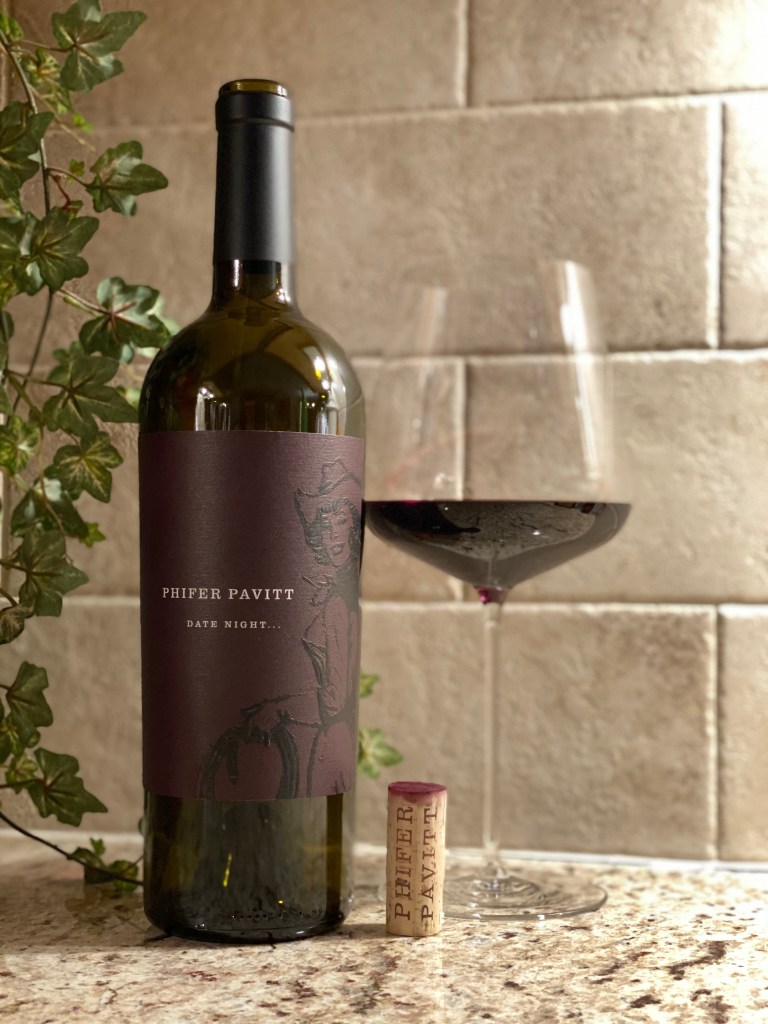
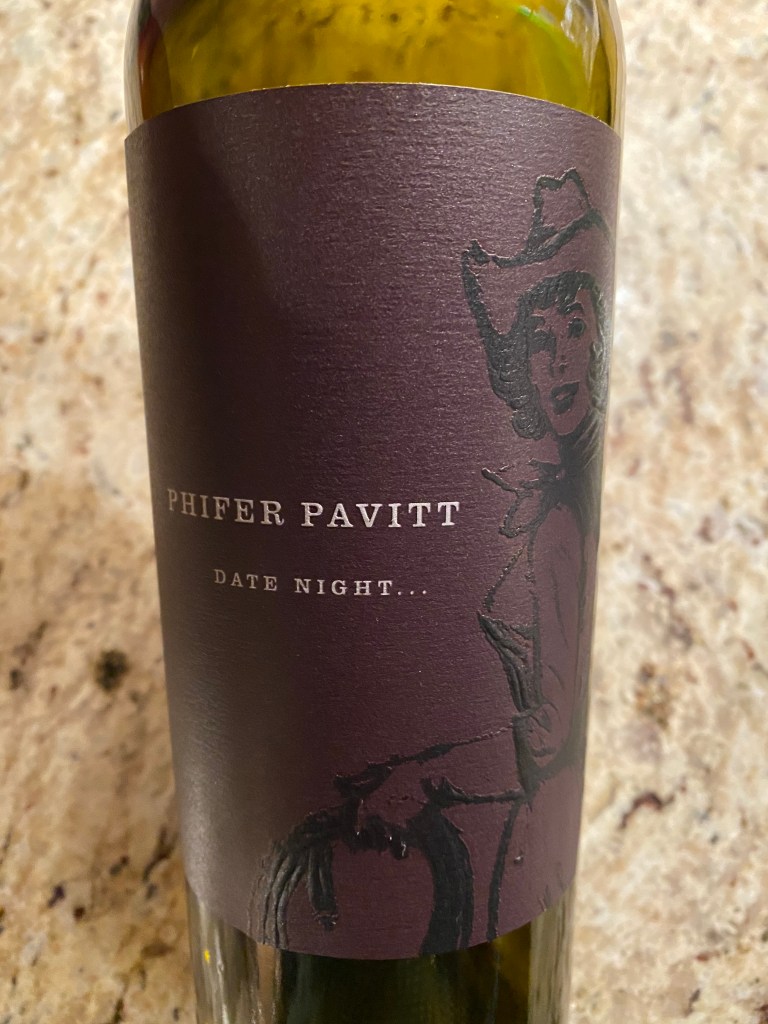
Phifer Pavitt is a boutique, family-owned winery located in the Napa Valley (Calistoga) and owned by Suzanne Phifer Pavitt and her husband Shane Pavitt. Though Suzanne grew up in rural Georgia and Shane in Manhattan Beach, CA, the couple share a love of wine and explored properties along the west coast before ultimately purchasing their property in 1998. Since their first vintage in 2005, Suzanne and Shane source their Cabernet Sauvignon from Temple Family Vineyards in Pope Valley and, since the first vintage in 2011, Sauvignon Blanc from Juliana Vineyards also in Pope Valley. Phifer Pavitt’s signature wine, the Cabernet Sauvignon named “Date Night,” is inspired by Suzanne and Shane’s weekly date night when they typically enjoy a bottle of wine and each other’s company away from work and the chaos everyday life can bring. On these weekly date nights, Suzanne and Shane seem to make decisions that greatly change their life’s scope (from career changes to family planning) so it makes sense their decision to purchase the property for Phifer Pavitt resulted from one of these nights as well. The couple’s wines are generally Bordeaux in style, and they have worked with winemaker Ted Osborne since the winery’s inception with Cabernet Sauvignon and father/father-in-law Gary Warburton with Sauvignon Blanc.
Today’s Wine: 2011 Date Night Cabernet Sauvignon
98% Cabernet Sauvignon, 2% Petit Verdot; 14.5% ABV
The 2011 Date Night is medium to deep ruby in color and almost fully opaque. Once this opens up, the nose showcases aromas of blackberry, plum, black cherry, violet, green pepper, scorched earth, chocolate, bacon fat, green herbs, crushed rock, and oak. There is some heat that needs some time to blow off as well. On the palate, I get notes of blueberry, spiced plum, blackcurrant, fig, licorice, tobacco, caramel, baking spice, wet rock, loamy soil, and smoke. This wine is medium- to full-bodied with medium (+) acidity, medium tannins, and a medium (+) length finish with added notes of iron and oak.
Price: $80. This is a tasty wine, but it’s up in that price-point where it faces significant competition from great value wines that I think pack a bit more of a punch for your “investment.” Pair this with roasted rack of lamb, a blue cheese burger, or braised beef short ribs.
Bodegas Muga is a family-owned winery established in 1932 in Haro, La Rioja, Spain by Isaac Muga and his wife Aurora Caño. Their children, Manuel and Isacín, picked up the baton to carry the winery into its second generation, however it is truly the current third generation responsible for modernizing the estate. Manuel’s sons Manuel, Juan, and Eduardo look after management of the estate, sales, and marketing, whereas Isacín’s sons Jorge and Isaac work in viticulture and winemaking. In recent past, Jorge shifted toward more complex blending in his wines by utilizing typically 20-30% of native varieties besides Tempranillo, particularly Garnacha, Graciano, and Mazuelo. For all of their wines, Muga utilizes classical winemaking methods and fermentation, aging, and storage is accomplished in oak barrels produced by their very own cooperage. The wines are racked using gravity every four months and before bottling they are fined using egg whites. Some of the wines (such as the one I’m reviewing today) are bottled unfiltered.
A relatively large winery, Muga owns 250 hectares of vineyards and produces roughly 1.5 million bottles of wine annually. With their vineyards planted to Tempranillo, Garnacha, Mazuelo, Graciano, Viura, and Malvasía, Muga’s portfolio includes a broad range of wines from White and Rosado to Red Rioja Reservas and Cava (sparkling). You can visit their website here.
The 2013 Rioja Reserva is nearly fully opaque medium ruby in color. I decanted this for about an hour and the nose opens to express aromas of black cherry, plum, blackberry, purple and blue florals, leather, charred earth, tar, chocolate, vanilla, and oak. On the palate, I get notes of blackcurrant, blackberry, cherry, black raspberry, cola, tobacco, slate, dried rocky earth, green herbs, and smoky mineral. This wine is medium- to full-bodied with medium (+) acidity, dusty medium tannins, and a long finish.
Price: $25 ($16-$18 in Europe). This is an incredible value that drinks with refined elegance now but still has gas in the tank to go another 5+ years. Pair this with roasted pork loin, veal, lasagna, or Manchego cheese.








 JB's Wine Talk