Teso la Monja was founded in 2007 by Marcos and Miguel Angel Eguren, however the history of their family in Spanish winemaking stretches much deeper. The Eguren family has been cultivating vines and producing wine in Rioja Alavesa since 1870 and today carries their culminated knowledge down five generations. The Eguren family, alongside Jorge Ordóñez, have been instrumental in the revitalization of the Toro DO and were the original founders of Bodegas Numanthia in the region. When the family sold Numanthia in 2007, they did not want to abandon their projects in Toro and Teso la Monja was born. With Marcos as winemaker and his son Eduardo assisting, we have the fourth and fifth generations of this family once again continuing their tradition of passing along knowledge of crafting exquisite wines.
Teso la Monja is one of six wineries the family operates under the Viñedos y Bodegas Sierra Cantabria umbrella. If you have an interest in exploring their other labels, check out the website here.
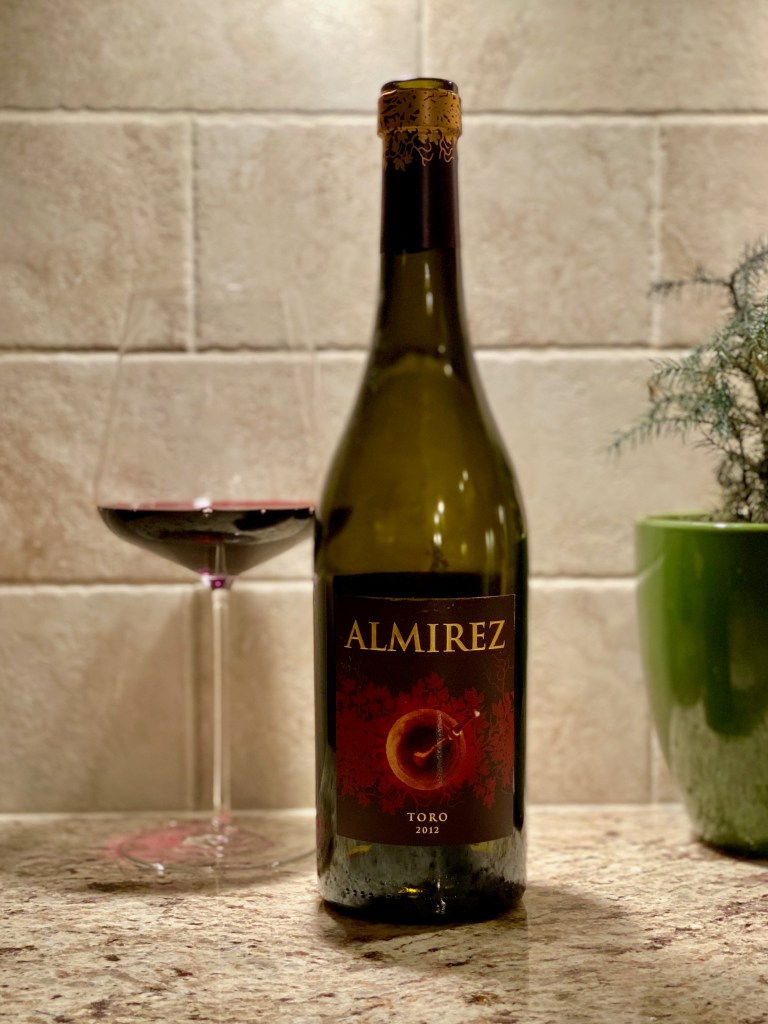
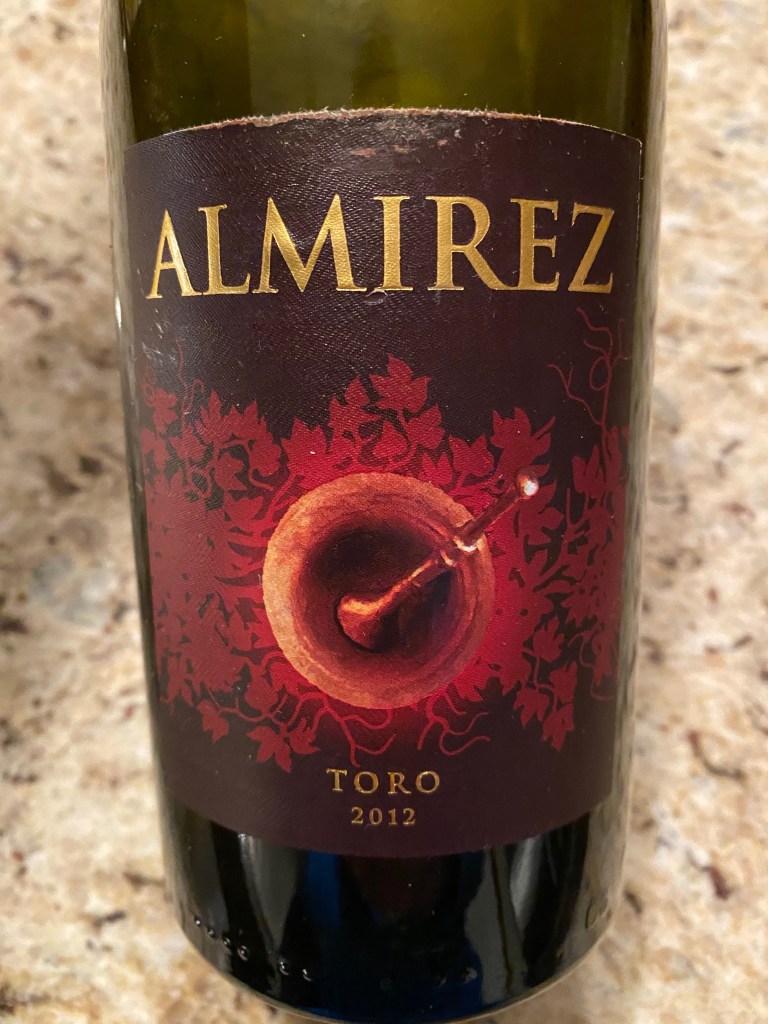
Today’s Wine: 2012 Almirez Toro
100% Tinta de Toro (Tempranillo); 14.5% ABV
The 2012 Almirez is opaque deep purple in color. I decanted this for about 30-45 minutes before trying the wine and the nose opens to reveal aromas of cherry, plum, figs, red licorice, tobacco, earth, shoe leather, and oak. Once in the mouth, the wine displays notes of blackberry, black cherry, bay leaf, dried fig, chocolate, forest floor, dried herbs, and nutmeg. This Tinta de Toro is full-bodied with medium (+) acidity, medium (+) tannins, and a long finish.
Price: $20. Typically a price-point for some great value Toro wines, however this one is a bit unbalanced and either needs more time in the cellar or I would suggest trying a different wine. Pair this with pizza, barbecue chicken, or tomato sauce pasta.
Beaulieu Vineyard is one of the most historic wineries in Napa Valley, founded in 1900 by Georges de Latour and his wife Fernande. I wrote about them previously in A Winery Synonymous with Napa Valley Itself when I reviewed the 2014 Tapestry Reserve, as well as in The Maestro when I reviewed the 2010 Maestro Collection Ranch No. 1. If you are not familiar with the history of BV, I highly suggest reading my first post linked above or checking out their website. Today, I will provide you with a little background on their famous Clone wines.
BV produces two highly limited wines with a clone designation, the Clone 4 and Clone 6. BV selected both clones after a 14-year series of trials with UC Davis that began in 1980 because they wanted to determine which clones best suited the terroir for their Rutherford vineyards. The Clone 6 (aka Jackson clone) was first planted during the 1880s by UC Davis professor Eugene Hilgard at the field station at Jackson in the Sierra Foothills, however it was abandoned until the past several decades. Clone 6 is characterized by small loose clusters and small berries that yield concentrated flavors and muscular tannins. The Clone 4 (aka Mendoza clone), meanwhile, was identified and isolated in Argentina before coming to the United States and is characterized by tight clusters of large berries that yield lush and opulent wines. Both Clone 4 and Clone 6 are components for the Georges de Latour and other reserve Cabernet Sauvignon bottlings.
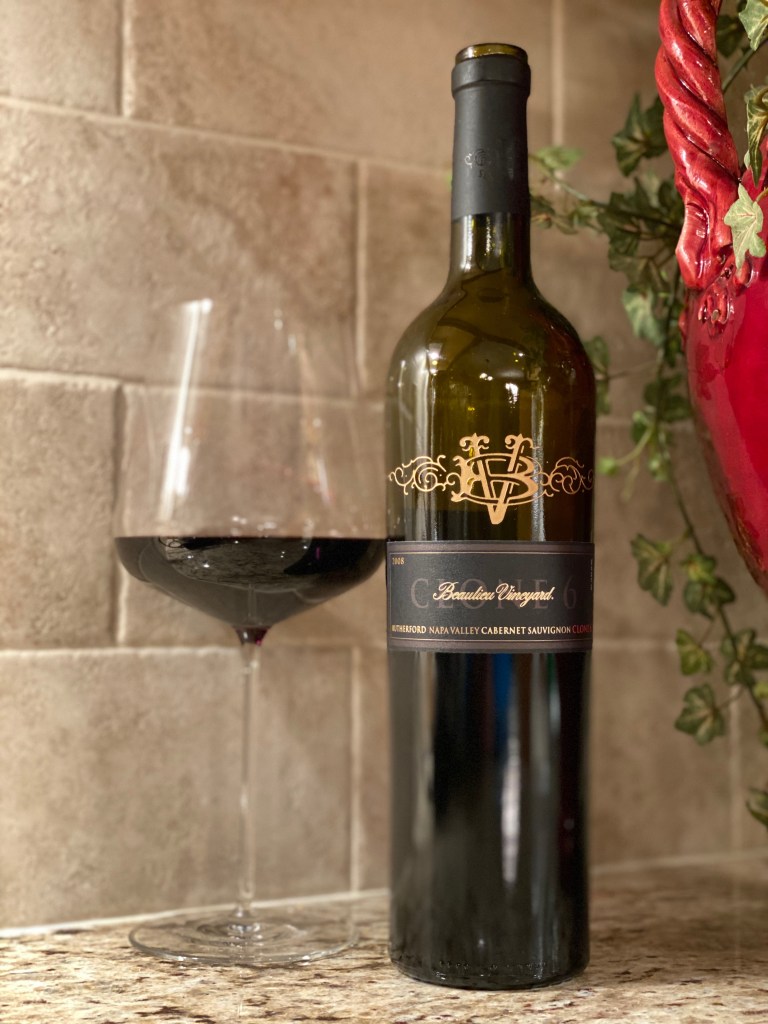
Today’s Wine: 2008 Clone 6
100% Cabernet Sauvignon; 14.9% ABV
The 2008 Clone 6 is opaque deep ruby in color with purple hues at its core. I let this open up in a decanter and the nose showcases aromas of blackberry, blackcurrant, anise, ripe red fruit, forest floor, earthy mushroom, tar, smoke, tobacco, and some oaky spice. Once in the mouth, this wine displays notes of blackberry, blueberry, black cherry, prune, redcurrant, black licorice, coffee bean, cigar box, scorched earth, dried underbrush, black pepper, and oak. This utterly complex and gorgeous wine is full-bodied with medium (+) acidity, medium refined tannins, and a long finish with some inky black fruit notes. The 2008 Clone 6 is not slowing down anytime soon, still full of fruit character and not taking on a ton of tertiary notes or any sediment in the bottle.
Price: $225 on BV’s website (though we purchased this from them in 2015 for ~$150). This is a great special celebration Cabernet Sauvignon, though their less-expensive Georges de Latour ($145-175 depending on vintage) is just as good if not better. Pair this with steak, lamb, or pepper-crusted ahi tuna.
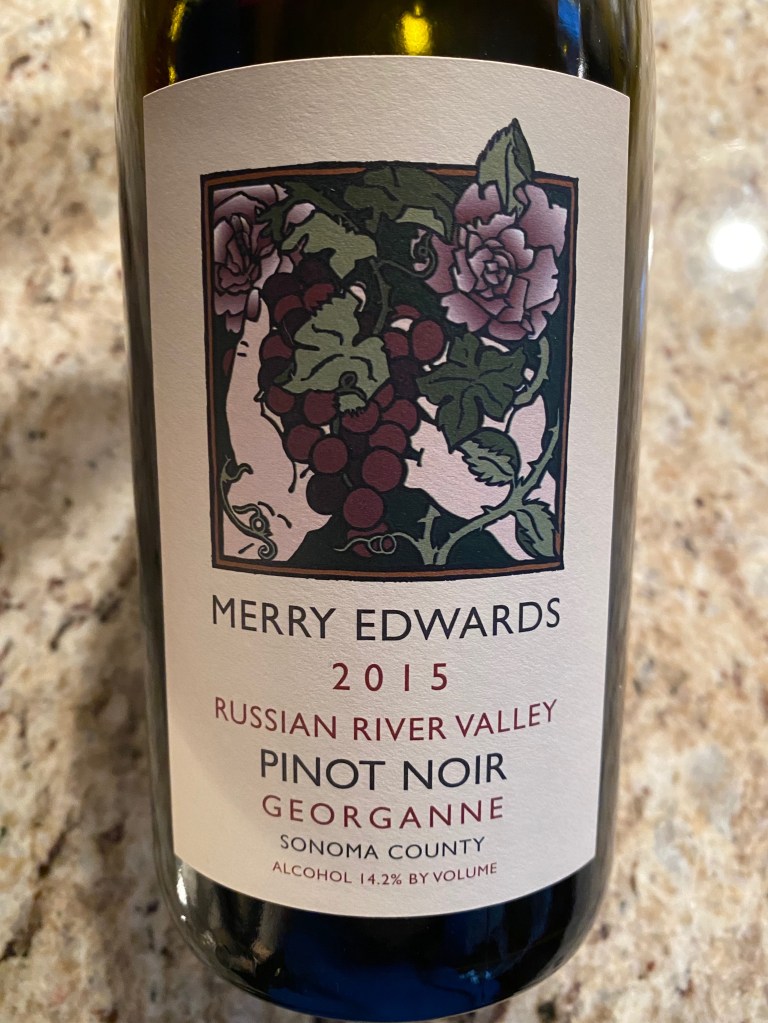
Merry Edwards Winery was established in 1997 by Merry Edwards and her husband Ken Coopersmith. However, Merry experienced quite a successful career before creating her namesake winery starting with her master’s degree in Food Science with an emphasis in Enology from UC Davis in 1973. After graduation, Merry fought to become a winemaker (not a lab technician like many women in the field during that time) and she was ultimately hired by Mount Eden Vineyards in February 1974 as winemaker. Merry spent three vintages with Mount Eden and during 1975 selected some of their Pinot Noir cuttings to send to UC Davis for heat treatment and propagation which resulted in UCD clone 37 (the “Merry Edwards selection”) that is planted in the Georganne Vineyard which sources fruit for the wine I am reviewing today.
In 1977, Merry Edwards spent time in France studying clone research at the University of Beaune and later moved to Sonoma County to become the founding winemaker of Matanzas Creek Winery. Shortly thereafter, Merry purchased property in the Russian River Valley in 1981 with plans for a family winery and built Merry Vintners Winery (focused on Chardonnay) in 1984 alongside her consulting business. Several years later, in 1996, Merry purchased 24 acres of what would become the Meredith Estate Vineyard and, in 1997 after meeting her would-be husband Ken, co-founded Merry Edwards Winery and produced her first namesake Pinot Noir.
Over time, Merry and Ken grew their holdings through vineyard purchases and leasing agreements and today produce Pinot Noir, Chardonnay, and Sauvignon Blanc. The Sauvignon Blanc is Merry’s favorite white wine from what I’ve heard, and it is indeed a must-try for any Sauvignon Blanc fan particularly those made in a Bordeaux Blanc style. This being said, Merry’s winemaking career that almost spans 50 years is dominated by her being a self-proclaimed perfectionist with a goal of producing wines that reflect the terroir rather than her own hand. Coupled with her winemaking philosophy, Merry also believes in sustainable farming and energy practices that help prolong both her own land and the environment around it. For more on Merry Edwards, check out the very extensive website here, as I could surely write an entire novel on this blog post and bog down your emails.
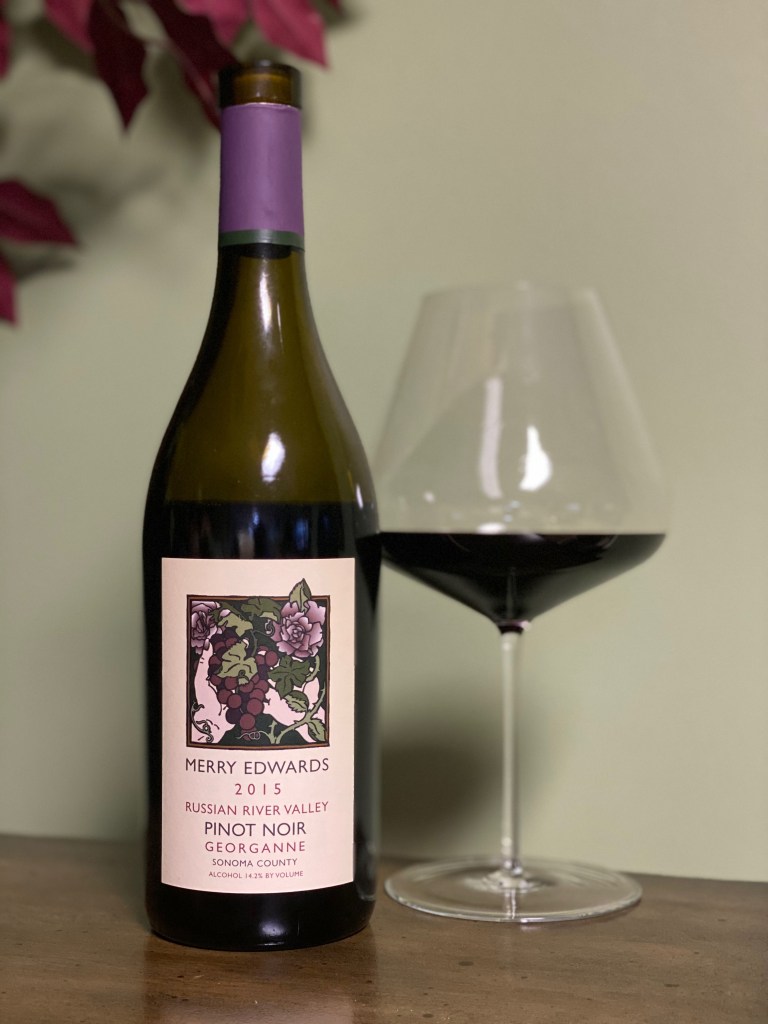
Today’s Wine: 2015 Georganne Pinot Noir
100% Pinot Noir; 14.2% ABV
The 2015 Georganne Pinot Noir is medium to deep purple/ruby in color and almost entirely opaque. I simply let this open up in the glass for 15-30 minutes to reveal aromas of black cherry, black raspberry, blueberry, acai, charred cedar, damp forest floor, wet gravel, blue and purple florals, and a hint of wild herbs mingled with peppery spice. Once in the mouth, this wine displays notes of cherry, dried raspberry, tart wild blueberry, red florals, sweet tobacco, loamy soil, mushroom, chocolate, clove, and oak. The wine is medium- to full-bodied with high acidity, medium (-) tannins, and a long finish dominated by herbaceous and cranberry tones.
Price: $63 upon release (I’m now seeing closer to $85 average online). Georganne is one of Merry Edwards’ newest vineyards and I am surprised by the elegance and finesse this wine displays as compared to some of her other vineyard designated wines that take more time in the bottle to blossom. Pair this with salmon, duck, or Panko-crusted rack of lamb.
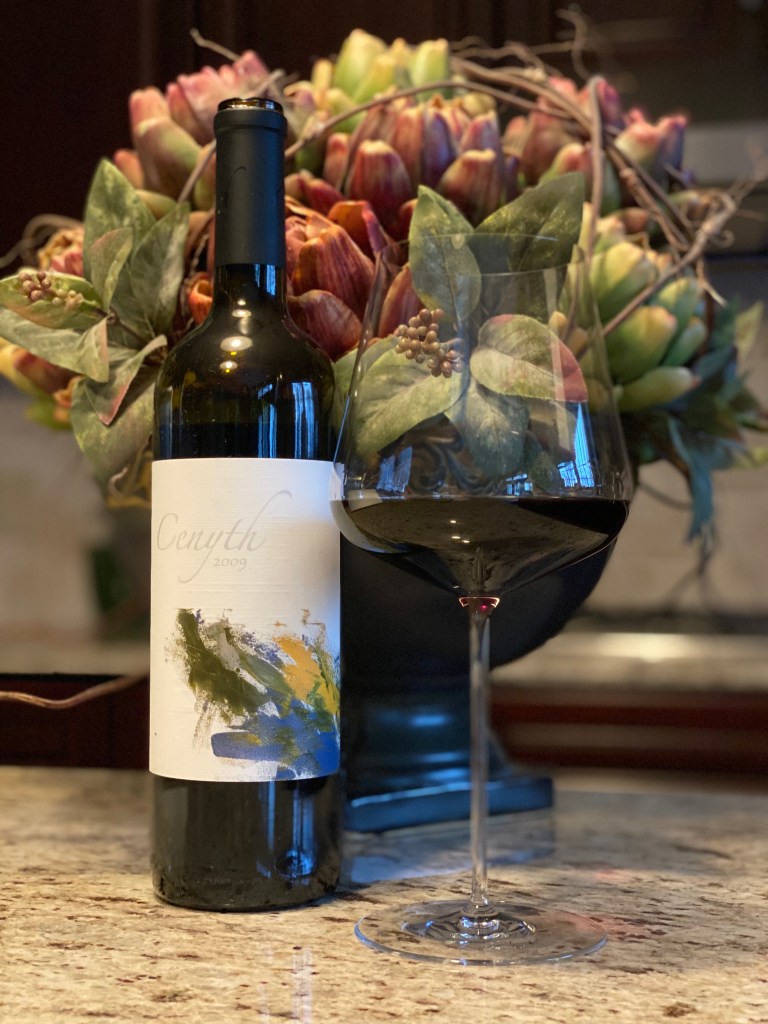
Cenyth was established in 2009 as a collaboration between winemaker Hélène Seillan and musician/artist Julia Jackson (daughter of Jess Jackson and Barbara Banke). Hélène Seillan is the daughter of renowned winemaker Pierre Seillan, the man behind Vérité winemaking and their micro-cru philosophy, and the two of them work together at Vérité as well. If you recall, I wrote about Vérité in Both Complexity and Elegance from Sonoma County when I reviewed the 2008 Le Désir and you can read a bit more about the winemaking style and history of the Seillan family there. While Hélène handles the wine at Cenyth, Julia created the label art and selected her palette in homage to Sonoma County: “blue for the Pacific Ocean, yellow for the mustard flowers, gray for the fog, and green for the vineyards.” While Cenyth represents the knowledge and mentorship Hélène gathered from her father over the years, it also represents the friendship between Hélène and Julia who grew up together in the vineyards of Sonoma County and France.
The 2009 Proprietary Red (Cenyth’s inaugural release) is deep purple in color with deep ruby variation near the rim. Once this opens up, the nose showcases aromas of blackberry, black cherry, redcurrant, licorice, tomato paste, green herbs, mint, tobacco, cedar, and a hint of vanilla. On the palate, I get notes of blackberry, blueberry, plum, cherry, mild forest floor, cigar box, black pepper, dried cooking herbs, rocky minerality, smoke, and oak. This wine is medium- to full-bodied with vibrant medium (+) acidity, medium tannins, and a long finish dominated by sappy red and black fruit alongside notes of iron.
Price: $60. Very solid value Bordeaux blend from Sonoma County, offering both complexity and the structure to go the distance. I am curious to try more recent vintages to see how style developed over the years. Pair this with ribeye steak, lamb, duck breast, or a good burger.
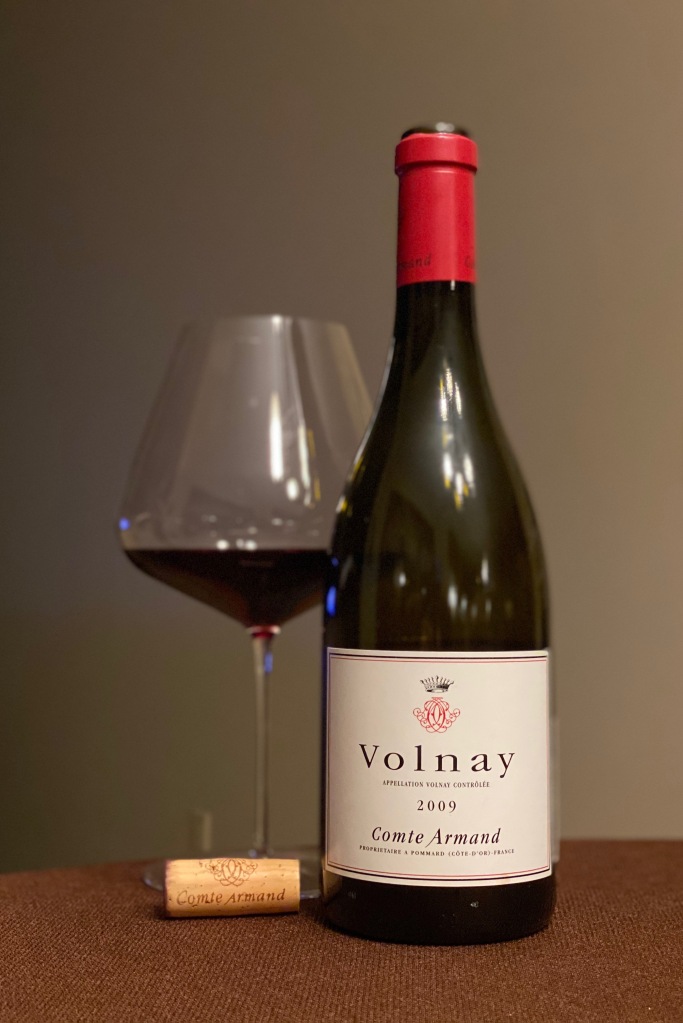
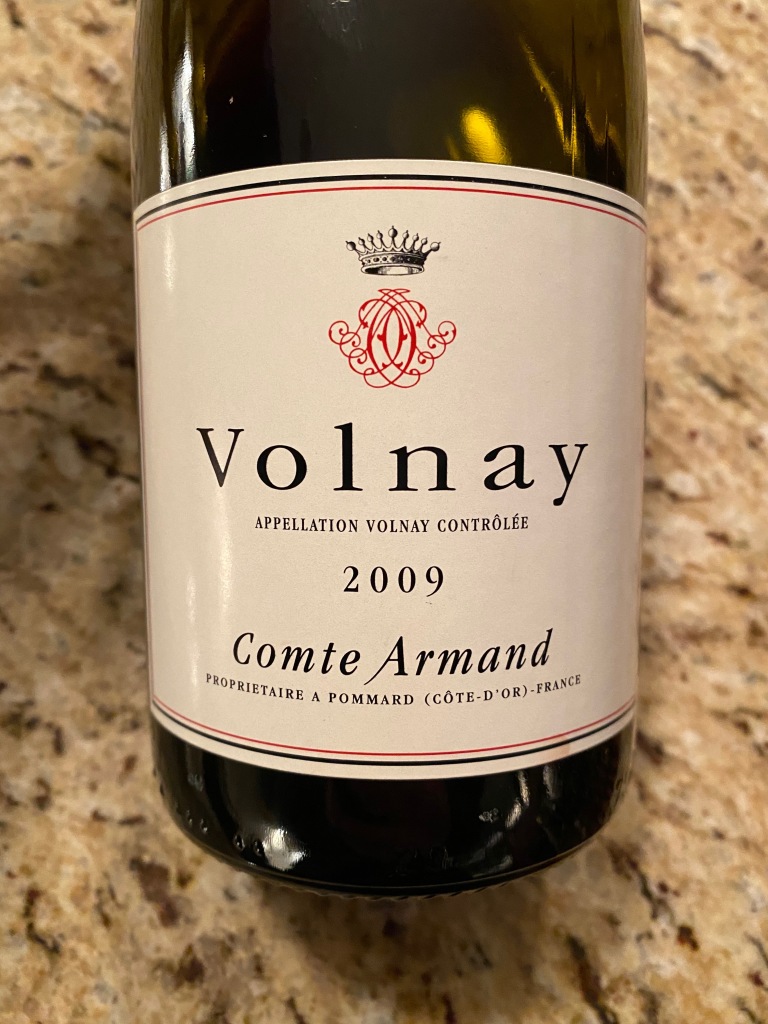
Domaine Comte Armand (also known as Domaine des Epeneaux) was established in the late 18th century when Nicolas Marey took ownership of the 5 hectare monopole Clos des Epeneaux. In 1828, the property came into the Comte Armand family and Clos des Epeneaux remained the only source of their fruit until 1994 when the domaine expanded and purchased property in Volnay. Today the domaine consists of roughly 9 hectares and is under supervision of Vicomte Gabriel Armand, a Parisian lawyer. The family, however, has relied on resident-managers throughout the domaine’s history to manage the estate’s affairs and Vicomte Gabriel Armand continues this tradition today. Benjamin Leroux became winemaker at Comte Armand in 1999 at the age of 23 and he completed the transition to biodynamic farming shortly thereafter. Benjamin transitioned to his own projects in 2014, however, handing the reigns to Paul Zinetti. Comte Armand produces Pinot Noir, Chardonnay, and Aligoté and vinifies their wines 100% de-stemmed, uses 20-30% new oak for aging, and bottles the reds unfined and unfiltered but the whites fined and lightly filtered.
Today’s Wine: 2009 Volnay
100% Pinot Noir; 13% ABV
The 2009 Volnay is medium to deep garnet in color and moderately transparent. I did not decant this wine but let it open up in the glass to reveal aromas of ripe red cherry, pomegranate, dried strawberry, forest floor, leather, rose petal, green herbs, cinnamon, and sandalwood. Once in the mouth, this wine offers notes of cranberry, tart cherry, raspberry, tobacco, black pepper, charred earth, black truffle, mineral, and a hint of vanilla. This is medium-bodied with medium (+) acidity, medium (-) tannins, and a long finish. Not the best red I’ve had from Volnay, but certainly not the worst as this is very easy drinking and should be pleasing to most palates. Typically about 460 cases produced.
Price: $90. Not a bad price-point for this regional Burgundy, though since it’s nothing to write home about I would suggest exploring 1er Cru options or sampling something else at a slightly lower price to begin exploring Volnay. Pair this with salmon, roasted chicken, or duck.
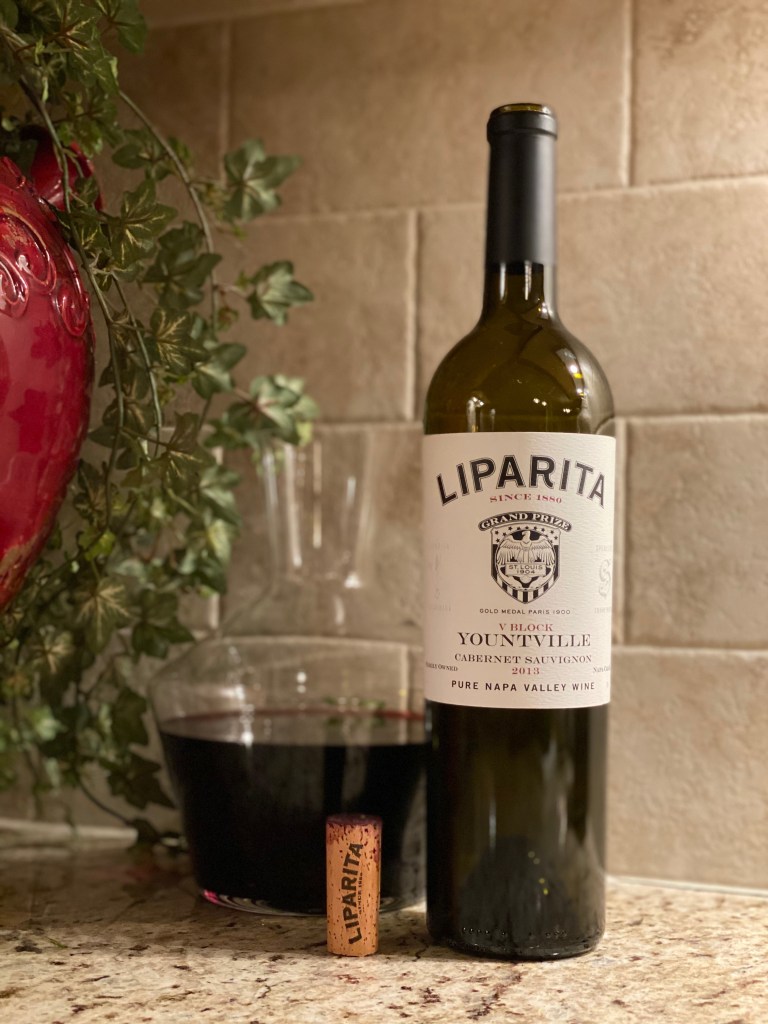
Liparita was founded in 1880 by William Keyes, a geologist by trade who discovered remarkable soil for winegrowing on Howell Mountain. When Keyes established his winery, he named it Liparita in homage to Lipari Island off the coast of Sicily because the soils he planted his vines in reminded him of the soils on the island. Liparita became one of the first wineries to bottle their wines with a vineyard designation, their first being the Liparita Howell Mountain Claret. This same wine later became the first from California to win a gold medal at the Paris Exposition in 1900. Unfortunately, like many Californian wineries established around this time, Prohibition and phylloxera greatly damaged Liparita and sent it back to obscurity.
With the rebirth of winemaking in Napa Valley during the middle and late 1900s, the Liparita brand reappeared and subsided yet again over time. In 2006, however, Spencer Hoopes purchased the brand and sought to not only bring it back to life but return Liparita to its glory days. Today, Spencer and his daughter Lindsay lead the winery in efforts to produce quality Cabernet Sauvignon from some of the Napa Valley’s best appellations and parcels. To read more about them individually, check out the website here.
Today’s Wine: 2013 V Block Cabernet Sauvignon
90% Cabernet Sauvignon, 10% Merlot; 15.4% ABV
The 2013 V Block is opaque deep ruby in color with purple at its core. Once this opens up in the decanter, the nose showcases aromas of black cherry, jammy blackberry, redcurrant, boysenberry, cedar, graphite, cocoa, granite, and oak. There is also unfortunately some heat from the rather high ABV. Once in the mouth, this wine offers notes of candied plum, blueberry pie, blackberry compote, black licorice, sweet tobacco, mocha, crushed rock, and vanilla. This Cab is full-bodied with high acidity, grippy medium (+) tannins, and a long finish dominated by inky black fruit.
Price: $65. This is certainly a high-end people-pleaser, so not necessarily fitting for my taste profile. However, for those of you who like Caymus, with how outrageously priced that wine is now I’d say skip it to try this Liparita next time as it is similar in profile but significantly better. Pair this with steak, prime rib, or lamb.
Williams Selyem is another winery with a homegrown, almost comical, origin story. During the 1970s, Burt Williams received several tons of free grapes from a grower with an abundance of fruit that would otherwise most likely go to waste. With his friend Ed Selyem, in 1979 the pair started making wine at Burt’s house over the weekends with Zinfandel grapes from the Martinelli family. Though the two set out to make wine only for themselves as a hobby, Burt and Ed fully devoted to the endeavor in 1981 and named their winery Hacienda del Rio.
They bottled their first vintage in 1982 and released it commercially in 1983, however Hacienda Winery quickly sent a cease and desist letter that resulted in removal of “Hacienda” from Burt and Ed’s labels. In 1984, Burt and Ed moved production to a nearby garage in Fulton and released the first vintage with the now famous and globally-recognized Williams Selyem label.
If this sounds familiar, you’ve probably heard of this cult winery before or read my prior post Cult Cali Pinot back in October, 2019 when I reviewed the 2014 Ferrington Vineyard Pinot Noir. If you haven’t read my prior post or Williams Selyem is new to you, check it out for the remainder of their story including the explosion into cult status.
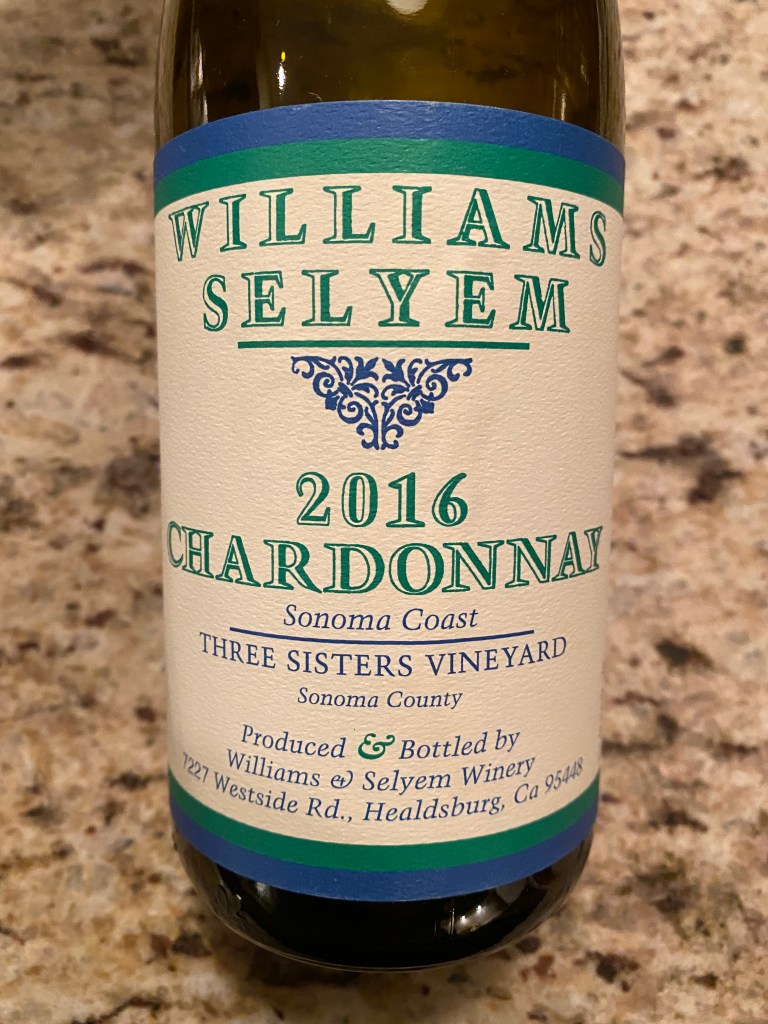
Today’s Wine: 2016 Three Sisters Vineyard Chardonnay
100% Chardonnay; 13.9% ABV
The 2016 Three Sisters Chardonnay is pale to medium gold/straw yellow in color and completely transparent. The nose showcases aromas of yellow apple, pear, melon, white wildflowers, hazelnut, spice, vanilla cream, and buttered toast (which is a little strong in my opinion). Once in the mouth, this wine displays notes of green apple, white peach, lemon peel, beeswax, snap peas, white pepper, white lily, vanilla, and butter (again, a little strong). This Chardonnay is full-bodied with high acidity and a lush, medium length rounded finish.
Price: $65 direct from winery upon release. Perhaps this needs more time to come together, but for now I’d suggest taking a look at their Chenin Blanc or Unoaked Chardonnay due to the surprisingly high butter notes in today’s bottling. Pair this with lobster, crab, or roasted chicken.
Coto de Gomariz is located in Ribeiro, a Spanish DO (Denominación de Origen) in the Avia River Valley in Galicia. Though Coto de Gomariz is proud to say they grow their vines in the oldest documented wine preserve in the Iberian Peninsula (it dates back to the 10th century), it wasn’t until the 1970s that Ricardo Carreiro started restructuring the family vineyards by planting only indigenous varieties. During the 1980s, Coto de Gomariz started bottling and marketing their first wines and by the late 1980s they became some of the most renowned from Galicia. Beginning in 2004, Coto de Gomariz started practicing organic and biodynamic farming under Ricardo’s son (also Ricardo) and their wines are made in a non-interventionist style. Fermentation is accomplished naturally with native yeasts and the wines are bottled without filtration.
Today’s Wine: 2017 Albariño Viño de Encostas de Xistos
95% Albariño, 5% Treixadura; 13.5% ABV
The 2017 Viño de Encostas de Xistos is a crystal clear deep straw color with gold variation near the sides of the glass and water white near the rim. The nose showcases aromas of lemon zest, golden apple, peach, honeydew, white florals, white pepper, and saline minerality. Once in the mouth, this refreshing Albariño displays notes of grapefruit, lemon citrus, apricot, stone fruit, honey, elderflower, exotic white spice, slate, and stoney minerality. This wine is medium-bodied with vibrant medium (+) acidity and a lingering finish that makes you want to take another sip. 500 cases produced.
Price: $25. This offers an outstanding QPR and would make for a fantastic summer wine (yes I know it’s winter). Pair this with white fish, sole, leafy greens, or fish tacos.
Domaine Faiveley was founded in 1825 as Maison Joseph Faiveley by Pierre Faiveley, a cobbler by trade who was also passionate about wine. Pierre worked his cobbler and wine merchant businesses side-by-side until the end of the 1840s when he decided to put all of his energy into the wine trade. In 1860, Joseph Faiveley began his wine merchant business with vine parcels he inherited from his uncle and his entrepreneurial spirit led him to export wines to Northern Europe to expand his brand. A plasterer, painter, and glazier by trade, Joseph exported his wines most notably to Belgium and the Netherlands and often exchanged his wines for textiles. In 1873, Joseph expanded his holdings by acquiring Nuits-Saint-Georges 1er Cru Les Porêts-Saint-Georges, Les Lavières, and the monopole of Corton Clos des Cortons Grand Cru.
François Faiveley, a doctor by trade, moved to Nuits-Saint-Georges in 1889 and spent the remainder of his life fighting to save the domaine’s vines from phylloxera, the worst crisis in Burgundy’s history at the end of the 19th century. In 1893 the domaine acquired vines in the Nuits-Saint-Georges 1er Cru Les Saint-Georges climat and in 1911 the famed Clos-de-Vougeot Grand Cru parcel.
In 1919, Georges Faiveley took over the domaine and shortly thereafter faced the economic crisis of the early 1930s that nearly destroyed his holdings. During the crisis, the domaine’s cellars were filled with inventory (even Grand Cru wines whose barrels were worth more than the wines inside them) and Georges decided to start the Confrérie des Chevaliers du Tastevin, a rebirth of an ancient wine brotherhood from the Middle Ages. With nobody buying the wines, Georges invited this brotherhood to the domaine and they drank wines together and helped provide rebirth to the popularity of Burgundy wines.
As the economic crisis subsided and Burgundian wines grew in popularity, the domaine acquired more vineyards and remained a family endeavor. In 1947, Guy Faiveley followed in his father’s footsteps and joined the domaine. He also became the Grand Master of the Confrérie des Chevaliers du Tastevin in 1969 and worked tirelessly to share his wines with the brotherhood and the world. In 1976, François Faiveley joined his family domaine at the age of 25 and continued acquiring vineyards. François produced wines known for their rich and concentrated character as well as long aging ability.
Today, Domaine Faiveley is under the guiding hands of its seventh generation in Erwan and Eve Faiveley. Erwan was always passionate for Burgundy wines and his family’s estate, so he took over from his father in 2005 and quickly set about investing in new facilities to modernize the winery and improve on the already exceptional quality in the wines. In 2014, his sister Eve joined the domaine after working in the cosmetics industry. She is the first daughter in seven generations of the family.
For more including their portfolio of wines, farming and winemaking methods, as well as pictures of the domaine, check out there website here. There are a lot of cool rabbit holes to go down!
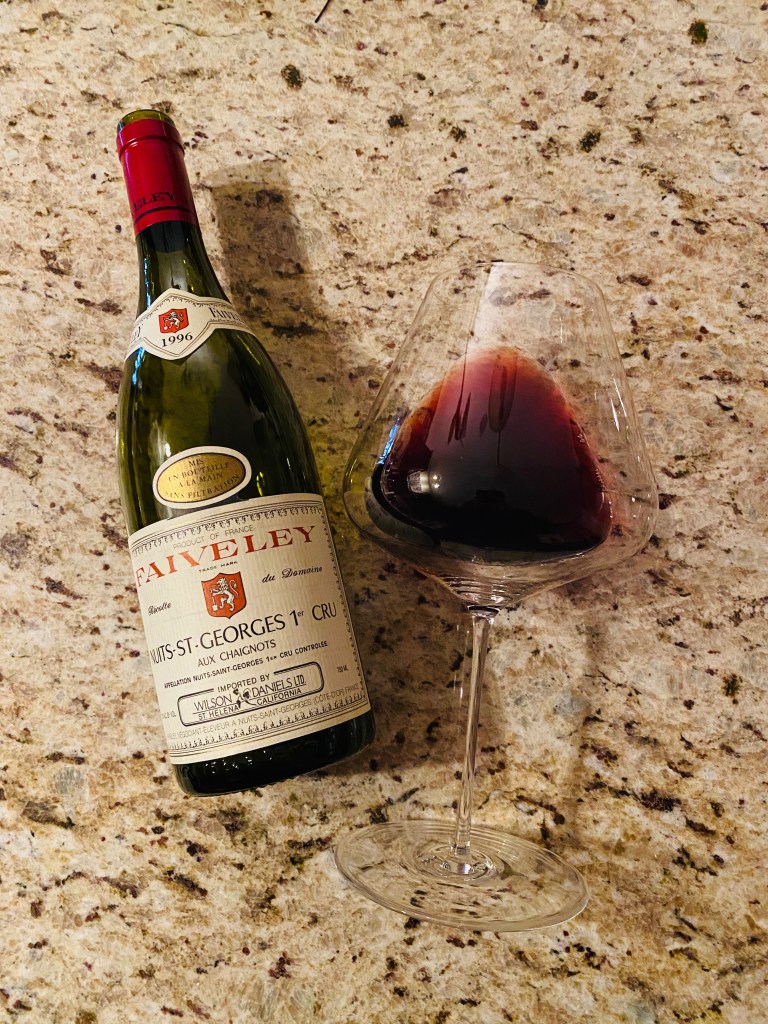
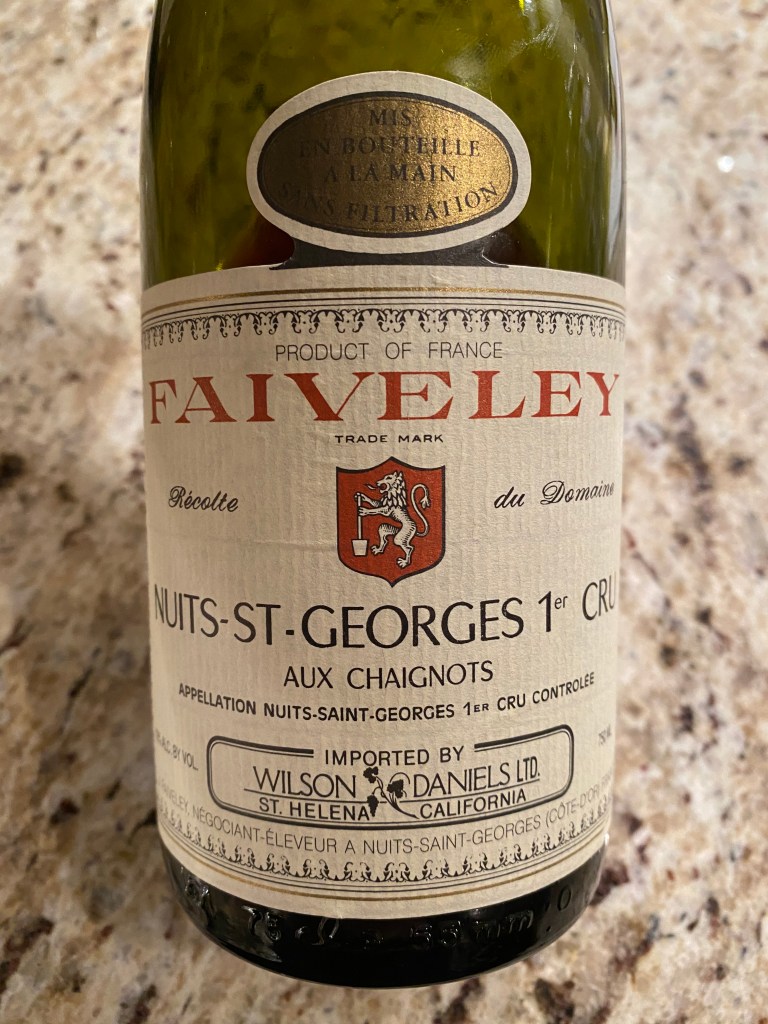
Today’s Wine: 1996 Nuits-Saint-Georges 1er Cru Aux Chaignots
100% Pinot Noir; 13% ABV
The 1996 Aux Chaignots is medium garnet in color and moderately transparent. I simply let this breathe for a bit in the glass and there was some funk that needed to blow off, though I decided not to decant the wine in case it became oxidized too quickly. On the nose, I get aromas of dried raspberry and strawberry, cherry, rose, tobacco, forest floor, truffle, wet gravel, thyme, underbrush, and a touch of oak. Once in the mouth, this wine showcases notes of cherry, cranberry, black raspberry, sous bois, dried green herbs, earthy mushroom, slate, and peppery spice. This nicely aged Burgundy is medium-bodied with medium (+) acidity, medium (-) dusty tannins, and a long finish.
Price: $130. Not a bad price for aged red Burgundy from one of the best producers in Nuits-Saint-Georges. This wine has the structure to go a little further, though I would drink up now. Pair this with roasted chicken, roasted pork, feathered game, or mild cheeses.
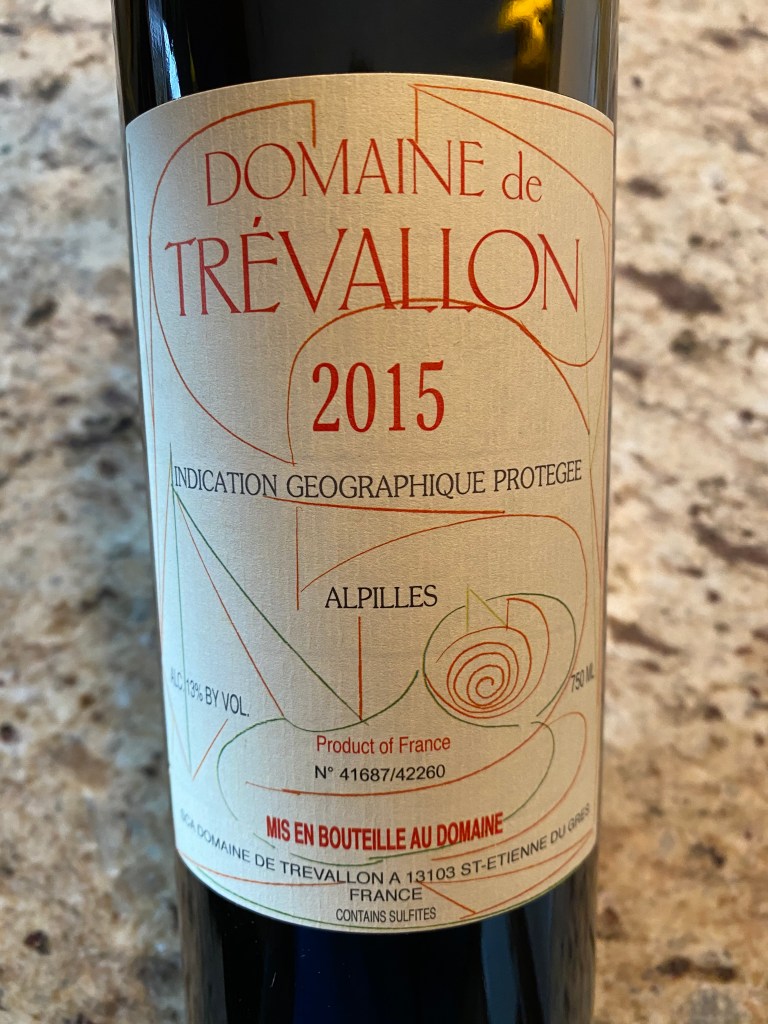
Domaine de Trévallon as it exists today was established in 1950 when Jacqueline and René Dürrbach fell in love with Alpilles and purchased Mas Chabert and its adjacent property, Trévallon. Jacqueline was a French textile artist whose commissioned tapestry of Picasso’s Guernica by Nelson Rockefeller helped pay for the domaine, and René was a sculptor and painter who was close friends with cubist movement founders Albert Gleizes, Fernand Léger, and Pablo Picasso. Eloi, the son of Jacqueline and René, planted vines on the estate in 1973 where 15 hectares are planted equally to Cabernet Sauvignon (existed there before the arrival of phylloxera) and Syrah as well as 2 hectares planted mainly to Marsanne and Roussanne. Due to great amounts of limestone in the soil and vast scrubland, great effort went into planting the vines by blowing up the soil, ploughing deep, and mixing rock fragments back in amongst the vines. In 1993, the AOC legislation authorized a maximum of 20% Cabernet Sauvignon in the vineyards and threatened to strip Trévallon’s appellation status if they did not reduce their blend from 50%. A staunch proponent of his wine’s unique personality, Eloi did not betray tradition and refused to alter his blend but rather saw the domaine knocked to the lesser Vin de Pays du Bouche du Rhône status. A family effort throughout its history, Domaine de Trévallon is joined today by Eloi’s children Ostiane and Antoine.
Domaine de Trévallon practices organic farming, methods they have used since the founding of the estate. They plow deeply in the soil to encourage vines to dig deeper in seeking out nutrients, shortly prune their vines to reduce yields but enhance the longevity of their vines, and do not use chemical fertilizers or artificial products. In the cellar, the winemaking team practices minimal intervention and use only indigenous yeasts during fermentation. The red wines are made using 100% whole cluster fermentation and are aged for two years in a combination of foudres (95%) and barrels (5%), while the whites see one year of barrel aging. The wines are racked as little as possible and the result is powerful wines that age effortlessly for decades.
With the backbone of art such an important aspect of Dürrbach family history, it is only fitting the wine labels display it. Though René passed away in 1999 at the age of 89, Eloi previously asked him to create 50 labels beginning with the 1996 vintage using colored pencils. The family selects a new label every vintage based on the characteristics of that unique vintage.
Today’s Wine: 2015 Domaine de Trévallon Rouge
50% Cabernet Sauvignon, 50% Syrah; 13% ABV
The 2015 Trévallon Rouge is deep ruby in color with purple hues and mostly opaque. Due to its youth, I let this wine breathe for about 45 minutes before consuming and drank it over the following couple hours. The nose showcases aromas of wild strawberry, raspberry, plum, licorice, smoke, tobacco, leather, violet, wet rock minerality, and a hint of sandalwood. Once in the mouth, this wine displays notes of black cherry, blackcurrant, candied red fruits, dried forest floor, white pepper, black tea leaves, chalk, eucalyptus, and some peppery spice. This is full-bodied with high acidity, medium tannins, and a long finish. Though starting to show its elegance and finesse, I would wait another 3-5 years before popping one of these and drink it over the following decade.
Price: $65. Trévallon is always an incredible value for high-quality Southern France wines and the dedication to the craft is palpable with each vintage. I highly recommend everyone try one of these wines at least once. Pair this with roasted lamb, beef, cheese and charcuterie, or a chocolate tart garnished with strawberries and raspberries.







 JB's Wine Talk