The Pinnacle of Blanc de Blanc Champagne

Today’s Story: Champagne Taittinger

Champagne Taittinger is a well-regarded and rather large Champagne house established in 1932 in Reims, France by Pierre Taittinger. Though the château and property came into Taittinger family ownership in 1932, the estate traces its roots back much further to the year 1734. In that year, Jacques Fourneaux started his wine business in Champagne by working with the Benedictine Abbeys who owned much of the finest vineyard land at the time. Following Pierre’s purchase of the estate from the house of Forest-Fourneaux, the Taittinger family began their incredibly run of producing some of the finest wines of the Champagne region. Pierre’s son François took over the family domaine in 1945, building out the cellars within 13th century chalk pits and expanding the vineyards. From then onward to the start of the 21st century, Taittinger became a Champagne house of the highest quality and of world renown. The estate remained in the family until 2005 when it was sold to the US private equity firm Starwood Capital Group, however the family re-purchased Champagne Taittinger shortly after.

Taittinger is well known for its Chardonnay-dominant wines, especially the Prestige Cuvée bottling of Comtes de Champagne. Today the family estate consists of 288 hectares (711 acres) of vineyards, of which roughly half is planted to Pinot Noir with Chardonnay and small holdings of Pinot Meunier accounting for the rest. Their own holdings make up for about half of the total production, though, so acting as a négociant Taittinger purchases the rest of its fruit from a number of growers with longstanding ties to the house. While the full Taittinger portfolio is rather robust, the top bottling of Comtes de Champagne (which I’m reviewing today) is worth isolating.

The Comtes de Champagne was introduced with the 1952 vintage as a Blanc de Blanc (100% Chardonnay) bottling of the highest magnitude. Fruit for this bottling comes mainly, if not entirely, from Grand Cru vineyards and winemaking, including use of oak, is meant to minimize an outside touch. Oak usage is meant solely to impart additive flavors such as brioche and nuts (almond, hazelnut, etc.), and the wines spend eight to ten years in the chalk pits before release. These wines are often said to be the best and purest expression of Blanc de Blanc Champagne, so without further delay…

Today’s Wine: 1998 Comtes de Champagne Blanc de Blancs Brut Champagne

100% Chardonnay; 12% ABV

The 1998 Comtes de Champagne Blanc de Blancs Brut Champagne is medium gold in color with delicate effervescence in the glass. The aromas are of medium (+) intensity, with the complex nose offering up notes of baked yellow apple, Asian pear, white peach, lemon cream, crème brûlée, brioche, browned butter, white chocolate, hazelnut, and chalk. Meanwhile the flavors are also of medium (+) intensity and the palate showcases notes of green apple, lemon meringue, lime zest, underripe pear, white floral, chalk, buttercream, brioche, and saline minerality. This dry Champagne is full-bodied with high acidity, medium alcohol, and a long finish. This is an outstanding wine with at least another decade of optimal drinking, as it comes across quite youthful today.

Price: $280. Though there are certainly better “values” out there when it comes to Champagne, I think this is of the caliber to be worth its price. It has great complexity, depth, balance, and a long finish while being incredibly youthful and age-worthy. A great vintage for Comtes de Champagne.
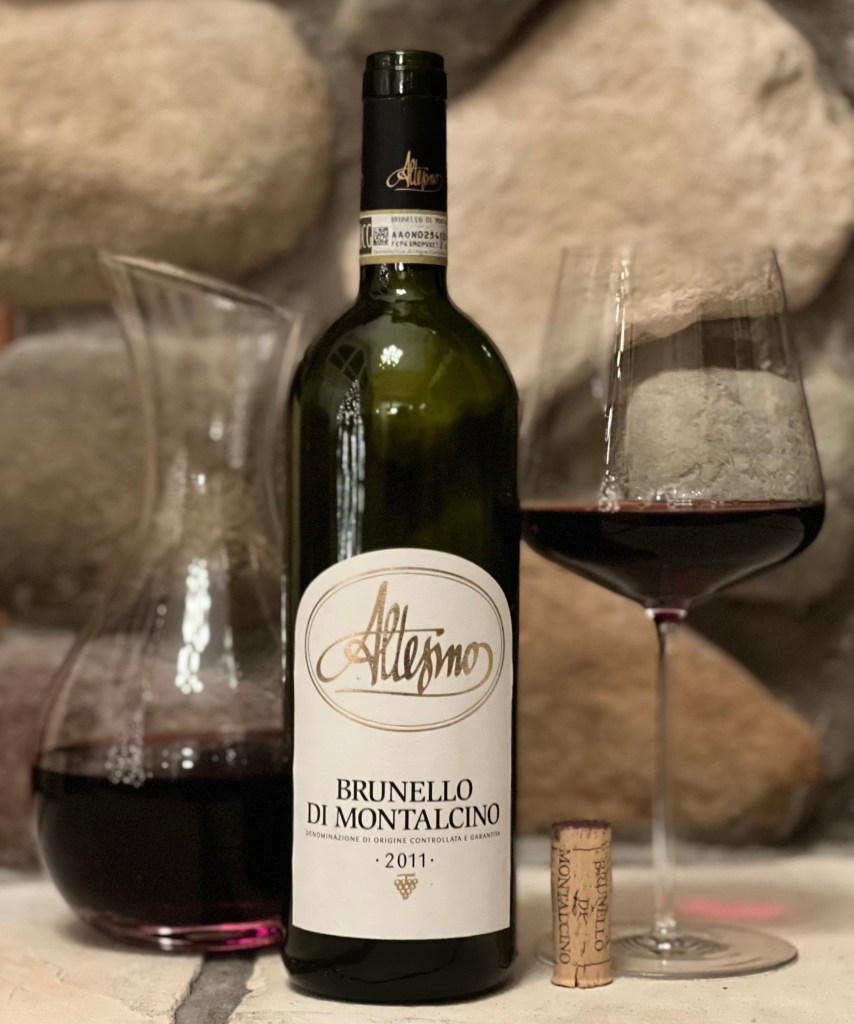
Brunello di Montalcino With Great Typicity and a Solid Price-Point

Today’s Story: Azienda Agricola Altesino

Altesino is a well-known and fairly large producer of Brunello di Montalcino, established in 1970 in the northeastern hills of Montalcino in central Tuscany. Situated in the 15th-century Palazzo Altesi, the estate’s historic cellars remain in use today though the winery has since expanded to a larger production facility built into the hillsides behind the vineyards. The property today consists of 100 hectares (247 acres), though only half of this area is planted to vineyards. These vineyards are then subdivided into the six parcels of Altesino, Macina, Cerbaia, Montosoli (which is the first-ever Cru/single-vineyard bottling of Brunello di Montalcino), Pianezzine, and Velona. A majority of the vines are planted to Sangiovese for the production of Brunello, Rosso di Montalcino, and Palazzo Altesi, however the property also contains Cabernet Sauvignon, Merlot, Trebbiano, Malvasia, Vermentino, Chardonnay, and Viognier to round out a rather robust portfolio of wines.

Today’s Wine: 2011 Brunello di Montalcino

100% Sangiovese; 14.5% ABV

The 2011 Brunello di Montalcino is deep garnet in color. I decanted this for about an hour, allowing the wine to open with aromas of medium (+) intensity and a nose of bing cherry, black raspberry, redcurrant, red rose, anise, tomato leaf, leather, charred green herbs, dried earth, a hint of mushroom, and dried gravel. The flavors are also of medium (+) intensity, with the palate offering up notes of cherry, red plum, raspberry, dried strawberry, grilled red tomato, licorice, tobacco, charred herbs, crushed rock, a hint of smoke, and terracotta. This dry red is full-bodied with medium (+) acidity, medium (+) but tightly-knit tannin, high alcohol, and a medium (+) length finish. Very good quality and a great representation of the variety and region.

Price: $60. I think this offers pretty decent value for Brunello. The typicity here is top notch as this offers a very classical representation of Sangiovese and Brunello di Montalcino, all while being well-balanced and fairly complex relative to pricier bottles.

Premium Napa Valley Cabernet Sauvignon Drenched in History

Today’s Story: Staglin Family Vineyard

Staglin Family Vineyard is a family-owned and operated wine producer located in the Rutherford AVA of California’s Napa Valley. The current estate was established by Shari and Garen Staglin in 1985, though this historic property on the Rutherford Bench traces its roots back much further. Back in 1864, John and Mary Steckter purchased 367 acres and planted the first grape vines on 60 acres surrounding their home. Ownership changed hands several times following John’s death in 1904, but came to a Texan gold and oil tycoon by the name of Frank Manley in 1922. Manley lived on the property with his family for several decades, ultimately selling the property to the Sullivan family in 1963 who, by marriage, had ties to the Latour family who owned Beaulieu Vineyard. The Sullivans sold the land containing the home, however they maintained ownership over the prune orchard where famed winemaker André Tchelistcheff converted the land to vineyards once again. Once up and running, fruit from this vineyard went toward BV’s premium Georges de Latour bottling until the Staglin family purchased the property in 1985.

Today the Staglin family owns just over 60 acres at their Rutherford estate, with roughly 51 acres planted to vineyards. While the focus here is on Cabernet Sauvignon and Bordeaux blends, they also have Chardonnay and Sangiovese planted on the property. In 2002, the family completed construction of 24,000 square feet of state-of-the-art underground production facilities and caves to lighten their environmental impact and provide a proper resting place for their wines. The Staglin family’s premier wine is an Estate Cabernet Sauvignon (often blended with Cabernet Franc and Petit Verdot), though they produce an Estate Chardonnay as well which is rare for the AVA. Staglin also produces a range of wines under the name Salus, with these bottlings meant to be more approachable in their youth. Rooted in philanthropy, all proceeds from the Salus line are donated to fight schizophrenia, bipolar disorder, and depression.

Today’s Wine: 2012 Cabernet Sauvignon

87% Cabernet Sauvignon, 10% Cabernet Franc, 3% Petit Verdot; 14.9% ABV

The 2012 Estate Cabernet Sauvignon is deep ruby in color. I decanted this for an hour and drank it over the following hour or two. The aromas are of medium (+) intensity, with the nose showcasing notes of cassis, blackberry, black plum, redcurrant, cigar box, scorched earth, truffle, graphite, baking spice, light vanilla, and milk chocolate. Flavors are also of medium (+) intensity, while the palate offers up notes of black cherry, blackberry, crème de cassis, sweet tobacco, loamy earth, charcoal, charred herbs, vanilla, baking spice, and mocha. This dry red is full-bodied with medium (+) acidity, medium but silky tannin, high alcohol, and a long finish. Of very good quality, this powerful but not over the top Cabernet is both silky and elegant.

Price: $250. While it’s tough for me to call this a good “value,” the quality level here certainly puts this bottling into the correct pricing tier relative to premium Napa Valley Cabernet. The balance is nearly perfect here, while the wine offers up a very inviting drinking experience of great depth and length.

Exceptional Cabernet From the Difficult 2011 Napa Vintage

Today’s Story: Harlan Estate

Harlan Estate is a highly regarded “cult” Napa Valley winery, established in 1984 by developer H. William Harlan in the western hills of Oakville. The Harlan property consists of 240 acres, about 40 of which are cleared for viticulture activity and planted to 70% Cabernet Sauvignon, 20% Merlot, 8% Cabernet Franc, and 2% Petit Verdot. Harlan’s first commercial vintage is the 1990, which was released in 1996, and over time the estate has commanded incredible critical praise and accompanying price action in becoming what many people refer to as the ultimate cult Napa wine. A staple in the winemaking process at Harlan is rigorous selection of fruit both in the vineyards and the winery, as only the highest quality fruit is accepted, triple sorted, and destemmed. Fermentations occur in open top vats with indigenous yeasts, then the wines feed into the barrel room for aging in French oak barrels for 24-36 months depending on vintage. Production is fairly limited, with 1,200 to about 2,000 cases produced of the flagship Harlan Estate bottling and about 900 cases produced of the estate’s second wine called The Maiden.

I previously wrote about the 2015 Harlan Estate.

Today’s Wine: 2011 Harlan Estate

Cabernet Sauvignon dominant blend; 14.5% ABV

The 2011 Harlan Estate is deep ruby in color. I decanted this for 2 hours and drank it for the following hour or two. The aromas are of pronounced intensity, with the incredibly complex nose evolving over time to showcase layered notes of blackcurrant, blueberry, violet, cigar box, graphite, forest floor, truffle, gravel, pine, eucalyptus, bell pepper, milk chocolate, mild baking spice, and cedar spill. Flavors are also of pronounced intensity and the palate equally complex, offering up notes of blackberry, blueberry, cassis, redcurrant, tobacco, scorched earth, black truffle, cracked pepper, charred green herbs, mint, coffee grounds, and mild baking spice. This dry red is full-bodied with medium (+) acidity, medium (+) but silky tannin, high alcohol, and a long finish that lingers for at least a minute. Outstanding quality in a “tough” vintage, with this wine incredibly elegant and well-balanced.

Price: $1,140. The value perspective here is difficult to discuss, as you can buy a case of good wine for the price of this one bottle. That being said though, the balance, intensity, complexity, and length of the finish here is truly incredible. I struggle to find a better representation of what Napa Cabernet can be, and this is another bottling that showcases my love of the 2011 vintage.

Textbook Syrah That Blends Northern Rhône Character With California

Today’s Story: Lillian Winery

Lillian came to fruition in 2004 with their inaugural release of Syrah. The winemaker, Maggie Harrison, worked as assistant winemaker for Manfred Krankl of Sine Qua Non (think $200-$1,000 bottles of cult Rhone variety wines) when he encouraged her to begin producing her own Syrah. With grapes coming from the White Hawk Vineyard, Maggie bottled 150 cases of her 2004 Syrah and, though I have not had that vintage, the several vintages I’ve had since clearly reflect on her experiences at Sine Qua Non.

Over time Lillian grew from 150 cases and, although still small, sources grapes from White Hawk Vineyard, Stolpman Vineyards, Bien Nacido Vineyards, and Cabernet Sauvignon from True Vineyard on Howell Mountain. Additionally, Maggie makes Lillian Roussanne and Grenache which are bottlings added later to the portfolio. With the focus on Syrah, though, each vineyard offers different character. White Hawk is sandy soil producing dark fruit personality, Stolpman is calcareous soil producing brighter fruit but more tannin structure, and Bien Nacido is cooler producing smokier and floral notes with higher acidity and tannin. When they come together, a very elegant wine is born.

I previously reviewed the 2013 Syrah and 2013 Gold Series No. 3 Syrah from Lillian.

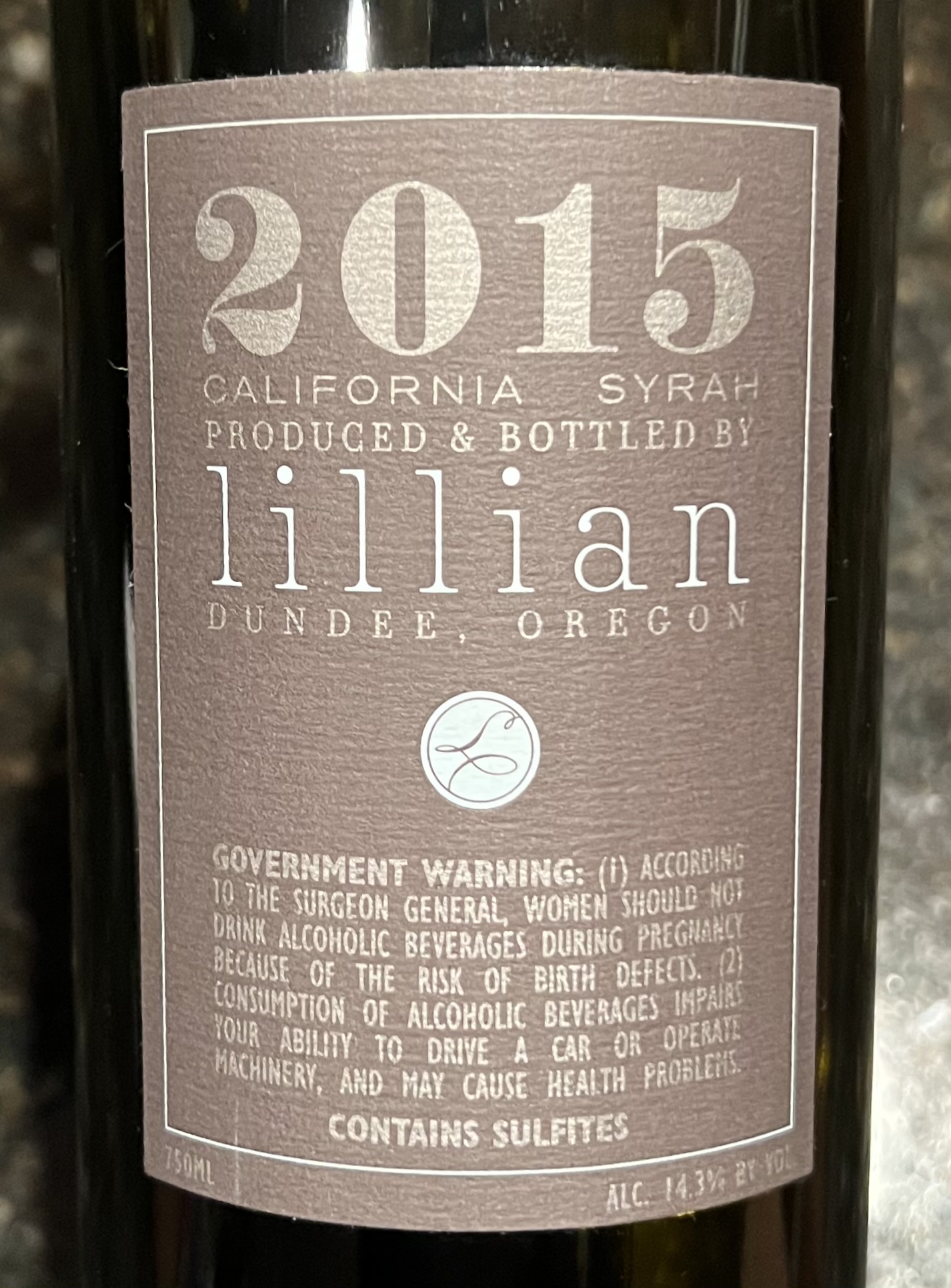
Today’s Wine: 2015 Syrah

100% Syrah; 14.3% ABV

The 2015 Syrah is deep purple in color. I decanted this for about an hour, though it was gorgeous from the start. The aromas are of medium (+) intensity, with the nose showcasing classic Syrah notes of blueberry, blackberry, black cherry, lavender, candied bacon, hickory smoke, toasted vanilla bean, crushed gravel, mocha, and sweet toasted oak. The flavors are also of medium (+) intensity, while the palate offers up notes of black plum, blueberry, blackberry, cassis, bacon fat, sweet tobacco, graphite, brown sugar, smoke, mint, and cocoa. This dry red is full-bodied with medium (+) acidity, medium but velvety tannin, high alcohol, and a long finish. Very good quality and a textbook Syrah.

Price: $75. I think this is very reasonably-priced given its high quality level, balance, length, intensity, and complexity. It is also exactly what I want out of a Syrah and a textbook example of the variety. I think this also strikes a good balance between Northern Rhône and California characteristics.

A Unique and Rare Wine Indigenous to Greece

Today’s Story: Domaine Nerantzi

Domaine Nerantzi is a family-owned and operated wine estate established in 1988 by Nerantzis Mitropoulos. He and his family established the domaine out of passion for winemaking and to honor the indigenous varieties of Greece, and until 1998 the wine was meant mainly for family consumption. In 1998, however, Nerantzi built their winery in the prefecture of Serres in Macedonia, Greece. With 1.3 hectares (3 acres) of vineyards at that time, Nerantzi discovered unknown vines of Asprouda Serron and Koniaros, saving them and gaining official recognition of these rare and indigenous varieties. A few years later, Nerantzis’ daughter Evanthia decided to join the family business and, in 2005, the family started construction on a new and larger winery in Pentapolis. Nerantzi started exporting their wines in 2009, and with it came demand for these high quality bottlings drenched in passion and history. This required them to upgrade the winery once again in 2012 by adding cellars, tasting facilities, and a lab. This same year Evanthia returned from studying in Burgundy and committed full-time to Domaine Nerantzi.

Today, Domaine Nerantzi consists of 20 hectares (49 acres) with 10.8 hectares (26 acres) planted to vineyards. Dedicated to organic viticulture, they also planted olive, fig, and other fruit trees on the property. The vineyards are planted to the varieties of Asprouda, Malagouzia, Assyrtiko, Koniaros, Cabernet Sauvignon, and Syrah. Winemaking itself is rather hands-off, with the use of native yeast fermentation and an effort to showcase the terroir and variety’s characteristics.

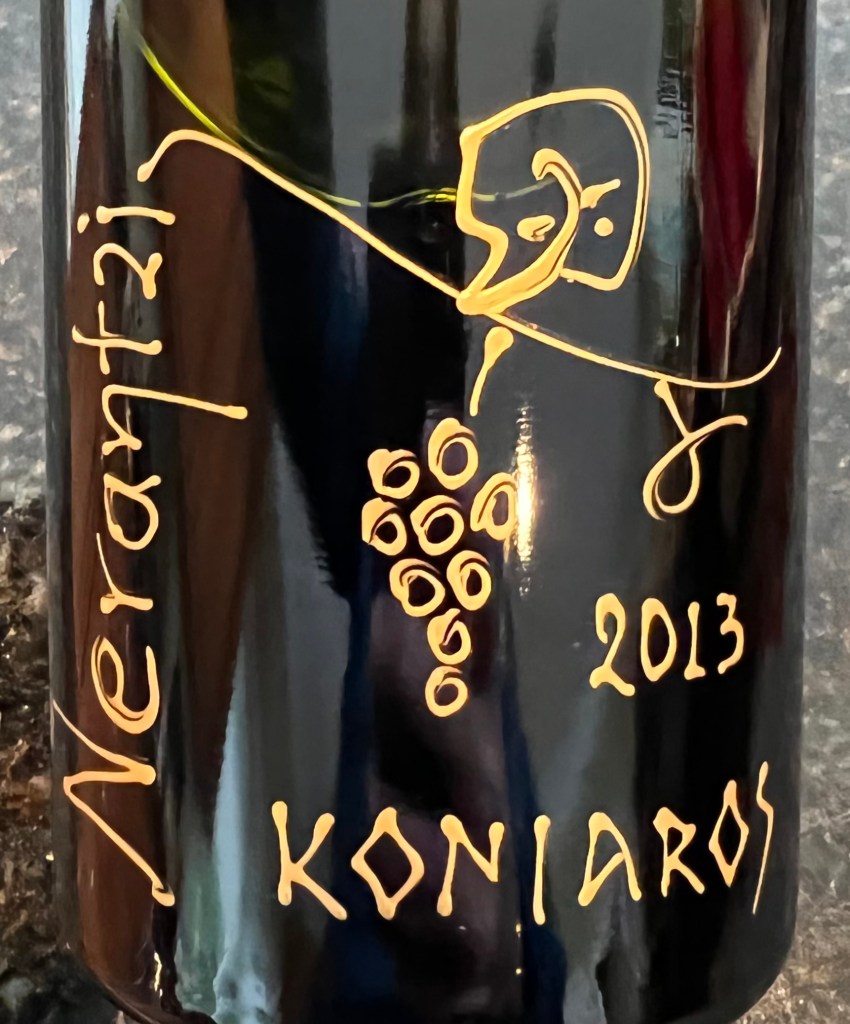
Today’s Wine: 2013 Koniaros

100% Koniaros; 13.5% ABV

The 2013 Koniaros is deep ruby in color turning deep garnet at the rim of the glass. I filtered this for sediment directly into the glass and let it develop. The aromas are of medium (+) intensity, with the nose showcasing notes of blackberry, black plum, black cherry, redcurrant, violet, smoked meat, a hint of barnyard, eucalyptus, black olive, crushed rock minerality, light smoke, and dark chocolate. The flavors are also of medium (+) intensity, while the palate offers up notes of blackberry, prune, black cherry, cola, violet, pine, dried tobacco, charred green herbs, dark chocolate, mild baking spice, and a touch of smoke. This dry red is medium-bodied with medium acidity, medium (+) but well-integrated tannin, medium alcohol, and a medium (+) length finish.

Price: $60. I think the price-point here is pretty fair given the balance, length, and complexity of the wine. It is also a very intriguing variety and, while it’s fun for that reason, this also offers very high quality.

Great Value Burgundy From Chambolle-Musigny

Today’s Story: Domaine Odoul-Coquard

Domaine Odoul-Coquard is a relatively small family-owned and operated wine estate established in Morey-St-Denis during the early 20th century. Today the domaine is under guide of fourth generation Sebastien Odoul who joined in 2004 and took over winemaking in 2009. Sebastien, who was initially uninterested in becoming a winemaker, first worked harvests at Domaine Dujac, Domaine Méo-Camuzet, and Domaine Thierry Mortet before joining the family venture. Domaine Odoul-Coquard today consists of 8.5 hectares (21 acres) situated across the appellations of Morey-St-Denis, Gevrey-Chambertin, Chambolle-Musigny, Vougeot, Vosne-Romanée, and Nuits-St-Georges. The domaine produces wines from two Grand Crus (Clos de Vougeot and Charmes-Chambertin), four 1er Crus, seven village appellations, and four regional appellations with a total production of 2,500 cases per vintage.

When it comes to the vinification process, Domaine Odoul-Coquard practices fairly traditional methods for the region. All fruit is hand-harvested and 100% destemmed, as Sebastien doesn’t care too much for the characteristics stems impart on the wine. They practice a week of cold maceration before the start of fermentation, all of which occurs in stainless steel or enamelled vats. Punch downs and pump overs occur daily and then, at the end of primary fermentation, they use a pneumatic press and barrel down the wine into French oak. The domaine uses Francois Frères barrels and aging lasts 15 to 18 months depending on vintage and cuvée, with each quality level seeing different percentages of new oak. For example, the Bourgogne bottling sees no new oak while 1er Crus may see up to 50% new oak and Grand Crus may see up to 90% new oak.

Today’s Wine: 2014 Chambolle-Musigny

100% Pinot Noir; 13% ABV

The 2014 Chambolle-Musigny is medium ruby in color. After some time in the glass, this opens rather nicely with aromas of medium (+) intensity and a nose of bing cherry, cranberry, stemmy strawberry, black raspberry, leather, forest floor, underbrush, and stony mineral. The flavors are also of medium (+) intensity, offering up classic notes of cherry, raspberry, red plum, blueberry, violet, charred green herbs, green peppercorn, and crushed rock. This dry red is light- to medium-bodied with high acidity, medium (-) tannin, medium alcohol, and a medium (+) length finish.

Price: $45. This bottling offers great value in my opinion. In a world of many village red Burgundy bottlings commanding prices over $100, this offers great depth, complexity, and balance for its price. It even seems like it has at least another decade of drinking and may just be entering its window.

Historic Bordeaux From the Iconic 1982 Vintage

Today’s Story: Château Margaux

Château Margaux is an incredibly historic wine estate located in the Margaux appellation of Bordeaux’s Left Bank. It is also one of the original four properties ranked as a First Growth (Premier Cru) in the Bordeaux Wine Official Classification of 1855 (with Château Mouton Rothschild being added as the fifth First Growth in 1973). Château Margaux traces its roots back to the 12th century with a name of La Mothe de Margaux, though there weren’t any vines planted on the property at that time. Throughout the property’s first several centuries, it was reserved for Lords and royalty. Margaux as we know it today, however, started to take shape in the late 16th century when Pierre de Lestonnac spent the years 1572 to 1582 completely restructuring the property to wine production. By the end of the 17th century, Château Margaux consisted of 265 hectares (655 acres) with about one-third of that area planted to vine. It remains largely in this same format to this day.

The 18th century brought great growth to both Château Margaux and the world of wine as we know it from a quality perspective. At this time, most of the wine made in Bordeaux was low quality and somewhat watery which didn’t bode well for aging ability. At Margaux, Berlon became the first to vinify red and white grapes separately while vine stocks were mixed throughout the vineyards. He also decided to delay harvest time from dawn to later in the day so dew would dry up and not dilute the juice. Thanks to the improved quality, Margaux’s 1771 vintage became the first “claret” to be sold through Christie’s and, during Thomas Jefferson’s trip to Bordeaux in 1787, became noted as one of the top four properties by the statesman.

The fortune of the 18th century died down unfortunately, thanks to the French Revolution that saw Elie du Barry (owner of Château Margaux at the time) sent to the guillotine. The estate was auctioned to the revolutionaries and its new owner, citizen Miqueau, let the property fall into a horribly dilapidated state. In 1801, Bertrand Douat, Marquis de la Colonilla, purchased Château Margaux and set about building a new mansion in 1810. This was the château that still stands today and adorns the Margaux labels, though Douat died before ever living at the property. His children had very little interest in the property, ultimately selling it to a wealthy banker named Alexandre Aguado in 1830. Margaux trudged onward until the financial troubles and phylloxera of the late 19th century, with the estate sold to Count Pillet-Will in 1879. The estate bounced back with a great 1893 vintage, though the young vines of phylloxera-resistant rootstock didn’t produce at a high enough quality and a second wine named Pavillon Rouge du Château Margaux was born.

Throughout the second quarter of the 20th century, wealthy wine trader Fernand Ginestet purchased shares in Margaux until ultimately purchasing the entire estate around 1950. Fernand and his son Pierre reorganized the vineyards and guided the estate through several successful vintages, though they were unfortunately no match for the financial crisis of the 1970s and the horrible vintages of 1972, 1973, and 1974. The Ginestet family, due to these struggles, had to sell Château Margaux and it was purchased by André Mentzelopoulos in 1977. André made his fortune trading cereals and through his ownership of a grocery chain, so he was able to invest heavily in Château Margaux during this trying time without the need for immediate financial gains. Though André passed away far too soon in 1980, during his short ownership of Château Margaux he completed drastic renovations to both the buildings and vineyards of the estate and set the property on a renewed path to greatness. André’s daughter Corinne adeptly took over in her father’s footsteps, guiding the estate through the incredible growing demand for Bordeaux wines following the 1982 vintage and into the 21st century. She remains CEO to this day.

Switching gears, as I mentioned before the size and format of Château Margaux hasn’t really changed since the end of the 17th century. Today the property consists of 262 hectares (647 acres) with only a third of that planted to vine. Vine density is fairly high but typical of Bordeaux, with 10,000 vines per hectare (2.5 acres) of land. For the red wines, 75% of this land is planted to Cabernet Sauvignon, 20% to Merlot, and the balance to Cabernet Franc and Petit Verdot. They also have 12 hectares (30 acres) planted to Sauvignon Blanc. With this Château Margaux makes four wines including the Grand Vin, Pavillon Rouge du Château Margaux, and Margaux du Château Margaux for their reds and the Pavillon Blanc du Château Margaux for the white.

From a winemaking standpoint, Margaux is fairly traditional for the realm of Bordeaux. The red wines ferment in a combination of oak and stainless steel vats ranging in size from 5 hectoliters up to 180 hectoliters. The reds also go through malolactic fermentation in vats, however the press wines complete their malolactic fermentation in barrel. Aging is accomplished in 100% new oak for 18-24 months, with many of these barrels coming from Margaux’s own in-house cooperage. The white wine, on the other hand, is whole cluster pressed with no skin contact and ferments partially in stainless steel before wrapping up in 33% new French oak barrels. This wine is aged on its lees but forgoes malolactic fermentation while aging for 7-8 months before bottling.

Today’s Wine: 1982 Château Margaux

Cabernet Sauvignon dominant Bordeaux blend; 12% ABV

The 1982 Château Margaux is deep garnet in color, showing no signs of bricking. I decanted this for sediment, but there really wasn’t any and this seemed ready to go after a short while. The aromas are of pronounced intensity, with the nose showcasing notes of redcurrant, blackcurrant, red plum, dried violet, tobacco, pencil shavings, graphite, smoked meat, forest floor, black truffle, eucalyptus, and cedar. Flavors are also of pronounced intensity, while the palate offers up notes of redcurrant, blackberry, cassis, stale licorice, violet, cigar tobacco, scorched earth, crushed gravel, charred green herbs, green peppercorn, and a touch of smoke. This dry red is medium-bodied with medium acidity, medium but perfectly integrated and silky tannin, medium alcohol, and a long finish. This is an outstanding bottle with exceptional balance, and it’s drinking perfectly right now.

Price: $1,200 (we paid $980). At this price-point I can’t really discuss the value proposition because, let’s be honest, nobody can argue it. However, this was an ethereal bottle that I am very happy and lucky to have enjoyed and it was firing on all cylinders. This showed intensity, complexity, and incredible balance that will be memorable for a long time. I would love to find a 1983 for comparison.

Exceptional Sauvignon Blanc From a Pioneering Legacy of the Loire

Today’s Story: Domaine Didier Dagueneau

Domaine Didier Dagueneau is a highly-regarded wine estate established in 1982 by Didier Dagueneau in the village of Saint-Andelain in France’s Pouilly-Fumé appellation. Dagueneau, who unfortunately passed away in 2008 at the age of 52 in a small plane crash, was a fourth generation winemaker who spent his earlier career years as a motorcycle sidecar racer and dog sled racer. When he returned to Saint-Andelain in 1982, he established his domaine instead of joining his family’s property of Domaine Serge Dagueneau et Filles. Dagueneau was a visionary winemaker, establishing his domaine with the intent of producing single vineyard Sauvignon Blanc using an experimental mentality. The estate today consists of 12 hectares (30 acres) across parcels named En Chailloux, Silex, and Pur Sang.

Dagueneau had a laser-like attention to detail and demanded perfection in all aspects of winemaking, especially in his vineyards. The domaine has a staggering ratio of one vineyard worker per hectare (unheard of in the Loire and more common on the finest estates of Burgundy) and they became an early adopter of organic and biodynamic viticulture in the region. Dagueneau had a preference for own-rooted vines and kept yields incredibly low, all for a focus on optimal ripeness, concentration, and quality. In the cellar, the domaine has a history of experimentation particularly with its oak program. Dagueneau pioneered longer barrels called “cigares,” which provide greater contact for the wine with its lees to add texture. While they have quite the range of vessels to play with, fermentations are accomplished with native yeasts and winemaking is otherwise pretty hands-off and traditional. The wines spend their first year in oak before they are moved to tank for a final five to seven months until bottling.

Though Didier’s untimely death caused great shock and worry throughout the world of people who loved his wines, Didier’s children Louis-Benjamin and Charlotte joined the family domaine and run it today. Louis-Benjamin worked closely with his father in the vineyards and cellar during Didier’s last few years, and he also shares the same drive and demand for perfection. The Domaine Dagueneau wines have maintained their quality (some argue they’re even better) and they offer a quintessential representation of the Sauvignon Blanc variety.

Today’s Wine: 2015 Pur Sang

100% Sauvignon Blanc; 13% ABV

The 2015 Pur Sang is pale straw yellow in color. This needs some time to open up in the glass, and you could honestly decant it for 30 minutes or so I think. The aromas are of medium (+) intensity, with the nose showcasing notes of white peach, Meyer lemon, green apple, jasmine, freshly cut grass, cheese rind, macadamia, white chocolate, and mineral. Flavors are also of medium (+) intensity, while the palate offers up notes of lime zest, green apple, grapefruit, lemon tart, chamomile, grass, crushed stone, almond, and saline. This dry white is medium-bodied with medium (+) acidity, medium alcohol, and a long finish. This is a creamy but still racy and well-balanced example of Sauvignon Blanc. 1,333 cases produced.

Price: $100. While not an inexpensive bottle of wine, I think pricing here is actually pretty fair given the quality. This is a great representation of the variety while still being somewhat unique thanks to the mouthfeel. It also has great balance, length, and complexity going for it.

Beautifully Aged Bordeaux in a Sweet Spot Right Now

Today’s Story: Château Léoville Las Cases

Château Léoville Las Cases is a historical Bordeaux estate ranked as a Second Growth (Deuxième Cru) in the Bordeaux Wine Official Classification of 1855. It is located in the appellation of Saint-Julien on the Left Bank. Though the estate used to be much larger and is one of the oldest in the Médoc, it was split up between 1826 and 1840 as a result of the French Revolution and came into the Las Cases family as 3/5 the size of the original estate. Luckily for the family, however, their land made up the heart of the domain and therefore consists of the original terroir back to the 17th century. Las Cases was managed by the same family through the 19th century, moving by inheritance through Pierre Jean, Adolphe, and Gabriel de Las Cases until Théophile Skawinski bought a stake in 1900 to become the manager. Today, Jean-Hubert Delon is the sole owner with the family coming in during the mid-20th century.

The estate today consists of 98 hectares (242 acres) of vineyards planted to roughly 66% Cabernet Sauvignon, 24% Merlot, 9% Cabernet Franc, and 1% Petit Verdot. The soil is classic Left Bank, made up of gravel over gravelly sand and gravelly clay subsoils. The heart of the property is the 55 hectare (136 acre) Grand Clos, where vines average an age of 52 years and farming is nearly 100% organic. The Grand Clos is walled-in and borders Château Latour to the north as well.

Winemaking is largely traditional at Léoville Las Cases, beginning with manual harvest and moving to fermentation in temperature-controlled wood, concrete, or stainless steel vats of varying size and age. Malolactic fermentation occurs in vat, and then the wines are blended before moving into French oak barrels for 18-20 months of aging. Come bottling, the wines are fined using egg whites and production of the Grand Vin is around 15,000 to 16,700 cases depending on vintage.

I previously wrote about the 1961, 1986, and 1990 (which I’ll be revisiting today) Château Leoville-Las Cases.

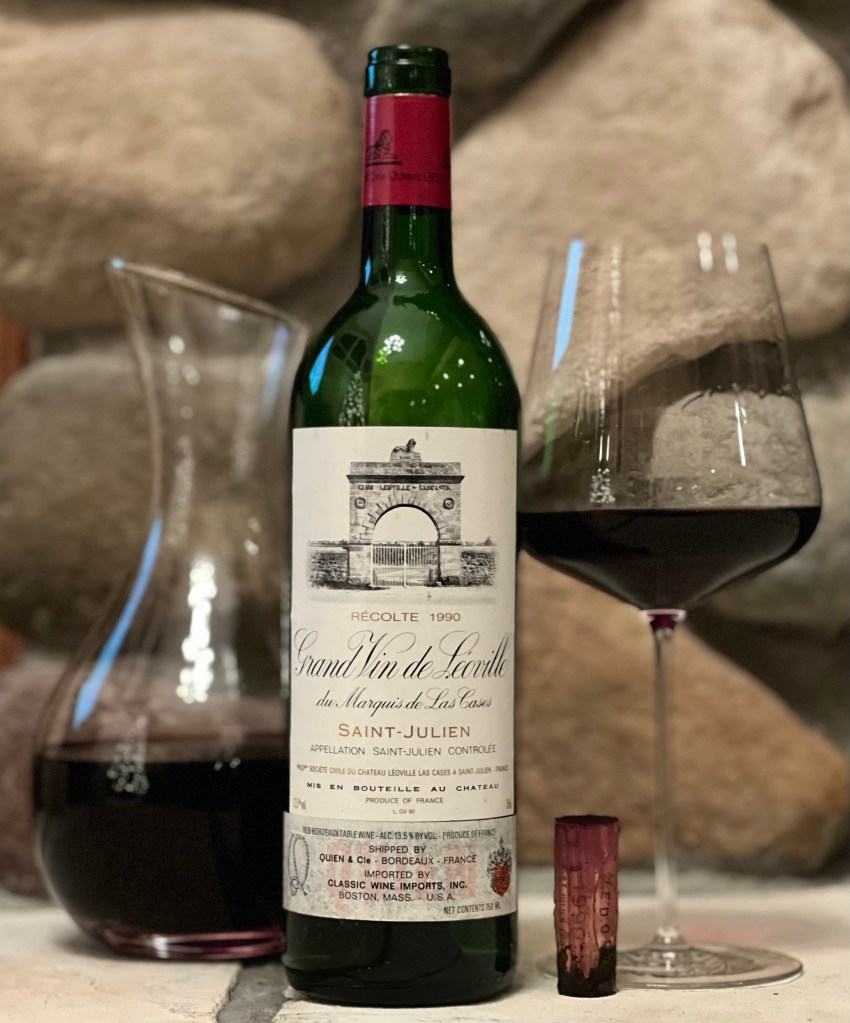
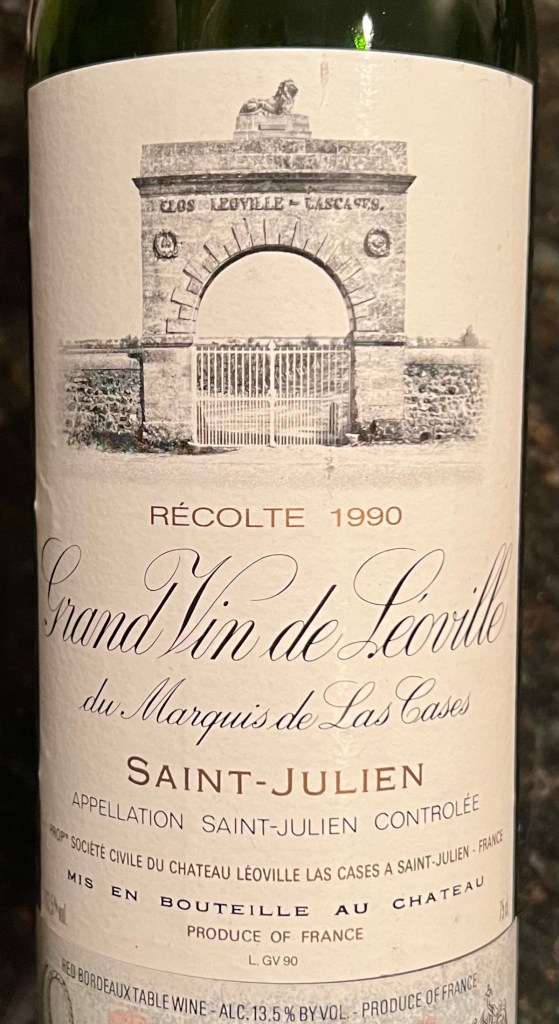
Today’s Wine: 1990 Château Leoville Las Cases

43% Cabernet Sauvignon, 29% Merlot, 21% Cabernet Franc, 7% Petit Verdot; 13.25% ABV

The 1990 Château Leoville-Las Cases is deep garnet in color. I decanted this for an hour, both for some mild sediment and per the winery’s recommended time. The aromas are of pronounced intensity and the complex nose showcases notes of redcurrant, black cherry, cassis, graphite, cigar box, pencil shavings, smoked meat, forest floor, truffle, green bell pepper, underbrush, eucalyptus, and clove. Flavors are also of pronounced intensity, with an equally complex palate of black cherry, redcurrant, blueberry, cigar tobacco, leather, gravel, forest floor, earthy mushroom, charred green herbs, green peppercorn, and a touch of cinnamon. This dry red is medium- to full-bodied with medium (+) acidity, medium (+) but super fine-grained tannin, medium alcohol, and a medium (+) length finish. Superb.

Price: $475 (we paid $340). The going market rate on this wine is tougher to discuss on a value perspective, though I think the price we paid is well worth it. I reviewed this same wine two years ago, with this bottle showing more complexity but equally great balance. For the depth, balance, and complexity of this wine at its age it is truly a memorable bottle.