Remarkable Expression of Terroir in an Incredibly Ageworthy Red Burgundy

Today’s Story: Domaine Armand Rousseau

Domaine Armand Rousseau is one of the most highly-regarded wine producers in all of Burgundy, established during the very early 1900s by Armand Rousseau in Gevrey-Chambertin of the Côte de Nuits. Rousseau inherited several plots of vines at the beginning of the 20th century, however he was able to expand his vineyard holdings, build a winery and cellar, and sell the wines following his marriage in 1909. Rousseau continued acquiring top quality vineyards, including several Grand Crus, up until the time his son Charles joined the family business in 1945. In 1959, Charles took full control over the family’s domain following the unfortunate death of Armand in a car accident. Charles was instrumental in adding additional vineyard sites to the family holdings mainly in Grand Crus, and he also further built out their export markets to include Britain, Germany, and Switzerland before ultimately reaching Canada, Australia, New Zealand, and Asia by the 1970s. Charles’ son Eric joined the business in 1982, beginning in the vineyards by instituting green harvesting, leaf stripping, and avoidance of chemical fertilizers or pesticides. Eric was instrumental in steering the estate toward organic viticulture, and since 2014 he has been joined by his daughter Cyrielle who will ultimately carry on the family legacy one day.

Domaine Armand Rousseau consists of about 15 hectares (37 acres) of vineyards in some of the choicest plots in the Côte de Nuits. Dedicated entirely to Pinot Noir, Rousseau produces 11 wines from Gevrey Chambertin, Charmes-Chambertin, Mazy-Chambertin, Ruchottes-Chambertin, and Chambertin. Of the 11 wines, they do however produce one from the Grand Cru of Clos de la Roche located in Morey-Saint-Denis. These wines are made in a very traditional style and are meant to be elegant expressions of each unique terroir, with minimal use of new oak depending on wine and vintage. Total production is around 63,000 bottles per vintage, with about 75% being exported to some 30 countries.

Today’s Wine: 2015 Gevrey-Chambertin 1er Cru Lavaux St. Jacques

100% Pinot Noir; 13.5% ABV

The 2015 Gevrey-Chambertin 1er Cru Lavaux St. Jacques is medium ruby in color. I normally don’t decant red Burgundy or Pinot Noir in general for that matter, however given how young this wine is we decanted it for about an hour. The aromas are of pronounced intensity, with the nose showcasing notes of black cherry, black raspberry, licorice, rose petal, gravel, sun-dried earth, sandalwood, and mineral. Meanwhile the flavors are also of pronounced intensity and the palate displays notes of cherry, strawberry, blackberry, eucalyptus, rose, mild baking spice, and stony mineral. This dry red is medium-bodied with high acidity, medium tannins, medium alcohol, and a long finish. Very precise and already gorgeous, but I would wait probably 5 more years and then drink this over the following decades.

Price: $600. It’s difficult to address value at this price-point because there are so many better “values” out there and pricing on Burgundy is sky-high. There’s no doubt this is one of the greatest red Burgundies I’ve had though, and since me and my tasting companions had never tried Armand Rousseau before we were incredibly glad for the experience.

Gorgeous and Fully Mature Red From Lebanon

Today’s Story: Chateau Musar

Chateau Musar is a highly-regarded wine estate established in 1930 in the Bekaa Valley of Lebanon by Gaston Hochar when he was 20 years old. Inspired by his travels throughout Bordeaux and the 6,000-year-old winemaking history of Lebanon, Gaston set about producing wines with a non-interventionist philosophy and planted Cabernet Sauvignon, Carignan, and Cinsault for his reds in high-altitude gravel and limestone soils. During WWII, Major Ronald Barton of Château Langoa-Barton and Leoville-Barton was stationed in Lebanon and became friends with Gaston which strengthened the tie to Bordeaux that exists to this day. In 1959, Gaston’s eldest son Serge took over winemaking after studying at the University of Oenology in Bordeaux and started making wines “his own way.” Shortly thereafter, in 1961, Gaston’s second son Ronald joined the family business to handle the financial and marketing aspects. Serge was named Decanter Magazine’s first ‘Man of the Year’ in 1984 thanks to his steadfast production of quality wines during Lebanon’s Civil War (1975-1990) and the brand continued to build upon international fame for its elegance and quality. In 1994, Serge’s son Gaston joined the winery and was accompanied later in 2010 by his brother Marc. The two manage the estate together today with Gaston running the winery operations and Marc running the commercial aspects.

Chateau Musar became Lebanon’s first certified organic winery in 2006 and their wines spend a remarkable 7 years at the winery before release. The red wines are fermented in separate cement vats, racked 6 months after harvest, aged for 12 months in French Nevers oak barriques, and bottled without filtration at the end of the third year after harvest before the blended wine is aged an additional 3-4 years before release. The white wines also ferment in Nevers oak barrels for 6-9 months but are bottled after their first year and spend 6 years in the cellars before release.

To explore additional notes of these wines, I previously wrote about the 2011 Chateau Musar Rouge and 2010 Chateau Musar Blanc.

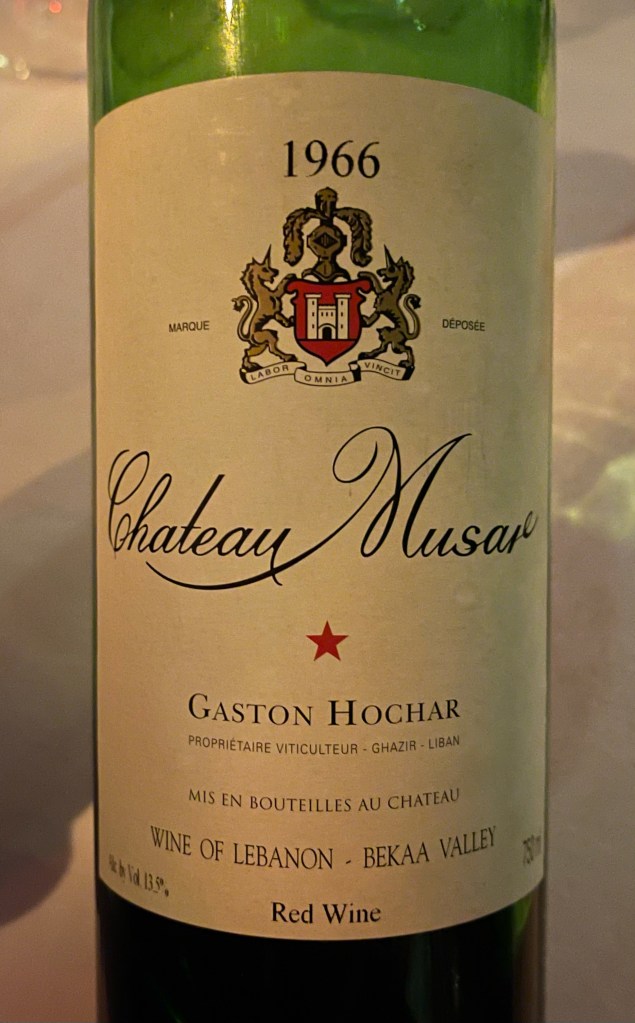
Today’s Wine: 1966 Chateau Musar Rouge

Blend of Cabernet Sauvignon, Cinsault, and Carignan; 13.5% ABV

The 1966 Chateau Musar Rouge is medium garnet in color with not really any signs of bricking yet. Per the restaurant where we ordered this, the bottle came from Chateau Musar’s cellars about five years ago. We elected to serve this as a pop-and-pour, which was the right call with the age. The aromas are of pronounced intensity and the wine is beautifully alive, with the nose showcasing aromas of dried cherry, cranberry, violet, leather, truffle, forest floor, gravel, and dried herbs. The flavors are also of pronounced intensity, and the palate displays notes of maraschino cherry, cranberry, tobacco, forest floor, truffle, smoke, and crushed rock. This dry red is medium-bodied with lively medium (+) acidity, fully mature light tannins, medium alcohol, and a medium (+) length finish. What a beautifully mature and fun wine to taste.

Price: $800. This is another experience bottle, and fortunately the restaurant where we purchased this had it for below retail cost. I’m a huge fan of Chateau Musar but haven’t had any older than early 1990s before this, so this was a very fun and special wine. Shared with two other Musar lovers, which can’t be beat.

Rarity From Nuits Saint Georges

Today’s Story: Domaine de l’Arlot

Domaine de l’Arlot is a historic and well-regarded wine estate located in Nuits St. Georges within the Côte de Nuits subregion of Burgundy, France. Though its roots trace back to the 18th century and owner Jean-Charles Vienot, its more recent history begins in 1891 when the domain was purchased and expanded by wine merchant Jules Belin. Domaine de l’Arlot remained in the Belin family until early 1987, and then was purchased by the French investment company of AXA Millésimes. Around the same time, Jean-Pierre de Smet came on board after spending eight years with Jacques Seysses of Domaine Dujac and he is largely credited with the winemaking philosophy at the domain of minimal intervention. Though Jean-Pierre retired in 2007, this philosophy remained largely intact and today de l’Arlot is run by technical director and Burgundy native Géraldine Godot.

Domaine de l’Arlot today consists of 14 hectares (35 acres) of vineyards planted 95% to Pinot Noir and only 5% to Chardonnay. Average vine age is about 50 years, however the property does maintain some vines aged 70+ years. de l’Arlot farms their vineyards adhering to biodynamic viticulture, a transition that started in 2003 following several years of organic viticulture. A couple of the most prized plots are monopoles of the domain, the 1er Cru vineyards of Clos des Forêts Saint Georges and Clos de l’Arlot.

In terms of winemaking style, Géraldine practices a minimal intervention and “less is more” mentality. Fruit is hand-harvested and every motion within the winery and cellar is accomplished by the use of gravity. The wines ferment spontaneously with only native yeasts, seeing minimal pumpovers and punchdowns by foot. For aging, Géraldine uses less new oak than what was previously used over the domain’s history, which in turn provides a more transparent and true-to-variety and terroir expression. New oak percentages and length of aging vary by vintage and bottling, however the end goal never wavers of producing terroir-driven wines.

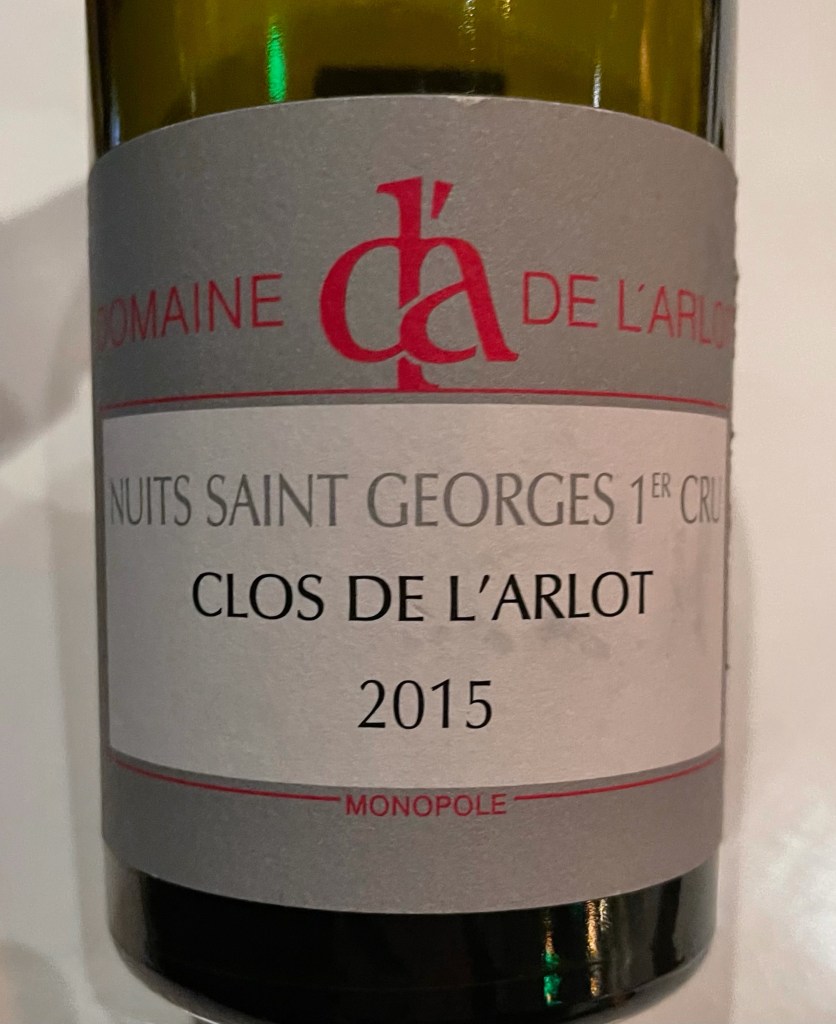
Today’s Wine: 2015 Nuits Saint Georges 1er Cru Clos de l’Arlot

100% Chardonnay; 13.5% ABV

The 2015 Nuits Saint Georges 1er Cru Clos de l’Arlot is pale golden straw in color. Given some time to blossom in the glass, the wine opens with aromas of medium (+) intensity and the nose showcases notes of lemon, green apple, white florals, flint, wet river stone, mild green herbs, and chalky mineral. Meanwhile the flavors are also of medium (+) intensity, with the palate showcasing notes of green apple, lemon pith, white peach, floral blossom, dried green herbs, and wet stone. This dry white is medium- to full-bodied with high acidity, medium alcohol, and a medium (+) length finish. Very good right now, but I would love to see if this adds complexities perhaps with a few more years of bottle age.

Price: $120. I think there are better values out there, however I think the pricing here is partly due to the great reputation of the producer as well as how rare white wines are from Nuits Saint Georges. As one of their rarest and top bottlings, I can see why this is priced the way it is.

Beautifully Mature Bordeaux

Today’s Story: Château Léoville Las Cases

Château Léoville Las Cases is a historical Bordeaux estate ranked as a Second Growth (Deuxième Cru) in the Bordeaux Wine Official Classification of 1855. It is located in the appellation of Saint-Julien on the Left Bank. Though the estate used to be much larger and is one of the oldest in the Médoc, it was split up between 1826 and 1840 as a result of the French Revolution and came into the Las Cases family as 3/5 the size of the original estate. Luckily for the family, however, their land made up the heart of the domain and therefore consists of the original terroir back to the 17th century. Las Cases was managed by the same family through the 19th century, moving by inheritance through Pierre Jean, Adolphe, and Gabriel de Las Cases until Théophile Skawinski bought a stake in 1900 to become the manager. Today, Jean-Hubert Delon is the sole owner with the family coming in during the mid-20th century.

The estate today consists of 98 hectares (242 acres) of vineyards planted to roughly 66% Cabernet Sauvignon, 24% Merlot, 9% Cabernet Franc, and 1% Petit Verdot. The soil is classic Left Bank, made up of gravel over gravelly sand and gravelly clay subsoils. The heart of the property is the 55 hectare (136 acre) Grand Clos, where vines average an age of 52 years and farming is nearly 100% organic. The Grand Clos is walled-in and borders Château Latour to the north as well.

Winemaking is largely traditional at Léoville Las Cases, beginning with manual harvest and moving to fermentation in temperature-controlled wood, concrete, or stainless steel vats of varying size and age. Malolactic fermentation occurs in vat, and then the wines are blended before moving into French oak barrels for 18-20 months of aging. Come bottling, the wines are fined using egg whites and production of the Grand Vin is around 15,000 to 16,700 cases depending on vintage.

I previously wrote about two wines from Léoville Las Cases, first the 1986 vintage in a side-by-side with a 1986 Château Pichon Longueville Comtesse de Lalande and then the 1990 vintage in early 2020.

Today’s Wine: 1961 Château Léoville Las Cases

Cabernet Sauvignon dominant Bordeaux blend; I presume around 12-13% ABV

The 1961 Château Léoville Las Cases is medium garnet in color and not really showing any signs of bricking. We served this as a pop-and-pour, and it really only took 10 minutes or so in the glass to open up and show beautifully. The aromas are of medium (+) intensity, with the gorgeous nose showcasing notes of dried cherry, dried cranberry, pencil shavings, dried violet, graphite, cigar box, forest floor, truffle, eucalyptus, and a hint of cinnamon. Meanwhile the flavors are of medium intensity and the palate displays notes of baked black cherry, dried plum, prune, cigar tobacco, truffle, graphite, and charred green herbs. This dry red is medium-bodied with medium acidity, light and fully matured tannins, medium alcohol, and a medium (+) length finish. The wine is in remarkable shape given its age and quite honestly there seems to be a window of a few more years to drink this.

Price: $800. This is more of an experience wine than anything, as I’ve never had a 1961 Bordeaux and neither had my tasting companions. So while I don’t want to discuss “value” because it seems subjective for a wine like this, I will state the obvious that provenance is key here and this bottle was superb while making for an incredible tasting experience.

Take Heed, Terroir Lovers

Today’s Story: Azienda Agricola COS

Azienda Agricola COS is a revered wine estate established in 1980 in Vittoria on the Italian island of Sicily. COS was established by three friends, Giambattista Cilia, Giusto Occhipinti, and Cirino Strano, with the first letter of their last names creating the acronym of COS for which the project is named. COS is largely considered a pioneer and champion for Sicilian wines, namely seeking to prove that world-class and high-quality wines can come from the island. COS farms all of their vineyards adhering to organic and biodynamic principles, and they have never used synthetic or chemical fertilizers throughout the life of the venture. This philosophy carries over into the cellar as well, where the wines are made as naturally as possible. For instance, COS is an adopter of clay amphorae dug into the ground for aging because Occhipinti believes them to be a vessel that doesn’t mask any terroir-driven element of the wines. For any bottlings that do not age in amphorae, they use large neutral Slavonian oak botti or concrete tanks to similar effect. All wines see extended maceration, including the whites, which Occhipinti uses as natural preservative so zero sulphur needs to be added during winemaking and at most a minimal dose is added at bottling.

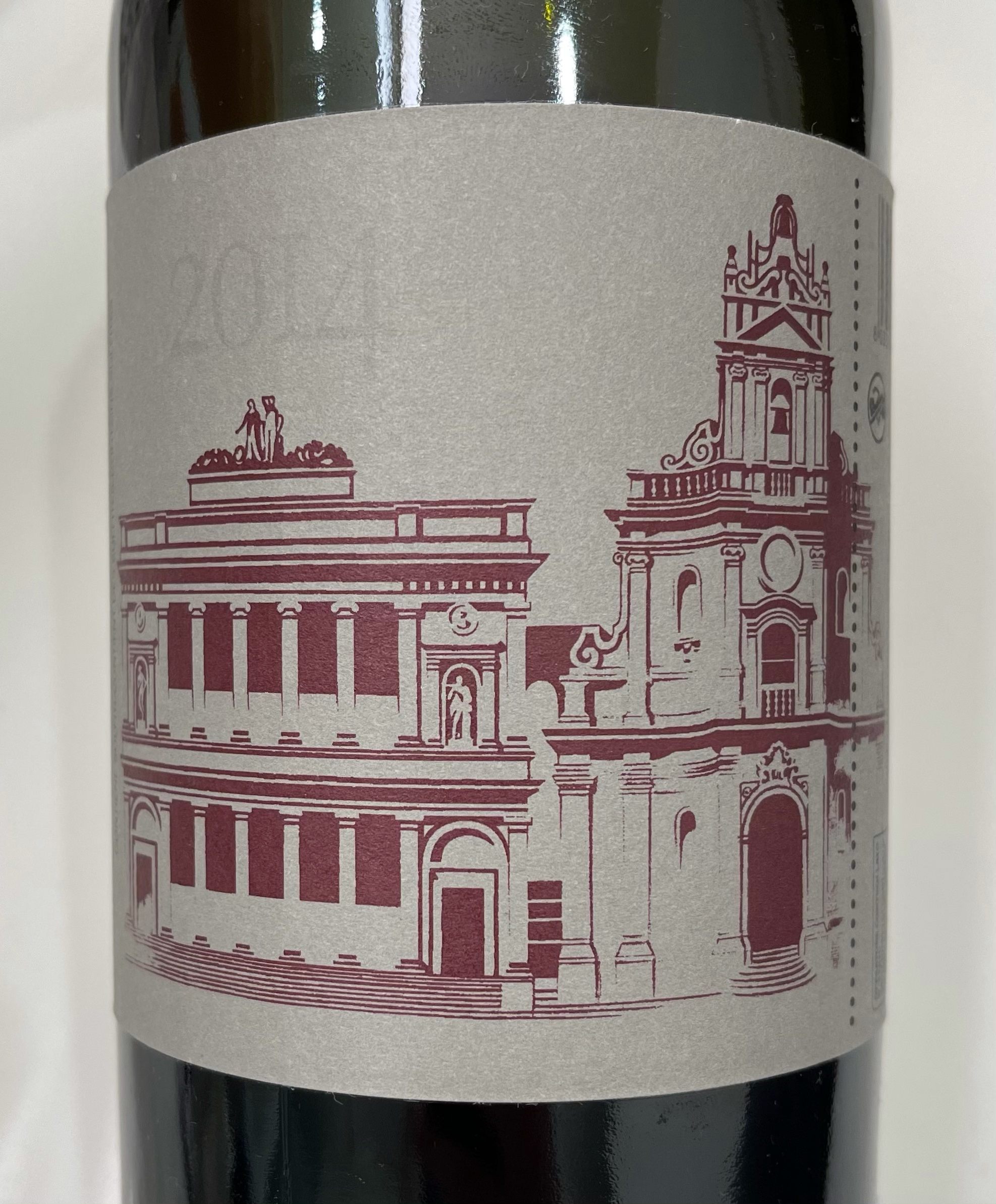
Today’s Wine: 2014 Cerasuolo di Vittoria Classico delle Fontane

60% Nero d’Avola, 40% Frappato; 13% ABV

The 2014 Cerasuolo di Vittoria Classico delle Fontane is medium garnet in color. I elected not to decant this wine because it seemed fairly expressive out of the bottle, though it did really open up after about 30 minutes in the glass. The aromas are of pronounced intensity and the nose is rather complex, showcasing notes of dried cherry, strawberry, red plum, anise, a hint of brett, leather, forest floor, green herbs, eucalyptus, and crushed volcanic rock. The flavors are also of pronounced intensity and the palate is equally complex, displaying notes of black raspberry, tart cherry, red plum, licorice, brett, cured meat, damp tobacco, truffle, forest floor, and mineral. This dry red is medium-bodied with high acidity, medium (+) dusty tannins, medium alcohol, and a long finish. Though there is fruit, this is so terroir-driven you can practically smell and taste the earth where these grapes grow.

Price: $45. For me, this is a great value wine but I love the terroir-driven profile of it. This strikes me as a wine people would either love or hate, and I would encourage the jammy-fruit-bomb lovers to look elsewhere unless you are looking to expand your horizons. This wine’s intensity, complexity, and transparent sense of place are all remarkable to me and I would highly suggest trying this if the profile seems to fit your palate.

Terroir Lover’s Chardonnay From the Sta. Rita Hills

Today’s Story: Liquid Farm

Liquid Farm is a Chardonnay-focused winery established in 2009 in the Sta. Rita Hills AVA of Santa Barbara County, California. Founded by Jeff and Nikki Nelson, Liquid Farm started with four barrels of wine and the dream to produce Old World style Chardonnay while supporting local viticulture. Two of these first four barrels showcased a more mineral-driven profile that reminded Jeff and Nikki of Chablis so they named it White Hill after the white chalky hills of Chablis. The other two barrels showcased warmer tones and fuller profiles reminiscent of Meursault, so they named that wine Golden Slope after the Côte d’Or. Though Liquid Farm expanded their portfolio over time, they still focus on four Chardonnay bottlings as well as a rosé and small amounts of Pinot Noir.

Sticking to their love of Old World wines, the winemaking philosophy at Liquid Farm is rather traditional. Under the guide of winemaker James Sparks, winemaking follows the path of minimal intervention from manual harvest through to native yeast fermentation and aging in neutral oak barrels. The team makes no machine adjustments or additions to the wine in order to preserve a sense of place and true-to-variety profile, ultimately even letting the wines go through malolactic fermentation naturally. Given the cool climate of Sta. Rita Hills, these wines are often bottled with higher natural acidity and lower alcohol which makes them perfect table wines for anyone who appreciates the style and an expression of terroir.

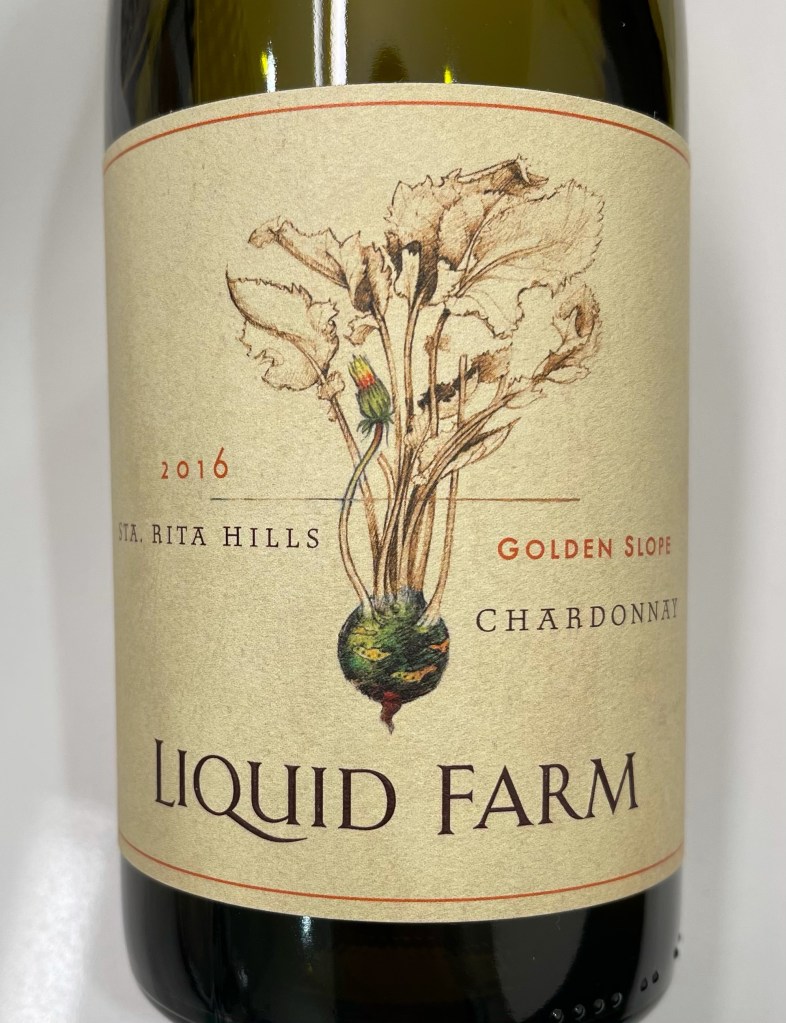
Today’s Wine: 2016 Golden Slope Chardonnay

100% Chardonnay; 13.5% ABV

The 2016 Golden Slope Chardonnay is medium gold in color. After about 45 minutes in the glass, this really opened up and showed nicely. The aromas are of pronounced intensity, with the nose showcasing notes of crisp yellow apple, lemon zest, tropical citrus, honeysuckle, flint, wet river stone, almond, freshly-baked bread, and smoke. Meanwhile the flavors are also of pronounced intensity and the palate displays notes of pear, quince, lemon and lime zest, dried pineapple, brioche, toasted almond, vanilla, and a hint of mineral. This dry white is medium- to full-bodied with high acidity, medium alcohol, and a long finish. This strikes a very solid balance between Old and New World, with an Old World tilt.

Price: $47. I think this fits somewhere between the fairly-priced and value distinctions, as it is certainly very high quality and offers great intensity and complexity. There’s just enough California fruit to this where I can’t quite equate it with white Burgundy, but it is pretty darn close which I enjoy with my domestic Chardonnay.

Delicious Northern Rhône Syrah That’s Light on Its Feet

Today’s Story: Domaine Vincent Paris

Domaine Vincent Paris was established in 1997 with 1 hectare of inherited vines in Cornas of the northern Rhône Valley in France. Vincent studied enology for four years before working alongside his uncle, famed Cornas vigneron Robert Michel, and ultimately desired autonomy with his own wines. Vincent set about planting vines in St. Joseph and Cornas, ultimately acquiring La Geynale in 2007 and farming a total of 8 hectares today. Vincent farms 1.5 hectares of Saint Joseph, 6 of Cornas, and 0.5 of Vin de Pays with meticulous attention and refuses to use insecticide or chemical fertilizers while limiting treatments. Vincent severely prunes his vines (to only 4 bunches per vine) which helps produce concentrated, high quality berries and cuts down on green harvests. In the cellar, Vincent destems his fruit to varying levels and ferments the wines naturally after cold maceration at relatively lower temperatures. The wines spend 3 months in vats and then a year in oak barrels that are never new but rather 2-8 years old in an effort to not mask terroir, before they are ultimately bottled with light fining but no filtration.

I previously wrote about the 2017 Cornas Granit 30 from Domaine Vincent Paris, so feel free to revisit those tasting notes if you care to explore another wine from the portfolio.

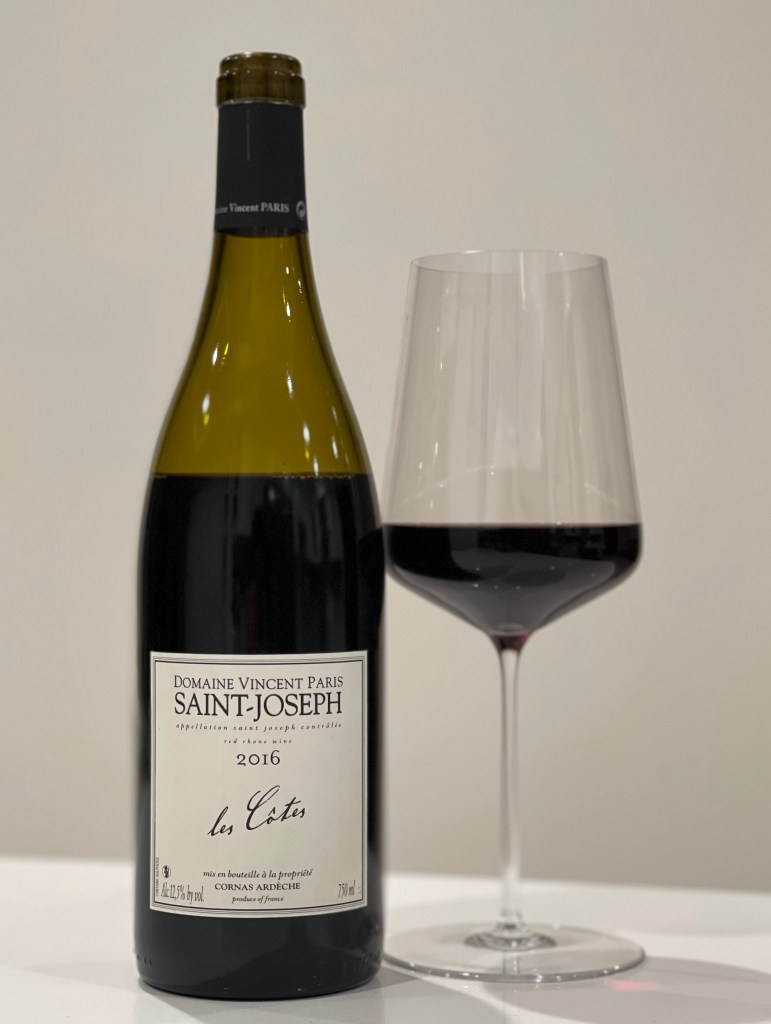
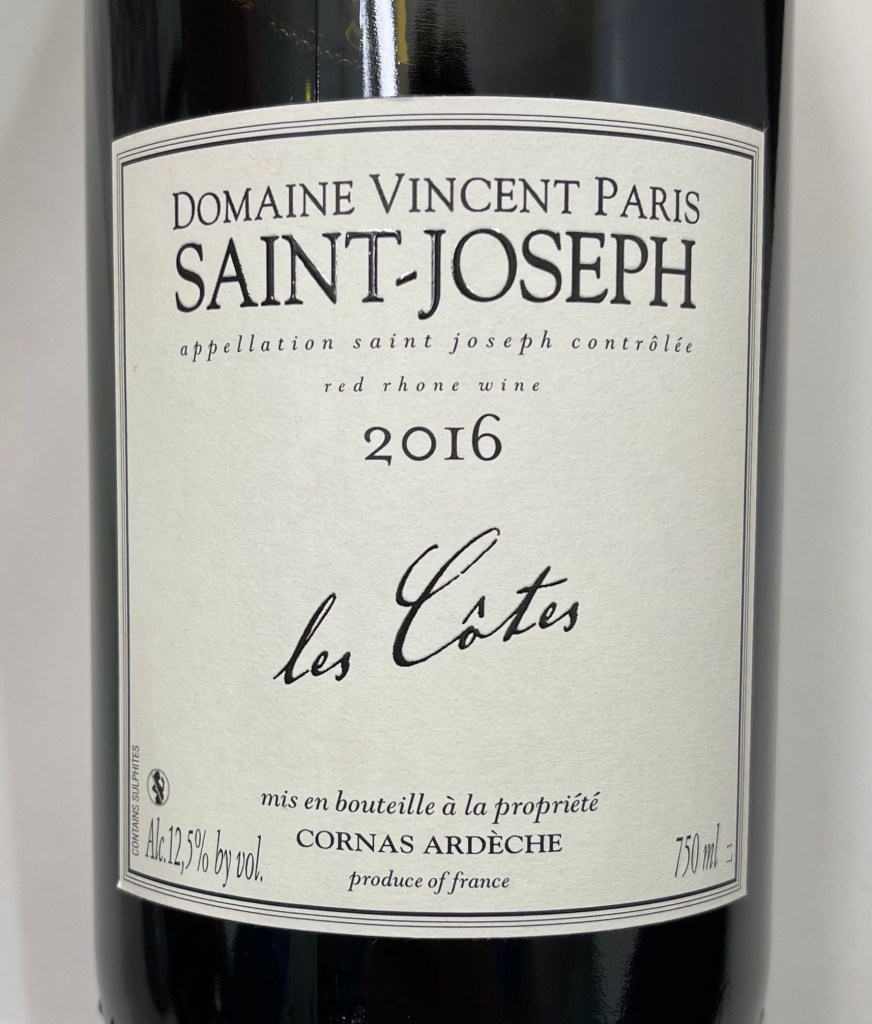
Today’s Wine: 2016 Saint-Joseph Les Côtes

100% Syrah; 12.5% ABV

The 2016 Saint-Joseph Les Côtes is medium purple in color. This was another Coravin pour for me, so I simply let this open up in the glass for about 30 minutes. The aromas are of pronounced intensity, and the nose showcases notes of plum, blueberry, violet, bacon fat, scorched earth, dried garden herbs, coffee grounds, and smoke. Meanwhile the flavors are also of pronounced intensity, with the palate displaying notes of blackberry, blueberry, black plum, smoked game, sweet tobacco, dried herbs, cracked pepper, and chocolate. This dry red is light- to medium-bodied with high acidity, low tannins, medium alcohol, and a long finish. The 2016 Les Côtes doesn’t drink like your typical Syrah but it is both incredibly accessible and fun to drink.

Price: $34. I’m very impressed by the value of this wine, as the aromas and flavors are so true to variety and showcase the terroir beautifully but this is rather light on its feet. Nothing sticks out of place here, with the finesse being rather impressive for the price.

Impressive South African Red That Outperformed My Expectations

Today’s Story: Vilafonté

Vilafonté is a relatively new wine estate established in 1997 in the Paarl region of South Africa. A joint venture between Mike Ratcliffe of South Africa and Zelma Long and Dr. Phil Freese of the United States, Vilafonté consists of 42 hectares (104 acres) with 16 hectares (40 acres) planted to vine. A unique aspect of Vilafonté, and where it derives its name, is the ancient vilafontes soil which is recorded as one of the oldest soil types in the world between 750,000 and 1.5 million years old. This soil, having evolved over the centuries, encourages the vines to struggle and in turn results in smaller vines, lower yields, and higher quality fruit. The estate is planted to Cabernet Sauvignon, Merlot, Cabernet Franc, and Malbec with the ultimate goal of producing Bordeaux blends. Vilafonté produces two main wines, the Cabernet Sauvignon dominant Series C and the Merlot/Malbec dominant Series M. They also produce a second label bottling called Seriously Old Dirt which I’ll be tasting today.

Today’s Wine: 2014 Seriously Old Dirt

41% Merlot, 31% Cabernet Sauvignon, 28% Malbec; 13.5% ABV

The 2014 Seriously Old Dirt is deep ruby in color and opaque. I used my Coravin, so instead of decanting the bottle I let this open up in the glass for about 45 minutes. The aromas are of medium (+) intensity, with the nose showcasing notes of blackberry, plum, black raspberry, black licorice, violet, chocolate, a hint of vanilla, and mild oak. Meanwhile the flavors are also of medium (+) intensity with the palate displaying notes of blackberry, red plum, black cherry, blueberry, sweet tobacco, crushed rock, charred green herbs, and mild baking spice. This dry red is medium- to full-bodied with medium acidity, medium (+) but refined tannins, medium alcohol, and a long finish.

Price: $40. To be honest I wasn’t expecting a ton with this wine, but it greatly outperformed my expectations. I think this offers solid value and it is certainly a high quality wine. It’s beautifully balanced, offers considerable complexity, and has great length in the finish.

Refreshing and Unique Austrian White Field Blend

Today’s Story: Weingut Werlitsch

Weingut Werlitsch is a relatively small family-owned and operated wine estate and farm located in southern Styria in Austria. Viticulture and winemaking are spearheaded by Ewald Tscheppe, who took over this family property at the age of 26. Though the Tscheppe family had been involved in winemaking and farming for generations, Ewald is part of a newer generation making exciting, complex, and long-lived wines while advocating for biodynamic viticulture and minimally invasive winemaking. The estate consists of about 18 hectares (44 acres) with roughly 12.5 hectares (31 acres) planted to vineyards and the balance dedicated to the winery, forests, pastures, and gardens. Weingut Werlitsch is certified biodynamic, and practically all of the vineyard work is done by hand thanks to the very steep slopes that make up the property. The vineyards are planted predominantly to Sauvignon Blanc and Morillon (a biotype of Chardonnay), though Ewald also grows Welschriesling. All fruit is hand-harvested, experiences slow pressing, and goes through fermentation only with native yeasts. Élevage is in large barrels and Austrian foudres, and the wines age typically for a minimum of 18 months but may see as long as 36 months. Bottling is accomplished with the wines unfiltered, and no SO2 is added unless absolutely necessary.

I recently wrote about the 2017 Glück from Werlitsch, which is a fun amber wine made from Sauvignon Blanc and Chardonnay.

Today’s Wine: 2017 Ex Vero I

Field blend of Morillon (Chardonnay) and Sauvignon Blanc; 12.5% ABV

The 2017 Ex Vero I is medium gold in color and transparent but slightly hazy. Per the back label, I gave this a lengthy decant which I found to be optimal around the 2 hour mark. The aromas are of pronounced intensity and the gorgeous nose showcases aromas of yellow apple, white peach, white wildflower, dried garden herbs, popcorn kernel, gravel, and chalk. There’s also a good deal of reduction (gunsmoke, matchstick) and some flint on the nose which plays somewhat of a dominant role. Meanwhile the flavors are of medium intensity, with the palate displaying notes of yellow apple, pear, honeysuckle, seashell, wet stone, dried herbs, and saline mineral. This dry white blend is medium-bodied with high acidity, medium alcohol, and a long finish.

Price: $35. Though this is a very different white wine, I feel comfortable calling it a great value. It’s incredibly fun while also maintaining a winning profile of intensity, complexity, length, and balance. Very excited to try this again in a couple years.

The Wildest Wine I’ve Tasted

Today’s Story: Ochota Barrels

Ochota Barrels is a small, family-owned winery located in the Basket Range area of the Adelaide Hills in South Australia. The idea for Ochota Barrels came about in 2000, when Taras and Amber Ochota were wrapping up a surf and wine trip along the western coast of Mexico in a Volkswagen campervan. Following some time spent as a punk rocker, Taras graduated with a degree in Oenology from Adelaide University then worked as a “flying winemaker consultant” concentrating in Puglia, Abruzzo, and Sicily in Italy. Taras also spent some time making wines in California before he and Amber settled on their 9.6 acres in South Australia and Ochota Barrels launched in 2008. The Ochota Barrels philosophy is to produce pure and fresh wines which, in Taras’ words, are “something delicious and gorgeous for all of us to enjoy with none of the nasties and more of the love.” A blow to the South Australian winemaking community (and beyond), Taras unfortunately passed away last year at the young age of 49 following a long battle with an auto-immune-related illness.

The Ochota Barrels farming and winemaking philosophies center on minimal intervention to produce pure, expressive wines with a true sense of place and variety. Taras and Amber were inspired by the biodynamic producers they met in France, farming their own vineyards with many of the same practices. Fruit is harvested early to preserve natural acidity, and wild fermentation occurs with only indigenous yeasts. Whites see whole-bunch pressing and reds get whole-bunch fermentation and extended maceration with texture an important focus. The wines age in old French oak barrels before bottling with a minimal addition of sulphur.

To learn more or read praise for the Ochota Barrels wines, you can visit their website here. I also previously wrote about their 2020 The Mark of Cain, which is a fun wine made of 100% Pinot Meunier.

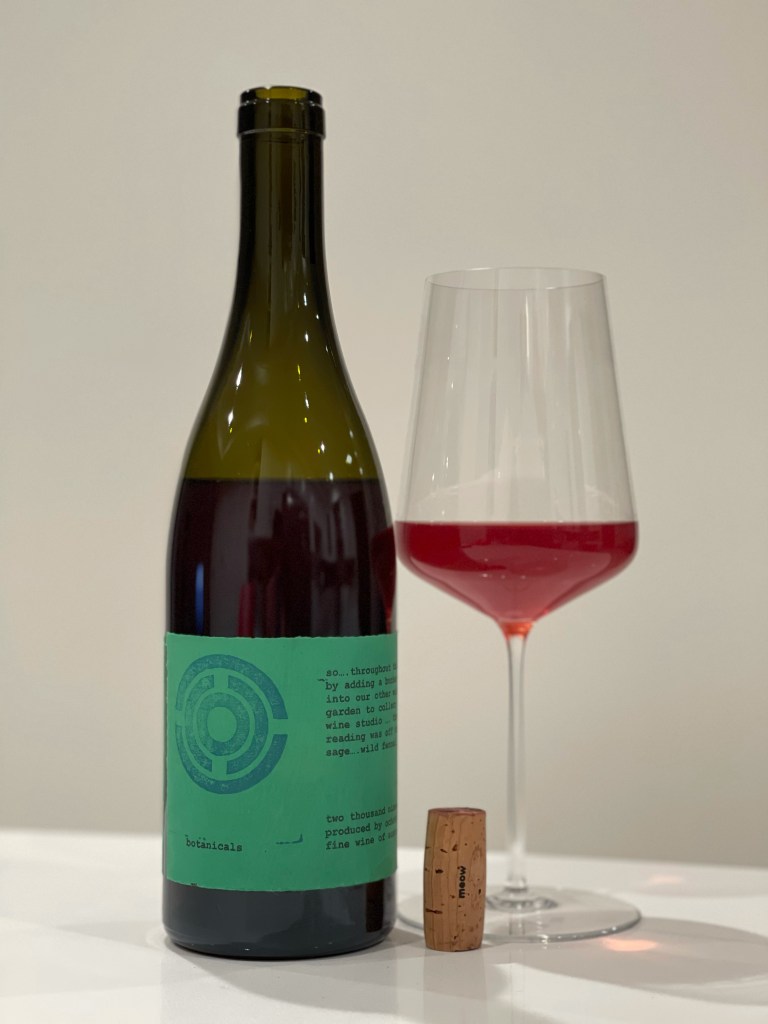
Today’s Wine: 2019 Botanicals of the Basket Range

Blend of Chardonnay, Gewürztraminer, Grenache, Merlot, Pinot Noir, Gamay, Isabella, and Shiraz; 12% ABV

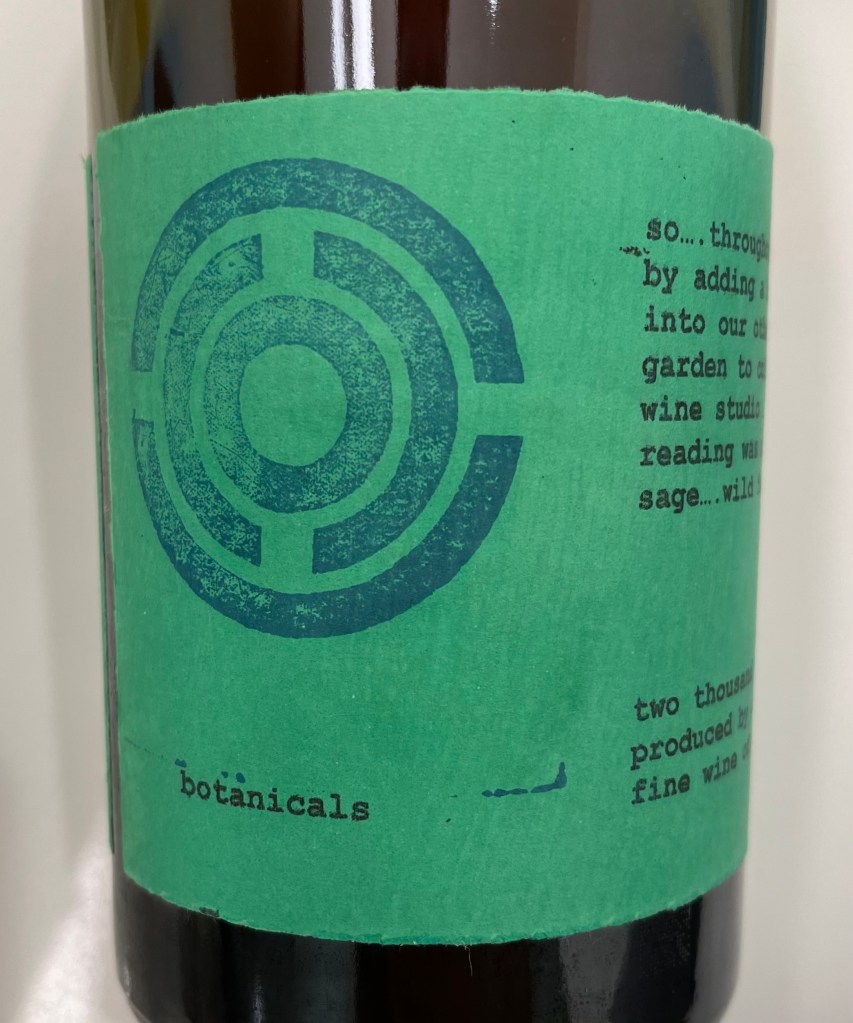
The 2019 Botanicals of the Basket Range is deep salmon in color. This wine leaps out of the glass with aromas of medium (+) intensity and you immediately know you’re in for a fun ride. The nose showcases aromas of white strawberry, raspberry, cherry, rose petal, rosemary, thyme, sage, and chalky mineral. The flavors are of medium intensity, with the palate displaying notes of maraschino cherry, freshly-picked strawberry, raspberry, lavender, thyme, lemongrass, mint, and crushed rock minerality. This dry, vermouth-inspired wine is light- to medium-bodied with high acidity, light tannins, medium alcohol, and a medium (+) length finish. In addition to the grape varieties listed in the blend below, 17 botanicals from the Ochota Barrels garden were submerged in the wine and they include sage, wild fennel, blood orange rind, elderflower, lemon balm, bay leaf, and thyme amongst others.

Price: $55. While I can’t put a value analysis on this as it compares to other wines since I’ve never tasted anything like it, I can say that for me this is absolutely worth the price and then some. This is one of the most unusual and fun wines I’ve tasted so far, all while maintaining impeccable quality, complexity, balance, and length. This is truly magical stuff.