Delicate and Elegant Chambolle-Musigny With a Long Life Ahead

Today’s Story: Domaine Cecile Tremblay

Domaine Cecile Tremblay has a very interesting history, partly because she did not start making wines until 2003 though her family owned vineyards for several generations. Cecile is the great-granddaughter of Edouard Jayer, uncle of the famed Henri Jayer (go Google some of his wines, and perhaps sell your car to buy a bottle). Cecile’s family inherited vineyards from Edouard, though the two generations before her leased out the land to other producers and did not make their own wine. In 2003, however, with the expiration of a lease on three hectares of vines Cecile started making wine under her own label with a plan for further growth. For instance, the Domaine owns roughly 10 hectares of vineyard land and while more of this becomes free from leasing agreements in 2021, Cecile rented or purchased land along the way in communes such as Gevrey-Chambertin.

When Cecile took over her family’s land for her own use, the vineyards were in no standing to produce high quality wines. The producers leasing the land, for instance, used too much fertilizer for Cecile’s taste and utilized herbicides instead of ploughing. Throughout her time thus far as a winemaker, Cecile transitioned to organic farming and many of her practices include biodynamic farming measures as well. During maintenance of her vineyards, Cecile ploughs the soil mechanically and with horses while using copper sulfate to prevent mildew and other fungi.

Similar to her views on caring for her vines, Cecile is very traditional in her winemaking process. She presses her grapes with an old-fashioned vertical press and her wines see only a moderate amount of new wood during fermentation and aging. All of this effort culminates into wines that are refined and elegant, though built for the long haul.

I previously reviewed the 2011 Chambolle-Musigny Les Cabottes and 2011 Vosne-Romanée, so feel free to revisit those tasting notes if you want a more side-by-side picture.
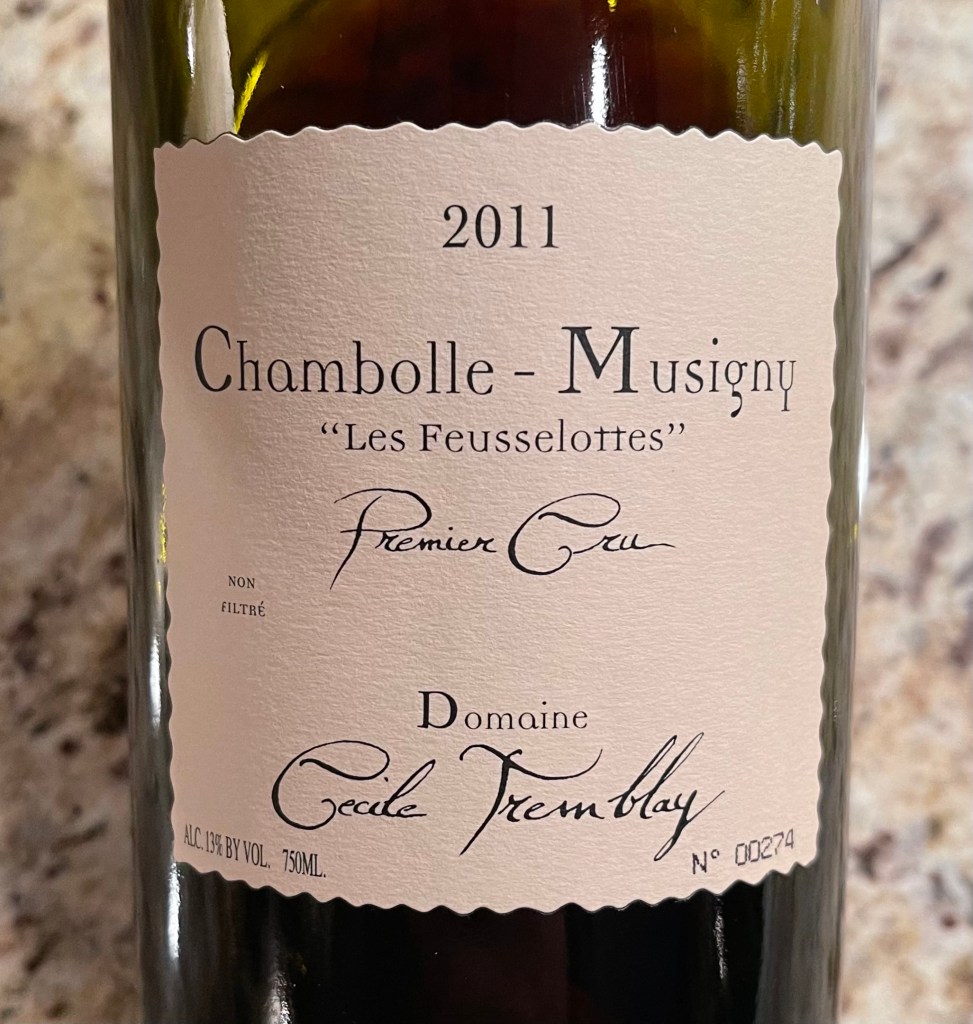
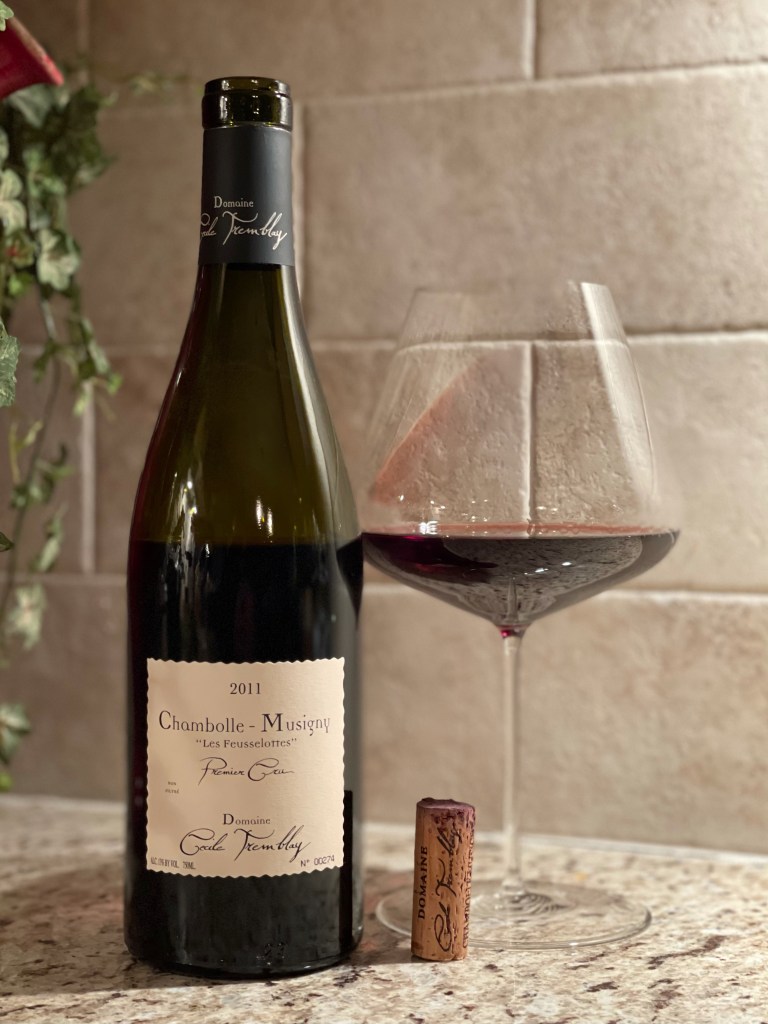
Today’s Wine: 2011 Chambolle-Musigny 1er Cru Les Feusselottes

100% Pinot Noir; 13% ABV

The 2011 Chambolle-Musigny 1er Cru Les Feusselottes is translucent pale ruby in color with garnet hues. I didn’t decant this, but the wine took a full 1-2 hours to really open up. The very delicate and feminine nose showcases aromas of black raspberry, strawberry, cherry, a hint of plum, red and purple florals, leather, delicate grilled herbs, and gravel. Meanwhile on the palate I get notes of cranberry, cherry, black raspberry, boysenberry, violets, sweet tobacco, savory green herbs, and rocky mineral. This is light- to medium-bodied with medium (+) acidity, refined medium tannins, and a long finish. Similar to Tremblay’s other 2011s, I do not get the green notes prevalent for the vintage. This is a beautifully elegant wine and it has a long life ahead of it.

Price: $480 (I paid $160). The price of these wines has really skyrocketed over the past several years, and unfortunately these are at a price-point where it is difficult to discuss value. While these are phenomenal, there are better values out there. I’m nonetheless glad to have snagged a good deal of her wines from $90 to $160 depending on bottling.
Beautifully Aged Napa Icon

Today’s Story: Beaulieu Vineyard

Beaulieu Vineyard at this point is a familiar “staple” on this blog, as I have previously reviewed the 2014 Tapestry Reserve, 2010 Maestro Collection Ranch No. 1 Red Blend, 2008 Clone 6, and both the 2005 and 2007 Clone 6. Nonetheless, I am returning today to write about the Georges de Latour Private Reserve which is one of the most historical and iconic Napa Valley Cabernet Sauvignons.

Beaulieu Vineyard is one of the most historic wineries in Napa Valley, founded in 1900 by Georges de Latour and his wife Fernande. Located in the Rutherford AVA, BV got its name from Fernande when she first saw the property and said it was a “beautiful place,” or “beau lieu.” Georges de Latour sold his successful cream of tartar business shortly thereafter and the couple purchased 4 acres with the intent of producing wines that could stand up to their native France. When they began planting, de Latour brought in Phylloxera-resistant rootstock from Europe in order to buck the trend of a California wine industry in trouble.

Though I have written about several wineries with origins in the late 1800s or early 1900s, BV is different in that unlike many of their neighbors they not only survived Prohibition but thrived during Prohibition. How? BV started selling sacramental wine to the Catholic Church and saw their business increase by four times while those around them shuttered their wineries. Once Prohibition ended, however, the story becomes more “traditional” Napa with de Latour focusing on how to create the best wines from his land by instituting updated farming and winemaking techniques. In an effort to raise his status higher, de Latour traveled to his native France to meet André Tchelistcheff, a world-renowned viticulturist and enologist, who championed continuous innovation. It was André who, upon tasting the 1936 vintage of BV’s Private Reserve wine, encouraged de Latour to bottle their flagship wine. André would become BV’s winemaker, a role he would maintain for over 30 years. In 1940 BV released their first Georges de Latour Private Reserve Cabernet Sauvignon, a wine still in production today.

BV has come a very long way from the initial 4 acre plot in 1900. BV currently operates on roughly 1,100 acres of estate vineyards, broken down into different “Ranch” designations. Ranch 1 (79 planted acres) came along in 1903, Ranch 2 (85 planted acres) in 1910, Ranch 3 in 1933 after the repeal of Prohibition, and so on. One of the cool features of BV’s winemaking technique is that each small vineyard lot stays separated throughout the entire process (not an easy feat with their vast holdings). During winemaking, each wine ferments such that the best expression of the fruit results. For instance, the white wines are cold-fermented to display a bright, vibrant character while the red wines are cold-soaked to showcase optimal color, flavor, and tannin. The reds are then fermented in small barrels and aged in oak varying in age, level of toast, and type.

For more on Beaulieu Vineyard’s history, portfolio of wines, or winemaking processes check out the website here, a source of much of the information above.

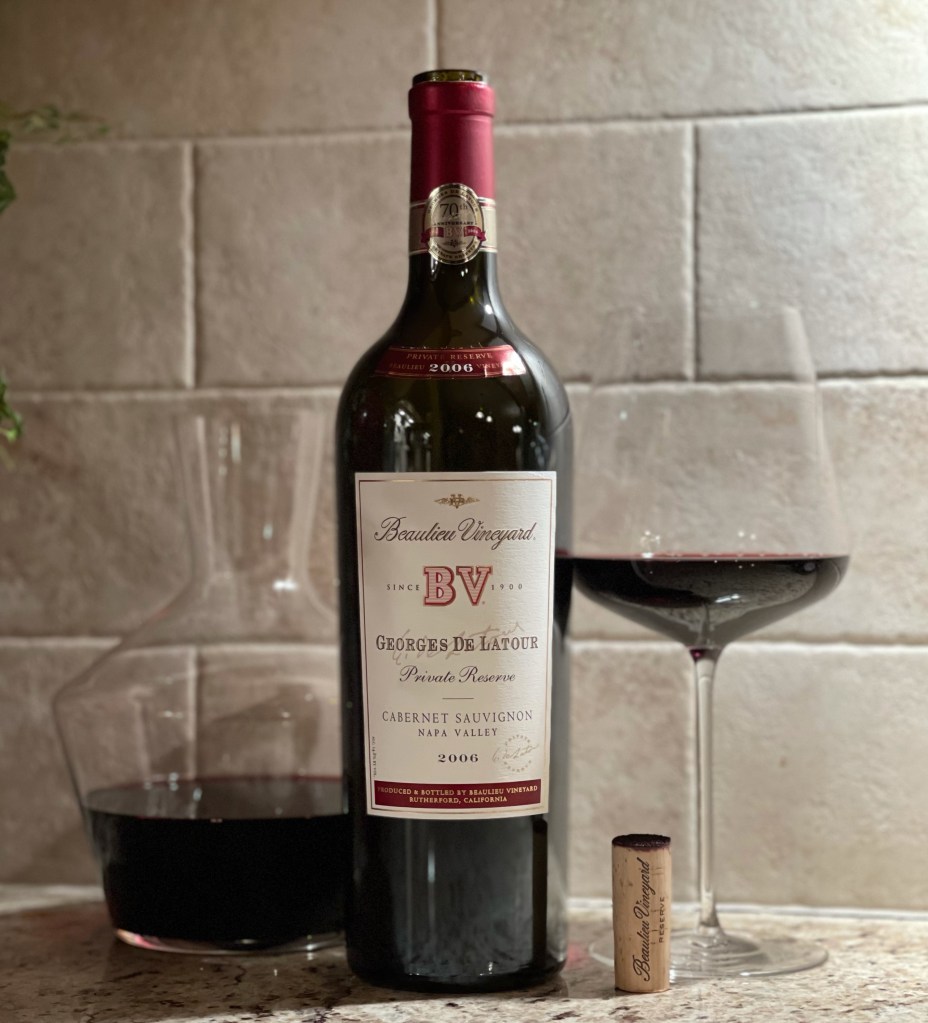
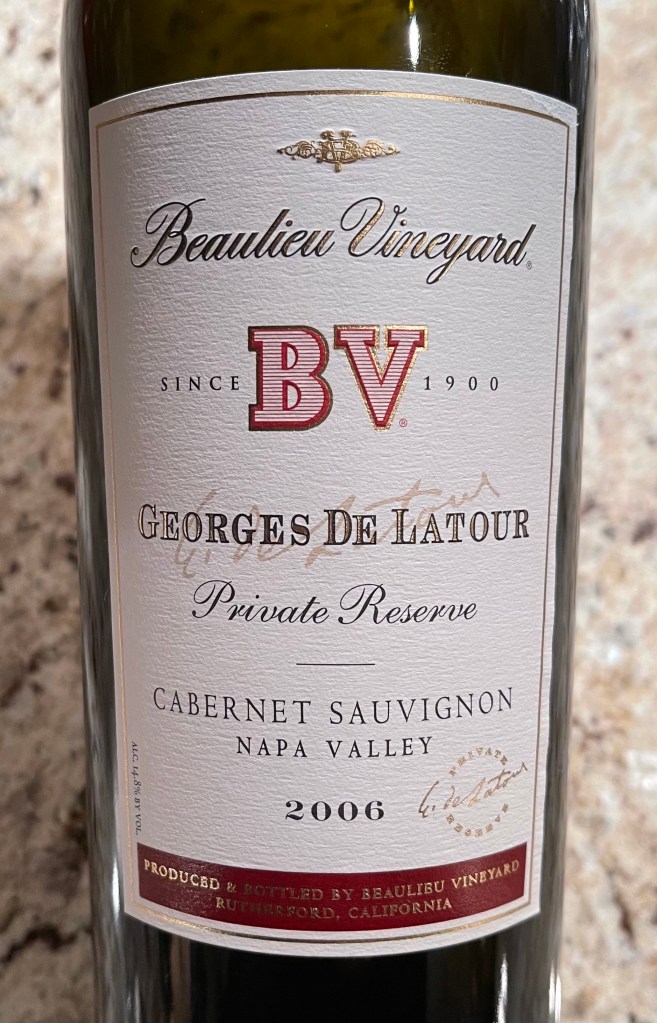
Today’s Wine: 2006 Georges de Latour Private Reserve Cabernet Sauvignon

No tech sheet (blend likely 100% Cabernet Sauvignon, or ~90% Cabernet Sauvignon and ~10% between Merlot, Petit Verdot, and Malbec); 14.8% ABV

The 2006 Georges de Latour is opaque deep ruby in color, quite youthful for the age. This was surprisingly fairly closed upon opening, so I decided to decant and it took about 2 hours to fully blossom. The nose showcases aromas of blackcurrant, blueberry, redcurrant, violet, cigar box, charred earth, graphite, green underbrush, espresso, and cedar. Meanwhile on the palate I get notes of blackberry, cassis, black raspberry, licorice, lavender, tobacco, graphite, charred green herbs, mocha, and cracked pepper. This is full-bodied with medium (+) acidity, fine-grained medium (+) tannins, and a long finish.

Price: $120. This is a great effort for the 2006 vintage, and I would consider it decent value if it weren’t for the 2007 and 2008 Georges de Latour I’ve had in the past couple weeks (not reviewed). Both the 2007 and 2008 vintages proved impeccable and drank like fine Left Bank Bordeaux. They also showed a gorgeous black truffle character I was hoping for but missed in the 2006. Nonetheless, the 2006 is an enjoyable and fairly complex wine if you happen to have a bottle.

Reliable and High Quality Santa Cruz Mountains Chardonnay

Today’s Story: Ridge Vineyards

Ridge Vineyards is another estate I wrote about several times previously, largely because they are a “go-to” or “ole reliable” producer for me thanks to their consistency. To read any of my notes on other bottlings from Ridge, check out the 2015 Syrah/Grenache/Mataro, 2012 Geyserville Vineyard, 2012 Lytton Springs, or 2018 Adelaida Vineyard Roussanne.

Ridge Vineyards, a historic California winery, found its beginnings near the top of Monte Bello Ridge in 1885. Osea Perrone, an Italian doctor in San Francisco, bought 180 acres and constructed the winery into three levels of the mountain using native limestone. He produced the first vintage under the Monte Bello Winery label in 1892, however later as Prohibition crippled the wine industry the facilities were abandoned.

Once Prohibition ended (thankfully), a man by the name of William Short purchased the winery and replanted several parcels to Cabernet Sauvignon in the late 1940s. The breakthrough came, however, in 1959 when the winery changed hands again to Dave Bennion, Hew Crane, Charlie Rosen, and Howard Ziedler and the partnership produced a quarter-barrel of “Estate” Cabernet. One of the greatest Cali Cabs at the time, this Monte Bello wine inspired Dave Bennion to leave Stanford Research Institute (where all partners worked) to focus on winemaking full-time.

As winemaking ramped up at Ridge, I would be remiss not to mention their Zinfandel, first made in 1964 from vines further down the mountain. In 1966, they produced their first Geyserville Zin that many of you should be able to find at your local wine store. By 1968, the winery was approaching 3,000 cases of annual production and had grown from 15 to 45 acres following an acquisition of the original Monte Bello terraces. Ridge demonstrated a quality and character in the upper echelon of California wines, with their 1971 Cab ultimately entered into the Paris Tasting of 1976.

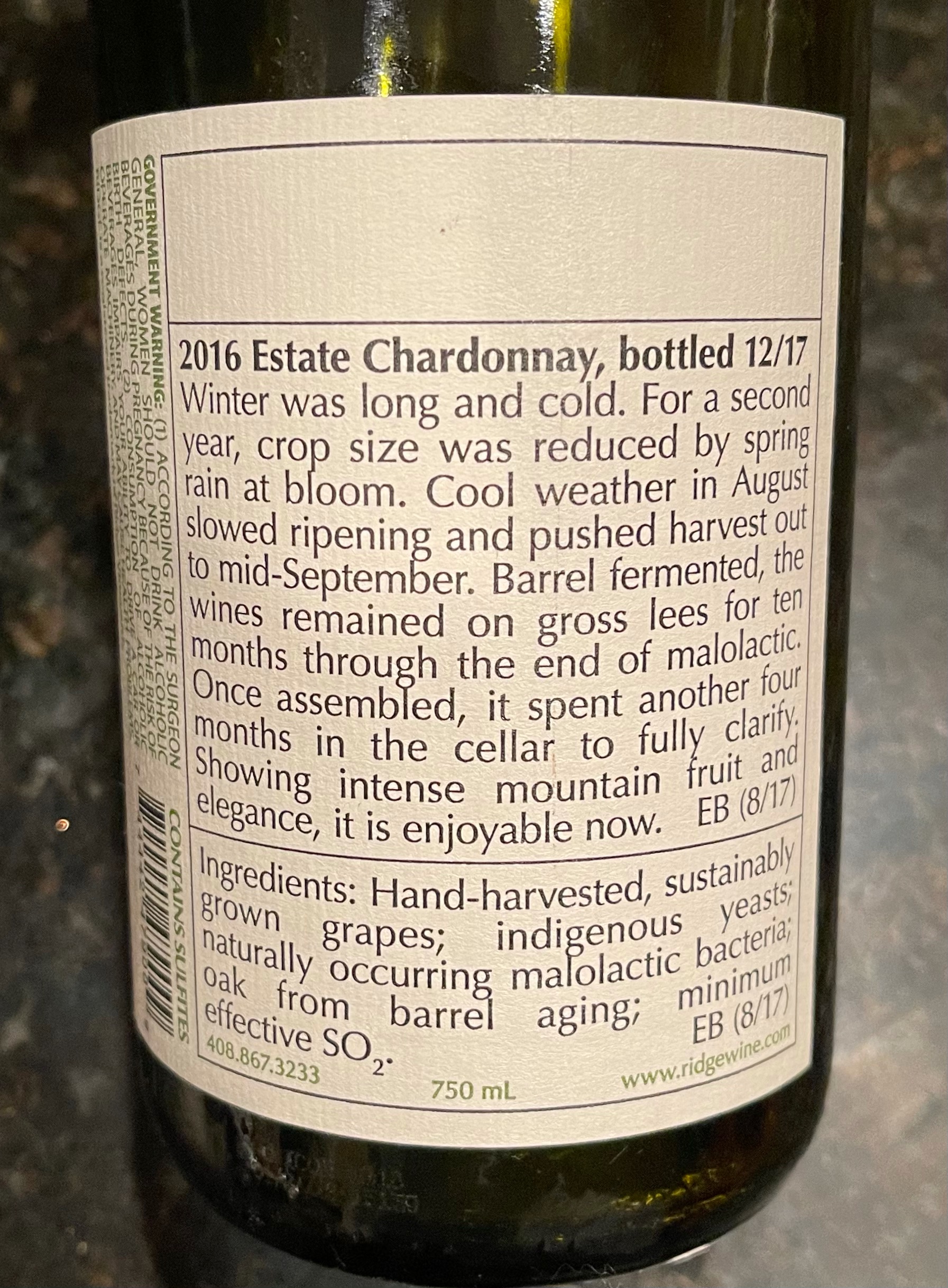
As further background on Ridge, I’d like the opportunity to discuss their winemaking practices as well. Calling their style “pre-industrial,” Ridge shies away from chemicals and additives prevalent in the industry nowadays. They ferment their wines only with natural yeast, do not use commercial enzymes or nutrients to affect color, flavor, or tannin in the wines, and are certified organic. Further, one of my favorite features of a bottle of Ridge is the back label that tells the winemaking process and lists ingredients, which is not common.

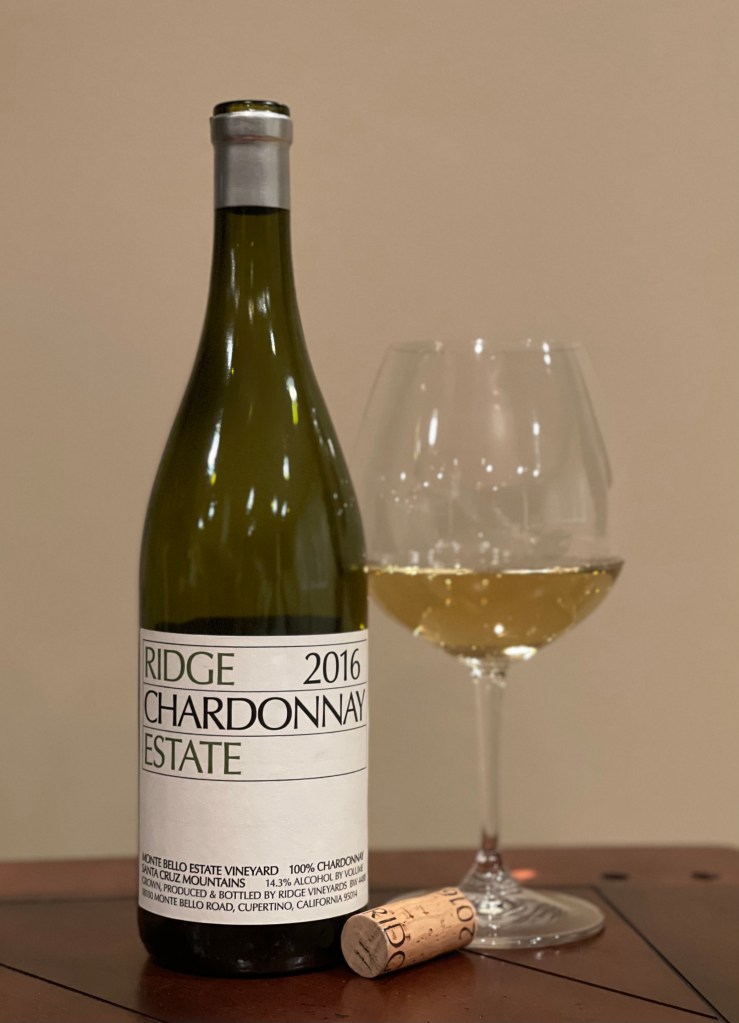
Today’s Wine: 2016 Estate Chardonnay

100% Chardonnay; 14.3% ABV

The 2016 Estate Chardonnay is transparent pale gold in color. Given some time to blossom in the glass, the nose showcases aromas of pear, golden apple, lemon zest, white florals, slight smoky reduction, crushed rock, butter, nutmeg, and exotic peppery spice. Once in the mouth, the wine displays notes of white peach, pineapple, golden pear, green apple, crème brûlée, chamomile, dill, dried vanilla, mild oaky spice, and bright stony mineral. This is medium- to full-bodied with racy medium (+) acidity, and oily and well-rounded mouthfeel, and a long finish.

Price: $55. I think there are better value Chardonnays out there closer to the $40 mark, however the pricing here is certainly not excessive. As always, the Ridge Estate Chardonnay is of impeccable quality and offers an incredibly enjoyable tasting experience now. The Ridge Monte Bello Chardonnay, priced $20 to $30 higher, is a very special wine though if picking between the two.

A Very Solid Value Play for Pauillac

Today’s Story: Château Haut-Bages Libéral

Château Haut-Bages Libéral is a Fifth Growth (Cinquième Cru) Bordeaux wine estate located in the Left Bank appellation of Pauillac. Established by the Libéral family who were négociants and vineyard owners in the early 1700s, Haut-Bages Libéral is named for its position on the Bages plateau and in homage to its founding family. The Libéral family created a solid reputation for their wines, ultimately earning classification as a Fifth Growth in the Bordeaux Wine Official Classification of 1855. Though the estate fell to a lower quality and state of somewhat disrepair during the wars and financial crises of the early 1900s, the Cruse family (owners of Château Pontet-Canet at the time) purchased Haut-Bages Libéral in 1960. The Cruse family engaged in widespread replanting of the vineyards and started to improve quality once again, though they sold the estate to the Villars-Merlaut family in 1982. Haut-Bages Libéral reached new heights under the Villars-Merlaut family, and Claire Villars-Lurton continues to run the estate today.

Today, Château Haut-Bages Libéral consists of about 30 hectares of vineyards planted to 70% Cabernet Sauvignon and 30% Merlot. The holdings are in great company within Pauillac, with the larger vineyard area neighboring Château Latour and a smaller vineyard area neighboring Château Pichon Baron. There is a third holding situated more inland as well. Haut-Bages Libéral practices organic viticulture as they work toward certification, though they include many biodynamic practices with an eventual goal of achieving biodynamic certification as well. Château Haut-Bages Libéral produces roughly 10,000 cases of wine per vintage, including the Grand Vin and their second wine (labeled as either Le Pauillac de Haut-Bages Libéral, La Chapelle de Bages, or La Fleur de Haut-Bages Libéral).

Today’s Wine: 2005 Château Haut-Bages Libéral

70% Cabernet Sauvignon, 30% Merlot; 13% ABV

The 2005 Château Haut-Bages Libéral is translucent deep ruby in color, which is still rather youthful and showing absolutely no bricking at this point. After about an hour decanting, this blossomed to showcase classic Pauillac aromas of blackcurrant, black cherry, redcurrant, pencil shavings, cigar box, tilled earth, mushroom, gravel, green herbs, and cedar spill. Meanwhile on the palate I get notes of blackberry, crème de cassis, black cherry, tobacco, graphite, eucalyptus, black truffle, cracked pepper, and iron. This is medium- to full-bodied with medium (+) acidity, medium (+) tannins, and a long finish. Drinks beautifully right now, but has the ability to go for at least another 5 years.

Price: $80 (paid $60 a few years ago). This was a very nice value surprise, especially having paid $60 for it a few years ago. It doesn’t have the power or depth like some of the higher-end 2005 Pauillac I’ve enjoyed, but it’s a very solid wine.

California Pinot Rooted in Burgundian Traditions

Today’s Story: Littorai Wines

Littorai is a small family-owned and operated winery established by Ted and Heidi Lemon in 1993. Dedicated to Pinot Noir and Chardonnay, Littorai produces vineyard-designate wines (save for the Sonoma Coast Pinot Noir and Chardonnay) from coastal vineyards in the Sonoma Coast and Anderson Valley of California. Ted is a career winemaker, having earned an Enology degree from the University of Dijon in Burgundy in 1981. During his time in Burgundy, Ted worked stints at a number of prestigious domaines including Domaine Georges Roumier, Domaine Bruno Clair, Domaine Parent, Domaine de Villaine, Domaine Delorme, and Domaine Dujac. In 1983, he became the first American ever to become winemaker and vineyard manager of a Burgundy estate by taking the reigns of Domaine Guy Roulot in Meursault. Though his stint at Roulot was fairly short-lived (this was during the uncertainty following Guy’s death), Ted returned to the United States and worked or consulted at a number of wineries before establishing Littorai. Heidi worked in wine as well prior to the couples’ own project, with an impressive resume including Domaine Chandon, Robert Pecota Winery, Robert Long Vineyards, and Stag’s Leap Wine Cellars.

As one might surmise, Ted’s winemaking philosophy is shaped tremendously by his studying and work in Burgundy. Ted believes the soil and more broadly terroir are the leading factors of winemaking and he strives to showcase a true sense of place with each bottle of wine he produces. To this end, Ted is very particular about the vineyards he sources from (though today his fruit is roughly half purchased and half estate grown) and common characteristics include low yields, organic viticulture, and biodynamic practices. Ted and his team further believe in manual farming and they only use natural materials such as “estate produced compost” for “fertilizer.” In the winery itself, Ted remains somewhat hush on his process but does certify there are no additives in his wines such as cultured yeasts, cultured bacteria, acidification, or enzymes. Littorai wines are also bottled unfined and unfiltered off the original lees. Production numbers are quite limited, and all wines sell direct to consumer via the mailing list or to various restaurants.

In 2003, Ted and Heidi purchased a 30-acre biodynamic farm to advance their goal of generative agriculture. The Lemons produce as much as they can on-site for both farming and winemaking needs, which the inhabitants of cows, sheep, chickens, and ducks assist with. Several years later, the Lemons completed their winery in 2008 and the walls are made of caged bales of hay! Natural cooling from nighttime temperatures helps maintain the winery and the cellars, and it is set up using gravity flow to minimize handling of the wines.

To view the source of the above information, view pictures of the winery and vineyards, or join the mailing list for Littorai Wines, visit their website (previously linked) here.

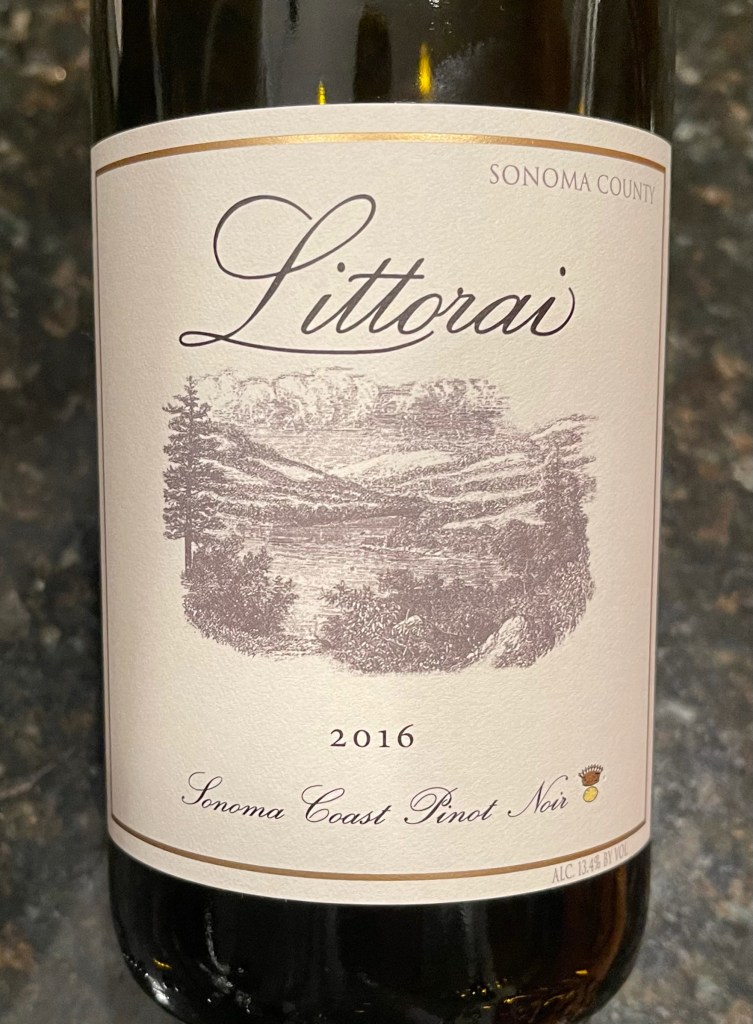
Today’s Wine: 2016 Sonoma Coast Pinot Noir

100% Pinot Noir; 13.4% ABV

The 2016 Sonoma Coast Pinot Noir is translucent pale to medium ruby in color, though it’s almost opaque. This requires about 45 minutes to an hour to blossom in the glass, showcasing a nose of black cherry, black raspberry, stewed strawberry, blueberry, violet, leather, tilled earth, chopped herbs, baking spice, and white pepper. The palate showcases classic notes of bing cherry, jammy raspberry, stemmy strawberry, plum, cola, leather, sweet tobacco, underbrush, slate, clove, and oaky spice. This is light- to medium-bodied with high acidity, medium (-) tannins, and a long finish.

Price: $60. I could argue there are better values for California Pinot Noir, but this is a very high quality and well-made Pinot Noir that does pose good value against the more “cult-level” bottlings that can be twice as expensive.

The Legend of Montalcino

Today’s Story: Soldera Case Basse

Soldera Case Basse (known broadly just as Soldera) was established by Gianfranco and Graziella Soldera in 1972. Soldera was born out of a desire to craft high-quality natural wine, and Gianfranco and Graziella settled on an uncultivated and abandoned estate in the southwestern area of Montalcino. Between 1972 and 1973, they planted the first vines and selected only the parcels most suitable for the Sangiovese variety. A staunch traditionalist, Gianfranco made his wines adhering to a very strict natural and hand-crafted process from vine to bottle. Gianfranco was even strict about who could visit to taste his wines, requiring they share a similar philosophy and appreciation for great wines and he did not allow anyone to spit his wines during tastings. Though Gianfranco passed away in February 2019, Soldera remains under the watchful eyes of Graziella and their children adhering to the same strict and time-tested principles.

Covering roughly 23 hectares at an elevation of 320m, the Soldera estate is as devoted to nature as it is to winemaking. In addition to the rich botanical garden on the property, the vines grow in a complex ecosystem with varying animal and insect life which allow the family to farm without the use of any weedkillers or other chemical products. In fact, only organic substances are used in the vineyards and all vine rows are worked only by hand. To allow for manual labor, the vineyards are kept to a maximum of 10 hectares and very low yields with the balance dedicated to the winery, eight hectares of woodlands, refurbished old buildings, fruit trees, berry bushes, pomegranates, and olive trees.

Winemaking at Soldera is very traditional, beginning with harvest of the grapes by hand. Once the grapes reach the winery, they are sorted berry by berry to ensure only the best fruit goes into their wines. Fermentation occurs in large vertical Slavonian oak vats and is entirely natural and spontaneous. Afterwards, the wines transfer to large Slavonian oak barrels without filtering and racking occurs only when necessary based on barrel sampling of the wines. Soldera only adds minimal SO2, and after four years of aging the wines are bottled in the cellar directly from barrel without filtration. After a few months in bottles, the wines are labelled, packed, and shipped but only if they are of a quality that meets the strict requirements of the winery’s expectations. Total production averages around 1,250 cases per vintage, though this output is drastically reduced in lesser quality vintages.

I highly recommend visiting the Soldera website here to view incredible pictures of the vineyards, gardens, and winery.

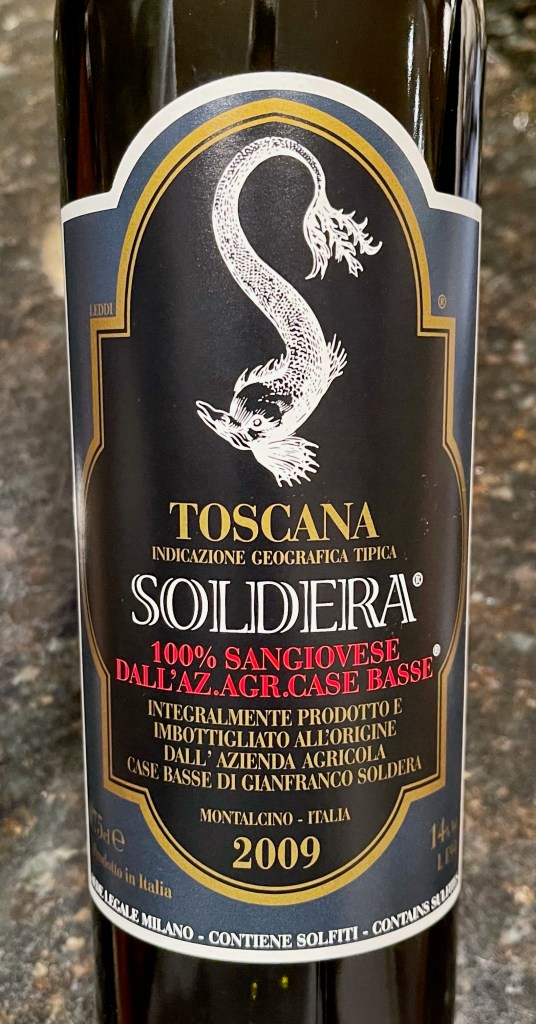
Today’s Wine: 2009 Soldera Toscana IGT

100% Sangiovese; 14% ABV

The 2009 Soldera is translucent medium garnet in color and absolutely beautiful in the glass. I gave this about 4 hours of air and tasted it along the way, which helped the nose add complexities and depth though the palate needs more coaxing. The nose blossoms into aromas of vibrant red cherry, wild strawberry, raspberry, red rose, anise, tomato paste, leather, scorched earth, truffle, savory green herbs, faint cinnamon, and crushed rock mineral. Meanwhile the perfectly balanced palate shows notes of bright cherry, strawberry, orange rind, mild sweet tobacco, roasted tomato, charred herbs, smoke, rocky earth, and oregano. This is medium- to full-bodied with medium (+) acidity, beautifully integrated medium tannins, and a long finish. Will only get better over the next 5+ years.

Price: $600 (paid $460 two years ago). I think the value conversation goes out the window at this price-point, however this is an absolutely magical wine and far and away the best Sangiovese I’ve ever tasted. I’m excited to taste the remaining bottles over the years to come, and I’m glad we snagged these before the prices rise even further.

A Fun New Bottling From Ridge

Today’s Story: Ridge Vineyards

Ridge Vineyards, another historic California winery, found its beginnings near the top of Monte Bello Ridge in 1885. Osea Perrone, an Italian doctor in San Francisco, bought 180 acres and constructed the winery into three levels of the mountain using native limestone. He produced the first vintage under the Monte Bello Winery label in 1892, however later as Prohibition crippled the wine industry the facilities were abandoned.

Once Prohibition ended (thankfully), a man by the name of William Short purchased the winery and replanted several parcels to Cabernet Sauvignon in the late 1940s. The breakthrough came, however, in 1959 when the winery changed hands again to Dave Bennion, Hew Crane, Charlie Rosen, and Howard Ziedler and the partnership produced a quarter-barrel of “Estate” Cabernet. One of the greatest Cali Cabs at the time, this Monte Bello wine inspired Dave Bennion to leave Stanford Research Institute (where all partners worked) to focus on winemaking full-time.

As winemaking ramped up at Ridge, I would be remiss not to mention their Zinfandel, first made in 1964 from vines further down the mountain. In 1966, they produced their first Geyserville Zin that many of you should be able to find at your local wine store. By 1968, the winery was approaching 3,000 cases of annual production and had grown from 15 to 45 acres following an acquisition of the original Monte Bello terraces. Ridge demonstrated a quality and character in the upper echelon of California wines, with their 1971 Cab ultimately entered into the Paris Tasting of 1976.

As further background on Ridge, I’d like the opportunity to discuss their winemaking practices as well. Calling their style “pre-industrial,” Ridge shies away from chemicals and additives prevalent in the industry nowadays. They ferment their wines only with natural yeast, do not use commercial enzymes or nutrients to affect color, flavor, or tannin in the wines, and are certified organic. Further, one of my favorite features of a bottle of Ridge is the back label that tells the winemaking process and lists ingredients, which is not common.

I previously wrote about Ridge with their 2015 Syrah/Grenache/Mataro, 2012 Geyserville Vineyard, and 2012 Lytton Springs.

Today’s Wine: 2018 Adelaida Vineyard Roussanne

100% Roussanne; 13.8% ABV

The 2018 Adelaida Vineyard Roussanne is transparent pale to medium gold in color with straw yellow hues. This needs some time to open up in the glass, but once it does the nose lets off aromas of apricot, peach, lemon, chamomile, wet stone, dried vanilla, and oak. On the palate, this showcases notes of lemon, quince, underripe pear, apricot, wax, white florals, brioche, and oaky spice. The wine is medium- to full-bodied with fairly high viscosity and medium (+) acidity into a medium (+) length finish. This is the first 100% Roussanne produced by Ridge and they only made 4 barrels of it.

Price: $25 direct from winery on release. Unfortunately Ridge is sold out of this bottling and I cannot find it anywhere in store or online, though thankfully we have 8 more bottles left of a case hiding in the cellar. This is a really fun wine that I think is a steal at $25, though I’d like to wait another year or two before revisiting it.

Clone 6 Showdown

Today’s Story: Beaulieu Vineyard

Beaulieu Vineyard is one of the most historic wineries in Napa Valley, founded in 1900 by Georges de Latour and his wife Fernande. Located in the Rutherford AVA, BV got its name from Fernande when she first saw the property and said it was a “beautiful place,” or “beau lieu.” Georges de Latour sold his successful cream of tartar business shortly thereafter and the couple purchased 4 acres with the intent of producing wines that could stand up to their native France. When they began planting, de Latour brought in Phylloxera-resistant rootstock from Europe in order to buck the trend of a California wine industry in trouble.

Though I have written about several wineries with origins in the late 1800s or early 1900s, BV is different in that unlike many of their neighbors they not only survived Prohibition but thrived during Prohibition. How? BV started selling sacramental wine to the Catholic Church and saw their business increase by four times while those around them shuttered their wineries. Once Prohibition ended, however, the story becomes more “traditional” Napa with de Latour focusing on how to create the best wines from his land by instituting updated farming and winemaking techniques. In an effort to raise his status higher, de Latour traveled to his native France to meet André Tchelistcheff, a world-renowned viticulturist and enologist, who championed continuous innovation. It was André who, upon tasting the 1936 vintage of BV’s Private Reserve wine, encouraged de Latour to bottle their flagship wine. André would become BV’s winemaker, a role he would maintain for over 30 years. In 1940 BV released their first Georges de Latour Private Reserve Cabernet Sauvignon, a wine still in production today.

BV has come a very long way from the initial 4 acre plot in 1900. BV currently operates on roughly 1,100 acres of estate vineyards, broken down into different “Ranch” designations. Ranch 1 (79 planted acres) came along in 1903, Ranch 2 (85 planted acres) in 1910, Ranch 3 in 1933 after the repeal of Prohibition, and so on. One of the cool features of BV’s winemaking technique is that each small vineyard lot stays separated throughout the entire process (not an easy feat with their vast holdings). During winemaking, each wine ferments such that the best expression of the fruit results. For instance, the white wines are cold-fermented to display a bright, vibrant character while the red wines are cold-soaked to showcase optimal color, flavor, and tannin. The reds are then fermented in small barrels and aged in oak varying in age, level of toast, and type.

For more on Beaulieu Vineyard’s history, portfolio of wines, or winemaking processes check out the website here, a source of much of the information above.

If you’d like to revisit some of the notes I wrote about BV’s wines before, I previously wrote about the 2014 Tapestry Reserve, 2010 Maestro Collection Ranch No. 1 Red Blend, and 2008 Clone 6.

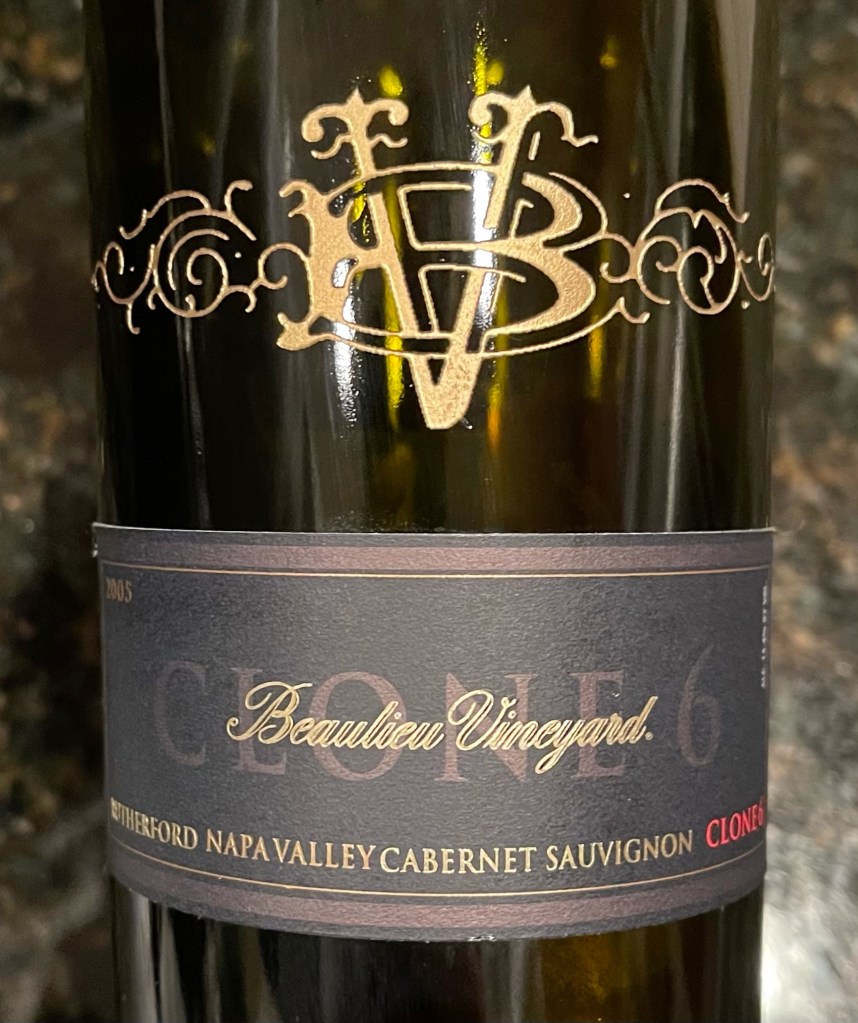
Today’s 1st Wine: 2005 Clone 6

100% Cabernet Sauvignon; 14.4% ABV

The 2005 BV Clone 6 Cabernet Sauvignon is opaque deep ruby in color, showing no signs of its age. After an hour in the decanter, I get aromas of blackcurrant, blackberry, black cherry, violet, cigar box, forest floor, black truffle, dried green herbs, a hint of green bell pepper, and slate. The palate showcases notes of blackberry, plum, redcurrant, black cherry, anise, tobacco, mushroom, black pepper, stony mineral, coffee, and dried cedar. This is full-bodied with high acidity, velvety medium tannins, and a long finish.

Price: $150 from the winery in 2015. I think this is a very fair price for this Cabernet Sauvignon, granted it is nearly impossible to find these in the marketplace nowadays. This is a very refined, elegant, and complex bottling that is drinking exceptionally well right now.

Today’s 2nd Wine: 2007 Clone 6

100% Cabernet Sauvignon; 15% ABV

The 2007 BV Clone 6 Cabernet Sauvignon is also opaque deep ruby in color, still very youthful in appearance. Given some time to open up, the nose showcases aromas of crème de cassis, blackberry, plum, black licorice, sweet tobacco, damp earth, wet gravel,  green herbs, and mild baking spice. The palate, meanwhile, displays notes of blackberry, blueberry, blackcurrant, tobacco, anise, green pepper, clove, coffee grounds, chocolate, and charred oak. This is full-bodied with medium (+) acidity, integrated medium (-) tannins, and a long finish.

Price: $150 from the winery in 2015. Especially next to the 2005 vintage, the pricing for this 2007 vintage seems a little steep. The wine is more of the people-pleasing type and the higher ABV gives the fruit character more of a jammy appeal. Nonetheless, this is just as difficult to find in the marketplace.

The Winner Is…

While both delicious wines, the 2005 takes the cake in this showing. The lower alcohol is easily apparent, and coupled with an extra two years of bottle age provides for a much more refined, elegant, and complex wine. The 2005 is also showing more of the tertiary notes I love in my Cabs.

The “Grand Cru” of Barolo

Today’s Story: Damilano

Damilano is a family owned and operated wine estate located in Piedmont, Italy and they are known for their Cru Barolo bottlings from the Cannubi, Brunate, Cerequio, and Liste vineyards. The Damilano family traces their winemaking roots to the year 1890 when Giuseppe Borgogno, the great-grandfather of today’s owners, began making wines from the family vineyards. It wasn’t until 1935, however, that Damilano got its name and “official” start under Giuseppe’s son-in-law Giacomo Damilano. Giacomo worked to improve the quality of his family’s wines, ultimately passing the estate to his children and then his grandchildren Guido, Mario, and Paolo Damilano who run the estate today.

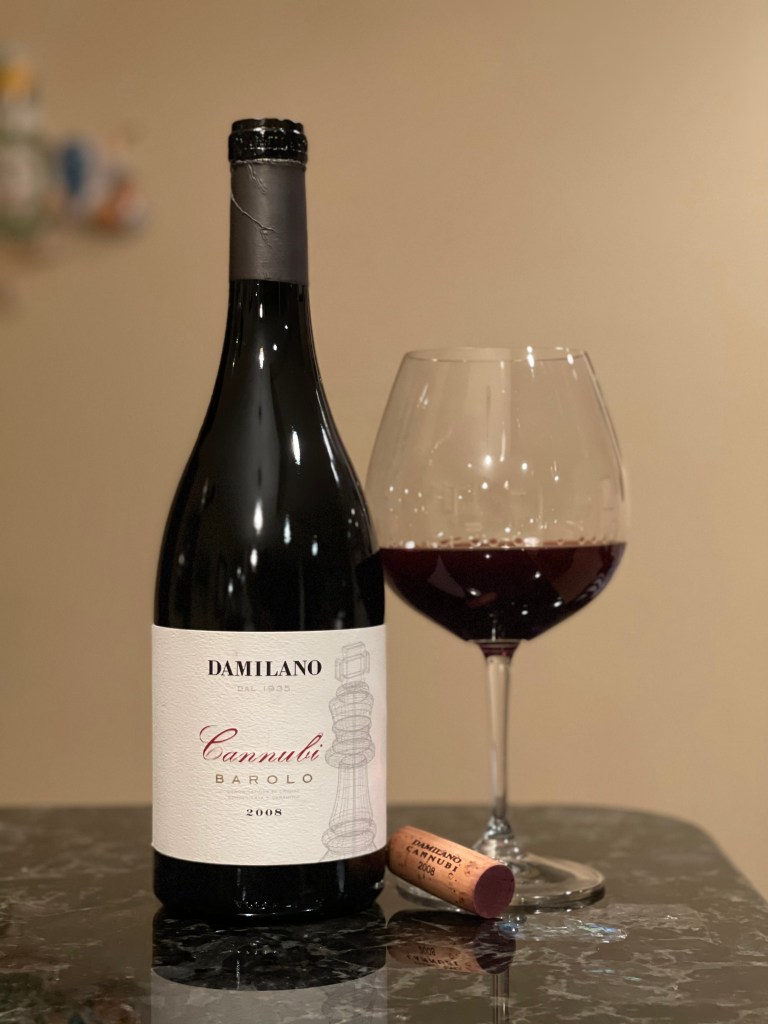
Today’s Wine: 2008 Barolo Cannubi

100% Nebbiolo; 15% ABV

The 2008 Barolo Cannubi is opaque deep garnet in color. Given an hour or two to open up, the nose showcases classic aromas of black cherry, black raspberry, anise, red rose, tobacco, truffle, basil, scorched earth, and oak. Meanwhile on the palate I get equally classic notes of black cherry, plum, baked strawberry, cola, black licorice, pipe tobacco, oregano, and mineral. This is full-bodied with medium acidity, grippy and dusty medium (+) tannins, and a medium length finish.

Price: $85. There is a lot of good here and I think the price is justified, but this is lacking in complexity and depth to really blow me away. Though the alcohol is not overbearing, at 15% you can tell it is there and this comes across as a more modern expression than I would like. It has all the great Barolo notes to it, but there are bottlings more my style around the $50-60 mark.

A Harlan Family Rarity

Today’s Story: The Napa Valley Reserve

I previously wrote about The Napa Valley Reserve when I reviewed the 2003 vintage, which I was fortunate to find in a retail location. These wines are not for resale so it is a rare opportunity to drink them, though I pulled today’s bottle of 2005 out of our family’s personal cellar.

The Napa Valley Reserve was established by H. William Harlan in 2000 and is a private members-only club located in St. Helena of the Napa Valley. While the vineyards are overseen by the Harlan Estate viticulture team and winemaking is spearheaded by Harlan Estate winemaker Bob Levy and winemaker Marco Gressi, members are involved in as much of the winemaking process as they desire. For instance, members are able to assist in pruning during the winter months, thinning during the summer months, and harvest in the fall which is accomplished entirely by hand. Members even get to help monitor the fermentation process, top up their barrels during aging, and can help determine a custom blend for their own wines, custom bottles, and custom labels. If you would like to join this exclusive club of about 600 members, prepare to pay upwards of $100,000 for entry after receiving the necessary invite.

To learn more, visit their website here.

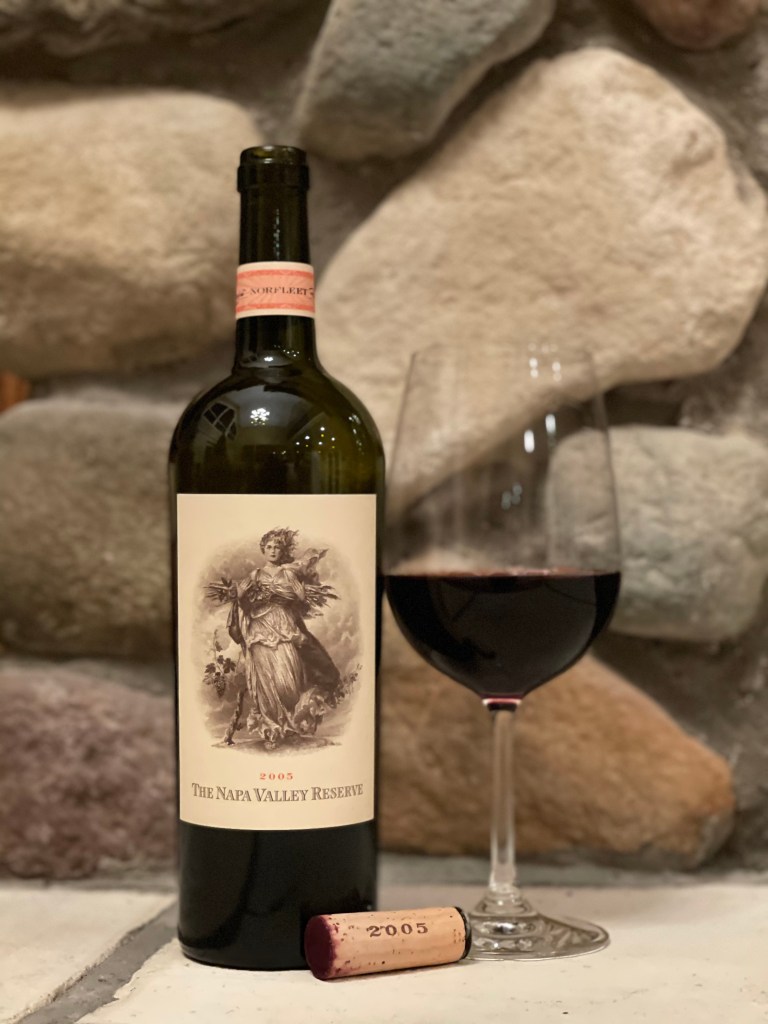
Today’s Wine: 2005 Napa Valley Reserve

Blend unknown; 14.5% ABV

The 2005 Napa Valley Reserve is opaque deep ruby in color showing no signs of its age. Given 2 hours to open up, the complex nose showcases aromas of plum, blackberry, cassis, violets, cigar box, graphite, volcanic earth, green herbs, a hint of bell pepper, eucalyptus, clove, vanilla, and mocha. Meanwhile on the palate I get notes of blackberry, blueberry, plum, redcurrant, tobacco, cola, crushed rock, graphite, cracked pepper, cedar spill, grilled herbs, and espresso. This is full-bodied with medium (+) acidity, refined and velvety medium (-) tannins, and a long finish. Perfectly balanced and opulent despite being soft and supple.

Price: Not for resale (we acquired this from The Napa Valley Reserve during a visit roughly ten years ago). This being said, I am seeing this vintage online for $450 per bottle, though I’m sure these will pop up in auction time to time and you can probably snag it for less. If you do have the rare opportunity to taste these wines, they are similar to the other Harlan properties but I would place it somewhere around the Bond offerings.