Domaine Duroché is a family owned and operated wine estate located in the Gevrey-Chambertin village in Burgundy. The Duroché family owns roughly 8.25 hectares of vineyards in Gevrey-Chambertin, producing wines that begin with both Bourgogne Rouge and Blanc before climbing through several village and 1er Cru bottlings to their Grand Cru sites of Charmes, Griottes, Latricieres, and Clos de Beze. Though the family has been bottling their wines since 1933, the quality of the domaine catapulted to new heights under the current leadership of fifth generation Pierre Duroché. Though Pierre is a relatively young winemaker in Gevrey, he refrains from being too heavy handed and seeks to create wines of elegance and finesse as compared to some of his neighbors favoring a bigger, bolder, and oakier style. Pierre and his family farm the vineyards using as few chemicals as possible (relying only on some sulfur or copper for treatments), and all fruit is hand-harvested and sorted before fermentation using only native yeasts. New oak usage varies by level of wine but always remains as minimal as possible, and the wines are bottled without fining or filtration. Beginning with the 2017 vintage, Pierre and his wife Marianne purchase fruit from her family to supply their new Vosne-Romanée Village and Echezeaux Grand Cru bottlings.
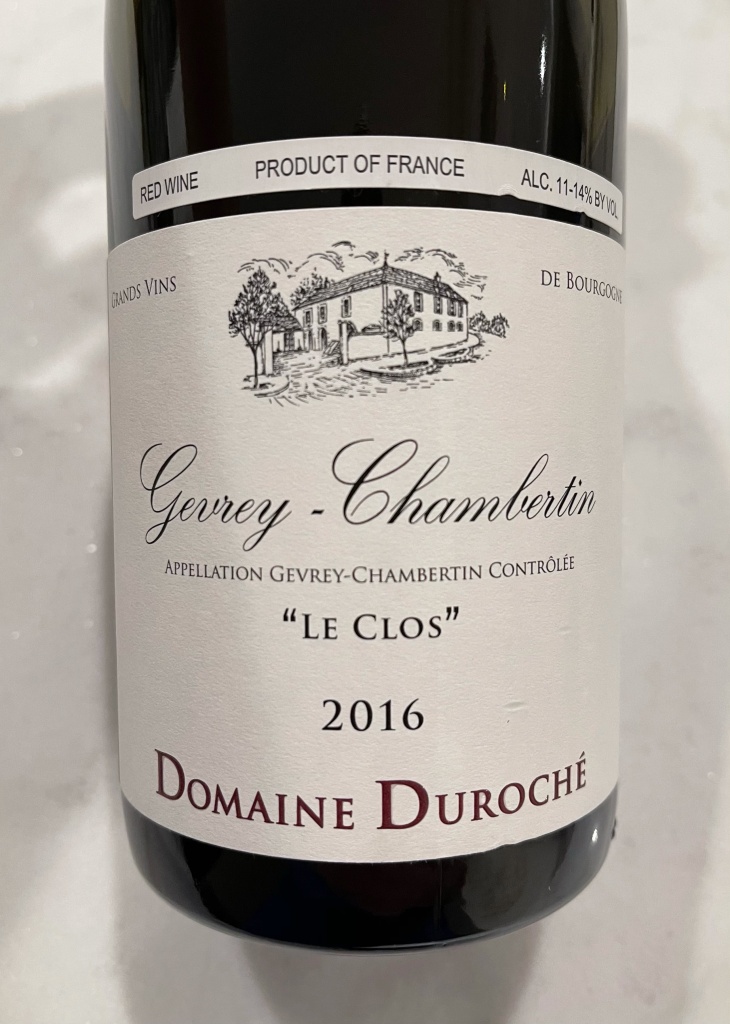
Today’s Wine: 2016 Gevrey-Chambertin Le Clos
100% Pinot Noir; 13% ABV
The 2016 Gevrey-Chambertin Le Clos is pale to medium ruby in color and slightly translucent. I let this slow ox in the bottle for a while before letting it open up in the glass, blossoming into a nose of black cherry, dried strawberry, boysenberry, charred earth, eucalyptus, crushed rock, stony mineral, and light oak. Still fairly tight on the palate, this took some time to open up and showcase notes of cherry, stemmy strawberry, raspberry, red and blue florals, leather, rocky earth, and mineral. The wine is light- to medium-bodied with medium (+) acidity, medium (-) tannins, and a long finish. Gorgeous Gevrey minerality with this one, but it does need probably at least 5 years of cellaring to come into its own.
Price: $65. I think this is a very good value red Burgundy, though I don’t necessarily think it will remain this fairly priced for long. Pierre Duroché is certainly a rising star in Gevrey-Chambertin and I would highly recommend picking some of this up if you come across it.
Kistler Vineyards is a small family-owned and operated winery established in 1978 by Steve Kistler and Mark Bixler in California’s Sonoma County. Founded on the belief that California could produce Burgundy-style Chardonnay representative of each unique vineyard site, Kistler works with a single Chardonnay clone planted across 15 vineyards to produce 11 single-vineyard bottlings. In addition to Chardonnay, Kistler produces small amounts of Pinot Noir using two heritage selections sourced from a Grand Cru site in Burgundy. Kistler farms their vineyards quite meticulously, with both the Chardonnay and Pinot Noir clones highly limited in yield in order to produce fruit of intense depth, contrentration, and focus. In pursuing wines of character and place, the winemaking team at Kistler ferments using only native yeasts with no machination of the fruit while being as minimally invasive as possible. At bottling, the wines are bottled unfined and unfiltered.
Today’s Wine: 2012 Cuvée Natalie Pinot Noir
100% Pinot Noir; 14.1% ABV
The 2012 Cuvée Natalie Pinot Noir is pale ruby in color and almost opaque. I let the wine slow ox for about 45 minutes before letting it blossom in the glass, opening up to reveal aromas of bing cherry, pomegranate, black raspberry, licorice, red florals, leather, dried earth, savory herbs, and mild cinnamon. Once on the palate, this showcases notes of baked strawberry, cherry, raspberry, plum, rose, sweet tobacco, forest floor, underbrush, white pepper, and mild oaky spice. This silky and elegant Pinot is light- to medium-bodied with high acidity, medium (-) tannins, and a long finish. 1,065 cases produced.
Price: $150 (though you might be able to find it closer to $130). As much as I hate to say it, I think this bottling is a bit overpriced. While undoubtedly delicious, there are simply too many Pinot Noirs out there that punch well above this in terms of value. $150 is a very, very expensive California Pinot and at that price point I’d be more apt to poke around Burgundy or buy 2-3 bottles of a more value-oriented wine.
I previously wrote about Hiyu Wine Farm when I reviewed the 2015 Ramato, which was such a unique and fun wine I had to try another bottling from them today.
Hiyu Wine Farm, established by Nate Ready and China Tresemer, is a 30 acre working farm in the Hood River Valley of Oregon. The property consists of 14 acres of vines, 4 acres of fields and pastures, 4 acres of forest and a pond, and 0.5 acres of market garden with the balance devoted to food forests. Guided by the practices of biodynamics and permaculture, Hiyu tends very little to their vines and they do not hedge or green harvest. Rather, all mowing or tilling is accomplished by pigs, cows, chicken, ducks, and geese that live in the vineyards in cycles throughout the year. Hiyu does not use any sulfur in the vineyards and claims to spray 85% less material than a standard organic or biodynamic vineyard, with the majority being cinnamon oil or herbal teas. Interesting to note, the vineyards are divided into 0.5 acre blocks each planted to a field blend of varieties. There are 80 different varieties and even more clones planted on the farm! In the cellar, Nate practices minimal intervention winemaking and prefers long aging in oak before the wines are bottled unfined and unfiltered with minimal SO2 (5ppm max).
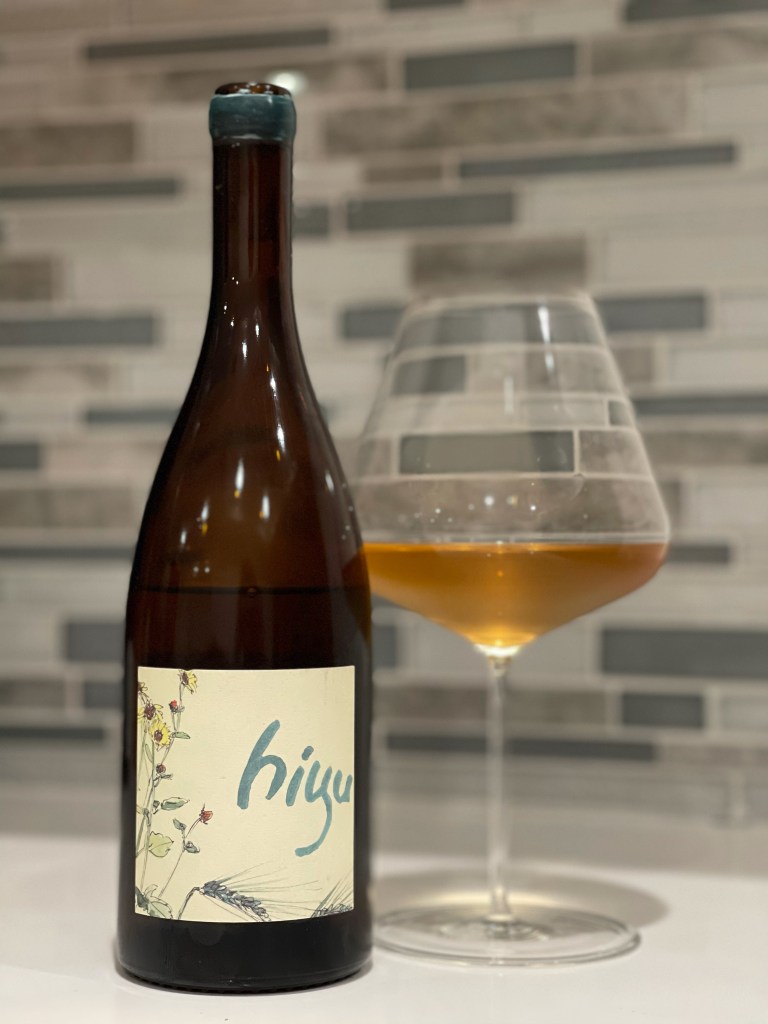
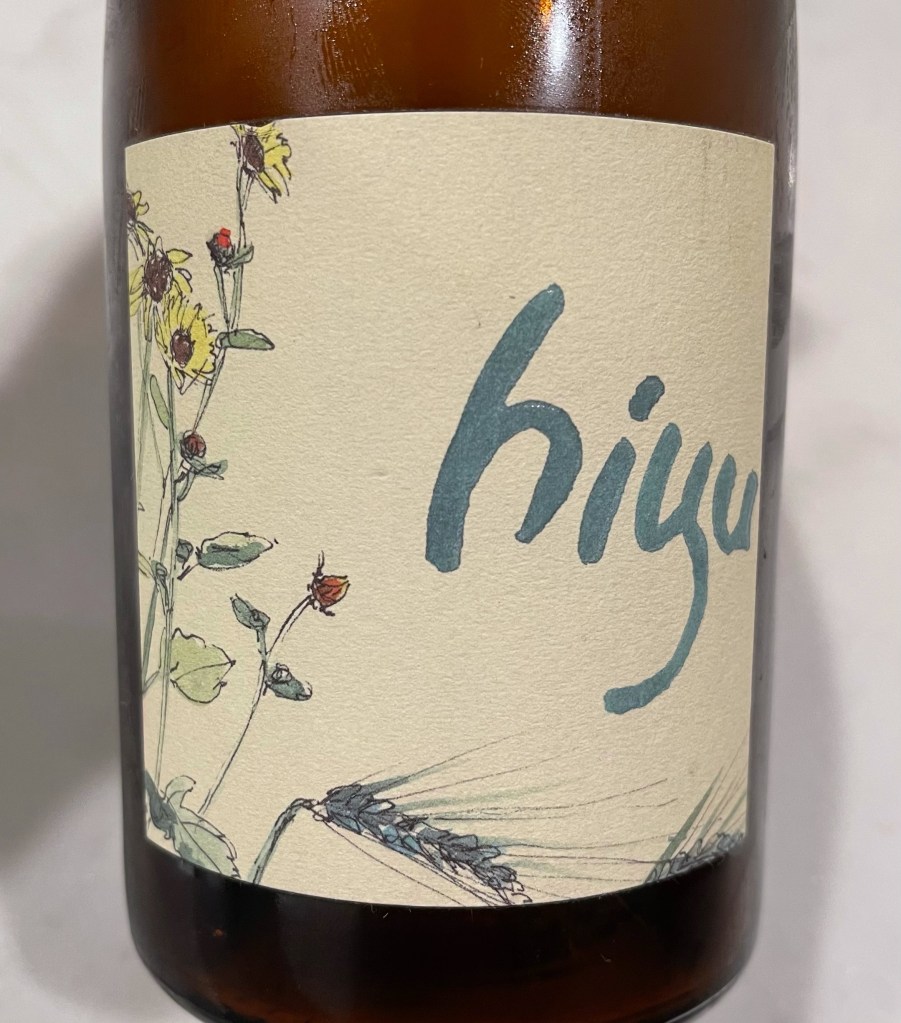
Today’s Wine: 2016 Falcon Box White Blend
Field Blend (Chardonnay, Aligoté, Pinot Blanc, Pinot Noir, Pinot Meunier, Pinot Gris, and Melon de Bourgogne); 13% ABV
The 2016 Falcon Box is a transparent but very rich, deep gold in color with hues of amber. As this develops in the glass, the nose emits aromas of peach, tangerine, melon, Dutch apple pie, honeysuckle, white wildflowers, brioche, and stony mineral. Once in the mouth, this light and airy Alpine wine showcases notes of golden apple, baked pineapple, peach, tropical citrus, light herbs, toffee, almond, and limestone. Well-rounded with medium body, medium (+) acidity, and a long but refreshing finish. 117 cases produced.
Price: $100 (I paid $80). I find it very difficult to call this a good value wine, simply because $100 for a white wine immediately makes me think of the immense quality you can get with a white Burgundy or a lower-priced California or Oregon white blend. However, this is nonetheless a very fun wine and something unlike wines I’ve tasted before, so I would approach it with that in mind.
Today’s Story: Château Pichon Longueville Comtesse de Lalande
I previously wrote about Château Pichon Longueville Comtesse de Lalande when I tasted the 1966, 1986, and 2003 vintages. Though I’ve had this wine many times and from vintages not written about (including 2014 which is showing very nicely now), I wanted to revisit them today for the 2008 vintage. Regularly I hear great things about the often “underrated” 2008 vintage for Bordeaux, so I figured it’s time to check for myself.
Château Pichon Longueville Comtesse de Lalande is a Second Growth (Deuxième Cru) estate based on the Bordeaux Wine Official Classification of 1855. Pichon Lalande is considered by many to be a classic example of Pauillac, known for its deep, concentrated layers of ripe fruit accompanied by notes of cassis, tobacco, and earth.
With nothing short of a somewhat tumultuous history, Pichon Lalande’s ownership changed hands over the years and earned its name when the founder’s daughter Therese received it as a dowry for her marriage to Jacques de Pichon Longueville. During the 18th century, the estate was dominated by women (Therese de Rauzan, Germaine de Lajus, and Marie Branda de Terrefort) throughout the winemaking process until Baron Joseph de Pichon Longueville took over for his mother. In 1850, with his death, the estate split between his two sons and three daughters and ultimately resulted in the division of Comtesse de Lalande and Pichon Baron.
With no familial heirs, Edouard Miailhe and Louis Miailhe purchased Pichon Lalande following WWI. Edouard’s daughter, May-Eliane de Lencquesaing, took over management in 1978 and became a prominent ambassador for Bordeaux wines while dramatically increasing quality of her estate. One of her major endeavors, and possibly most famous, was growing the size of Pichon Lalande from 40 hectares of vines to 89. In 2007, however, May-Eliane sold a majority stake of the estate to the Rouzaud family, owners of Roederer Champagne, and management changes as well as renovations took place.
Today’s Wine: 2008 Château Pichon Longueville Comtesse de Lalande
The 2008 Pichon Lalande is opaque medium to deep ruby in color. After 4 hours or so in the decanter, the wine seems perfectly open and the nose showcases classic aromas of blackcurrant, redcurrant, cassis, pencil shavings, cigar box, scorched earth, gravel, cracked pepper, green herbs, and mild oak. Moving onto the palate, I get more classic notes of cassis, black cherry, plum, licorice, violet, tobacco, graphite, loamy earth, underbrush, and chocolate. This is medium- to full-bodied with medium (+) acidity, medium (+) dusty tannins, and a long finish. Gorgeous wine from an underrated vintage, and I think this has a very long life still ahead of it.
Price: $140 ($180 average online). Relative to vintages around this such as 2005, 2009, or 2010, this is a great value play particularly at the price I found it for. While it doesn’t have the power some of these stronger vintages possess, it is a gorgeous wine nonetheless that is really starting to come into its own.
Chanin Wine Co. was established in 2007 by winemaker Gavin Chanin, and his goal is to produce single vineyard Pinot Noir and Chardonnay from Santa Barbara County. Gavin selected the vineyards to source his fruit based on their organic (or at minimum sustainable) farming practices while also seeking older vines. The current vineyard selections include Sanford & Benedict in the Sta. Rita Hills, Los Alamos between the Santa Maria and Santa Ynez Valleys, Bien Nacido in the Santa Maria Valley, and Duvarita just west of the Sta. Rita Hills. Gavin eschews higher alcohol levels in his wines to foster balance and finesse, while practicing gentle winemaking methods and avoiding additives such as commercial yeasts, bacteria, and enzymes. All of Chanin’s wines are bottled unfiltered and the labels feature his own artwork.
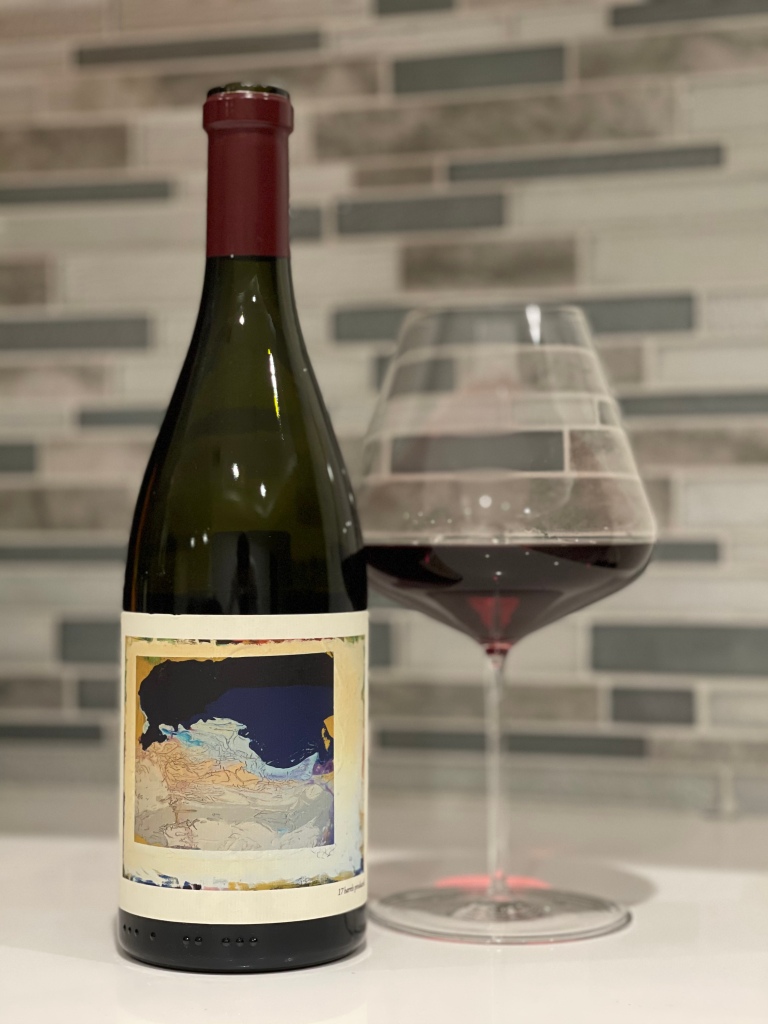
Today’s Wine: 2015 Bien Nacido Vineyard Pinot Noir
100% Pinot Noir; 13% ABV
The 2015 Bien Nacido Vineyard Pinot Noir is translucent pale ruby in color. Once this opens up, the nose showcases aromas of baked cherry, black raspberry, brambly strawberry, rose, forest floor, dried green herbs, and mint. Meanwhile on the palate, I get notes of ripe red cherry, crunchy cranberry, boysenberry, sweet tobacco, sous bois, underbrush, and cinnamon. This is light- to medium-bodied with medium (+) acidity, medium (-) tannins, and a medium (+) length finish. 17 barrels produced.
Price: $55. I’d call this wine very appropriately priced, with an inclination to say it punches above its price due to the gorgeous purity of fruit, balance, and elegance. While distinctly Californian thanks to the ripe fruit character, the Burgundian flair and more traditional winemaking help this shine versus the competitors.
Vecchie Terre di Montefili was established in the Chianti Classico area of Tuscany by the Acuti family in 1975, right in the midst of rising popularity of “Super Tuscan” wines. The family planted their Sangiovese vineyards when they established Montefili, later giving in to the rise of Tuscan wines containing Cabernet Sauvignon by adding the variety in 1981. Dedicated to the craft of sustainable winemaking, Montefili helped create Italy’s first organic winemaking district in 2000 which is overseen by the Panzano in Chianti Winemakers Association. Though the winery shifted hands in late 2015 to American investors Nicola Marzovilla, Frank Bynum, and Tom Peck Jr., the trio is dedicated to maintaining the traditions of the Acuti family and their wines.
Vecchie Terre di Montefili consists of 31 acres of vineyards situated at just over 1,500 feet elevation. While the majority of these vineyards are planted to Sangiovese, there are smaller amounts of Cabernet Sauvignon for the Bruno di Rocca bottling. Adhering to their place in Panzano’s organic district, Montefili practices organic and sustainable viticulture with minimal intervention to the natural flora and fauna of the land, allowing them to increase an already diverse biological ecosystem. Winemaker Serena Gusmeri views herself as more of an observer and guide to the fruit and wines, avoiding a heavy hand throughout the winemaking process with use of spontaneous fermentations and long aging in barrel. Her goal is simply to create wines that reflect the terroir and sense of place in her corner of Tuscany.
Today’s Wine: 2015 Bruno di Rocca
80% Cabernet Sauvignon, 20% Sangiovese; 14.5% ABV
The 2015 Bruno di Rocca is opaque deep ruby in color. I decanted this for 3 hours or so, but I sense it will only blossom further and I’m saving some to revisit on day 2. Dense and powerful, this does start to open up and showcase a nose of blackberry, blackcurrant, plum, licorice, leather, wet slate, charred herbs, vanilla, chocolate, and oak. The palate benefited from air time as well, offering notes of blackberry, blueberry, black cherry, tobacco, damp rocky earth, coffee grounds, nutmeg, savory green herbs, mild oak, and iron. This youthful Tuscan red is full-bodied with medium (+) acidity, grippy high tannins, and a long finish. I think if one gives this another 5 years of cellaring they will be handsomely rewarded.
Price: $50 (typically $100+). The $100 or higher price tag is certainly a large stretch on value, and I’d recommend you look elsewhere for now. However, if you can find a great deal like I did and pay $50 for this wine it’s certainly worth trying. Give it a lot of air now, or remain strong and let this rest.
Maloof Wines is a fun, lively, and somewhat exploratory winery established in 2015 by husband and wife duo Ross and Bee Maloof. Situated in Forest Grove, Oregon, Maloof produces single vineyard wines mainly with often overlooked white grape varieties sourced from their estate vineyard No Clos Radio or other vineyard partners. Before crafting these wines, Bee worked in the aerospace industry as a materials science engineer and Ross gained a penchant for winemaking first after working in dining establishments and later working a harvest in the Willamette Valley. As wacky as some might consider the wines (particularly after reading some of their entertaining tasting notes), the end goal is to produce fun, lighthearted wines through minimal intervention in order to showcase each unique vineyard site and its farmers.
I HIGHLY recommend visiting the Maloof Wines website here, especially to read through the fun and entertaining tasting notes on the “Wines” tab. The website also does a fantastic job discussing each farmer and vineyard they work with.
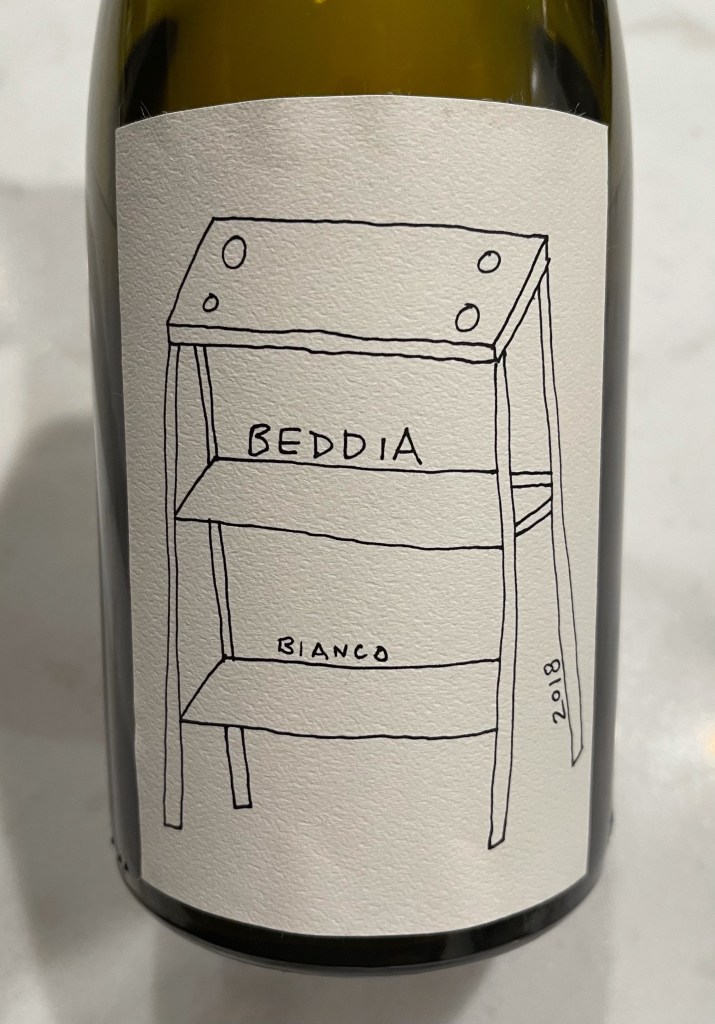
Today’s Wine: 2018 Beddia Bianco Chardonnay
85% Chardonnay, 15% Pinot Gris; 12% ABV
The 2018 Beddia Bianco is deep hazy gold/amber in color, actually reminiscent of an apricot. I must say this was a tough wine to taste at first, namely for the fact that upon first whiff you feel like you are about to enjoy an effervescent wine that really is not. Perhaps it’s the way this leaps from the glass with clean veracity and precision… Nonetheless, the nose does reveal captivating aromas of orange marmalade, marzipan, apricot, white florals, honey, finely crushed stone, and brioche. There’s some barnyard there too upon opening, but it largely blows off. Moving to the palate, I travel further into the adventure with notes of peach, yellow apple, melon, stone fruit, banana laffy taffy, snap pea, mineral, yeast, and lightly buttered toast. The wine is medium- to full-bodied with medium (+) acidity into a well-rounded long finish, leaving one both perplexed and yearning for that next sip. This is a very fun and weird wine. 81 cases produced.
Price: $32. This is a tough wine to discuss in regards to value, but I assure you that I cannot recommend it enough for the adventurous side of wine. Wines like this provide remembrance of the uniqueness, broadness, and power of the wine world which can help break up our often mundane tasting experiences. If you want something new and fun, look no further.
Today’s Story: Bodegas Benjamin de Rothschild & Vega Sicilia
Bodegas Benjamin de Rothschild & Vega Sicilia was established in 2004 as a joint venture between Tempos Vega Sicilia and Compagnie Vinicole Baron Edmond de Rothschild. With the Rothschild family legendary in Bordeaux and Vega Sicilia legendary in Ribera del Duero, the two came together over a mutual appreciation of the terroir and history of La Rioja as a winegrowing region. The venture’s first vintage is 2009, with the release of the first bottles of Macán and Macán Clásico in 2013. Macán is the flagship bottling and Macán Clásico is a “second wine,” modeled after Bordeaux’s first and second wine traditions. With 92 hectares of estate vineyards in San Vicente de la Sonsierra, Labastida, Ábalos, and El Villar, the winery produces wines exclusively with Tempranillo and seeks to create a modern expression of the variety.
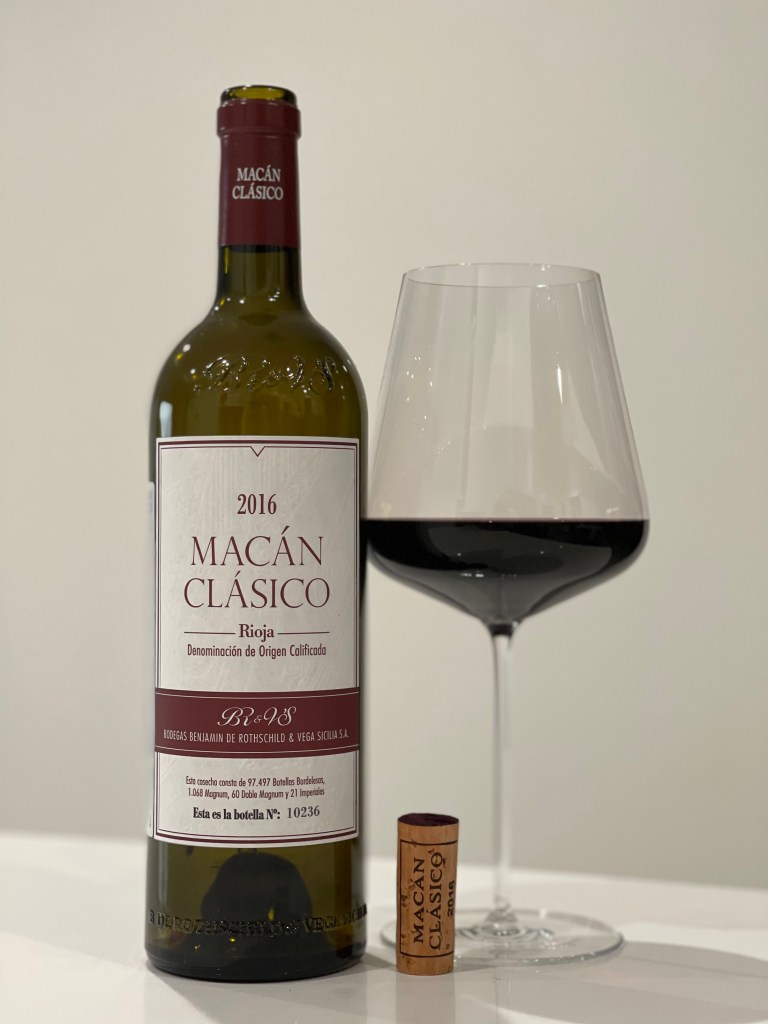
Today’s Wine: 2016 Macán Clásico Rioja
100% Tempranillo; 14.5% ABV
The 2016 Macán Clásico Rioja is opaque deep purple/ruby in color, but nearly black at its core. This needed a solid 4-5 hours in the decanter to start really opening up, but once it does the nose showcases aromas of cherry, plum, black licorice, leather, tobacco, slight barnyard, baking spice, and vanilla. Moving to the palate, this modern Rioja offers notes of dark juicy cherry, cranberry, spiced plum, rose, cigar box, dried earth, dill, clove, and pepper. The wine is medium- to full-bodied with medium (+) acidity, medium (+) tannins, and a long finish.
Price: $55. At this price there are certainly better value Riojas out there, particularly for me since I prefer the more rustic, terroir-driven bottlings over a wine as modern as this one. A modern Rioja is, however, what this winery goes for so they do hit that target. Though not necessarily a wine for me now, I will certainly continue to monitor these wines to see how the powerhouses of the Rothschilds and Vega Sicilia grow into this new venture over time.
Château Haut-Brion is a historic Bordeaux wine estate that traces back to at least 1521, and it was awarded First Growth (Premier Grand Cru) status in the Bordeaux Wine Official Classification of 1855. In 1533, Jean de Pontac acquired the land that would become Château Haut-Brion and he immediately set about renovating the vineyards and expanding the estate. He is also the owner who, in 1549, started building the château. Jean de Pontac was instrumental in each vintage under his ownership until he passed away in 1589 at the age of 101, though the estate remained in the Pontac family by passing to his son Arnaud II and then Arnaud II’s nephew Geoffroy. Geoffroy’s son Arnaud III took over during the early 17th century and expanded the château itself while doubling the size of the vineyards. He also used his political influence to extend the fame and reputation of Haut-Brion, particularly in England.
As the influence of Haut-Brion grew, particularly amongst nobility and the intellects of the time (including John Locke), Joseph de Fumel inherited the estate from his father in 1749. The estate’s influence took another leap when, in 1787, Thomas Jefferson visited the château and wrote with great admiration about the soils and wines of Haut-Brion. The rosiness ended during the French Revolution, however, as Joseph de Fumel was beheaded by guillotine and his holdings were divided. Over the next four decades or so, the estate changed hands several times.
In 1836, Joseph Eugène Larrieu purchased the estate and worked tirelessly to improve on the exceptional wines it was known for. His efforts were rewarded when Haut-Brion was awarded Premier Grand Cru status in 1855, though pain struck again through disease and political upheavals within the region in the latter half of the 19th century. In 1859, Amédée took over upon his father’s death and replanted the vineyards over time to deal with mildew. By 1873 when his son Eugène took over Haut-Brion, there was optimism which unfortunately proved futile when phylloxera struck with a vengeance in 1880. Eugène spearheaded a massive replanting of the vineyards yet again, this time using rootstock from North America that was resistant to the disease.
Jumping forward through multiple new ownerships, the Dillon family came into the picture during the early 1900s. The owner at the time, André Gibert, faced the need to find a proper owner for Haut-Brion with no heirs of his own. Clarence Dillon, a banker from New York, visited in 1934 and received notice on his way back to America he could buy the estate. The purchase was finalized in 1935 and the Dillon family remains the owner of Château Haut Brion to this day. This purchase by the Dillon family helped bring Haut-Brion to the modern age, with them first installing electricity, new plumbing, and renovating the cellars. Over the decades that followed leading up to current times, the family continued to improve the estate, modernized the winemaking process with a high tech vat room, and completely renovated the château with utmost attention to detail.
Château Haut-Brion today consists of 51 hectares of vineyards located in the Pessac-Léognan appellation of Bordeaux. Of the 51 hectares, 48 are planted to red varieties of Merlot, Cabernet Sauvignon, Cabernet Franc, and Petit Verdot while the remaining 3 hectares are planted to white varieties of Sémillon and Sauvignon Blanc. Situated across from Château La Mission Haut-Brion (which I wrote about two days ago), Château Haut-Brion shares the same gravelly soil of small quartz stones above a subsoil of clay, sand, and limestone. Following the same practices of their neighbor, all fruit is harvested by hand and then sorted before transferral to temperature controlled vats for fermentation. After two weeks, the vats are drained and the wine moves to barrel where it spends 20-24 months before bottling. Château Haut-Brion produces four wines: Château Haut-Brion, Château Haut-Brion Blanc, and two 2nd wines named Le Clarence de Haut-Brion (red) and La Clarté de Haut-Brion (white).
To read more of the history of Château Haut-Brion, view images of the beautiful château, or explore vintages of wines, visit the website here (also the source of the information above).
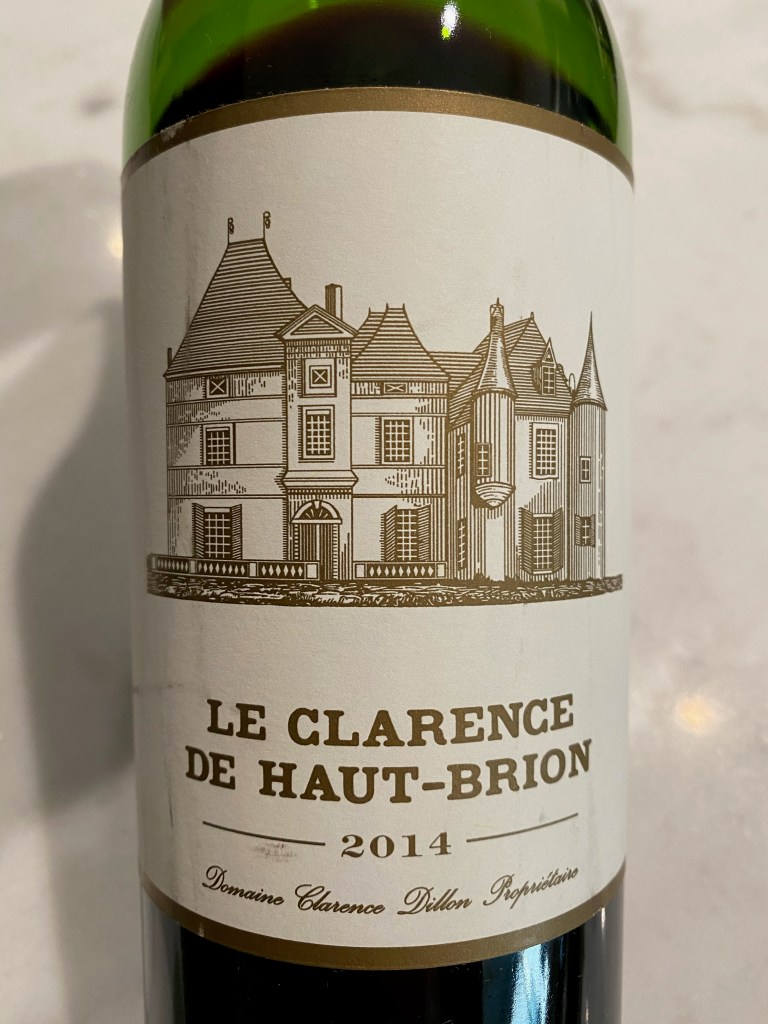
The 2014 Le Clarence de Haut-Brion is medium to deep ruby in color and almost opaque. I decanted this wine for 4 hours, though it did really start opening up around the 2 hour mark and only improved from there. On the nose, this gorgeous wine showcases aromas of blackcurrant, black raspberry, cigar box, violet, forest floor, gravel, graphite, and thyme. Moving to the palate, I get notes of black cherry, cassis, pomegranate, tobacco, pepper, tilled earth, crushed rock, and a hint of charred oak. This is full-bodied with medium (+) acidity, medium (+) tannins, and a long finish. Superb effort and the best 2nd wine from the 2014 vintage I’ve had to date.
Price: $100 (though many bottles are priced closer to $130 online). Though not an inexpensive bottle of wine, I find this to be a very strong value play particularly given the vintage (often undervalued) and relative value to the Grand Vin. This has everything you want out of a great Bordeaux, punching well above its price point.
Whitcraft is a small, family-owned and operated winery in Santa Barbara, CA known for their traditionally made and “unadulterated” Pinot Noir and Chardonnay. Established in 1985 by Chris and Kathleen (Barnato) Whitcraft, the winery started as a passion for both the craft of winemaking and the lifestyle. Chris learned from California greats including Joe Heitz, Dick Graff, and Burt Williams while simultaneously hosting a radio show about wine from 1978 to 1989. Chris and Kathleen’s son Drake joined the family winery and took over in 2007, maintaining the traditional practices of hand-harvesting, foot-pressing, no added enzymes, and native yeast fermentation. Whitcraft’s wines are pure, well-balanced, and honest representations of the fruit and terroir, often remaining low in alcohol and not seeing much added SO2. Drake hand fills and corks his wines, with production incredibly limited and often reserved for mailing list clients or restaurants. Though Chris passed away in 2014, his vision and passion live on through Drake to this day.
Today’s Wine: 2016 Presqu’ile Vineyard Chardonnay
100% Chardonnay; 12.27% ABV
The 2016 Presqu’ile Vineyard Chardonnay is transparent medium to deep gold in color. This wine certainly blossoms with time in the glass, with the nose opening to showcase aromas of ripe golden pear, lemon curd, stone fruit, white lily, dried vanilla, flint, and crushed rock minerality. Once on the palate, I get notes of green apple skins, lime zest, tropical citrus, honeysuckle, limestone, and saline mineral. This Chardonnay is medium-bodied with gorgeous and vibrant medium (+) acidity, a plush and somewhat oily mouthfeel, and a long, refreshing finish.
Price: $45. As with the majority of Whitcraft I drink, I find this wine to be a great value. The restrained beauty here coupled with the purity of fruit and palpable respect for terroir is profound, coming across in a very Burgundian style. Definitely snag one or two bottles if you come across it.











 JB's Wine Talk