Guilbaud Frères is a family-owned winery and wine merchant established in 1927 by Edouard and Marcel Guilbaud in the Muscadet Sèvre et Maine appellation of the Loire Valley. Edouard and Marcel came from a long family history of winegrowers and took their culminated knowledge of the land, quality producers, and attention to detail in creating the principles of their new venture. Now nearly a century later, a fourth generation guides the Guilbaud Frères brand and, in addition to sustainably farming around 60 hectares of their own vineyards, purchases and produces wine from carefully selected growers. To check out their broad range of AOP wines, you can visit the link here.
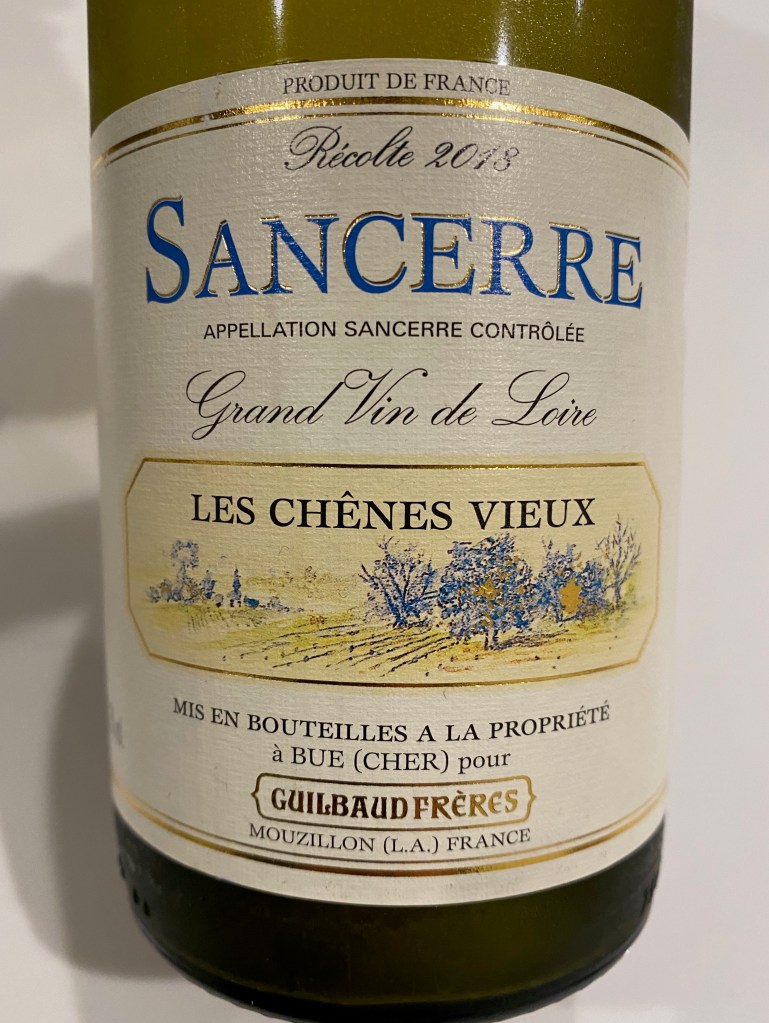
Today’s Wine: 2018 Sancerre Les Chênes Vieux
100% Sauvignon Blanc; 12.5% ABV
The 2018 Les Chênes Vieux is transparent medium straw/yellow in color. The nose is quite expressive with aromas of tangerine, honeydew melon, lemon peel, honeysuckle, grass, slight smoke, and chalky minerality. On the palate, the wine displays notes of white peach, grapefruit, green apple skins, chamomile tea, finely crushed rock, brioche, and bright mineral. This is medium-bodied with mouthwatering medium (+) acidity and a lush mouthfeel into a crisp and refreshing medium length finish.
Price: $30. This is a very nice Sancerre for the price and drinks with beautiful precision while making me excited for a warm day outside again. Pair this with sole, lobster, or roasted chicken.
Fontodi is a historical wine estate located in Panzano in the heart of Chianti Classico. Though vines have been cultivated there dating to the Roman Empire and vinification history at the estate traces its roots to at least the 16th century, the Manetti family who currently operates the estate acquired it more recently in 1968. Prior to purchasing Fontodi, the Manettis produced terracotta tiles for several centuries which, alongside winemaking, is another activity the Chianti region is famous for. The Manetti family poured a large amount of resources into the estate, which today consists of around 130 hectares with 70 hectares planted to vine and certified organic. The great quality of their tiles crossed over into the wines, which come from vineyards that are sustainably-farmed where the family eschews chemical use. Vinification takes place in Fontodi’s incredibly modern cellar built across multiple levels to make use of gravity flow and the wines age in French oak barrels.
Today’s Wine: 2015 Chianti Classico
100% Sangiovese; 15% ABV
The 2015 Chianti Classico is opaque deep ruby in color. I decanted this for 3 hours and drank it over the following hour. The nose showcases aromas of black cherry, blackcurrant, black plum, red licorice, rose and violet, tobacco, truffle, scorched earth, mocha, white pepper, and sage. There is also some heat which throws off the balance and needs time to integrate. Once in the mouth, the wine displays notes of blackberry, jammy blueberry, rich black plum, black cherry, cigar box, graphite, dried chalky soil, ground green herbs, black pepper, and espresso. This is medium- to full-bodied with medium (+) acidity, grippy medium (+) tannins, and a long finish dominated by black and blue fruit. Needs at minimum another 5 years, as it’s kind of a kick in the teeth right now, but the quality is certainly there.
Price: $42. A very solid QPR with this one, but there are other Chianti Classicos that are cheaper, more approachable now, offer similar complexity, AND have the structure to go the distance like this bottle. But don’t get me wrong, this is certainly worth a try if it’s in your price range and you have the patience to lay it down. Pair this with lasagna, chicken parm, or pizza.
I could not, for the life of me, find any information about Brero. I could, however, find accounts of others enjoying their wines; but no family/winery history or if they are still producing wine (I would put my money on “no”). If you can tell me anything about Brero, please do! If not, enjoy the tasting notes of their 1978 Barbaresco below.
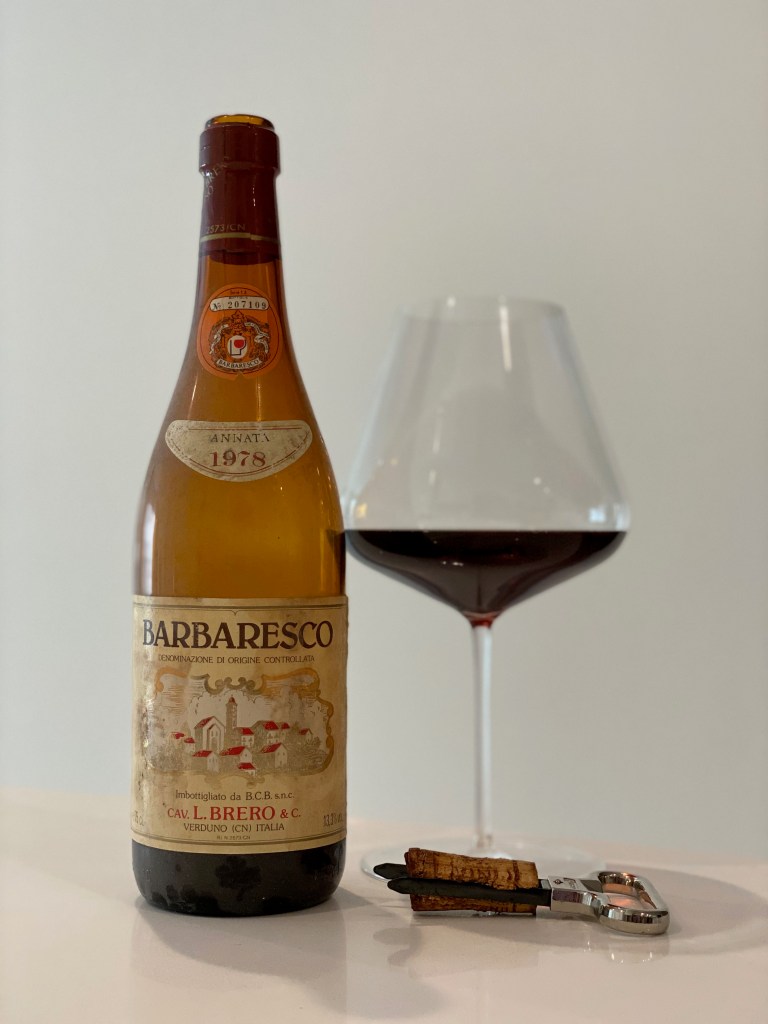
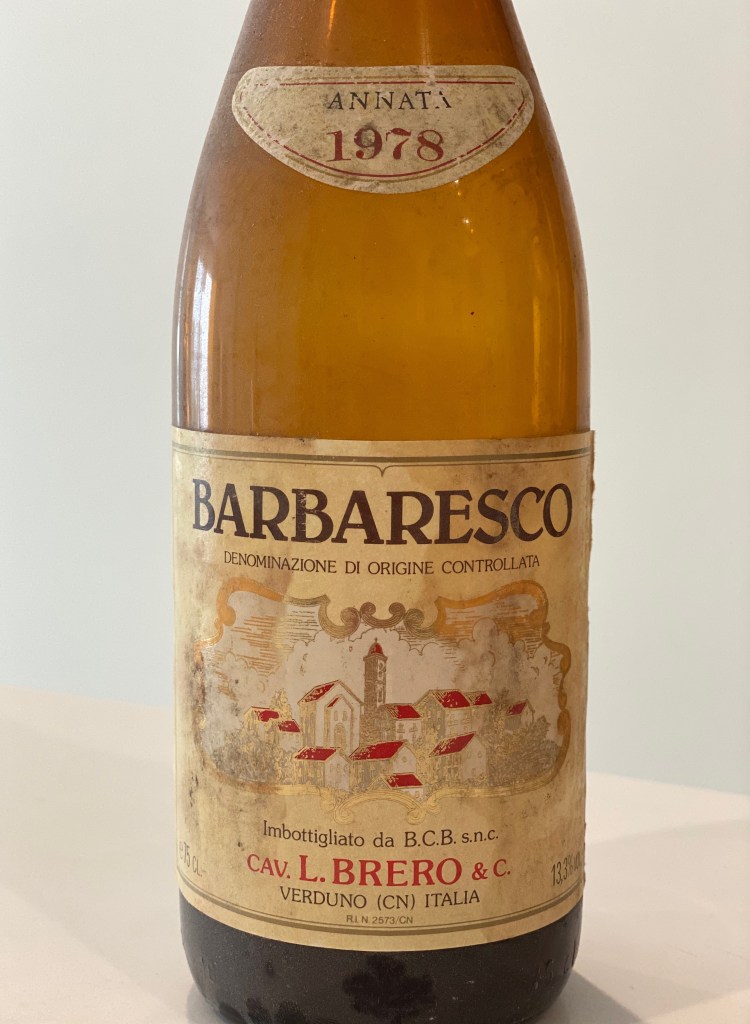
Today’s Wine: 1978 Barbaresco
100% Nebbiolo; 13.3% ABV
The 1978 Barbaresco is moderately transparent and pale garnet in color heading toward pale tawny. The nose is dominated by tertiary notes like forest floor, earthy mushroom, damp cellar, and tar but after a little over an hour in the decanter blossoms to showcase aromas of delicate dried red rose, cherry, dried raspberry, a pinch of cinnamon, black tea, and tobacco. On the palate, which is vibrantly alive, the wine displays sweet red cherry, dried raspberry, savory green herbs, red and purple florals, tobacco, forest floor, truffle, stemmy underbrush, and white peppery spice. This is medium-bodied with still lively medium (+) acidity, integrated but dusty medium (-) tannins, and a medium length finish. There is still remarkable structure in this wine but I would drink it now.
Price: I paid $80, who knows what it’s worth! This was an immaculate bottle and provided a very fun drinking experience. Pair this with veal, pheasant, or filet mignon with truffles.
Produttori del Barbaresco was established in 1958 when, during widespread poverty of the 1950s, a priest in the village of Barbaresco gathered 19 small Nebbiolo growers to pool their resources/fruit and produce wine together to survive. For the first three vintages, the group made their wine in the church basement until they built a winery across the town square where Produttori del Barbaresco is still located. Today, the Produttori consists of 51 members and controls over 100 hectares of vineyards planted entirely to Nebbiolo to craft only Barbaresco D.O.C.G. and a more approachable Nebbiolo Langhe. Though each family is in complete control of their land, when it is time to come together in the cellar the wines are made using traditional methods including 18-21 day primary fermentation and aging in botti for up to three years. In exceptional vintages, the Produttori produces 9 single-vineyard Barbaresco wines from the remarkable Asili, Rabajà, Pora, Montestefano, Ovello, Pajè, Montefico, Muncagota, and Rio Sordo crus. The cooperative’s total annual output is roughly 45,000 cases of which 50% are Barbaresco, 30% are single-cru, and 20% are Nebbiolo Langhe.
Produttori del Barbaresco vineyards range from 600-1,300 feet above sea level on steep hills and consist largely of clay and limestone marl with veins of sand. The land varies greatly due not only to its size and varying microclimates, but also in terms of various crus such as how Ovello, Montefico, and Montestefano having higher clay content. The distinct personalities of the fruit from each cru blend together into the final wine to beautifully marry some of Barbaresco’s greatest vineyards in an unusual and honest representation of the terroir. To learn more about the individual crus and browse a gallery of the vineyards, check out the Produttori website here.
Today’s Wine: 2016 Barbaresco
100% Nebbiolo; 14.5% ABV
The 2016 Barbaresco is deep garnet in color and slightly transparent. I decanted this for 3.5 hours and drank it over the following 2. The nose showcases aromas of black cherry, dried raspberry, blood orange, licorice, rose petal, violet, dry tobacco, loamy earth, damp cellar, tar, hay, dried herbs, and cedar. There is a touch of heat as well. Once on the palate, the wine displays notes of black cherry, raspberry, cranberry, red rose, dried leather, clay, ground peppercorn, pipe tobacco, asphalt, and smoke. This is medium-bodied with medium (+) acidity, grippy medium (+) tannins, and a medium (+) length finish. Certainly approachable with a good deal of decanting, but this needs another 5-7 years in bottle.
Price: $40. Crazy, crazy good value and a wine I cannot count how many times I recommended to friends and family. Often overshadowed by Barolo (though that seems to be changing) Barbaresco is another wine made from Nebbiolo you need to try and this is one of the great producers. Pair this with wild duck, veal chop, or filet mignon.
Domaine Romaneaux-Destezet is a small wine estate established by Hervé Souhaut in 1993 in the Saint-Joseph AOC of northern Rhône. Souhaut farms roughly 5 hectares of vineyards with vines aged 50-100 years old and crafts his small batch wines in the cellars of his in-laws’ converted hunting lodge. In making his wine, Souhaut uses hand-harvested organic whole grape bunches and semi-carbonic maceration in an effort to achieve wines that are elegant with refined tannins and approachable in their youth. The wine ferments in wooden and concrete tanks using only natural yeasts before being aged on fine lees in used oak barrels for 8-12 months. Souhaut adds only a minimal amount of SO2 at bottling and his wines are unfiltered. With production totaling less than 4,000 cases annually and wines highly allocated, Souhaut produces Vin de Pays wines (largely Gamay, Roussanne, and Viognier) under the Domaine Romaneaux-Destezet name as well as the AOC wines under his own name.
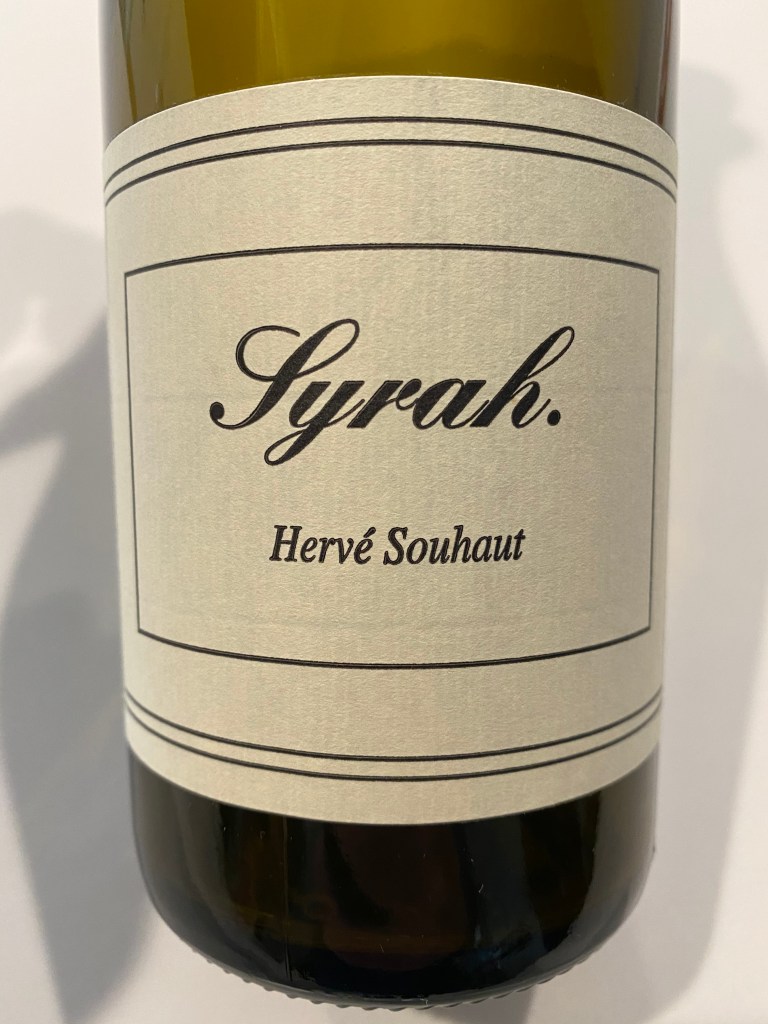
Today’s Wine: 2017 Syrah
100% Syrah; 12.5% ABV
The 2017 Syrah is opaque medium to deep purple in color. I decanted this for 2 hours and drank it over the following 4 hours. The nose is complex and evolves over time to showcase aromas of blueberry, black plum, olive, violet, sweet tobacco, loamy earth, smoke, clove, chocolate, and light oak. On the palate, I get notes of tart blueberry, sweet and juicy plum, black cherry, purple and blue florals, black olive, scorched rocky earth, tobacco, grilled meat, and green herbs. This is full-bodied with medium (+) acidity, elegant medium tannins, and a long finish filled with jammy black fruit.
Price: $39. Excellent value for this Rhône Syrah made in a more “natural” style. Though the domaine’s production is limited and the wines highly allocated, this is worth seeking out. Pair this with lamb, herb-roasted pork, or venison.
The Hilt is a small, relatively young winery located in the rough, rugged, and windswept Santa Rita Hills AVA about 13 miles from the Pacific Ocean. The Hilt is a sister winery to Jonata, whose wines I reviewed three times prior, and falls under support of Stan Kroenke who owns the LA Rams and Screaming Eagle. The Hilt shares an adept winemaker in Matt Dees with Jonata, and similarly provides him a vast and difficult terroir ranging in soil type, altitude, and microclimates to craft wine. The Hilt’s fruit, consisting only of Pinot Noir and Chardonnay, comes from vines that are forced to dig deep for nutrients, face brutal maritime winds, and yield small numbers of concentrated grapes.
The Hilt consists of three vineyards named Bentrock, Radian, and Puerto del Mar. Bentrock is made up of long, rolling hills roughly 400-500 feet above sea level and totals roughly 92 acres of which just under 80 are planted to Pinot Noir and just over 13 are planted to Chardonnay. Radian differs greatly in that its terrain is rugged and steep where, at its highest point, grapes face fierce winds at 700 feet elevation. Consisting of just over 100 acres, Radian is planted to 95 acres of Pinot Noir and only 6.1 acres of Chardonnay. The Puerto del Mar vineyard sources much of the fruit for The Hilt’s Estate wines, and also houses the winery where Matt Dees goes to work in the cellars. Typically Bentrock fruit sits at the core of The Vanguard bottlings, Radian at the core of The Old Guard bottlings, and a blend at the core of the Estate bottlings.
You can read more about the winery and their offerings (including tech sheets) at the website here.
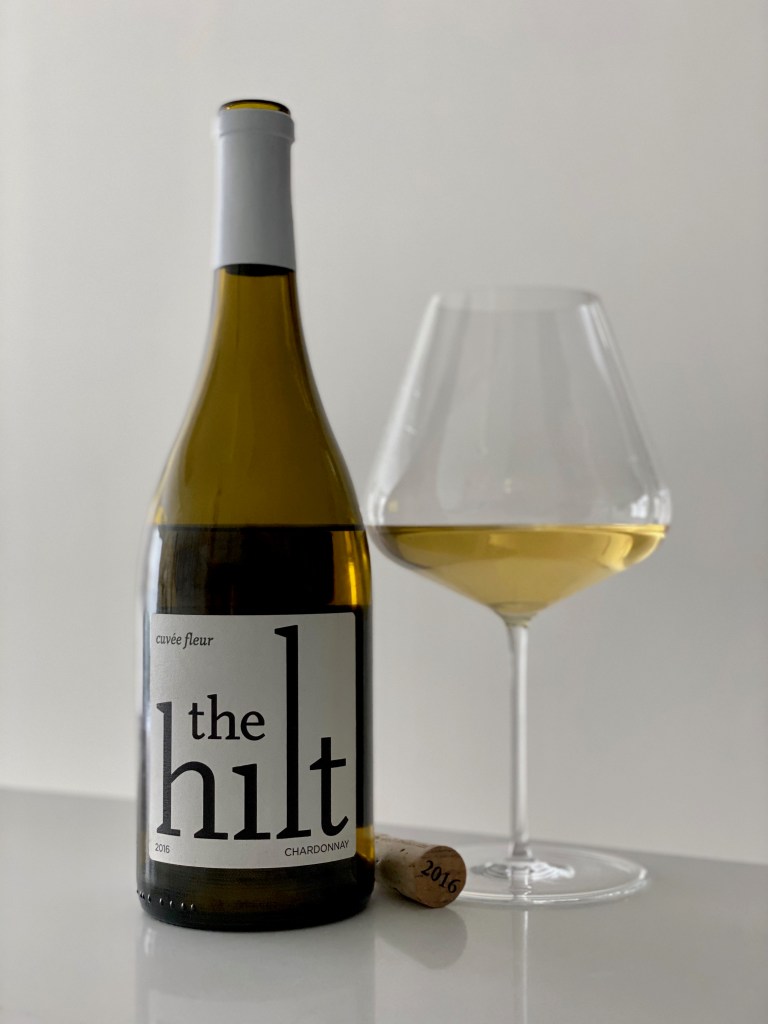
Today’s Wine: 2016 Cuvée Fleur Chardonnay
100% Chardonnay; 13.2% ABV
The 2016 Cuvée Fleur is vibrant medium to deep gold in color. Once this opens up in the glass, the incredibly expressive nose showcases aromas of melon, yellow apple, jackfruit, white florals, vanilla, beeswax, exotic spice, and saline mineral. In the mouth, this beauty displays notes of lemon, pineapple, stone fruit, honeysuckle, almond, dill, flint, saline mineral, and mild oak. The wine is medium- to full-bodied with mouthwatering medium (+) acidity and a well-rounded, lengthy finish. This is a beautiful Burgundian-style Chardonnay made exclusively for Wally’s in Los Angeles and will only get better with a few more years of bottle age.
Price: $45. This is priced closely with the standard Hilt Chardonnay and delivers similarly great value, however it is more difficult to acquire since it appears Wally’s is the only carrier. Pair this with lobster, herb-roasted chicken, or halibut.
Château-Figeac is an ancient Bordeaux wine estate located in Saint-Émilion that traces its roots to the 2nd century and the Gallo-Roman period. The estate is named for Figeacus who built a villa on the property, and with such excellent terroir it is one of the few wine properties to see continuous use for the past 2,000 years. In 1586, Raymond de Cazes rebuilt the origins of the château in classic Renaissance style and the cellars today where the wine ages during its second year trace to this construction. In 1654, the estate transferred by marriage of Marie de Cazes to the Carles family who were very influential in the region and undertook modernization of viticultural techniques. The Carles family also built the current château in 1780. During the late 18th and early 19th centuries as financial crises roiled the region, Château-Figeac sold some of its land holdings, including 15 hectares that became Château Cheval Blanc, and passed through seven owners in 50 years.
In 1892, the Manoncourt family acquired the heart of Château-Figeac and brought in Albert Macquin to structure the vineyards, bring in oak vats from the property, and test novel agricultural species on the property. The label was created in 1907 and bears the crest of Henri de Chèvremont (great-grandfather of Thierry Manoncourt) and for decades the estate produced world-class Bordeaux largely under management of enologists. In 1943, however, Thierry Manoncourt participated in his first vintage and convinced his mother to keep the estate and play a more hands-on role. In 1947, Thierry started at Figeac full-time with a degree in agricultural engineering and tirelessly set about learning and understanding the incredible terroir.
The 20th century was filled with other milestones for Château-Figeac, including its classification as Premier Grand Cru Classé in 1955. Figeac became famous for its near 1:1:1 blend with Thierry planting the vineyards to 35% Cabernet Sauvignon, 35% Cabernet Franc, and 30% Merlot and his wife Marie-France joins him to increase the wine’s global exposure. During the late 1980s, Laure and Eric d’Aramon (daughter and son-in-law of Thierry and Marie-France) moved to the château to help manage the estate and Eric eventually took operational control until 2012. Agricultural engineer Frédéric Faye joined Château-Figeac in 2002 and learned their vineyards and winemaking techniques alongside Thierry until his death in 2010. Today, Madame Manoncourt alongside her daughters and team guide the estate onward keeping to the traditions set forth by Thierry.
Today, Château-Figeac consists of 40 hectares of vineyards (down from its peak of 200 hectares) and is the largest wine estate in Saint-Émilion. The signature features of the terroir, three gravel ridges, provide excellent growing conditions for the three grape varieties planted there and the castle finds itself surrounded by 14 hectares of parks, meadows, ponds, and woods as well. Figeac respects the biodiversity of their vineyards as a founding principle, while also relying heavily on scientific analysis of the terroir and traditional yet modernized winemaking techniques. Château-Figeac produces about 100,000 bottles of wine per year, in addition to about 40,000 bottles of the second wine Petit-Figeac. For more on this remarkable estate, check out their website here.
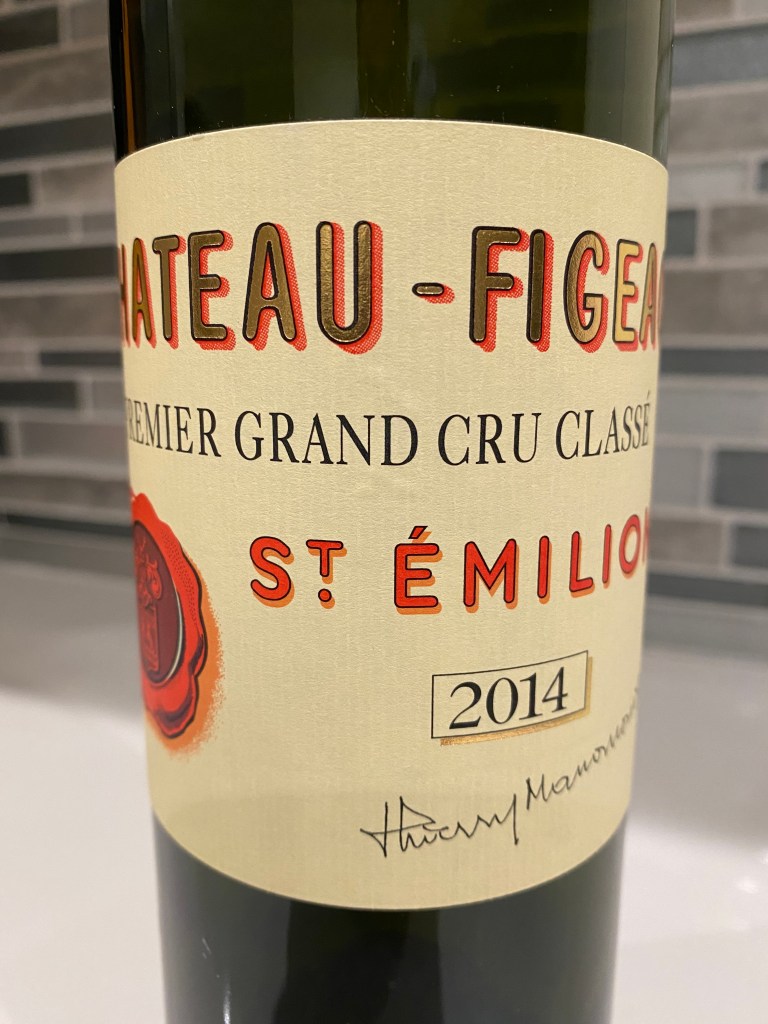
The 2014 Figeac is opaque deep ruby in color. I decanted this for 2 hours and drank it over the following 3 hours. The nose is ridiculously complex and profound, changing dramatically as I drank this and showcasing aromas of blackberry, blackcurrant, redcurrant, crushed lilac, anise, pencil shavings, graphite, cigar box, tobacco, loamy earth, crushed green peppercorn, baking spice, and oak. Once in the mouth, the wine displays notes of blackberry, plum, blueberry, redcurrant, violet, licorice, tobacco, scorched earth, mocha, dried herbs, and toasted oak. This wine is full-bodied with medium (+) acidity, high tannins, and a long finish with added notes of slate and iron.
Price: $115 (average price in US is $166). I got this for an absolutely incredible price at one of my local wine stores, but even around $160 per bottle this is fantastic and still less expensive than other vintages that overshadow 2014. Pair this with Beef Wellington, stewed game, or veal.
Bruno Giacosa was one of the most respected and legendary winemakers not only in Piedmont, Italy where he crafted some of the most highly regarded and traditionally made Barolo and Barbaresco, but throughout Italy and the world. At age 13, Bruno helped his father and grandfather in the cellar of their Langhe winery and joined the family business full-time two years later. Though Bruno never studied to become an enologist, his appreciation of traditionally made Barolo and Barbaresco spawned from this time with his family and instilled in him some of the most important practices he followed for his entire career until his death at the age of 88 in early 2018. Bruno was quite adept at selecting parcels and fruit for his wines, and always emphasized intentionally small grape yields, limiting treatments in the vineyards, traditional vinification methods, and allowing the wines to honestly display the terroir and typicity through minimal intervention. Historically, Bruno crafted his wines with fruit sourced/purchased from some of the greatest crus of Barolo and Barbaresco and it wasn’t until the early 1980s he purchased his own vineyards as estate-bottling rose in prominence. In 1982, Bruno purchased the Falletto di Serralunga d’Alba vineyard which became the source of arguably his greatest Barolos ever made, followed in near significance by his purchase of the Asili and Rabajá plots in Barbaresco in 1996. Today, the Bruno Giacosa estate is in the capable hands of his daughter Bruna alongside his longtime enologist Dante Scaglione and they continue Bruno’s winemaking philosophies while respecting traditional techniques.
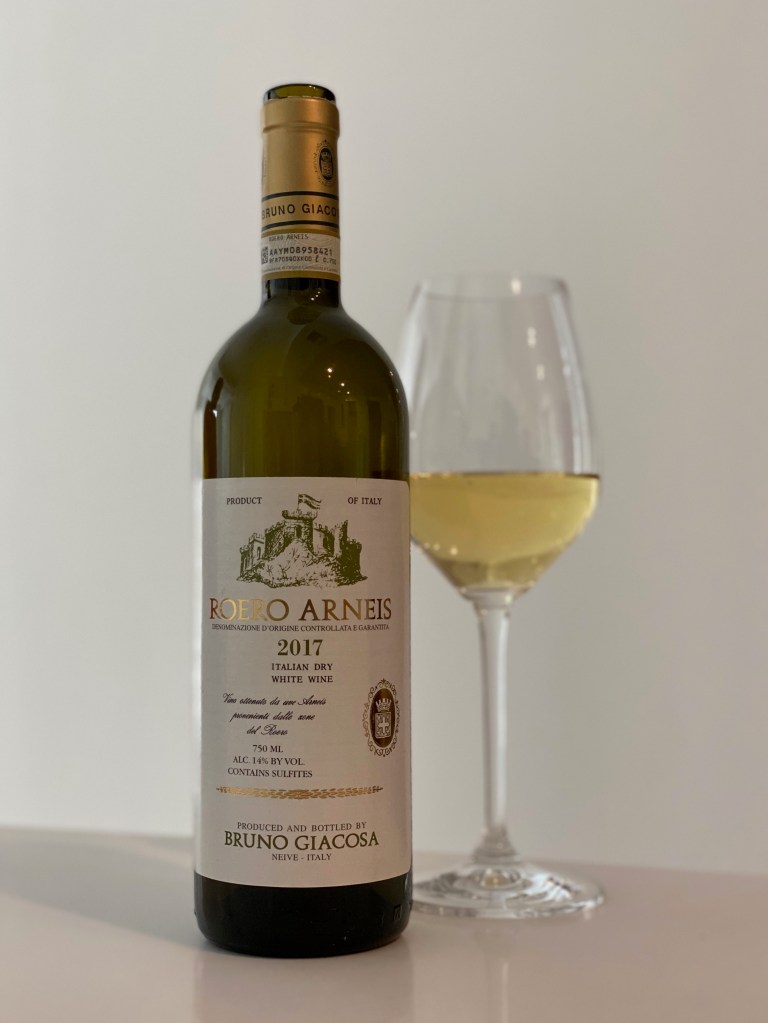
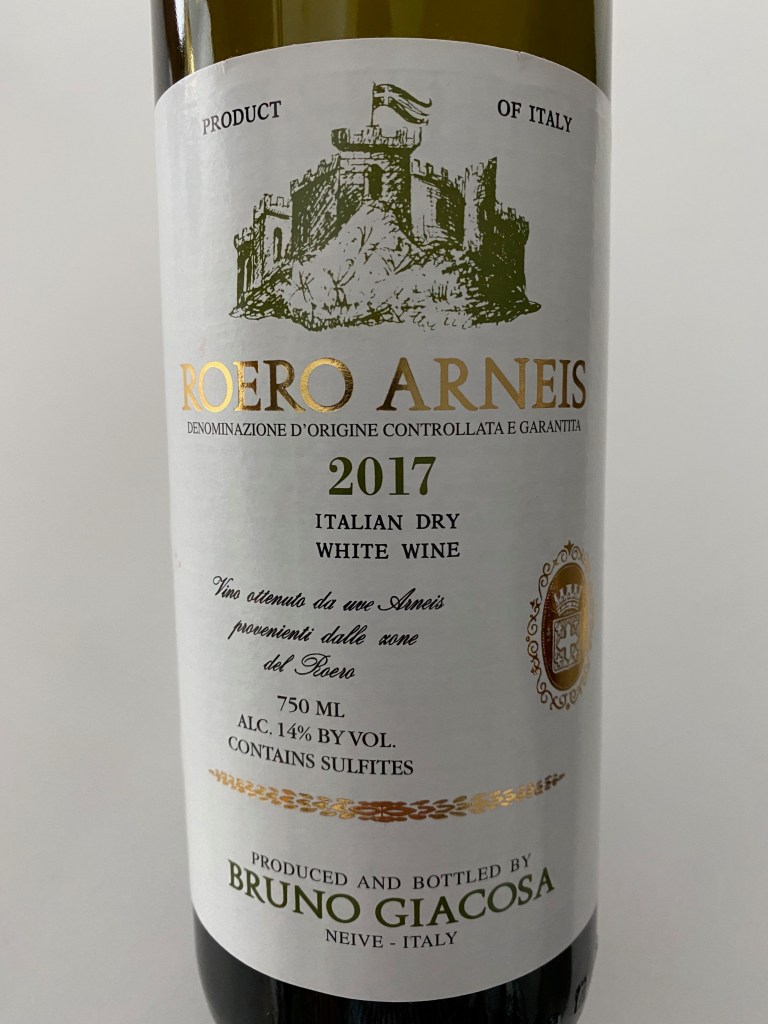
Today’s Wine: 2017 Roero Arneis
100% Arneis; 14% ABV
The 2017 Arneis is transparent deep straw in color with golden hues. On the incredibly aromatic and somewhat earthy nose, the wine emits aromas of white peach, golden apple, stone fruit, lemon zest, grass, white florals (especially lily), saline minerality, and cream. Once in the mouth, the wine displays notes of pear, peach, dried pineapple, lemon, stone fruit, white and yellow florals, honey, beeswax, almond, white peppery spice, slate, and mineral. This is medium-bodied and bone-dry with vibrant medium acidity and a crisp mouthwatering finish. Definitely a bottle of wine for the beach.
Price: $26. Outstanding value and one of the more exciting white wines I’ve had lately. I highly recommend enjoying this on a hot summer’s day. Pair this with roasted chicken, light seafood, or creamy cheeses.
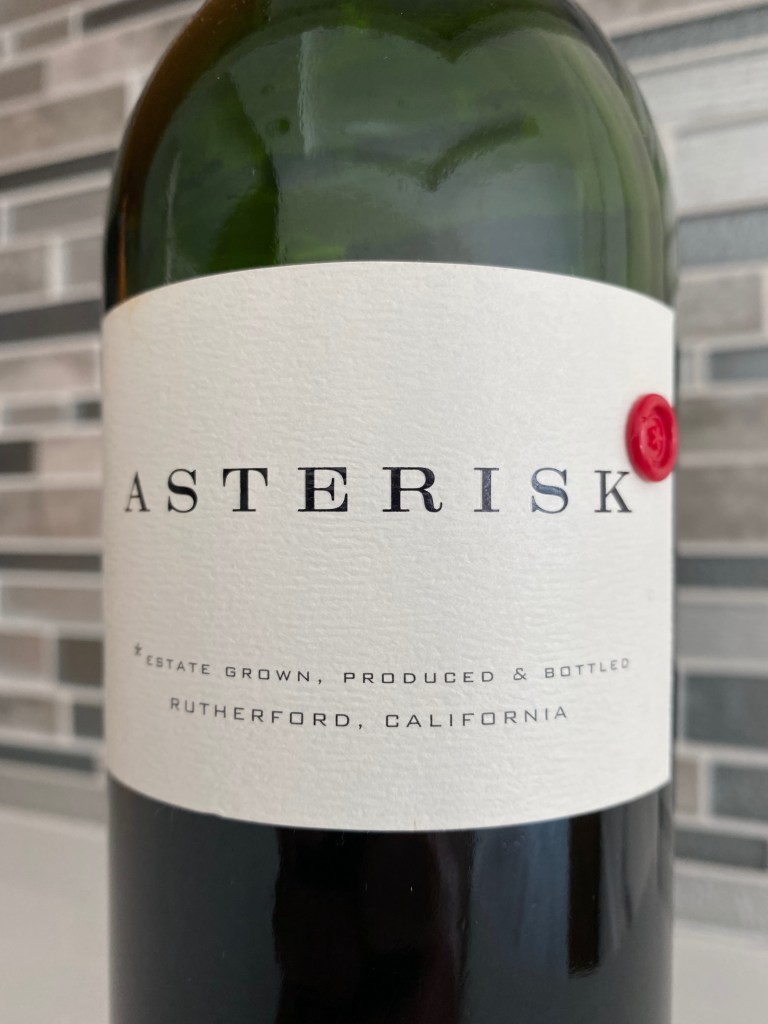
Sloan Estate was founded in 1997 by Stuart Sloan, a former Seattle-based owner and executive of the Quality Food Centers supermarket chain. After he purchased 40 acres on the eastern hills of Rutherford between 875-990 feet in elevation, Sloan assembled a team of wine rockstars including vineyard manager David Abreu, winemaker Mark Aubert (replaced in 2004 by Martha McClellan), and shortly thereafter renowned consultant Michel Rolland. With 13 acres planted to vine, the team set about creating one of Napa Valley’s greatest Cabernet Sauvignon wines and crafted their first vintage in 2000. While the flagship wine is a proprietary blend of Cabernet Sauvignon (dominant), Merlot, Cabernet Franc, and Petit Verdot, Sloan released a second wine named Asterisk which is typically a blend of Cabernet Sauvignon and Merlot that debuted with the 2004 vintage. In 2011, longtime Sloan fans Sutong Pan and his daughter Jenny acquired Sloan Estate alongside the Goldin Group and to this day maintain the goals set forth by Stuart Sloan alongside the incredible winemaking team he put in place.
Today’s Wine: 2004 Asterisk
Blend of Cabernet Sauvignon and Merlot (no tech sheet); 14.5% ABV
The 2004 Asterisk is opaque deep garnet with ruby hues. I let this open up for about an hour and drank it over the following hour, allowing the nose to showcase aromas of blackberry, black plum, black cherry, tobacco, rocky earth, truffle, graphite, chocolate, clove, exotic spice, and well-integrated oak. Once in the mouth, the wine displays notes of blackberry, crème de cassis, black raspberry, purple florals, cigar box, smoky volcanic earth, earthy mushroom, black tea leaf, black pepper, coffee grounds, and dark chocolate. This is full-bodied with medium (+) acidity, medium yet still firm tannins, and a medium (+) length finish. Not drinking at all like it’s nearly 16 years old. Even though some tertiary notes are certainly starting to come through, there remains a significant backbone of dark fruit.
Price: $150. This is certainly a great value next to the Sloan flagship and other cult Napa Cabs/Bordeaux blends, and drinks magnificently well for its age. Pair this with filet mignon, herb roasted lamb, or duck breast.
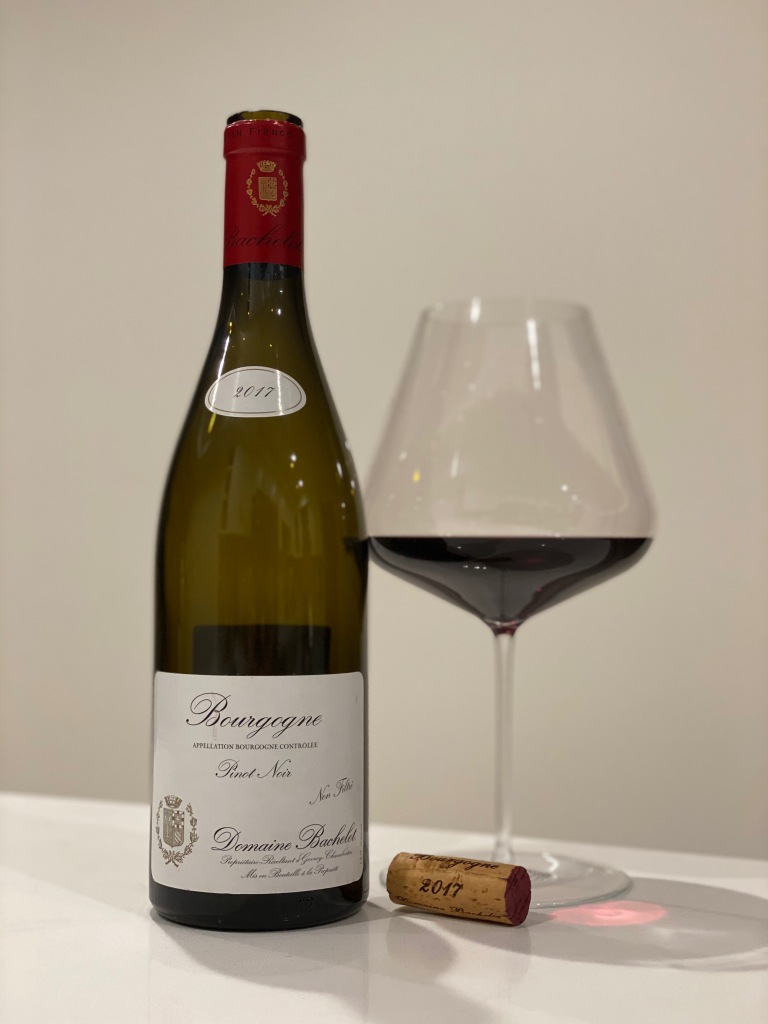
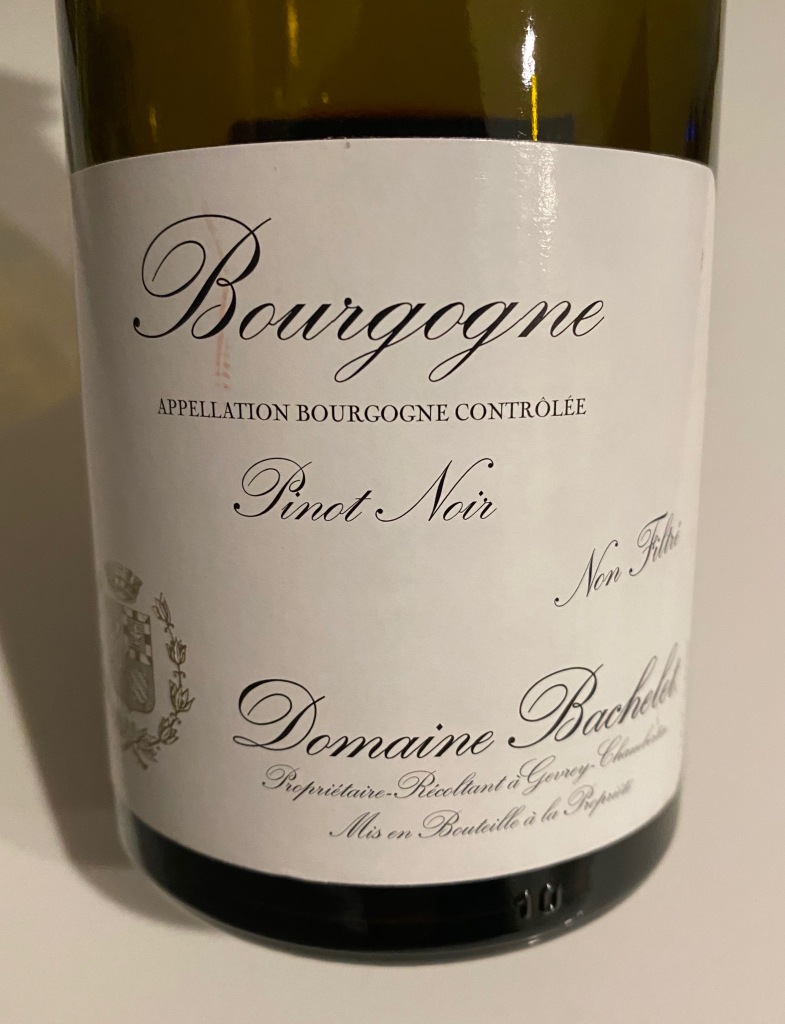
Domaine Bachelet is a small wine estate located in Gevrey-Chambertin consisting of just over 4 hectares of vineyards. The domaine is run by Denis Bachelet who, since 1983, almost single-handedly works tirelessly to produce elegant and honest wines. Denis was born in Belgium, and though his family is drenched in winemaking tradition his father elected to work in the chemical industry there while his grandparents tended the domaine back in France. Denis studied winemaking in Beaune for three years before ultimately joining his grandparents at the estate, though he only became fully involved in winemaking in 1981 shortly after his grandfather’s death. By 1983 when he took over completely, the domaine consisted of only 1.8 hectares and he quickly sought to expand his holdings to make a better living. In 2008, Denis’ son Nicolas joined the domaine and the Bachelet family slowly grew by purchasing more parcels. Today, Domaine Bachelet produces a range of wines including Bourgogne, Village, 1er Cru, and Grand Cru offerings though these gems remain difficult to find but worthwhile seeking out.
For more, there is a great “interview” with Denis here and a background of the domaine and their portfolio here.
Today’s Wine: 2017 Bourgogne Rouge
100% Pinot Noir; 12.5% ABV
The 2017 Bourgogne Rouge is pale ruby/purple in color but fairly dark and moderately opaque most likely due to its youth. This requires about 1.5 hours to truly open up, and once it does the nose showcases aromas of blackberry, baked cherry, raspberry, violet, saddle leather, freshly tilled soil, steel cut oats, a hint of baking spice, and oak. On the palate, I get notes of blueberry, spiced plum, sour cherry, stemmy strawberry, sweet tobacco, forest floor, charred green herbs, bright mineral, and peppery spice. This is light- to medium-bodied with medium (+) acidity, medium tannins, and a medium (+) length finish. Certainly very tight right now without extended decanting, but this is a very precise wine that needs another 5 years in the bottle.
Price: $65 (cheaper overseas). Certainly not cheap for a Bourgogne Rouge (I saw some stores selling this at almost $80), though you can definitely say its quality puts this near a Village wine. I need to revisit this bottling in a few years and explore the Bachelet portfolio further. Pair this with seared tuna, roasted chicken, or mild goats cheese and charcuterie.








 JB's Wine Talk