Outstanding Napa Valley Chardonnay That Drinks Like Aged Burgundy

Today’s Story: Chateau Montelena

Chateau Montelena traces its roots back to 1882 when Alfred L. Tubbs purchased 254 acres of rugged land with the dream of turning it into vineyards. Tubbs first planted his vineyards before constructing the chateau in 1886 and bringing in a winemaker from France, and by 1896 the A.L. Tubbs Winery was the seventh-largest in the Napa Valley. This prowess was short-lived, however, when winemaking shut down during Prohibition. With its repeal in 1933, Alfred’s grandson Chapin Tubbs continued harvesting the vineyards to make some wine and started selling fruit to others. He re-christened the winery to Chateau Montelena Winery in 1940 with the name derived from a contraction of Mount St. Helena.

In 1947, Chapin unfortunately passed away and winemaking at Chateau Montelena ceased again two years later. The Tubbs family sold this magnificent estate in 1958 to Yort and Jeanie Frank, a couple who emigrated from Hong Kong after WWII and were then seeking a peaceful place to retire. The Franks did not resume winemaking but rather worked to transform some of the overgrown grounds into a lake and landscaping reminiscent of their native gardens back home. Jade Lake on the property still provides evidence of this today and remains a beautiful and peaceful sanctuary.

The renaissance of this great winemaking estate, however, came about in the early 1970s under the leadership of Jim Barrett. Barrett quickly cleared and replanted the vineyards and brought in modern winemaking equipment alongside a team to oversee the vineyards and production. In 1972, winemaking resumed at Chateau Montelena and within years it would become one of the most important wineries in all of California and at that time even throughout the world. Chateau Montelena today thrives under the watchful eyes of Jim’s son, Bo Barrett.

Arguably the most important event in Chateau Montelena’s history occurred in 1976, though halfway around the world in France. Steven Spurrier, a British wine merchant, sought to put the best Californian wines head to head with the best French wines and assembled the Paris Wine Tasting of 1976 (known as the Judgment of Paris). There were an assortment of red wines and an assortment of white wines, with the Chateau Montelena Chardonnay being one of six Californian whites going against four greats from France’s Burgundy region. The 1973 Chateau Montelena Chardonnay beat all of the other white wines in a blind tasting and shocked not only the panel and those in attendance but the entire world, cementing California as a winemaking region demanding respect. Funny enough, Stag’s Leap Wine Cellars also in Napa Valley won for the red wines with their 1973 Cabernet Sauvignon.

I previously wrote about Chateau Montelena on a few occasions, reviewing the 2011 Estate Cabernet Sauvignon, 2009 Chardonnay, Twenty Year Ruby, and 1995 Chardonnay from magnum which I am revisiting again today.

Today’s Wine: 1995 Chardonnay

100% Chardonnay; 13.5% ABV

The 1995 Chardonnay is deep gold in color, beautifully radiant in the glass. The aromas are of pronounced intensity, leaping from the glass in an incredibly complex nose of golden apple, ripe pear, pineapple, orange marmalade, dried apricot, flint, honeysuckle, white truffle, wet stone, a hint of butter, raw almond, and dried vanilla. Flavors are also of pronounced intensity, as the palate offers up similar and equally complex notes of crisp yellow apple, pear, charred pineapple, apricot, tropical citrus, dill, white truffle, white pepper, crushed rock, almond, and a touch of brioche. This dry white is medium- to full-bodied with still-lively medium (+) acidity, medium alcohol, and a long finish that goes on for almost a minute. Absolutely outstanding.

Price: $90 for 750ml or $180 for this magnum direct from the winery. This is my second time reviewing this wine (first was also from magnum January 2021), though I thought this bottle showed so incredibly well I’m writing about it again. I’m left speechless here, as this is remarkably intense, deep, complex, balanced, and long. Truly on par with some of the greatest white Burgundy I’ve enjoyed, and while my last bottle was incredible this takes it even higher. Insane value here, if you can find an immaculate bottle.

Quaffable Spätlese With Age and a Great Price

Today’s Story: Weingut Dr. Loosen

Weingut Dr. Loosen is a storied wine producer located just outside Bernkastel in the Mosel region of Germany. The winery has been in the Loosen family for over 200 years, making them one of the most well-known producers of Riesling not only throughout Germany but throughout the world. The winery and vineyards came to Ernst “Erni” Loosen in 1988, and he immediately set about improving the quality of wines that ungrafted 60+ year-old vines in some of the Mosel’s best vineyards can produce. Erni believes that great wine should be both a sensual and intellectual pleasure, with each bottle showcasing the unique terroir, passion of the winemaker, and a snapshot of history. This philosophy feeds through to his winemaking style, where Erni strives to balance traditional and family-honed winemaking practices with experimental studies (such as time on lees) to make the best and most transparent wine possible. Nonetheless, all the Dr. Loosen wines ferment spontaneously in wooden barrels and see a minimum of 12 months on lees with no racking and no bâttonnage so as to not add excess weight or cover any nuances provided by the variety or site.

Dr. Loosen has been part of Germany’s VDP (Verband Deutscher Prädikatsweingüter) since 1993, showcasing the incredible pedigree of their vineyards. What’s more, seven of the Dr. Loosen vineyards are designated VDP Grosse Lage (Grand Cru) and these wines are bottled as single vineyard bottlings since 1988. Any other wines produced by Dr. Loosen are labeled Estate or Village Rieslings. The vineyard sites under the Dr. Loosen umbrella include Bernkasteler Lay, Bernkasteler Johannisbrünnchen, Graacher Himmelreich, Graacher Domprobst, Wehlener Sonnenuhr, Ürziger Würzgarten, Erdener Treppchen, and Erdener Prälat. As a whole, the variety breakdown is 98% Riesling and 2% Pinot Blanc.

I previously reviewed the 2018 Erdener Treppchen Riesling Kabinett.

Today’s Wine: 2009 Ürziger Würzgarten Riesling Spätlese

100% Riesling; 7.5% ABV

The 2009 Dr. Loosen Ürziger Würzgarten Riesling Spätlese is medium gold in color. The aromas are medium (+) intensity, with the nose showcasing notes of peach, dried apricot, mango, lime zest, honeysuckle, slate, honey, and a hint of petrol. Overall this is quite delicate and floral on the nose. Meanwhile the flavors are also of medium (+) intensity, with the palate offering up notes of yellow apple, peach, golden pear, apricot, pineapple, honey, stony mineral, and a touch of white pepper. This medium sweet white is medium- to full-bodied with high acidity, low alcohol, and a medium (+) length finish. Very good quality.

Price: $32. I think this offers great value, particularly thanks to its age, high quality level, depth, and balance. This is a very good representation of site and variety as well.

Iconic Oakville Cabernet

Today’s Story: Far Niente

Far Niente was founded in 1885 by a forty-niner of the California gold rush named John Benson. John constructed his winery just below the hillsides in western Oakville, and he had it designed by Hamden McIntyre who was behind the Christian Brothers winery (now the CIA at Greystone). Like several prominent wineries today, John built Far Niente to function as a gravity flow winery.

Though Far Niente was quite successful for its first few decades, during the onset of Prohibition in 1919 it was abandoned and fell into disrepair. It wasn’t until sixty years later in 1979 that a man by the name of Gil Nickel purchased the dilapidated winery and began a three year restoration project. Winemaking resumed once again in 1982 with the harvest of the estate’s first Cabernet Sauvignon as well as Chardonnay. To this day, Far Niente continues to only produce Cabernet Sauvignon and Chardonnay.

Switching gears a little bit, in addition to their Cabernet Sauvignon and Chardonnay bottlings you can find at many wine stores (and sometimes grocery stores), Far Niente releases a Cave Collection. Their Cave Collection wines make up an annual limited release of wines from the Far Niente library and are simply the Cabs and Chards put aside by the winery for further aging before release. You can tell the difference between a normal bottle and a Cave Collection by the black band added around the capsule. Their goal with the Cave Collection, which started in the late 1980s, is to provide collectors an opportunity to taste more mature wines without waiting years to age them themselves. This is a great way for wine enthusiasts and collectors to guarantee provenance of aged wine.

I previously reviewed the 2011 Cave Collection Cabernet Sauvignon from Far Niente.

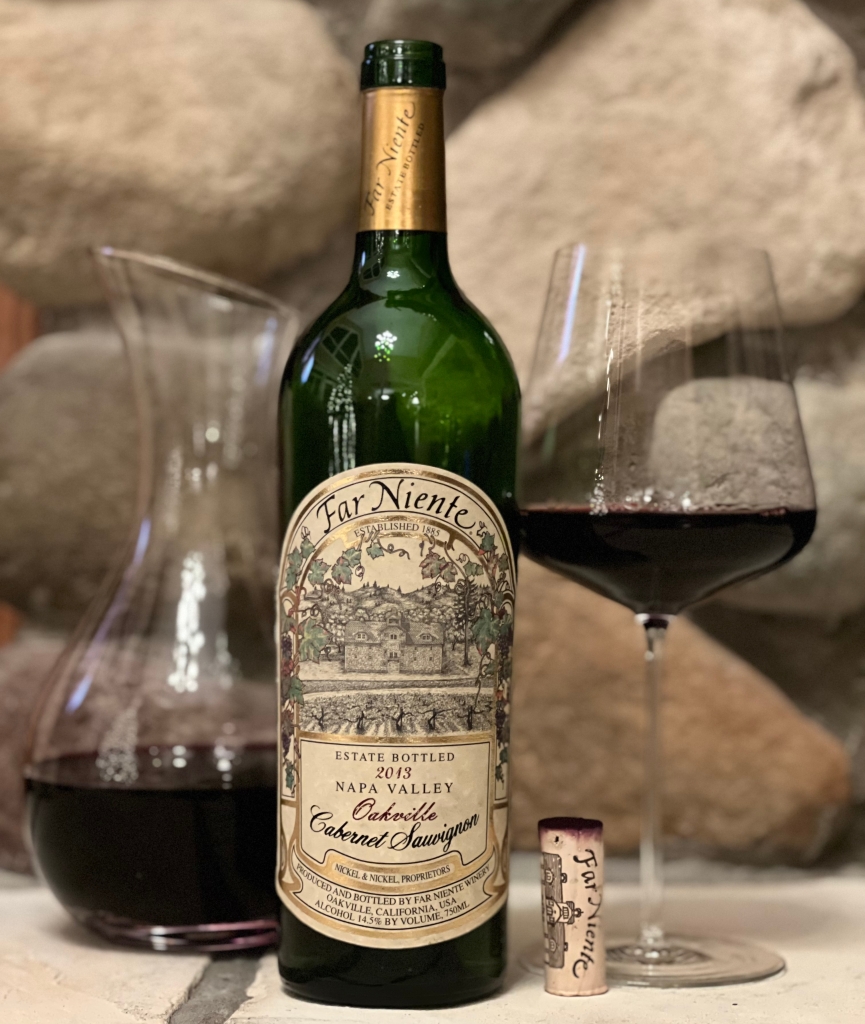
Today’s Wine: 2013 Cave Collection Cabernet Sauvignon

97% Cabernet Sauvignon, 3% Petit Verdot; 14.5% ABV

The 2013 Cave Collection Cabernet Sauvignon is deep ruby in color and rather opaque. I decanted this for two hours, helping to open the wine with aromas of medium (+) intensity and a nose of blackberry, blueberry, redcurrant, violet, cigar box, graphite, chocolate, vanilla, and charred oak. Meanwhile the flavors are also of medium (+) intensity, with the palate showcasing notes of cassis, black plum, blueberry, black cherry, tobacco, black truffle, gravel, a hint of vanilla, and woodsmoke. This dry red is full-bodied with medium (+) acidity, medium (+) but fine-grained tannin, high alcohol, and a medium (+) length finish.

Price: $185. This is a very solid wine from an iconic Napa winery, though there are certainly better “values” out there. I think some of the other vintages from Far Niente show better than the 2013, though there’s no denying the quality level is high and this offers decent depth and great balance.

Green but Delicious Morey-Saint-Denis

Today’s Story: Domaine Dujac

Domaine Dujac is a highly regarded wine estate established in 1968 by Jacques Seysses in the Morey-Saint-Denis appellation of Burgundy. Though Jacques loved wine at an early age thanks to his father, he worked until the age of 25 at his family’s biscuit manufacturing company before moving into wine full-time. In 1966 and 1967, Jacques worked the harvest with Gérard Potel at the Domaine de la Pousse d’Or to learn his winemaking craft, ultimately purchasing the 5 hectare (12 acre) Domaine Graillet in 1968 and renaming it to Domaine Dujac.

Over time, Dujac expanded from 5 hectares to 15.5 hectares (38 acres) and their holdings include some of the greatest vineyard sites throughout Burgundy. The Grand Cru sites of Clos de la Roche and Clos St. Denis came early in the portfolio, with later additions of Charmes-Chambertin and Mazoyères-Chambertin still somewhat early in Dujac’s history. Today Dujac produces seven Grand Cru wines, five 1er Cru wines, and two village wines under the domaine label. They also produce five white wines, three of which are 1er Cru. Beginning in 2001, Dujac started experimenting with organic viticulture and expanded the practices to all holdings in 2008. They also started experimenting with biodynamic practices in 2003 and utilize that philosophy on all holdings today as well.

Jacques, during the domaine’s early decades, was a staunch proponent of whole cluster fermentation thanks to the character stems bring to the wine. Though today they destem some of the fruit, this is still a major philosophical backbone and the fruit sees minimal destemming. Winemaking is rather traditional in practice, with the team using only native yeasts for fermentation with light punchdowns early in the process and pump overs toward the end. Oak usage has changed over time, with Jacques establishing the domaine with religious use of 100% new oak. Nowadays, however, new oak percentages vary by quality level and the team has discretion given vintage conditions. The wines are all bottled unfiltered and rarely fined.

Domaine Dujac today is operated by its second generation, though Jacques is still very much involved. Jacques’ son Jeremy started working at Dujac in 1998, followed by his wife Diana in 2001 and brother Alec in 2003. Jeremy was the leading force behind some of the whole cluster and oak aging changes to winemaking, though the wines of Domaine Dujac remain incredible representations of Pinot Noir and the terroir they come from.

Today’s Wine: 2011 1er Cru Morey Saint-Denis

100% Pinot Noir; 13% ABV

The 2011 1er Cru Morey Saint-Denis is medium ruby in color and quite youthful in appearance. Given some time to blossom in the glass, the wine opens with aromas of medium (+) intensity and a nose of cherry, cranberry, stemmy strawberry, rose, forest floor, truffle, underbrush, olive, eucalyptus, menthol, mint, and crushed stone. Meanwhile the flavors are also of medium (+) intensity and the palate showcases notes of bing cherry, black raspberry, strawberry, dried plum, violet, olive, forest floor, eucalyptus, green pepper, and mineral. This dry red is light- to medium-bodied with medium (+) acidity, light tannin, medium alcohol, and a long finish. Very good quality and certainly showing the green notes of the vintage and stem inclusion.

Price: $150. I think this is a pretty solid price-point and offers decent value in the realm of red Burgundy. While the 2011 vintage can be overbearingly green in some wines, I think this handles it well and comes across rather memorable. It’s intense, complex, and should be long-lived. If you try to steer clear of greener wines, though, this might not be your thing.

My Favorite Aligoté to Date

Today’s Story: Domaine Roulot

Domaine Roulot is a renowned Burgundy wine estate situated in the village of Meursault in the Côte de Beaune sub-region. Though Roulot’s history dates back to at least 1830 when Guillaume Roulot registered as a vigneron, the modern domaine traces its roots more directly to a 1930 founding and growing success following WWII under Guy Roulot. Guy came into some vineyard property through his marriage to Geneviève Coche, though he quickly set about purchasing additional vineyard parcels of village and 1er Cru classifications. Unique at the time, Guy vinified and bottled his wines by single vineyard, also mastering the lieu-dit practice of bottling a named vineyard without its own “legal” classification within the larger village. Guy made some of the greatest white Burgundy at the time, even later having his 1973 Meursault Charmes place second for the white wines at the Judgment of Paris in 1976. Sadly, Guy passed away suddenly and far too soon in 1982 and left his domaine in a precarious situation since his son Jean-Marc was in Paris studying acting. Though Domaine Roulot had several winemakers come in until Jean-Marc returned home, it wasn’t until 1989 when he fully took the reigns.

Shortly after taking over, Jean-Marc transitioned fully to organic viticulture and he has not used any herbicides since. Further, any treatments used in the vineyards ensure minimal if any impact on the natural microbial life amongst the vines. In the cellar, Jean-Marc crafts wines based on a philosophy that they should be what he likes to drink, not necessarily what the “modern palate” likes to drink. While many of the wines of Meursault can be rich and concentrated, Roulot’s wines are often described as chiseled, linear, precise, restrained, tense, and transparent. He achieves these descriptors through incredibly rigorous harvesting, very gentle pressing of the fruit, indigenous yeast fermentation, barrel aging for 12 months on lees followed by 6 months in stainless steel, and modest use of new oak of between 10% and 30%. Roulot even minimizes stirring the lees (and mainly does it in vintages of higher acidity), which is a practice more common with producers who like adding richness to the wines.

I previously reviewed the 2015 Bourgogne Blanc and 2017 Bourgogne Blanc from Domaine Roulot.

Today’s Wine: 2015 Bourgogne Aligoté

100% Aligoté; 11.5% ABV

The 2015 Bourgogne Aligoté is pale straw yellow in color. The nose is rather delicate and aromas are of medium intensity, offering up classic notes of green apple skins, lemon, white peach, honeysuckle, flint, saline minerality, and a touch of cream. Meanwhile the flavors are also of medium intensity, with the palate showcasing notes of green apple, grapefruit, lemon zest, dried white flowers, mild green herbs, chalk, a hint of smoke, and stony mineral. This dry white is light- to medium-bodied with high acidity, medium (-) alcohol, and a medium length finish. A great representation of the variety while incorporating that classic Roulot reductive character.

Price: $70 (I paid $37 a year ago). Pricing on this bottling continues to rise alongside Roulot’s others and Burgundy as a whole, so the value proposition is of course narrowing or evaporated. At the price I paid this is screaming value, for it’s bright, precise, delicious, and a great representation of the variety.

Premium Cabernet From Perhaps the World’s Greatest Wine Consultant

Today’s Story: Michel Rolland Napa Valley

Michel Rolland Napa Valley is the individual wine project of world-renowned wine consultant Michel Rolland, with its first vintage being 2010. Rolland grew up in Pomerol, France on his family’s estate Château Le Bon Pasteur, so one can say the path of winemaking started the day he was born. He excelled in his studies of viticulture and enology, ultimately purchasing an enology lab on the Right Bank of Bordeaux to begin his consulting career. Over time Rolland has consulted for hundreds of clients the world over, namely centered in his native Bordeaux in addition to Argentina, the United States, and other countries. With names on his resume like Château Ausone, Château L’Évangile, and Château Pontet-Canet it is also no surprise he consults for some of the greatest estates in the Napa Valley: Harlan Estate and Bryant Family to name a couple. As the Napa Valley became almost like a second home, Rolland decided to start his own venture sourcing from some of the greatest vineyards (many of them Beckstoffer) and MR Cabernet Sauvignon was born.

Today’s Wine: 2013 MR Cabernet Sauvignon

100% Cabernet Sauvignon; 14.7% ABV

The 2013 MR Cabernet Sauvignon is deep ruby in color and completely opaque. I decanted this for about 2 hours and drank it over the following hour or so. The aromas are of pronounced intensity, with the nose offering up notes of blackberry, blueberry, plum, orange rind, violet, cigar box, graphite, slate, mint, savory green herbs, a touch of smoke, and cedar. The flavors are also of pronounced intensity, with the concentrated palate showcasing notes of blackcurrant, blackberry, plum, black cherry, licorice, sweet tobacco, graphite, charred herbs, coffee grounds, clove, and cinnamon. This dry red is full-bodied with medium (+) acidity, medium (+) but silky and refined tannin, high alcohol, and a long finish. Very good and still quite youthful.

Price: $150. This is another high-quality Napa Cab in the ever-competitive price-point, and while for this saturated zone I cannot call this great “value” it certainly drinks at its price-point. Fruit sources here include the incredible sites of To Kalon, Missouri Hopper, Dr. Crane, and Stagecoach which, coupled with a limited production of 300 cases, contributes to the pricing. Nonetheless this is an incredibly concentrated, intense, and complex Napa Cab that was very enjoyable.

Bold and Powerful Stags Leap District Cabernet

Today’s Story: Odette Estate

Odette Estate is the newest property in the PlumpJack Group of wineries, established in 2012 by partners Gordon Getty, Gavin Newson, and John Conover. The trio found success with their earlier properties of PlumpJack in Oakville and CADE up on Howell Mountain, so they set their eyes on this third property in the historic Stags Leap District. The 45 acre property was owned by the Steltzner family who purchased it in 1964, and they first converted the land to vineyards in 1970. Though the family originally sold all of their fruit in those early years, they started making their own wine and released the first of it in the year 1980. This working winery was in full swing by the time the PlumpJack Group purchased the property in 2012, though the team immediately undertook a massive renovation project of both the facilities and caves. They also transitioned the entire property to organic farming like the other two properties.

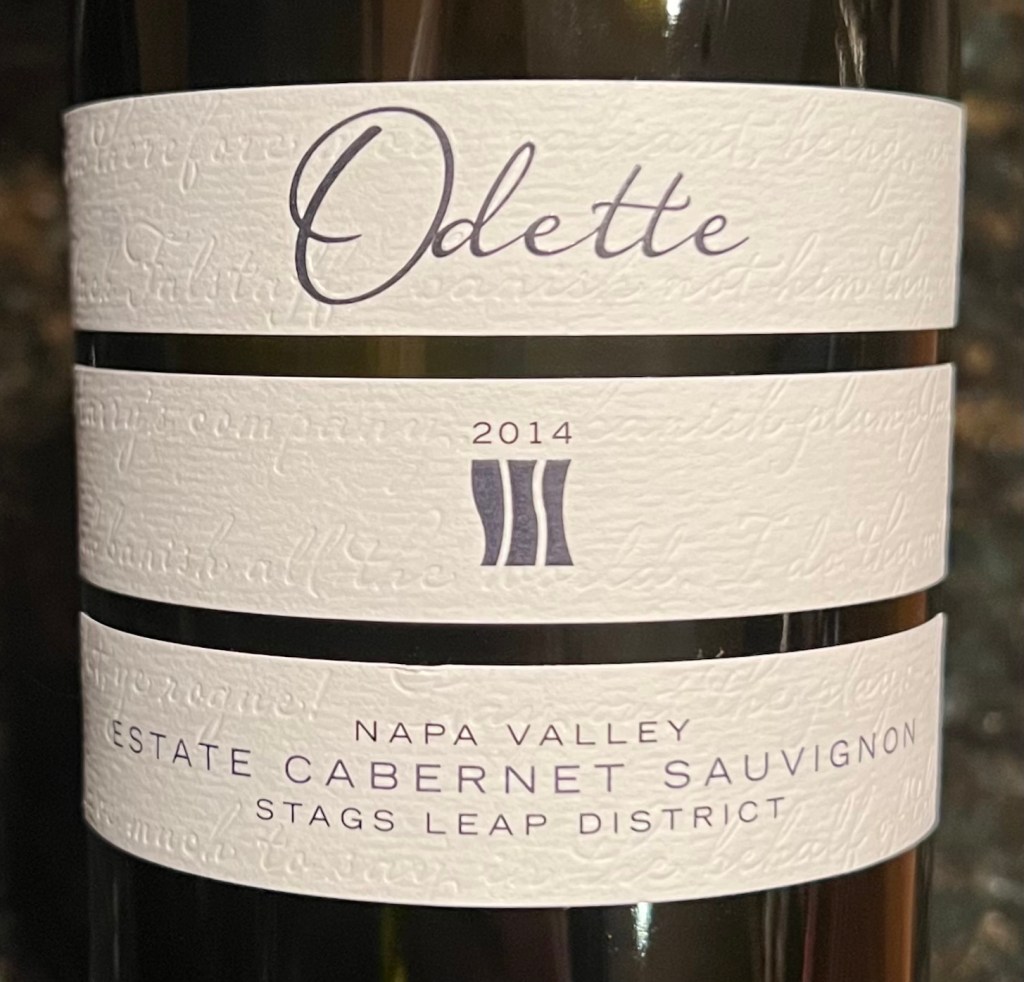
Today’s Wine: 2014 Estate Cabernet Sauvignon

75% Cabernet Sauvignon, 15% Merlot, and remaining 10% between Cabernet Franc, Malbec, and Petit Verdot; 15.2% ABV

The 2014 Estate Cabernet Sauvignon is deep ruby in color and completely opaque. I decanted this for two hours to allow it to open up. The aromas are of pronounced intensity, with the nose showcasing notes of blackberry compote, plum, crème de cassis, blueberry, black licorice, violet, sweet tobacco, a hint of truffle, graphite, vanilla, and clove. Flavors are also pronounced, and the palate offers up notes of blackberry, blackcurrant, black cherry, blueberry, black plum, anise, charred green herbs, mushroom, gravel, coffee grounds, and baking spice. This dry red is full-bodied with medium (+) acidity, high tannin, high alcohol, and a long finish. Very good for the style, as these are meant to be big, bold, concentrated, and intense.

Price: $150. Though this is in an incredibly competitive price range, I do think it drinks at the level. While this isn’t my particular style of Cabernet (I prefer more restrained and terroir-driven bottlings made in a more traditional style), there is no denying it is of great quality. The complexity and balance here are quite good, and this wine would certainly appeal to a broad range of consumers.

Textbook Viognier From Amador County

Today’s Story: Favia Erickson Winegrowers

Favia was founded in 2003 by viticulturist Annie Favia and winemaker Andy Erickson, a husband and wife duo. Annie has experience working with John Kongsgaard and Cathy Corison, though her viticulturist expertise came working under David Abreu. Andy also has an extensive resume, which includes winemaking stints at Screaming Eagle, Dalla Valle, Ovid, Harlan Estate, and Staglin amongst others. Andy also consults for Arietta, Mayacamas, and Dancing Hares Vineyard.

I had an opportunity to visit Favia for a tour and tasting in the past, and it truly is a special experience. Annie and Andy live on the property in a home built in 1886 for the Carbone family, who are believed to be the first Italian immigrants to Napa Valley. Though modernized, Annie and Andy restored the home using historical documents alongside other structures on the property. A very cool feature, the cellar sits under the family home and Favia stores their wine right where they live. Strong believers in biodynamic practices and caring for the earth, Annie and Andy planted fruit trees, an olive orchard, and a garden (which we got to try a tomato from) in addition to the existing walnut orchard.

I highly suggest a visit to Favia if you take a trip to Napa Valley, as it’s a very small, unique tasting experience and is not too far from downtown Napa. In the meantime, check out their website here to browse their wines and see incredible pictures of the property. I also previously reviewed their 2013 Linea Sauvignon Blanc and 2014 Quarzo Syrah.

Today’s Wine: 2016 Suize Viognier

100% Viognier; 14.1% ABV

The 2016 Suize Viognier is deep straw in color with medium gold hues. Aromas are of medium (+) intensity, with the nose showcasing notes of white peach, mango, tangerine, honeysuckle, white rose, popcorn kernel, butter, and brioche. Meanwhile the flavors are also of medium (+) intensity, while the palate offers up notes of white peach, mango, tangerine, juniper berry, honeysuckle, beeswax, dried herbs, vanilla, and butter. This has the classic oily mouthfeel of Viognier as well. This dry white is full-bodied with medium acidity, high alcohol, and a medium (+) length finish. Quality here is good, with this being a textbook representation of the variety.

Price: $75. Price-wise and therefore value-wise this is pretty steep for a classic representation of Viognier. The quality, depth, and length here are all quite good though and it’s an enjoyable wine if you come across it and feel spendy.

Complex Bourgogne Blanc That Needs a Little More Time

Today’s Story: Domaine Roulot

Domaine Roulot is a renowned Burgundy wine estate situated in the village of Meursault in the Côte de Beaune sub-region. Though Roulot’s history dates back to at least 1830 when Guillaume Roulot registered as a vigneron, the modern domaine traces its roots more directly to a 1930 founding and growing success following WWII under Guy Roulot. Guy came into some vineyard property through his marriage to Geneviève Coche, though he quickly set about purchasing additional vineyard parcels of village and 1er Cru classifications. Unique at the time, Guy vinified and bottled his wines by single vineyard, also mastering the lieu-dit practice of bottling a named vineyard without its own “legal” classification within the larger village. Guy made some of the greatest white Burgundy at the time, even later having his 1973 Meursault Charmes place second for the white wines at the Judgment of Paris in 1976. Sadly, Guy passed away suddenly and far too soon in 1982 and left his domaine in a precarious situation since his son Jean-Marc was in Paris studying acting. Though Domaine Roulot had several winemakers come in until Jean-Marc returned home, it wasn’t until 1989 when he fully took the reigns.

Shortly after taking over, Jean-Marc transitioned fully to organic viticulture and he has not used any herbicides since. Further, any treatments used in the vineyards ensure minimal if any impact on the natural microbial life amongst the vines. In the cellar, Jean-Marc crafts wines based on a philosophy that they should be what he likes to drink, not necessarily what the “modern palate” likes to drink. While many of the wines of Meursault can be rich and concentrated, Roulot’s wines are often described as chiseled, linear, precise, restrained, tense, and transparent. He achieves these descriptors through incredibly rigorous harvesting, very gentle pressing of the fruit, indigenous yeast fermentation, barrel aging for 12 months on lees followed by 6 months in stainless steel, and modest use of new oak of between 10% and 30%. Roulot even minimizes stirring the lees (and mainly does it in vintages of higher acidity), which is a practice more common with producers who like adding richness to the wines.

I previously reviewed the 2017 Bourgogne Blanc from Domaine Roulot.

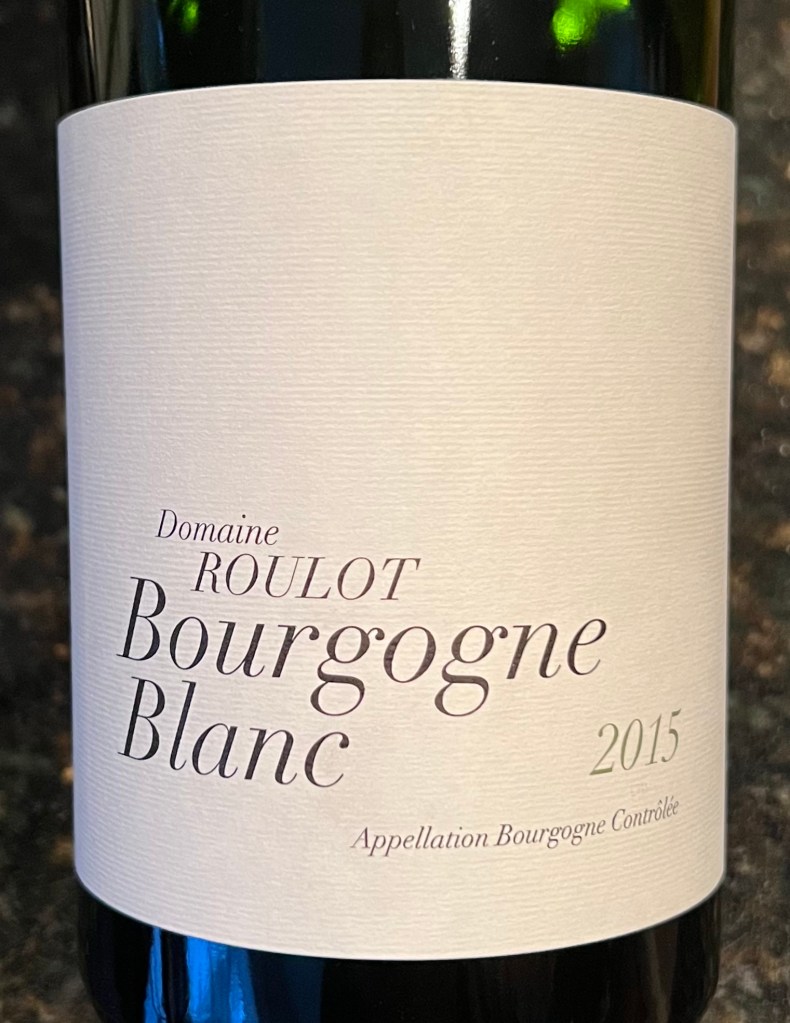
Today’s Wine: 2015 Bourgogne Blanc

100% Chardonnay; 12.5% ABV

The 2015 Bourgogne Blanc is pale straw yellow in color and crystal clear. This shows at its best after at least 45 minutes in the glass. The aromas are of medium (+) intensity, with the nose showcasing notes of green apple, lemon, crisp pear, white flowers, flint, gunsmoke, limestone, saline, raw almond, and a hint of vanilla. Meanwhile the flavors are of medium intensity and the palate offers notes of green apple, lime zest, white peach, pear, white flowers, dried gravel, limestone mineral, a hint of smoke, and almond. This dry white is medium-bodied with medium (+) acidity, medium alcohol, and a medium length finish. The wine seems to hollow out on the mid-palate, and the finish leaves one wanting for a bit more. Perhaps a dumb phase? Nonetheless this is a solid white Burgundy and offers up the classic reductive characteristics of Roulot.

Price: $140 (I paid $66 one year ago). At current market prices I think this struggles in value terms. There are quite a few lesser known Bourgogne Blancs well below $100 per bottle, and I am glad for the price I paid last year. While still an enjoyable wine, I would focus my efforts on the 2014 or 2017 Roulot Bourgogne Blanc if you’re spending the money.

Delicious Ice Wine From One of My Favorite Oregon Winemakers

Today’s Story: Antica Terra

Antica Terra was established in 2005 by Scott Adelson, John Mavredakis, and Michael Kramer, three friends and partners who had collaborated before and dreamed of owning a vineyard together. This being said, vines were first planted in 1989 on the property, an 11 acre vineyard on pre-historic seabed in the Eola-Amity Hills of Oregon’s Willamette Valley. Having taken ownership of their new vineyard, Scott, John, and Michael started seeking a winemaker and their crosshairs quickly fell upon Maggie Harrison.

Maggie began her winemaking career at Sine Qua Non (known for $200-$1,000+ bottles of cult Rhone variety wines) working for Manfred Krankl and her expertise was quickly realized. In 2004, Manfred encouraged her to begin her own Syrah project on the side, and Lillian was born (I reviewed two of these Syrahs previously). Maggie worked tirelessly on her passion project wines while still tending to barrels at Sine Qua Non, demonstrating her pure passion for the craft. When Scott, John, and Michael asked Maggie to become their winemaker, she refused profusely though the three friends ultimately convinced her to simply visit the property to offer her opinions of the vineyard. 26 seconds after Maggie stepped foot into the vineyards and observed the fossils, oaks, and vines, “she found herself hunched beneath one of the trees, phone in hand, explaining to her husband that they would be moving to Oregon.”

The vineyard of Antica Terra is rather intense, both in appearance above the earth and underground for the vines. The vines find home amongst fossilized oyster shells and sandstone with no topsoil, leaving them to struggle for nutrients and in turn producing incredibly unique fruit. Aboveground, the vineyard is strewn with boulders, steep grades, and vines that (due to the soil) appear spindly and frail. Fruit for Antica Terra wines forms in tiny clusters with thick-skinned grapes that are half the size that is typical for their varieties and the canopy of these plants is incredibly sensitive. Maggie provides immense care and attention to these delicate vines, which culminates into unique and immeasurably profound wines. Antica Terra produces four Pinot Noir bottlings, two Chardonnays, and one Rosé. In the 2018 vintage, they also produced their first-ever and incredibly limited ice wine that I’m reviewing today.

To explore the wines of Antica Terra, join the mailing list, or plan a visit, check out their website here. I also previously reviewed the 2017 Botanica Pinot Noir and 2018 Aurata Chardonnay.

Today’s Wine: 2018 Paraselene Ice Wine

100% Chardonnay; 10.4% ABV; 24.4% residual sugar by weight

The 2018 Paraselene is deep gold, almost amber, in color. Aromas are of medium (+) intensity, with the nose showcasing welcoming notes of peach cobbler, orange marmalade, apricot jam, baked apple, honeysuckle, and hazelnut. The flavors are also of medium (+) intensity, while the palate offers equally inviting notes of pineapple, apricot, orange pith, lychee, squash blossom, and honey. This sweet ice wine is medium- to full-bodied with medium (+) acidity, low alcohol, and a medium (+) length finish. While not incredibly complex at this stage, the wine is incredibly concentrated and rather intense. A delicious way to cap off the evening or as a pairing for dessert.

Price: $100 per 375ml. While this is incredibly expensive on a value perspective, ice wine is a very labor-intensive and expensive product to make and these bottles are incredibly limited. While you can argue there are better ways to spend $100, I thoroughly enjoyed this wine and am glad to have a couple bottles left. If you’re given the opportunity to try it, this is another window into Maggie’s highly skilled winemaking.