Exquisite Chardonnay From a Violent Terroir

Today’s Story: The Hilt

The Hilt is a small, relatively young winery located in the rough, rugged, and windswept Santa Rita Hills AVA about 13 miles from the Pacific Ocean. The Hilt is a sister winery to Jonata, whose wines I reviewed three times prior, and falls under support of Stan Kroenke who owns the LA Rams and Screaming Eagle. The Hilt shares an adept winemaker in Matt Dees with Jonata, and similarly provides him a vast and difficult terroir ranging in soil type, altitude, and microclimates to craft wine. The Hilt’s fruit, consisting only of Pinot Noir and Chardonnay, comes from vines that are forced to dig deep for nutrients, face brutal maritime winds, and yield small numbers of concentrated grapes.

The Hilt consists of three vineyards named Bentrock, Radian, and Puerto del Mar. Bentrock is made up of long, rolling hills roughly 400-500 feet above sea level and totals roughly 92 acres of which just under 80 are planted to Pinot Noir and just over 13 are planted to Chardonnay. Radian differs greatly in that its terrain is rugged and steep where, at its highest point, grapes face fierce winds at 700 feet elevation. Consisting of just over 100 acres, Radian is planted to 95 acres of Pinot Noir and only 6.1 acres of Chardonnay. The Puerto del Mar vineyard sources much of the fruit for The Hilt’s Estate wines, and also houses the winery where Matt Dees goes to work in the cellars. Typically Bentrock fruit sits at the core of The Vanguard bottlings, Radian at the core of The Old Guard bottlings, and a blend at the core of the Estate bottlings.

You can read more about the winery and their offerings (including tech sheets) at the website here.

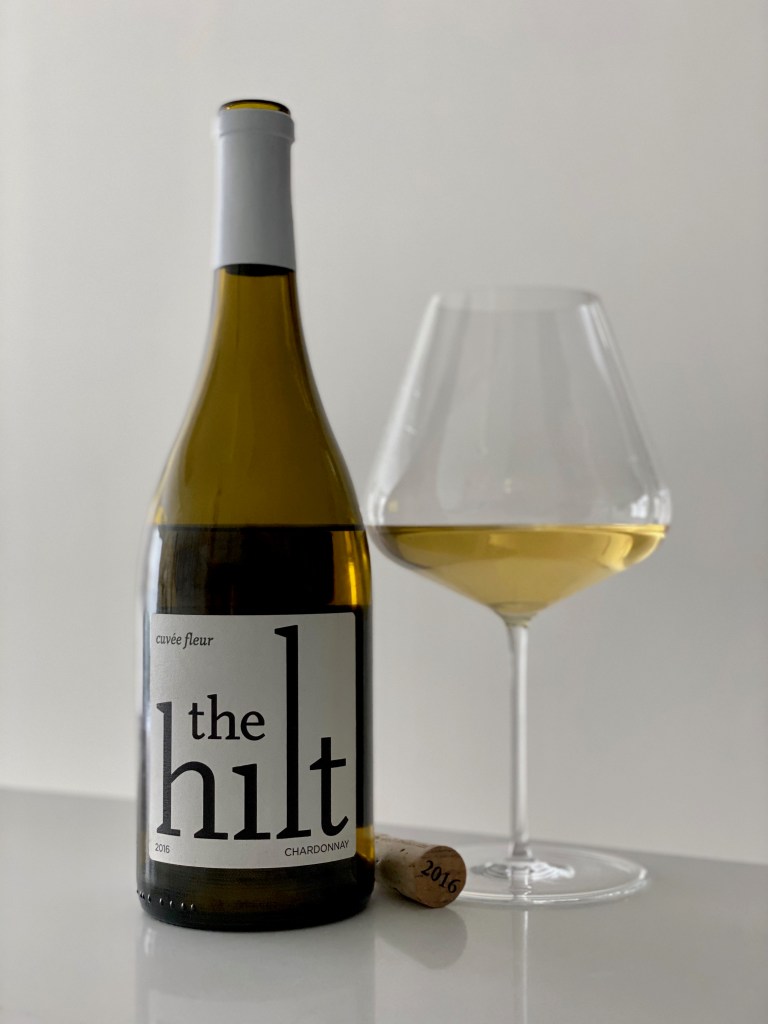
Today’s Wine: 2016 Cuvée Fleur Chardonnay

100% Chardonnay; 13.2% ABV

The 2016 Cuvée Fleur is vibrant medium to deep gold in color. Once this opens up in the glass, the incredibly expressive nose showcases aromas of melon, yellow apple, jackfruit, white florals, vanilla, beeswax, exotic spice, and saline mineral. In the mouth, this beauty displays notes of lemon, pineapple, stone fruit, honeysuckle, almond, dill, flint, saline mineral, and mild oak. The wine is medium- to full-bodied with mouthwatering medium (+) acidity and a well-rounded, lengthy finish. This is a beautiful Burgundian-style Chardonnay made exclusively for Wally’s in Los Angeles and will only get better with a few more years of bottle age.

Price: $45. This is priced closely with the standard Hilt Chardonnay and delivers similarly great value, however it is more difficult to acquire since it appears Wally’s is the only carrier. Pair this with lobster, herb-roasted chicken, or halibut.

Ancient Bordeaux Estate

Today’s Story: Château-Figeac

Château-Figeac is an ancient Bordeaux wine estate located in Saint-Émilion that traces its roots to the 2nd century and the Gallo-Roman period. The estate is named for Figeacus who built a villa on the property, and with such excellent terroir it is one of the few wine properties to see continuous use for the past 2,000 years. In 1586, Raymond de Cazes rebuilt the origins of the château in classic Renaissance style and the cellars today where the wine ages during its second year trace to this construction. In 1654, the estate transferred by marriage of Marie de Cazes to the Carles family who were very influential in the region and undertook modernization of viticultural techniques. The Carles family also built the current château in 1780. During the late 18th and early 19th centuries as financial crises roiled the region, Château-Figeac sold some of its land holdings, including 15 hectares that became Château Cheval Blanc, and passed through seven owners in 50 years.

In 1892, the Manoncourt family acquired the heart of Château-Figeac and brought in Albert Macquin to structure the vineyards, bring in oak vats from the property, and test novel agricultural species on the property. The label was created in 1907 and bears the crest of Henri de Chèvremont (great-grandfather of Thierry Manoncourt) and for decades the estate produced world-class Bordeaux largely under management of enologists. In 1943, however, Thierry Manoncourt participated in his first vintage and convinced his mother to keep the estate and play a more hands-on role. In 1947, Thierry started at Figeac full-time with a degree in agricultural engineering and tirelessly set about learning and understanding the incredible terroir.

The 20th century was filled with other milestones for Château-Figeac, including its classification as Premier Grand Cru Classé in 1955. Figeac became famous for its near 1:1:1 blend with Thierry planting the vineyards to 35% Cabernet Sauvignon, 35% Cabernet Franc, and 30% Merlot and his wife Marie-France joins him to increase the wine’s global exposure. During the late 1980s, Laure and Eric d’Aramon (daughter and son-in-law of Thierry and Marie-France) moved to the château to help manage the estate and Eric eventually took operational control until 2012. Agricultural engineer Frédéric Faye joined Château-Figeac in 2002 and learned their vineyards and winemaking techniques alongside Thierry until his death in 2010. Today, Madame Manoncourt alongside her daughters and team guide the estate onward keeping to the traditions set forth by Thierry.

Today, Château-Figeac consists of 40 hectares of vineyards (down from its peak of 200 hectares) and is the largest wine estate in Saint-Émilion. The signature features of the terroir, three gravel ridges, provide excellent growing conditions for the three grape varieties planted there and the castle finds itself surrounded by 14 hectares of parks, meadows, ponds, and woods as well. Figeac respects the biodiversity of their vineyards as a founding principle, while also relying heavily on scientific analysis of the terroir and traditional yet modernized winemaking techniques. Château-Figeac produces about 100,000 bottles of wine per year, in addition to about 40,000 bottles of the second wine Petit-Figeac. For more on this remarkable estate, check out their website here.

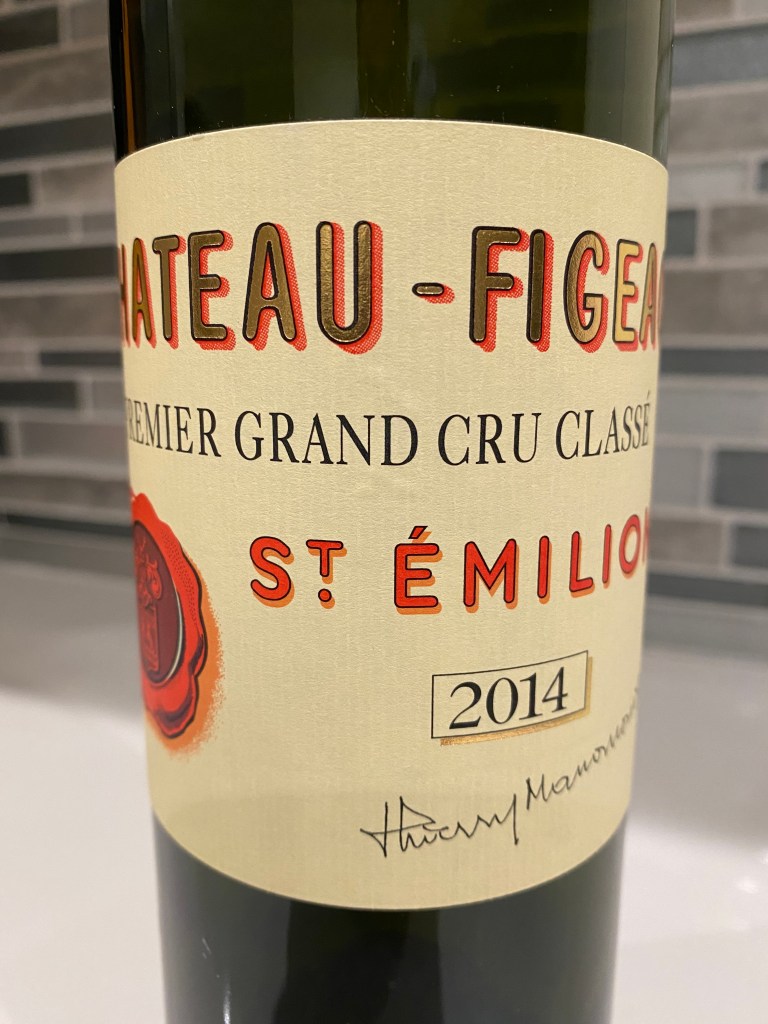
Today’s Wine: 2014 Château-Figeac

40% Merlot, 32% Cabernet Sauvignon, 28% Cabernet Franc; 13% ABV

The 2014 Figeac is opaque deep ruby in color. I decanted this for 2 hours and drank it over the following 3 hours. The nose is ridiculously complex and profound, changing dramatically as I drank this and showcasing aromas of blackberry, blackcurrant, redcurrant, crushed lilac, anise, pencil shavings, graphite, cigar box, tobacco, loamy earth, crushed green peppercorn, baking spice, and oak. Once in the mouth, the wine displays notes of blackberry, plum, blueberry, redcurrant, violet, licorice, tobacco, scorched earth, mocha, dried herbs, and toasted oak. This wine is full-bodied with medium (+) acidity, high tannins, and a long finish with added notes of slate and iron.

Price: $115 (average price in US is $166). I got this for an absolutely incredible price at one of my local wine stores, but even around $160 per bottle this is fantastic and still less expensive than other vintages that overshadow 2014. Pair this with Beef Wellington, stewed game, or veal.

Refreshing Arneis From an Italian Legend

Today’s Story: Bruno Giacosa

Bruno Giacosa was one of the most respected and legendary winemakers not only in Piedmont, Italy where he crafted some of the most highly regarded and traditionally made Barolo and Barbaresco, but throughout Italy and the world. At age 13, Bruno helped his father and grandfather in the cellar of their Langhe winery and joined the family business full-time two years later. Though Bruno never studied to become an enologist, his appreciation of traditionally made Barolo and Barbaresco spawned from this time with his family and instilled in him some of the most important practices he followed for his entire career until his death at the age of 88 in early 2018. Bruno was quite adept at selecting parcels and fruit for his wines, and always emphasized intentionally small grape yields, limiting treatments in the vineyards, traditional vinification methods, and allowing the wines to honestly display the terroir and typicity through minimal intervention. Historically, Bruno crafted his wines with fruit sourced/purchased from some of the greatest crus of Barolo and Barbaresco and it wasn’t until the early 1980s he purchased his own vineyards as estate-bottling rose in prominence. In 1982, Bruno purchased the Falletto di Serralunga d’Alba vineyard which became the source of arguably his greatest Barolos ever made, followed in near significance by his purchase of the Asili and Rabajá plots in Barbaresco in 1996. Today, the Bruno Giacosa estate is in the capable hands of his daughter Bruna alongside his longtime enologist Dante Scaglione and they continue Bruno’s winemaking philosophies while respecting traditional techniques.

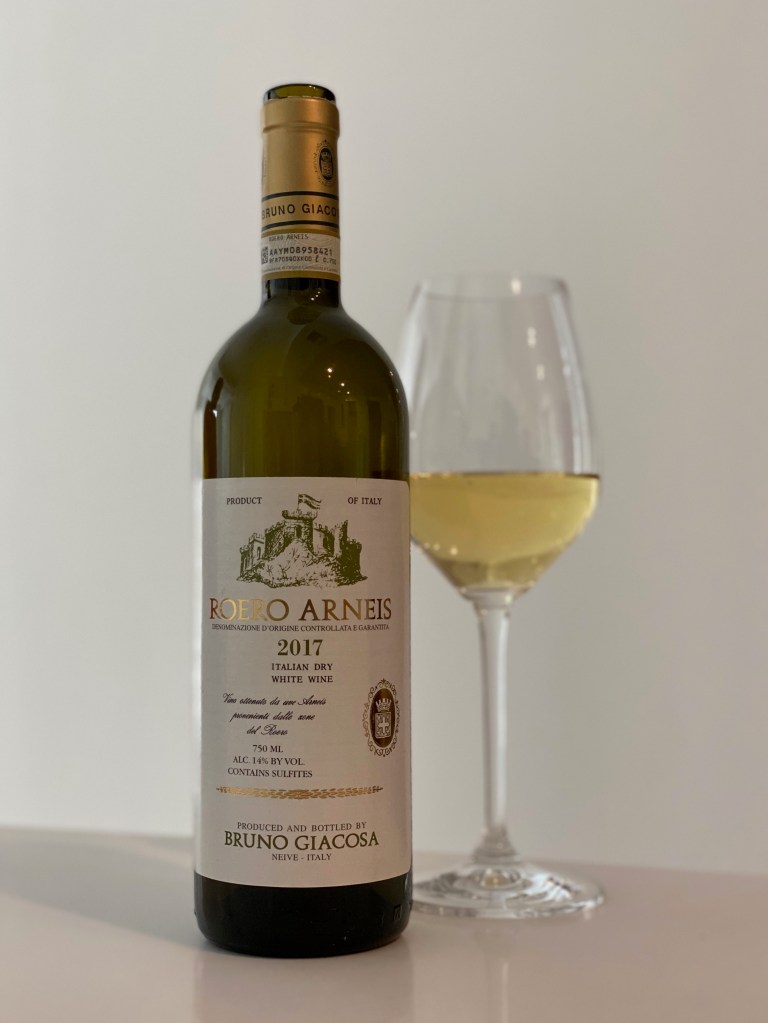
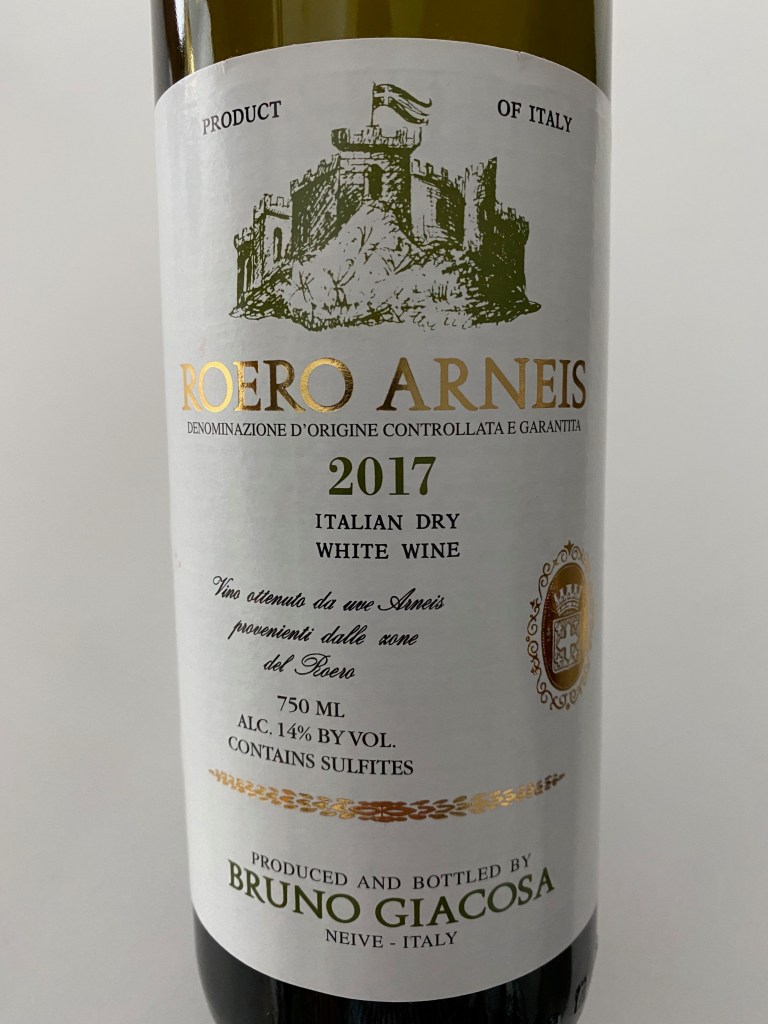
Today’s Wine: 2017 Roero Arneis

100% Arneis; 14% ABV

The 2017 Arneis is transparent deep straw in color with golden hues. On the incredibly aromatic and somewhat earthy nose, the wine emits aromas of white peach, golden apple, stone fruit, lemon zest, grass, white florals (especially lily), saline minerality, and cream. Once in the mouth, the wine displays notes of pear, peach, dried pineapple, lemon, stone fruit, white and yellow florals, honey, beeswax, almond, white peppery spice, slate, and mineral. This is medium-bodied and bone-dry with vibrant medium acidity and a crisp mouthwatering finish. Definitely a bottle of wine for the beach.

Price: $26. Outstanding value and one of the more exciting white wines I’ve had lately. I highly recommend enjoying this on a hot summer’s day. Pair this with roasted chicken, light seafood, or creamy cheeses.

Napa Second Holding Up Quite Well

Today’s Story: Sloan Estate

Sloan Estate was founded in 1997 by Stuart Sloan, a former Seattle-based owner and executive of the Quality Food Centers supermarket chain. After he purchased 40 acres on the eastern hills of Rutherford between 875-990 feet in elevation, Sloan assembled a team of wine rockstars including vineyard manager David Abreu, winemaker Mark Aubert (replaced in 2004 by Martha McClellan), and shortly thereafter renowned consultant Michel Rolland. With 13 acres planted to vine, the team set about creating one of Napa Valley’s greatest Cabernet Sauvignon wines and crafted their first vintage in 2000. While the flagship wine is a proprietary blend of Cabernet Sauvignon (dominant), Merlot, Cabernet Franc, and Petit Verdot, Sloan released a second wine named Asterisk which is typically a blend of Cabernet Sauvignon and Merlot that debuted with the 2004 vintage. In 2011, longtime Sloan fans Sutong Pan and his daughter Jenny acquired Sloan Estate alongside the Goldin Group and to this day maintain the goals set forth by Stuart Sloan alongside the incredible winemaking team he put in place.

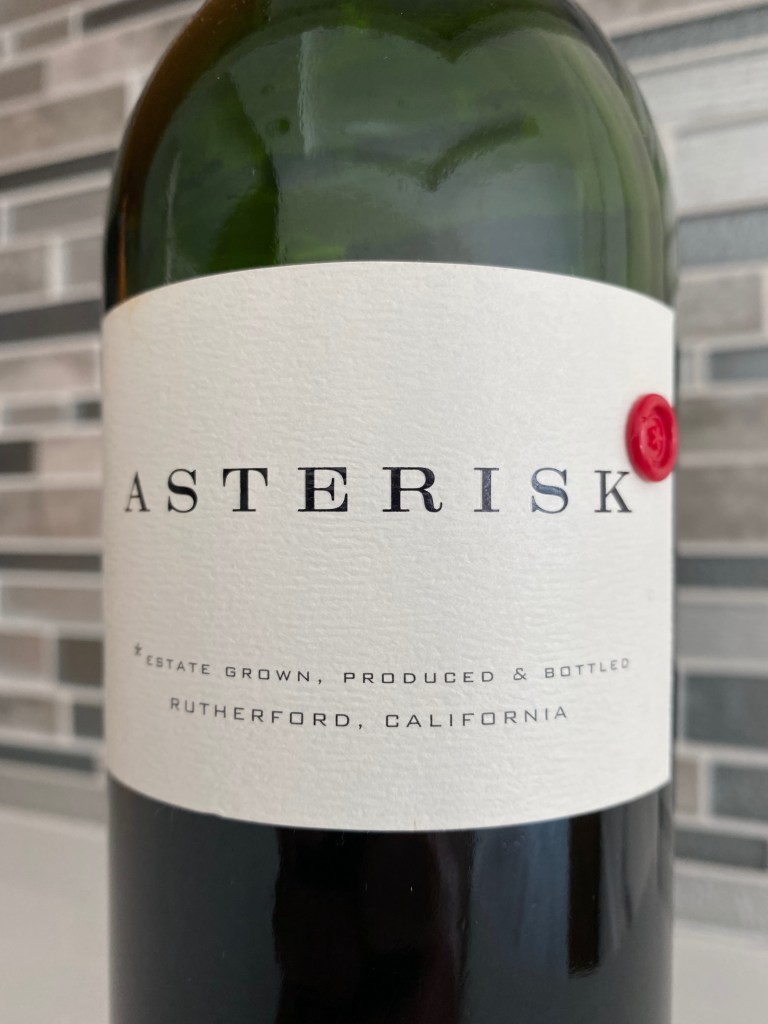
Today’s Wine: 2004 Asterisk

Blend of Cabernet Sauvignon and Merlot (no tech sheet); 14.5% ABV

The 2004 Asterisk is opaque deep garnet with ruby hues. I let this open up for about an hour and drank it over the following hour, allowing the nose to showcase aromas of blackberry, black plum, black cherry, tobacco, rocky earth, truffle, graphite, chocolate, clove, exotic spice, and well-integrated oak. Once in the mouth, the wine displays notes of blackberry, crème de cassis, black raspberry, purple florals, cigar box, smoky volcanic earth, earthy mushroom, black tea leaf, black pepper, coffee grounds, and dark chocolate. This is full-bodied with medium (+) acidity, medium yet still firm tannins, and a medium (+) length finish. Not drinking at all like it’s nearly 16 years old. Even though some tertiary notes are certainly starting to come through, there remains a significant backbone of dark fruit.

Price: $150. This is certainly a great value next to the Sloan flagship and other cult Napa Cabs/Bordeaux blends, and drinks magnificently well for its age. Pair this with filet mignon, herb roasted lamb, or duck breast.

Bourgogne at Village Quality

Today’s Story: Domaine Bachelet

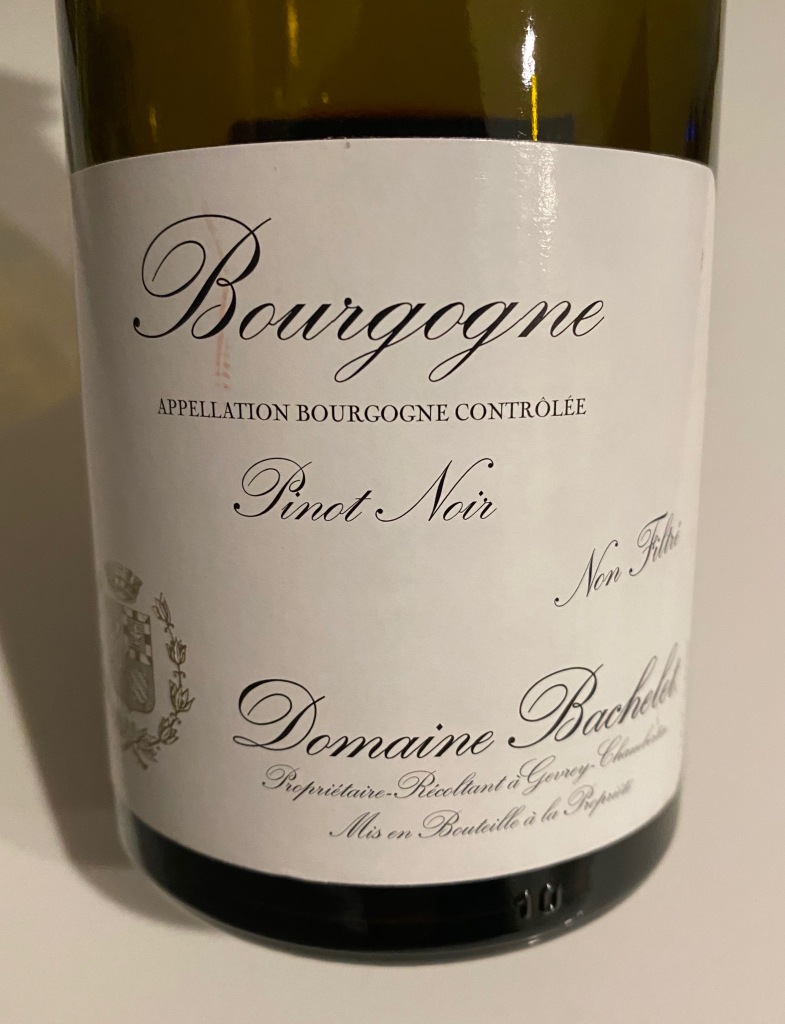
Domaine Bachelet is a small wine estate located in Gevrey-Chambertin consisting of just over 4 hectares of vineyards. The domaine is run by Denis Bachelet who, since 1983, almost single-handedly works tirelessly to produce elegant and honest wines. Denis was born in Belgium, and though his family is drenched in winemaking tradition his father elected to work in the chemical industry there while his grandparents tended the domaine back in France. Denis studied winemaking in Beaune for three years before ultimately joining his grandparents at the estate, though he only became fully involved in winemaking in 1981 shortly after his grandfather’s death. By 1983 when he took over completely, the domaine consisted of only 1.8 hectares and he quickly sought to expand his holdings to make a better living. In 2008, Denis’ son Nicolas joined the domaine and the Bachelet family slowly grew by purchasing more parcels. Today, Domaine Bachelet produces a range of wines including Bourgogne, Village, 1er Cru, and Grand Cru offerings though these gems remain difficult to find but worthwhile seeking out.

For more, there is a great “interview” with Denis here and a background of the domaine and their portfolio here.

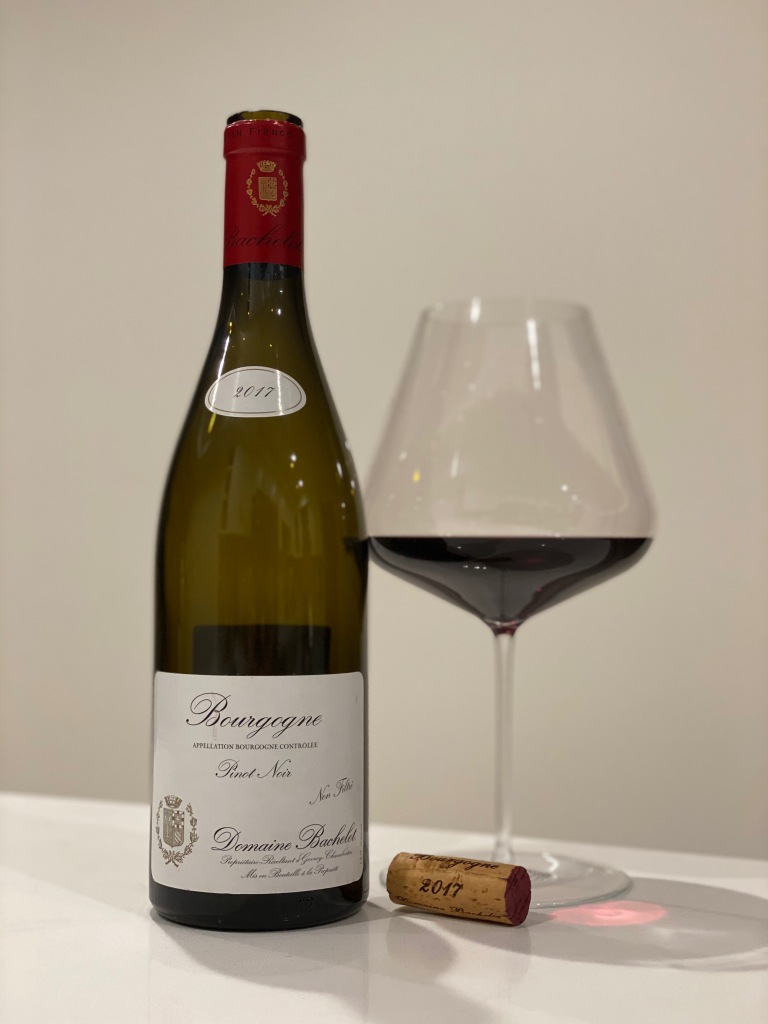
Today’s Wine: 2017 Bourgogne Rouge

100% Pinot Noir; 12.5% ABV

The 2017 Bourgogne Rouge is pale ruby/purple in color but fairly dark and moderately opaque most likely due to its youth. This requires about 1.5 hours to truly open up, and once it does the nose showcases aromas of blackberry, baked cherry, raspberry, violet, saddle leather, freshly tilled soil, steel cut oats, a hint of baking spice, and oak. On the palate, I get notes of blueberry, spiced plum, sour cherry, stemmy strawberry, sweet tobacco, forest floor, charred green herbs, bright mineral, and peppery spice. This is light- to medium-bodied with medium (+) acidity, medium tannins, and a medium (+) length finish. Certainly very tight right now without extended decanting, but this is a very precise wine that needs another 5 years in the bottle.

Price: $65 (cheaper overseas). Certainly not cheap for a Bourgogne Rouge (I saw some stores selling this at almost $80), though you can definitely say its quality puts this near a Village wine. I need to revisit this bottling in a few years and explore the Bachelet portfolio further. Pair this with seared tuna, roasted chicken, or mild goats cheese and charcuterie.

Gorgeous Etna Rosso With an Incredible Backstory

Today’s Story: Le Vigne di Eli

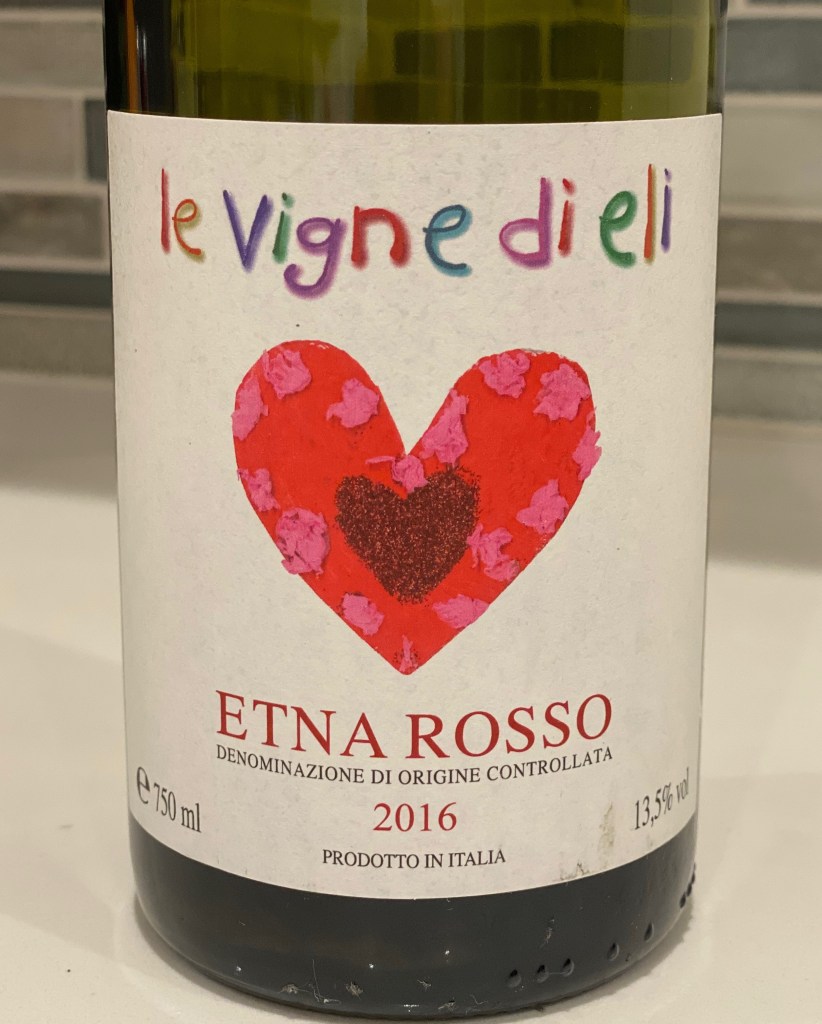
Le Vigne di Eli is a small, family-owned winery established on the slopes of Mount Etna in 2006 by Marco de Grazia who is also behind the acclaimed Tenuta delle Terre Nere. Marco decided to establish Le Vigne di Eli after being offered two of Etna’s tiniest and most coveted vineyards (Feudo di Mezzo and Moganazzi-Voltasciara), though instead of adding them to his portfolio at Tenuta delle Terre Nere he started another winery. Marco says the two vineyards made him think of his daughter Elena (Eli), so not only did he create this winery out of his love for her but he uses her artwork on his labels and dedicates a significant portion of his profits to the Ospedale Pediatrico Meyer children’s hospital in Florence to make it truly a “child’s estate.” Over time Marco selected additional tiny vineyards to increase his offerings and the estate produces about 20,000 bottles annually across several Etna Bianco and Etna Rosso bottlings.

Today’s Wine: 2016 Etna Rosso

98% Nerello Mascalese, 2% Nerello Cappuccio; 13.5% ABV

The 2016 Etna Rosso is moderately opaque and medium garnet in color with bright ruby hues. I let this breathe in the glass for about an hour and the nose emits aromas of ripe strawberry, muddled raspberry, red cherry, red licorice, lavender, tobacco, barnyard, volcanic soil, savory Italian herbs, marine minerality, and oak. Once on the palate, the wine offers notes of strawberry, cherry, wild raspberry, red and purple florals, sweet tobacco, graphite, baking spice, crushed rock minerality, and smoke. This is light- to medium-bodied with vibrant medium (+) acidity, refined medium tannins, and a long herbaceous finish. The wine is incredibly precise and its drinking experience is completely gorgeous. 1,000 cases produced.

Price: $30. This is one of the better Etna Rosso wines I’ve had, and for this price it is a screaming value as a lot of Etna Rosso is (for now). Pair this with chicken parmigiana, tuna with tomatoes, roasted pork, or even pepperoni pizza.

Unique Natural Côtes du Rhône

Today’s Story: Domaine Gramenon

Domaine Gramenon was established in 1978 in Montbrison-sur-Lez which rests in the northernmost area of southern Côtes du Rhône in France. Located on the foothills of the Alps, Domaine Gramenon sits at about 1,150 feet above sea level on soils made largely of limestone, sands, and clay once covered by the sea 86 million years ago. The domaine is largely planted with Grenache thanks to its adaptability to the elevation and region, and many of their vines are old with ages ranging from 50 to 120 years old. Since the domaine’s founding, they practice natural and organic vineyard cultivation though adopted biodynamic practices and received the DEMETER certification in 2010. All harvesting is accomplished by hand and rigorous selection goes into sorting the fruit before they are ultimately shaken (never crushed by tools) into concrete vats. All Domaine Gramenon wines are meant to showcase their terroir in unadulterated fashion, so spring cuvées age in vats and old vine cuvées age in old barrets and minimal (if any) SO2 is added.

To learn more about the domaine, particularly with a wonderful depiction of their terroir, check out the website here.

Today’s Wine: 2018 l’élémentaire

75% Grenache, 25% Syrah; 14.3% ABV

The 2018 l’élémentaire is opaque deep purple in color which leaves heavy staining on the glass. This needs at least an hour or two to decant, but once it opens up the nose showcases aromas of blackberry, black plum, cassis, anise, tobacco, clay, wet gravel, chocolate, and dark roast coffee bean. On the palate, I get notes of blackberry compote, jammy blueberry, plum, black cherry, leather, loamy soil, dried herbs, black pepper, and smoky spice. This wine is medium- to full bodied with medium acidity, medium tannins, and a medium (+) length finish. Drinks better on the second day.

Winemaking process: Produced from 45 year old vines cultivated with biodynamic farming; fruit is sorted manually; 15 day maceration in concrete vats; partially de-stemmed clusters; natural yeast fermentation; light addition of SO2.

Price: $30. Not a bad price for this fun “natural” wine, and it’s one of those that is different than what most people expect from a Grenache/Syrah blend. Pair this with grilled beef, smoked game, or smoky barbecue chicken.

Classic Sonoma County Zin

Today’s Story: Joseph Swan Vineyards

I very recently wrote about Joseph Swan Vineyards when I reviewed their 2012 Mancini Ranch Zinfandel in Not Your Typical Cali Zin, so I wanted to check in on another bottling today while it is fresh in my mind. Today’s wine will be a very different experience, what I expect largely due to its 15.3% ABV versus the 12.9% of the 2012 Mancini Ranch bottling.

To recap……Joseph Swan Vineyards was founded during the early 1970s by Joe Swan, a man whose passion for wine spawned at an early age through reading. However, Joe’s career did not begin in wine but rather as an artist, a flight instructor for the Army Air Corps during WWII, and ultimately a pilot for Western Airlines. Though Joe retired in 1974, his passion for wine remained strong through those middle years and he even produced Zinfandel when stationed in Salt Lake City and made friends visiting the Enology and Viticulture department at UC Davis following the war. In 1967, Joe purchased a small farm planted with 13 acres of Zinfandel, fruit trees, and a pasture near Forestville in the Russian River Valley with a plan to follow his dream of operating a small vineyard and winery. Though Joe made Zinfandel in 1968, he quickly received encouragement from André Tchelistcheff (a highly influential winemaker I discussed in my BV posts, as well as Joe’s friend and mentor) to replant his vineyards to Chardonnay and Pinot Noir. With significant inspiration from French winemakers and the belief that lower production would increase his quality, Joe selected low production clones and both pruned and thinned his vines to significantly reduce yield. In 1987, Joe’s son-in-law Rod Berglund worked the Joseph Swan harvest with him and this would unfortunately be Joe’s last vintage. Joe fell ill during 1988 and passed away January, 1989 but his perfectionism and love of wine carries on with his daughter Lynn and son-in-law Rod today.

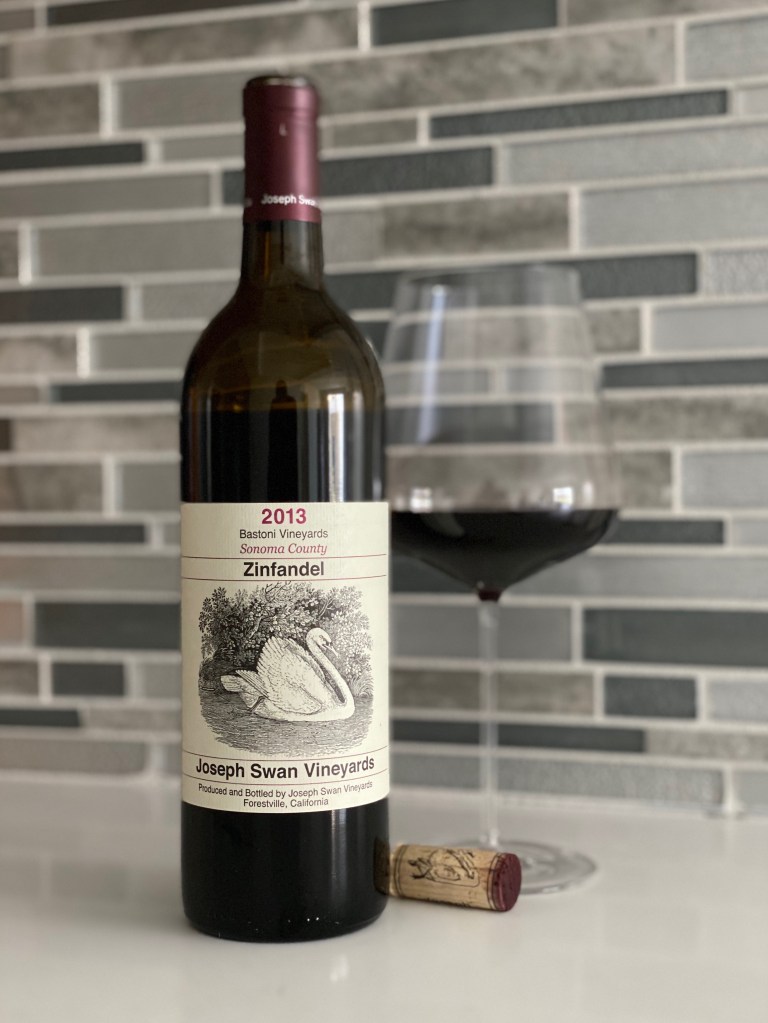
Today’s Wine: 2013 Bastoni Vineyards Zinfandel

100% Zinfandel; 15.3% ABV

The 2013 Bastoni Zinfandel is opaque medium to deep garnet in color with medium ruby variation. Once this opens up, the nose showcases aromas of boysenberry, wild blueberry, cherry, leather, sweet tobacco, rocky soil, cinnamon, a hint of chocolate, and oak. On the palate, I get notes of juicy blackberry, pomegranate, plum, bing cherry, ripe raspberry, pipe tobacco, loamy earth, white pepper, dried green herbs, and a touch of oak. This is medium- to full-bodied with medium (+) acidity, medium tannins, and a long finish with added notes of iron and crushed rock.

Price: $30. This is an incredible value, similar to the 2012 Mancini Ranch I just had and Joseph Swan wines as a whole. This bottling certainly drinks more like your “classic” Californian Zin whereas the Mancini Ranch was more “old-school.” Pair this with barbecue pork sandwiches, pepperoni pizza, or roasted leg of lamb.

Wildly Fun California Mourvèdre

Today’s Story: Dirty & Rowdy Family Winery

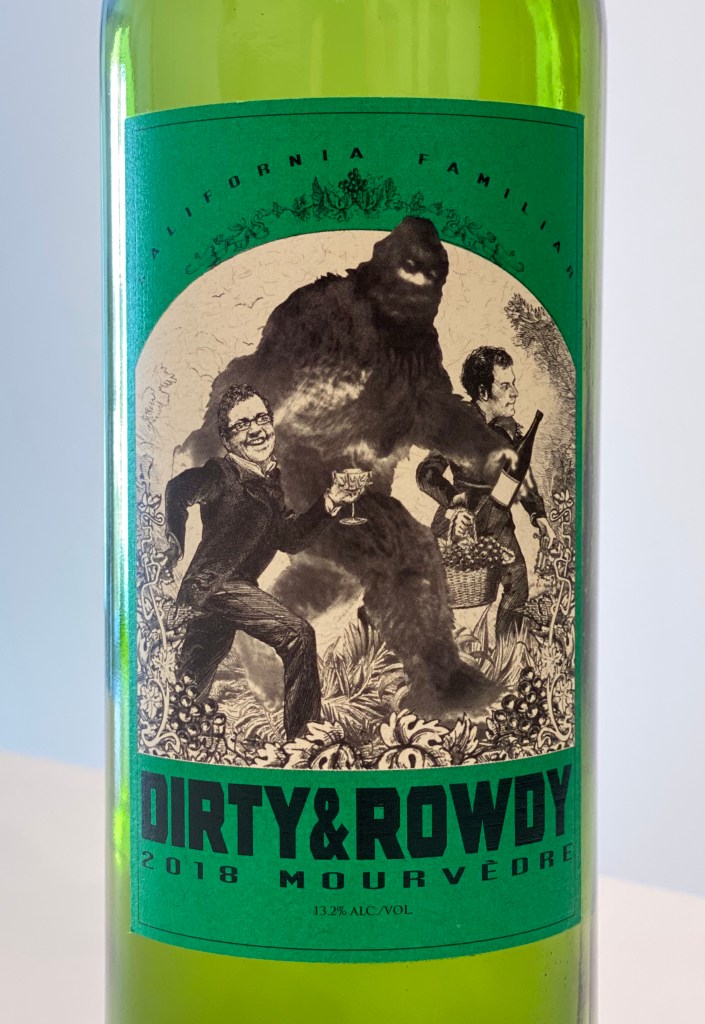
Dirty & Rowdy is a small, family-operated winery founded in 2010 by couples Hardy & Kate and Matt & Amy with the goal of producing minimal intervention “honest wines.” Known for their range of Mourvèdre bottlings, Dirty & Rowdy also produces Petite Syrah, Chenin Blanc, and blends that include a GSM and Semillon-dominant white almost all with 100% whole cluster native fermentation, either zero or minimal SO2 added, and no filtering or fining when bottled. Dirty & Rowdy sources their fruit from vineyards in Mendocino, Monterey, Contra Costa, El Dorado, and Amador Counties, with most vineyards organically farmed or at a minimum “responsibly” farmed and unique.

Today’s Wine: 2018 Familiar Mourvèdre

100% Mourvèdre; 13.2% ABV

The 2018 Familiar Mourvèdre is opaque pale purple in color with ruby hues near the bowl of the glass. I decanted this for about an hour, and the nose displays aromas of blueberry, sweet blackberry, plum, violet, dried green herbs, smoked meat, wet gravel, and a hint of oak. Once in the mouth, this wine showcases notes of tart blueberry, black raspberry, strawberry rhubarb, licorice, smoke, red and purple florals, wet granite, and stemmy underbrush. This is medium- to full-bodied with medium (+) acidity, medium tannins, and a medium (+) length finish. 100% whole cluster native fermentation with organic grapes, bottled unfiltered and unfined with minimal SO2 added. 700 cases produced.

Price: $30. This is a really fun, well-made wine to drink and something that broadens the palate of most of today’s wine drinkers. If you’re looking to explore, check out these wines. Pair this with herb-roasted lamb, duck breast, or I imagine this goes quite well with Dirty & Rowdy’s spicy fried chicken (which I will hopefully try one day).

Outstanding Value from Chianti Classico

Today’s Story: Castello di Volpaia

Castello di Volpaia is a historic winery situated in the fortified medieval village of Volpaia in the heart of Chianti Classico. Drenched in winemaking history, Volpaia’s viticultural roots trace to 1172 and they were a founding member of the Lega del Chianti (Chianti League) in 1250. In 1966, a printer and bookbinder named Raffaello Stianti purchased the Volpaia estate and 2/3 of the village, later giving it to his daughter Giovannella and her newlywed husband Carlo Mascheroni as a wedding gift in 1972. Carlo and Giovannella instituted a major renovation project to modernize the winery and convert historical buildings into cellars, all while instituting an underground “wineduct” that carries wine from their fermentation tanks to the cellar by gravity. Castello di Volpaia is the highest elevation winery in Chianti Classico with 114 acres of vineyards situated between 1,300-2,100 feet above sea level. All viticultural practices at the estate are certified organic by Q Certificazioni srl.

Today’s Wine: 2016 Chianti Classico Riserva

100% Sangiovese; 13.5% ABV

The 2016 Chianti Classico Riserva is mostly opaque and medium garnet in color with ruby hues. This needs to decant for an hour or two, but once it does the nose blossoms to showcase aromas of black cherry, blackcurrant, anise, lavender, smoked game, tobacco leaf, damp gravel, dark chocolate, sage, and oak. Once on the palate, this wine delivers notes of blackberry compote, spiced black plum, brambleberry, black cherry, violet, licorice, crushed rock, wet volcanic soil, smoke, savory green herbs, and blood. This is full-bodied with high acidity, medium (+) tannins, and a very long finish. The wine is beautifully complex for how young it is, and based on its structure I would give this another 7-10 years to develop in the bottle.

Price: $35. This is one of the greatest value Italian wines I’ve had, and every time I find either this vintage or the 2015 I stock up. Pair this with chicken parmigiana, ossobuco, or lamb chops.