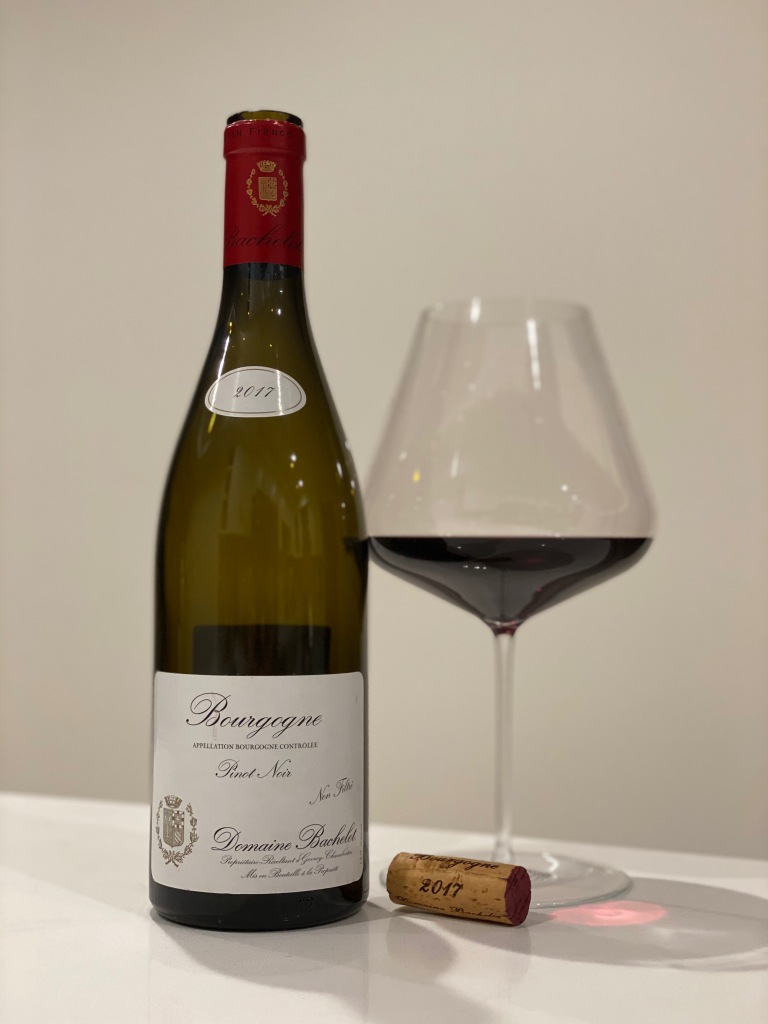
Bourgogne at Village Quality

Today’s Story: Domaine Bachelet

Domaine Bachelet is a small wine estate located in Gevrey-Chambertin consisting of just over 4 hectares of vineyards. The domaine is run by Denis Bachelet who, since 1983, almost single-handedly works tirelessly to produce elegant and honest wines. Denis was born in Belgium, and though his family is drenched in winemaking tradition his father elected to work in the chemical industry there while his grandparents tended the domaine back in France. Denis studied winemaking in Beaune for three years before ultimately joining his grandparents at the estate, though he only became fully involved in winemaking in 1981 shortly after his grandfather’s death. By 1983 when he took over completely, the domaine consisted of only 1.8 hectares and he quickly sought to expand his holdings to make a better living. In 2008, Denis’ son Nicolas joined the domaine and the Bachelet family slowly grew by purchasing more parcels. Today, Domaine Bachelet produces a range of wines including Bourgogne, Village, 1er Cru, and Grand Cru offerings though these gems remain difficult to find but worthwhile seeking out.

For more, there is a great “interview” with Denis here and a background of the domaine and their portfolio here.
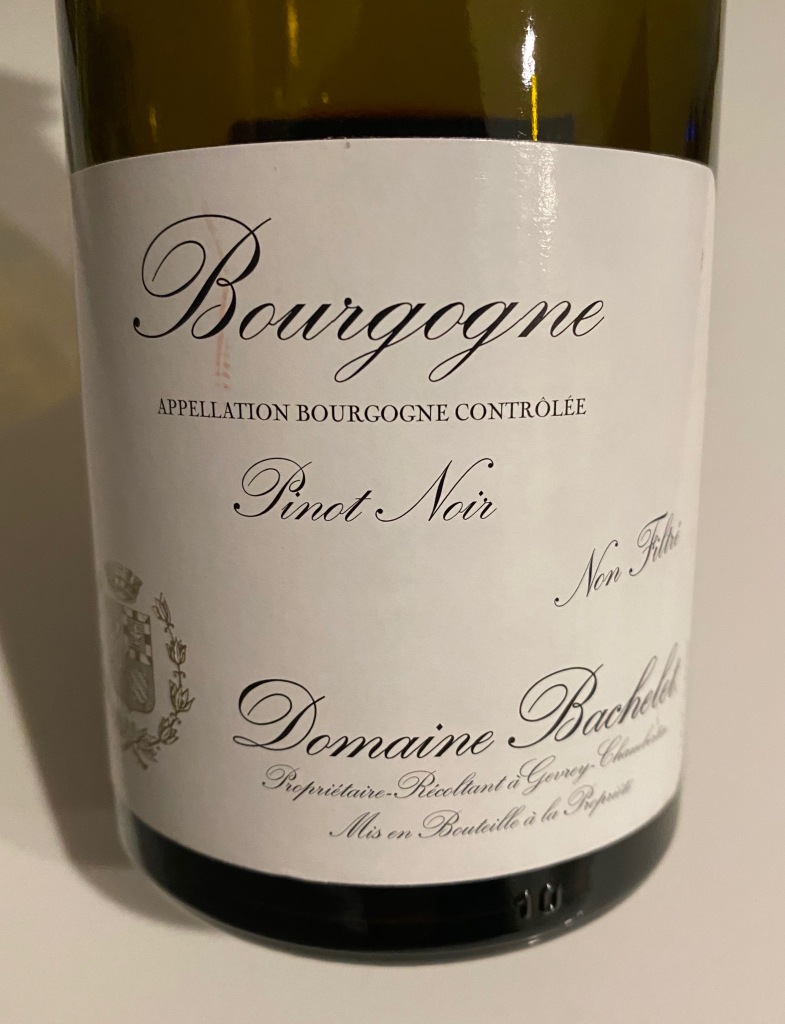
Today’s Wine: 2017 Bourgogne Rouge

100% Pinot Noir; 12.5% ABV

The 2017 Bourgogne Rouge is pale ruby/purple in color but fairly dark and moderately opaque most likely due to its youth. This requires about 1.5 hours to truly open up, and once it does the nose showcases aromas of blackberry, baked cherry, raspberry, violet, saddle leather, freshly tilled soil, steel cut oats, a hint of baking spice, and oak. On the palate, I get notes of blueberry, spiced plum, sour cherry, stemmy strawberry, sweet tobacco, forest floor, charred green herbs, bright mineral, and peppery spice. This is light- to medium-bodied with medium (+) acidity, medium tannins, and a medium (+) length finish. Certainly very tight right now without extended decanting, but this is a very precise wine that needs another 5 years in the bottle.

Price: $65 (cheaper overseas). Certainly not cheap for a Bourgogne Rouge (I saw some stores selling this at almost $80), though you can definitely say its quality puts this near a Village wine. I need to revisit this bottling in a few years and explore the Bachelet portfolio further. Pair this with seared tuna, roasted chicken, or mild goats cheese and charcuterie.
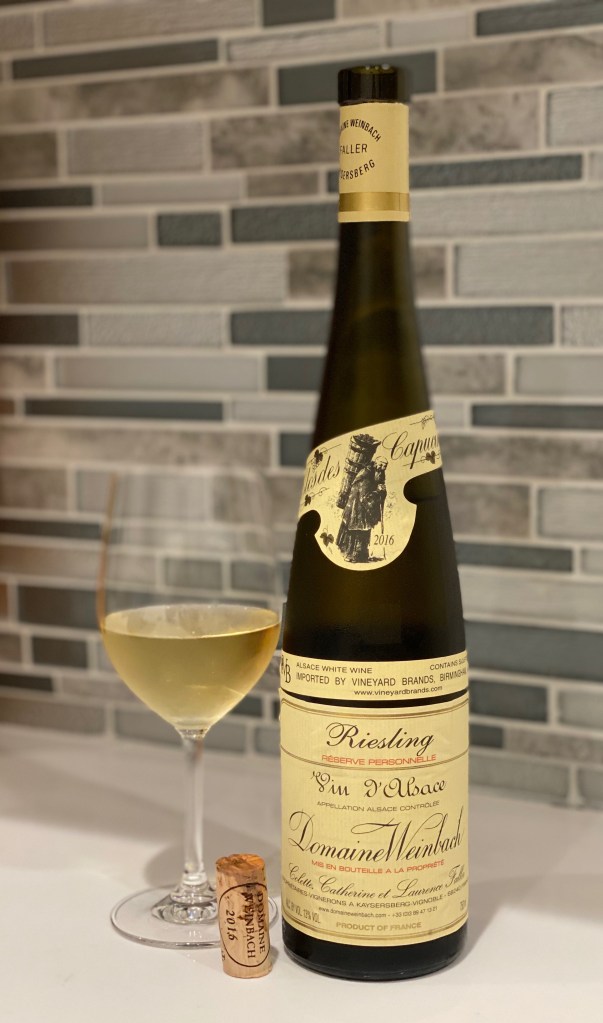
Delicious Entry Level Alsatian Riesling

Today’s Story: Domaine Weinbach

Domaine Weinbach was established in 1612 by Capuchin friars and is named for the stream meandering through the property. Located at the foot of a hill called Schlossberg in Alsace, France, the property has been planted to vine since as early as the 9th century and the vineyards are surrounded by ancient walls named Clos des Capucins. During the French Revolution, the domaine sold as national property though came into the Faller family when two brothers acquired it in 1898. Domaine Weinbach remains in the family today and passed to Théo who expanded and improved the winery; then Colette (Théo’s wife), Catherine, and Laurence; and finally to Eddy and Théo who currently work alongside their mother Catherine. The domaine now totals 28 hectares which, since 2005, are entirely farmed according to biodynamic principles. All harvesting is accomplished by hand, and minimal intervention takes priority in the cellar.

Today’s Wine: 2016 Riesling Réserve Personnelle

100% Riesling; 13% ABV

The 2016 Réserve Personnelle is transparent and medium straw in color with water-white near the rim. On the nose, I get aromas of melon, lemon citrus, stone fruit, green apple, honeysuckle, petrol, saline minerality, and vanilla. Once in the mouth, the wine showcases notes of white peach, pear, pineapple, apricot, white florals, petrol, crushed rock, mineral, cream, and straw. This is medium- to full-bodied with high acidity and a long, mouthwatering finish.

Price: $30. This is a great entry price to explore Alsatian Riesling, which alongside Mosel, Germany produces some of my favorite wines with the variety. Pair this with smoked whitefish, Thai food, or charcuterie with goat cheese.

Incredible Value in a Second Wine

Today’s Story: Château Montrose

Château Montrose is a historical Bordeaux wine estate located in Saint-Estèphe and established in 1815 by Etienne Théodore Dumoulin on a patch of land his family purchased from Nicolas Alexandre de Ségur but largely forgot. At the time of Etienne’s death in 1861, the estate spanned 95 hectares though his heirs sold it in 1866 to factory owner Mathieu Dollfus who quickly redeveloped and modernized the buildings and winery with the best technology of the time. One of Mathieu’s most interesting achievements, in my opinion, is the construction of a windmill to pump water aboveground and flood the estate which ultimately saved much of the vineyards from phylloxera. After Mathieu passed away in 1886, the estate fell to the Charmolüe family who, from 1896 to 2006, guided Château Montrose through wars and financial crises while crafting some of the best vintages and providing stability. Martin and Olivier Bouygues acquired the estate in 2006 and engaged in a massive renovation project, propelling Château Montrose to ever increasing heights for decades down the road. Montrose, one of fourteen Deuxièmes Crus (Second Growths) in the Bordeaux Wine Official Classification of 1855, produces world-class wines and even placed third with their 1970 vintage in the Judgment of Paris in 1976.

To learn more about this great estate, check out their website here. In particular, I recommend checking out the “From Vine to Wine” section!

Today’s Wine: 2016 La Dame de Montrose

52% Merlot, 35% Cabernet Sauvignon, 11% Petit Verdot, 2% Cabernet Franc; 13.5% ABV

The 2016 La Dame de Montrose is opaque deep ruby and nearly black at its core with purple hues. I decanted this for 6 hours (wanted a preview of my Grand Vins still in hiding) and it needed every second of it. On the nose, I get aromas of blackberry, crème de cassis, black plum, pencil shavings, cigar box, finely crushed rock, dried earth, chocolate, black pepper, and oak. Once in the mouth, the wine showcases notes of blackcurrant, blueberry, cherry, redcurrant, graphite, loamy soil, slate, tobacco, spice box, and toasted oak. This is full-bodied with medium (+) acidity, high tannins, and a long finish. The wine is incredibly promising, and makes me excited to try the Grand Vin in 15 years.

Price: $50 (though you can find steals closer to $40). This is an absolute rockstar for value from the utterly incredible 2016 vintage, though you will have to be patient. Pair this with steak, grilled leg of lamb, or a high-end burger.

Refreshing Small-Batch Languedoc Blanc

Today’s Story: Domaine Saint Sylvestre

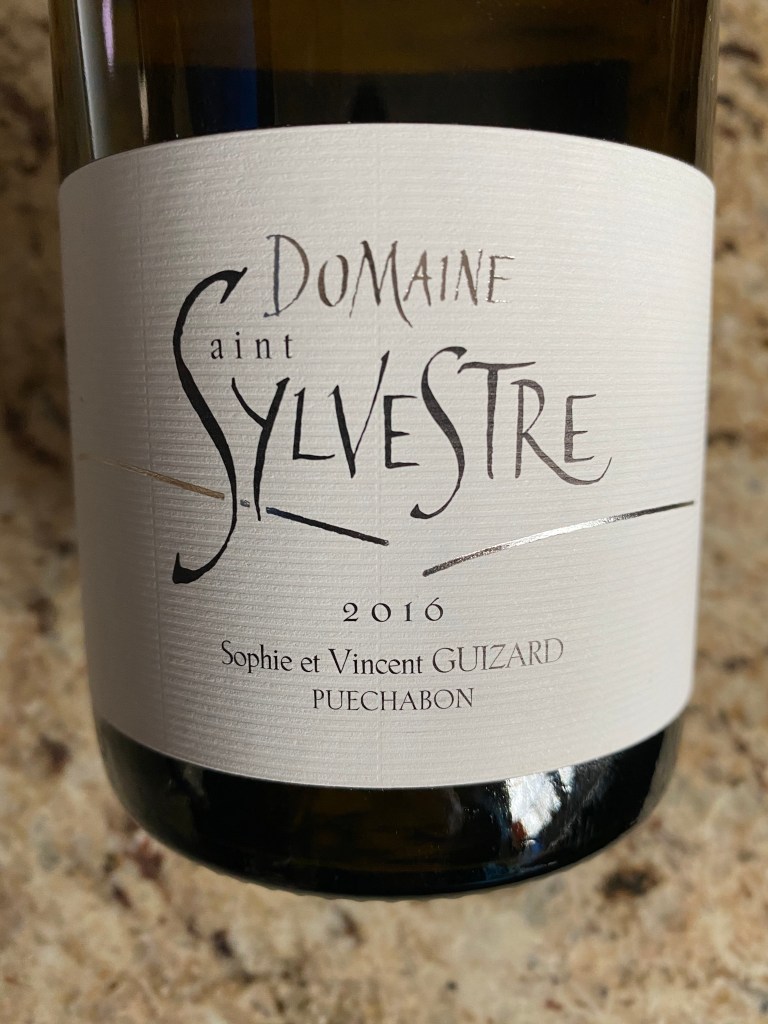
Domaine Saint Sylvestre was established at the end of 2010 by husband and wife duo Vincent and Sophie Guizard. Located in the small commune of Puéchabon within the Terrasses du Larzac appellation of the Languedoc region in France, the domaine consists of roughly 8 hectares of vines planted to Roussanne, Marsanne, Chardonnay, Viognier, Syrah, Grenache, and Mourvèdre. They produce two white wines, denoted Blanc and Le Coup de Calcaire Blanc, as well as one red, denoted Rouge. At young ages, both Vincent and Sophie joined their respective grandfathers in family vineyards and learned how to grow wine grapes. Vincent ultimately went on to learn how to produce Languedoc wines from Olivier Jullien at Mas Jullien between 1998 and 2000 before venturing on his own to clear hillsides of rolled pebbles and oak trees to plant his own vineyards. Between 2003 and 2010, Vincent worked at Domaine de Montcalmès in an effort to raise their status to become one of the top producers in Puéchabon, with the domaine using fruit from his parcels Fon de la Coste, Red Défriche, and White Défriche. These three parcels laid the foundation of Domaine Saint Sylvestre and are the source of their fruit today.

Vincent and Sophie are both highly involved in their vineyards, said to consider each vine an individual person that demands the same attention in each parcel. All vineyard work (including pruning, trellising, and de-budding) is accomplished by hand and green harvesting limits yields to a low 20 hl/ha. The vineyards are completely tilled and the only treatments used are with copper and sulphur. When it comes time to harvest their fruit, Vincent and Sophie pick by hand controlling for varietal and parcel with some picking being more selective to include only the highest quality grapes on a vine when necessary. The fruit is destemmed at the winery and crushed by variety and parcel before being fermented using only natural yeasts. The two white wines are aged in Burgundian oak for 12 months, while the red is aged in Burgundian oak for 24 months.

Today’s Wine: 2016 Domaine Saint Sylvestre Blanc

45% Roussanne, 45% Marsanne, 10% Viognier; 14% ABV

The 2016 Blanc is transparent medium gold in color with water-white variation near the rim. On the nose, this showcases aromas of lemon, apricot, stone fruit, beeswax, chamomile tea, limestone, tropical minerality, light vanilla, and brioche toast. Once on the palate, the wine displays notes of lemon and lime zest, dried orange peel, quince, mango, honeysuckle, white florals, wax, and bright spicy minerality. This wine is medium-bodied with medium (+) acidity and a long, dry finish. 150 cases produced.

Price: $45 (though closer to $26 if you can find this in France). This is a delicious and well-made Languedoc Blanc and will be, I presume, unfortunately hard to find. The domaine’s low yields were lowered further thanks to weather with this vintage, but the quality is all there. Pair this with herb-roasted chicken, vegetable stir fry with Asian spices, or prawns.

Delicious Middle-Road Sweet Wine

Today’s Story: Coume del Mas

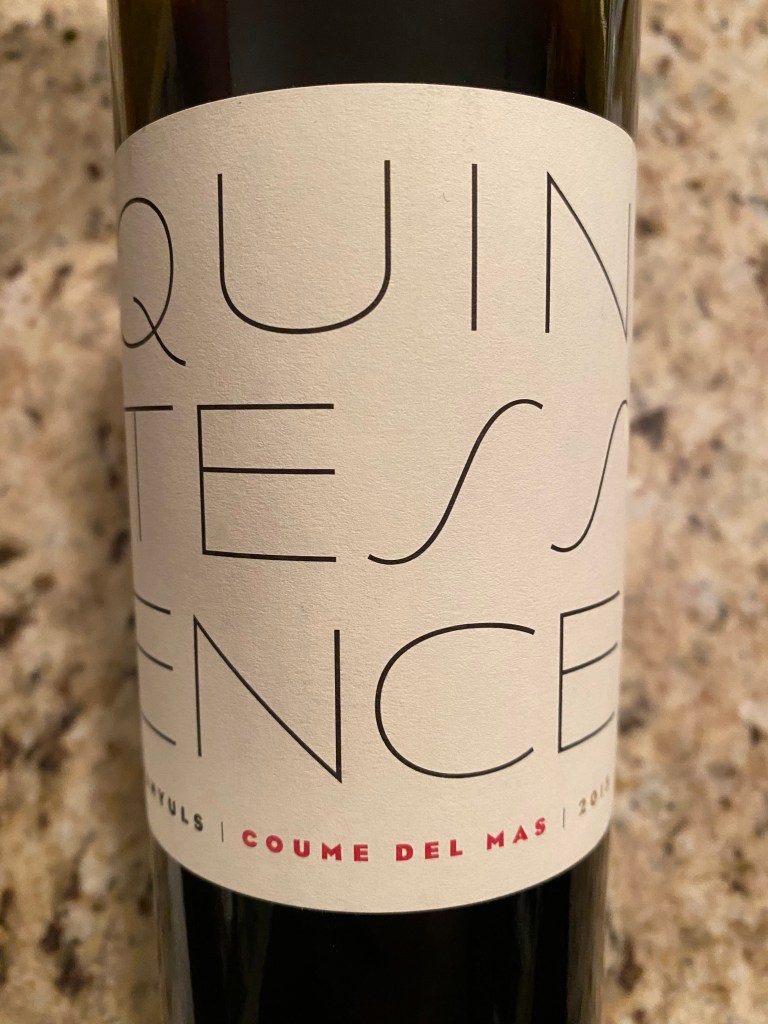
Coume del Mas was established in 2001 by Philippe and Nathalie Gard and today encompasses roughly 15 hectares of vines on the steep slopes of Banyuls sur Mer. Though the Gards work an incredibly challenging terroir, they work almost entirely by hand and in close contact with their vines to glean an understanding of the varying soil and nuances it can impart into wine. Coume del Mas cannot reach their vines by tractor and a majority cannot be reached by plough horse, while both the rocky soil and extreme climate keep yields low (around 20 hl/Ha). Coume del Mas produces wines in two categories: Banyuls which are sweet wines fortified during fermentation, and dry wines namely with Grenache, Mourvèdre, and Carignan. Banyuls is one of the older appellations dating to 1936, whereas the appellations that source Coume del Mas dry wines date to 1971 for the reds and 2002 for the whites.

Today’s Wine: 2015 Quintessence Banyuls

100% Grenache Noir; 16.5% ABV

The 2015 Quintessence is moderately opaque and pale to medium purple in color. On the nose, this Banyuls showcases aromas of muddled strawberry, prunes, baked plum, black licorice, damp earth, cinnamon, eucalyptus, and a touch of oak. Once in the mouth, I get notes of stewed black raspberry, candied strawberry, cranberry sauce, jammy blackberry, dates, fig, saturated soil, chocolate, and purple florals. This wine is full-bodied with medium (+) acidity, medium (+) tannins, and a long finish dominated by inky black fruit. 250 cases produced.

Price: $50. This is what I paid for a 500ml bottle, though I am certain this is cheaper overseas if you can find it. This is a delicious sweet wine that is neither too sweet nor too syrupy to enjoy after a decadent meal, and an easy one to have multiple glasses of which can be difficult with something else like Port. Pair this with chocolate, raspberry tart, or mixed berries.

Historical Châteauneuf-du-Pape – for a Great Value!

Today’s Story: Château La Nerthe

Château La Nerthe was established in 1560 by the Tulle de Villefranche family, though they had lived in Avignon since the 14th century. Located in the Provence region in southeast France, Château La Nerthe sits about 80km north of Marseille and occupies 92 hectares of vines in the Châteauneuf-du-Pape appellation. The estate’s vines are organized into 57 different plots representing all of the appellation’s terroir variation, as well as the 13 grape varieties planted there. Château La Nerthe practices organic farming (ECOCERT certification in 1998); hand-picks, table-sorts, and destems their fruit before fermentation; uses only indigenous yeasts during fermentation; vinifies by individual plots to showcase terroir variation; and blends only after the wines have aged for 12 months.

While the proprietorship of the Tulle de Villefranche family lasted several centuries, the estate grew drastically under Marquis Jean-Dominique Tulle de Villefranche (1711-1760) when he developed the vineyards to become one of the preeminent estates throughout the Rhône Valley. Between 1736 and 1784, the castle at the estate took shape as it exists today and allowed the family to not only live on the property but host guests in elegant style. Coincidentally during this time (and the 18th century as a whole more or less), members of the Tulle de Villefranche family in high military positions embarked on marketing endeavors throughout Europe and the wines of Château La Nerthe were sold in Russia, America, England, Germany, Italy, and Spain. In 1776, Château La Nerthe became the first estate in Châteauneuf-du-Pape to ship their wines in bottles while gradually fading out barrels.

Château La Nerthe was destined for arguably its greatest change, however, in 1870 when the Tulle de Villefranche family sold it to Commander Joseph Ducos. At this time, many of Joseph Ducos’ neighbors were tearing up vineyards and replanting the land with fruit trees, however he replanted his new estate with phylloxera resistant rootstocks. These visionary efforts accomplished by Joseph Ducos helped shape his neighbors’ changes in winemaking and certainly find their place in overall history of the appellation. In 1985, the estate changed hands yet again when the Richard family purchased it and promised to ensure revival of the original values of excellence and innovation at Château La Nerthe.

Today’s Wine: 2015 Châteauneuf-du-Pape

50% Grenache Noir, 30% Syrah, 15% Mourvèdre, 5% Cinsault; 14.5% ABV

The 2015 La Nerthe CdP is moderately transparent and medium garnet in color with ruby variation near the rim. Once this breathes for about 45 minutes, the nose showcases aromas of cherry, baked strawberry, tomato sauce, cedar, cola, worn saddle leather, clay, mineral, freshly baked bread, and oak-driven spice. In the mouth, I get notes of sour cherry, tart raspberry, strawberry leaf, purple and blue florals, dried tobacco, parched dusty earth, a hint of bitter chocolate, and sandalwood. This CdP is full-bodied with high acidity, medium (+) tannins, and a long finish. This was drinking very nicely after an hour and a half decant.

Price: $50. This is a good value CdP, though there are a number of other options in the same price range that seem to be drinking better now. I’m curious to see how this develops with some bottle age. Pair this with game, steak, or lightly spiced lamb.

For the Bold and the Daring

Today’s Story: Domaine Leon Barral

Domaine Leon Barral was founded in 1993 in the Faugères appellation, which lies within the heart of Languedoc-Roussillon (the Languedoc). Didier Barral, the proprietor today, is the 13th generation of his family to grow grapes though he is the first to start estate bottling his own wine under the domaine. From the domaine’s beginning, Didier devoted his 30 hectares of vineyards to biodynamic farming practices and is seen by many as a pioneer and visionary. For instance, one of the very unique aspects of Didier’s farming is his use of cows, horses, and pigs that roam the vineyards during the winter months to graze on cover crop while naturally fertilizing the soil. These animal helpers bring with them mushrooms, earthworms, ants, flies, toads, larks, and other lifeforms that all help aerate and add nutrients to the soil. For pictures of some of these helpers, check out the domaine’s website here.

If you couldn’t tell by now from what is written above, Didier is a naturalist winemaker. While it certainly starts with his biodynamic farmings practices, Didier utilizes very stringent practices in harvesting and in the cellar. During harvest, all grapes are harvested and sorted by hand and are sometimes destemmed and other times left whole cluster (depending on variety). The wine is vinified by gravity in large cement tanks, it is fermented with only natural yeasts, and maceration takes place for 3-4 weeks with manual punchdowns. Didier’s wines are also never racked, fined, or filtered and only a small dose of SO2 is added if necessary at bottling.

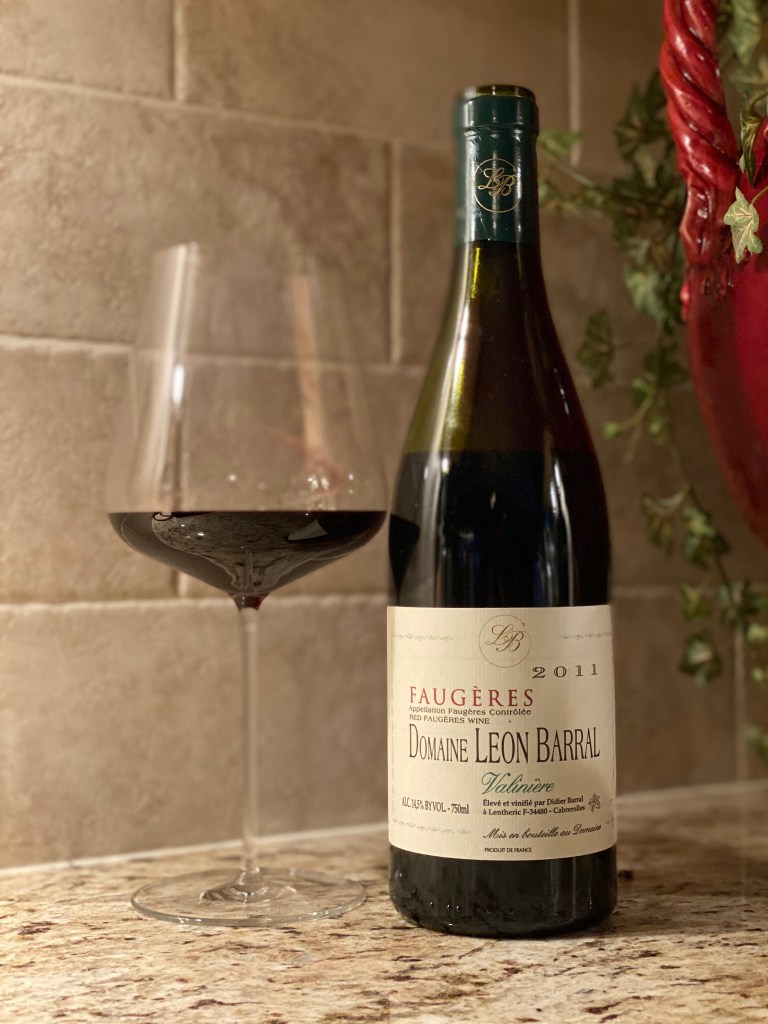
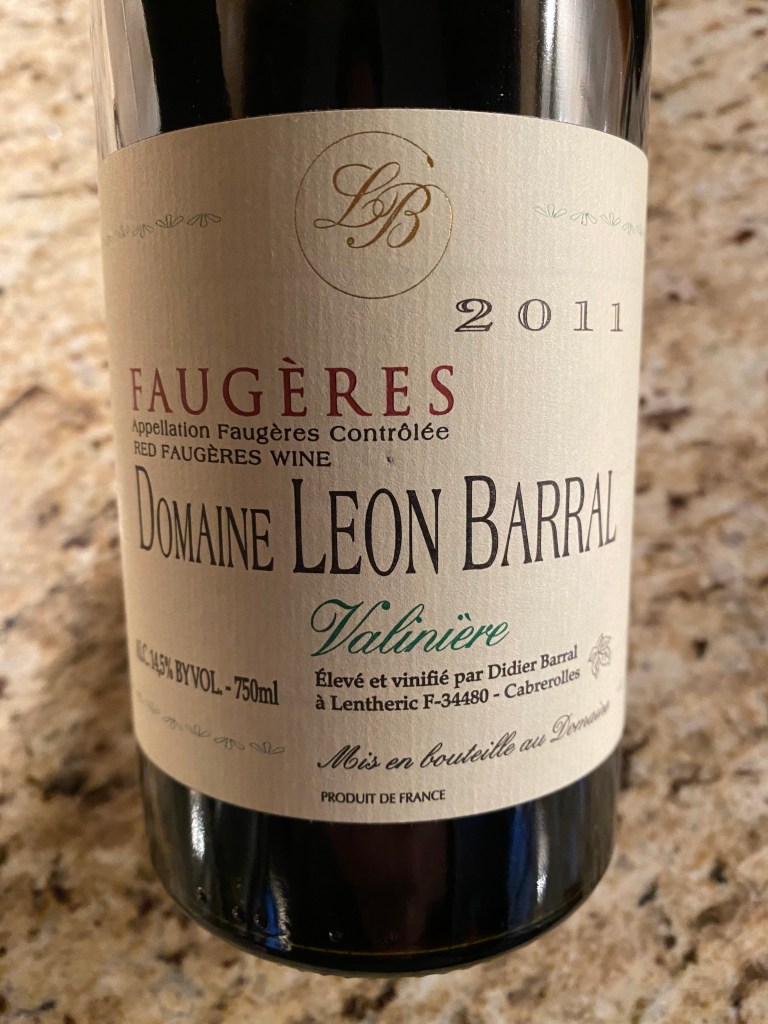
Today’s Wine: 2011 Faugères Valinière

80% Mourvèdre, 20% Syrah; 14.5% ABV

The Valinière is Barral’s smallest production cuvée, coming from 4.3 hectares of vines 15-30 years old. Like all of his vineyard land, these vines are planted in schist. The 2011 is deep, opaque ruby in color with garnet rim variation. There is sediment in the glass thanks to this being unfined and unfiltered (and possibly due to age). Once this opens up, the intense nose showcases aromas of blueberry, plum, black licorice, violet, nail polish remover, smoke, leather, damp soil, and a hint of barnyard. In the mouth, the wine shows notes of ripe black cherry, blueberry, red licorice, game, black pepper spice, wet rocky soil, and vibrant minerality. The 2011 Valinière is full-bodied with high acidity, dusty medium tannins, and a very long finish.

Price: $79. This wine is NOT for everybody. It is not for those who like big jammy, fruit-forward wines; it is not for those who like elegant, easy to drink wines. This being said, I was greatly impressed and enjoyed this wine (though my palate can become quite tired of the people-pleasers or the wines you can find anywhere). This is one of the greatest representations of “place” I have had to date (remember the farm animals). Pair this with grilled game meats or a dry-aged steak.

Opulent CdP

Today’s Story: Château de Beaucastel

A much-needed easy one today, as I’m still recovering from all the wine I drank over the Thanksgiving holiday and this past weekend… I previously wrote about Château de Beaucastel on October 27 in Ethereal Chateauneuf-du-Pape, coincidentally reviewing a different vintage of the same wine today.

Long story short, Beaucastel is a long-standing and famous producer of CdP. The château has had its ups and downs and changed ownership multiple times over the years, however with its deep roots and the Perrin family’s guiding hands over the last century the wines are of exceptional quality. I encourage you to read my previous post, linked above, for more of their exciting story.

Today’s Wine: 2003 Hommage a Jacques Perrin

60% Mourvèdre, 20% Grenache, 10% Syrah, 10% Counoise; 13.5% ABV

The wine is medium ruby/garnet in color and opaque. Unfortunately I didn’t have a decanter, so I let this breathe in the glass and it allowed some initial barnyard to blow off the nose. When opened, the nose showcases aromas of black cherry, blackberry, purple florals, loamy earth, black truffle, tar, and exotic white spice. Once in the mouth, I get notes of blackberry, plum, black raspberry, black licorice, charred earth, truffle, Asian spice, and mineral. I was pleasantly surprised with the complexity of this wine given its status as a “lesser” vintage. This CdP is full-bodied with high acidity, medium refined and dusty tannins, and a medium (+) length finish. This is showing quite well right now, though I’d imagine it will stay in its optimal drinking window for another 5-7 years.

Price: $350 (though this vintage seems to have a very broad range of $250-500). Much like the last Hommage I reviewed (the 1994), this is a rare bottle experience that I couldn’t pass up. Unless you get a great deal, however, as lovely as this bottle is I’d save your money for a spectacular vintage such as 2001, 2007, or even 2009. Pair this with beef, game, or lamb (and truffles are your friend).

Tear-Jerking Syrah

Today’s Story: Thierry Allemand

Founded in 1982, Thierry Allemand’s winery originated as one member of a small bastion of producers in Cornas who sought to revitalize what was the “red-headed stepchild” of Northern Rhône. Though the wines of Cornas were once adored, the terraced vineyards fell into great disrepair during the early 20th century and many large négociants churned out harsh wines with heavy tannins that drove consumers away. During the 1980s, Thierry Allemand worked for Domaine Robert Michel when he started assembling (and more so rescuing) abandoned vineyards that needed clearing and restructuring of terraced walls. The process of building his own domaine took 15 years and he utilized many things he learned at Domaine Robert Michel (including terrace farming and noninterventionist winemaking) during construction and onward.

Allemand’s vineyards total less than 5 hectares and his annual production is about 650 cases of wine. While all fruit is farmed organically, Allemand takes this a step further and does everything by hand (not even a tractor is used in the vineyards). All of his wines are fermented in stainless steel and open-top wood vats, stems are left on cluster, punch-downs are by foot, and each wine is vinified separately. The wines are bottled unfined and unfiltered, while very little (and sometimes none at all) sulfur is added. Allemand produces the “Les Chaillots” from vines 5-40 years old in limestone and granite, as well as the “Reynard” with vines 34-90 years old in decomposed granite.

Today’s Wine: 2011 Cornas Reynard Vineyard

100% Syrah; 13.5% ABV

My first (and long overdue) bottle of Allemand and I must say I am incredibly impressed. The wine is medium to deep ruby in color and we let this decant due to its young age. Once the wine opens up, the nose showcases aromas of plum, black cherry, blueberry, crunchy cranberry, smoked red meat, fresh leather, purple florals, black peppercorn, cedar, and mint. Right out of the bottle, the nose showed aromas of barnyard and forest floor that mostly blew off after decanting. In the mouth this beauty shows notes of blackberry, blueberry, violet, damp loamy soil, cigar box, slate, crushed stone, and spicy minerality. Medium- to full-bodied with high acidity and dusty medium (+) tannins, this incredible Syrah finishes long with dominating notes of black fruit, crushed rock, and spicy pepper.

Price: $300. Not an everyday wine, though great for a celebration or nice dinner (I drank this at Spago Beverly Hills). Pair this with beef (like Spago’s Snake River Farms Wagyu), duck, pheasant, or even roast chicken and rabbit (like my fellow diners).

Thank God Vineyard Leases End

Today’s Story: Domaine Cecile Tremblay

Domaine Cecile Tremblay has a very interesting history, partly because she did not start making wines until 2003 though her family owned vineyards for several generations. Cecile is the great-granddaughter of Edouard Jayer, uncle of the famed Henri Jayer (go Google some of his wines, and perhaps sell your car to buy a bottle). Cecile’s family inherited vineyards from Edouard, though the two generations before her leased out the land to other producers and did not make their own wine. In 2003, however, with the expiration of a lease on three hectares of vines Cecile started making wine under her own label with a plan for further growth. For instance, the Domaine owns roughly 10 hectares of vineyard land and while more of this becomes free from leasing agreements in 2021, Cecile rented or purchased land along the way in communes such as Gevrey-Chambertin.

When Cecile took over her family’s land for her own use, the vineyards were in no standing to produce high quality wines. The producers leasing the land, for instance, used too much fertilizer for Cecile’s taste and utilized herbicides instead of ploughing. Throughout her time thus far as a winemaker, Cecile transitioned to organic farming and many of her practices include biodynamic farming measures as well. During maintenance of her vineyards, Cecile ploughs the soil mechanically and with horses while using copper sulfate to prevent mildew and other fungi.

Similar to her views on caring for her vines, Cecile is very traditional in her winemaking process. She presses her grapes with an old-fashioned vertical press and her wines see only a moderate amount of new wood during fermentation and aging. All of this effort culminates into wines that are refined and elegant, though built for the long haul.

Today’s Wine: 2011 Chambolle-Musigny Les Cabottes

100% Pinot Noir; 13% ABV

This bottle was gifted to me by a great friend, and after opening it today I sure am happy that I recently purchased another one. Right out of the bottle I can tell this will be a bold Burgundy thanks to its medium to deep ruby (but mostly clear) color. The nose on this thing is sort of a roller coaster (of emotions) as I get aromas of black cherry, boysenberry, eucalyptus, mint, purple florals, ground coffee, tobacco leaf, and moist forest floor. This even took on notes of gravel/crushed rock as it sat in the glass. The palate continues this dark theme with notes of wild blackberry and blueberry, licorice, smoked red meat, crushed granite, mocha, and tobacco. Shockingly (for me) full-bodied, this wine shows high acidity, medium (+) tannins, and what seems like an immeasurably long finish. This is one of those wines that makes me want to smell the glass all day, and eat the glass when that last drop is gone.

Price: $110 (though I got lucky and the going rate online is about $300). I would buy this again in my sleep at $110 and I’d even buy it again at $300. This is an exceptional bottle from an “off vintage” and the complexity I get out of this wine is mind-boggling. This will also age gracefully for another 15+ years! Pair this with filet mignon, rabbit, quail, or duck…and if you can accompany these dishes with black truffle you’re in for a real treat.