An Old World Style Syrah From the Santa Lucia Highlands

Today’s Story: Sandlands Vineyards

Sandlands Vineyards is a small family-owned and operated passion project of Tegan and Olivia Passalacqua established in 2010. Tegan, a winemaker with a proven track record of crafting fantastic old vine Zinfandel at Turley Wine Cellars, branched out into this side project with a focus on ancient and “forgotten” varieties. In the far reaches of California winegrowing in Lodi, Contra Costa County, Santa Lucia Highlands, Amador County, and the more familiar Sonoma Coast, Tegan sources Chenin Blanc, Cinsault, Trousseau, Carignane, Mataro, Syrah, Zinfandel, and other varieties from vines that are at times more than 100 years old. Though these varieties and the vineyards he sources from have been farmed for decades and generations, they oftentimes lay outside of the “norm” for California viticulture and are even mostly planted in decomposed granite (i.e. sand). What’s more, the vineyards Tegan works with are typically head-trained, dry-farmed, and own rooted. Tegan crafts these wines in a traditional and minimally invasive manner, allowing the unique terroir and vine to shine through in each bottling which results in lower alcohol, easy drinking, but complex wines. Production is miniscule and quantities are quoted by the barrel, so these can be hard to find and the mailing list is the easiest way.

I previously wrote about Sandlands’ 2018 Lodi Red Table Wine, which is an interesting blend of 33.3% Cinsault, 33.3% Carignane, and 33.3% Zinfandel all from very old vines. If you’d like to check out other wines in their portfolio as well, visit the Sandlands website here.

Today’s Wine: 2018 Santa Lucia Highlands Syrah

100% Syrah; 12.8% ABV

The 2018 Santa Lucia Highlands Syrah is deep purple in color, certainly showcasing its youth. I let this open up for 1.5 hours and then drank it over the following 1.5 hours, which I think it needs at this stage. The aromas are absolutely gorgeous and of medium intensity, showcasing notes of crushed blackberry, black plum, wild blueberry, violets, licorice, gravel, graphite, and grilled herbs. Flavors are also of medium intensity, with the palate displaying notes of blueberry, blackberry, orange rind, leather, tobacco, cracked pepper, green herbs, and smoke. This dry red is medium-bodied with medium (+) acidity, medium (+) but refined tannins, medium alcohol (shows slightly due to youth), and a long finish. Too young for sure, but already so delicious.

Price: $40. Prices are already on the rise for these wines, but at $40 (which is now low for the secondary market) I still think this is a very solid value for Syrah. It drinks rather Old World in style, and the complexity already is quite generous. Once the alcohol finishes integrating, this will be a showstopper.
Fun Representation of Sicilian Terroir

Today’s Story: Azienda Agricola Arianna Occhipinti

Azienda Agricola Arianna Occhipinti is a continuously rising star of a winery established by Arianna Occhipinti in the Vittoria region of southeastern Sicily in 2004. Though Arianna started making her own wines at the young age of 22, she first got into wine even younger at age 16 thanks to a visit to Vinitaly with her uncle Giusto Occhipinti of COS, another benchmark Sicilian wine producer. Today Arianna works with estate fruit, sourced from her 25 hectares of certified organic vineyards which are planted to about 50% Frappato, 35% Nero d’Avola, and 15% between the white varieties of Albanello and Zibibbo. Arianna never irrigates her vineyards or uses any chemicals, and since 2009 she transitioned to biodynamic viticulture. As far as philosophy goes, Arianna’s wines are meant to showcase the terroir of Vittoria, and they are made in as “natural” a way as possible. Vineyard work is very manual, all grape and wine movements use gravity, and the wines ferment with only indigenous yeasts in concrete tanks before aging in neutral oak. Arianna produces ten wines (including three single-vineyard bottlings called Vino di Contrada) and total production each vintage is around 10,000 cases.

I somewhat recently reviewed the Occhipinti 2019 SP68 Rosso, so feel free to check that out if you missed it!

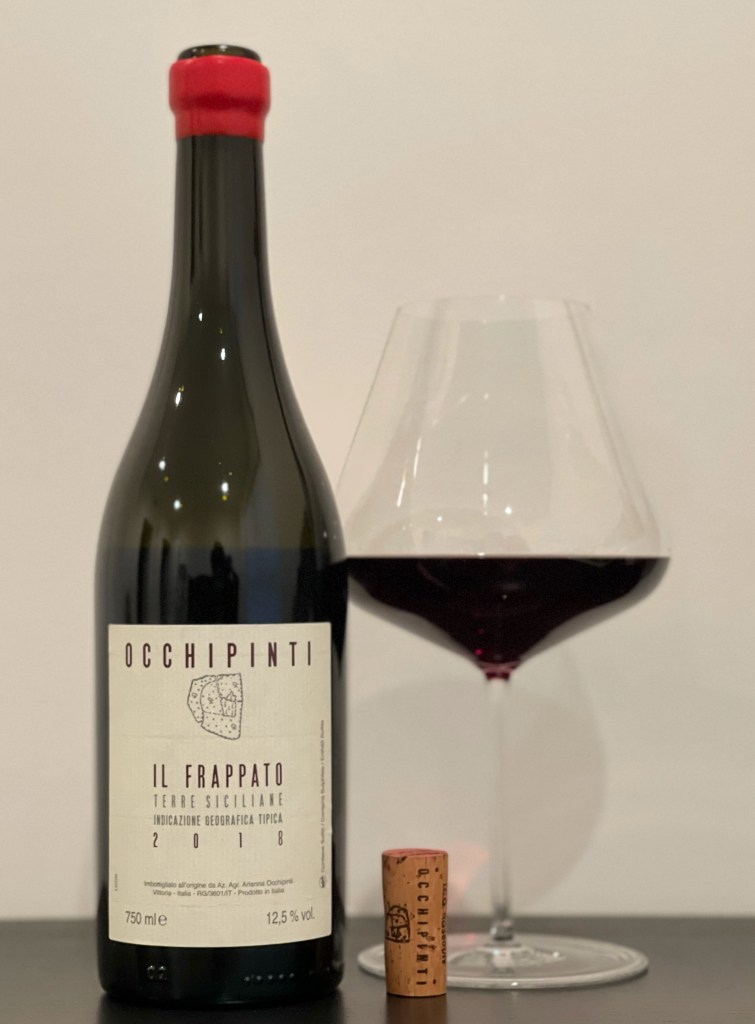
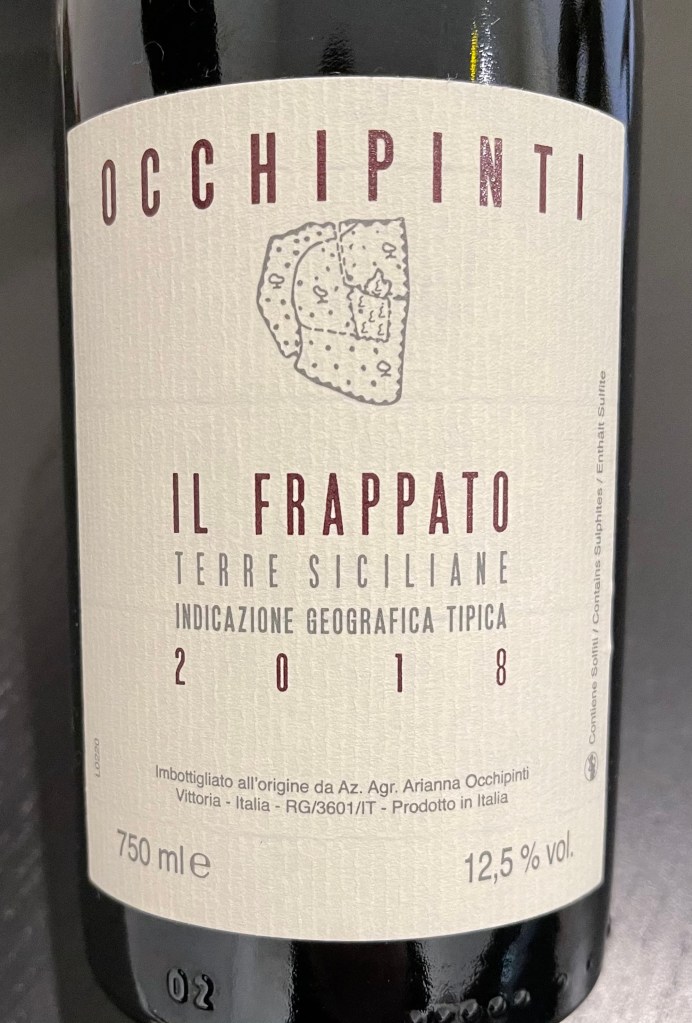
Today’s Wine: 2018 Il Frappato

100% Frappato; 12.5% ABV

The 2018 Il Frappato is pale to medium ruby in color. This is still very youthful and requires a good 45 minutes to blossom in the glass, though it’s already showing a very elegant representation of Frappato. The aromas are of pronounced intensity, showcasing a nose of strawberry, red cherry, leather, clay pot, tilled rocky soil, charred savory green herbs, mild chocolate, exotic spices, and clove. Meanwhile the flavors are also of pronounced intensity, with the palate displaying notes of dried strawberry, tart cherry, pomegranate, anise, sweet tobacco, ground green herbs, clove, and white pepper. This dry red is light- to medium-bodied with medium acidity, medium (-) tannins, medium alcohol, and a medium length finish. Certainly has the stuffing to go a few more years, but it is rather delightful and hard to resist already.

Price: $45 average in the US (cheaper in Europe). I haven’t had enough 100% Frappato to say how this compares to other representations of the variety, however compared to other wines of a similar price-point I think this offers great value. This drinks so pure and shows a lot of complexity for its age already, all while being decidedly high quality and a great representation of the terroir.

Sancerre Unicorn

Today’s Story: Domaine Edmond Vatan

Domaine Edmond Vatan is a miniscule but highly regarded producer situated in the small town of Chavignol in the Sancerre appellation of France’s Loire Valley. The vineyards consist only of one hectare (2.5 acres) and are planted to the Sauvignon Blanc variety as is required for white wines in the appellation. Vatan’s vines, planted on the steepest slopes with optimal sun exposure, are low-yielding and severely pruned to maximize quality and intensity. Vatan also uses minimal additives/treatments in the vineyards, harvests later than his neighbors, and vinifies the wines adhering to very traditional methods in old oak barrels. The wines are racked only once and then bottled without fining or filtration. Since 2008, Edmond’s daughter Anne took over production following his semi-retirement during the early 2000s, though he is still involved as a guide and teacher. Production is incredibly limited, with about 500 cases total produced each vintage.

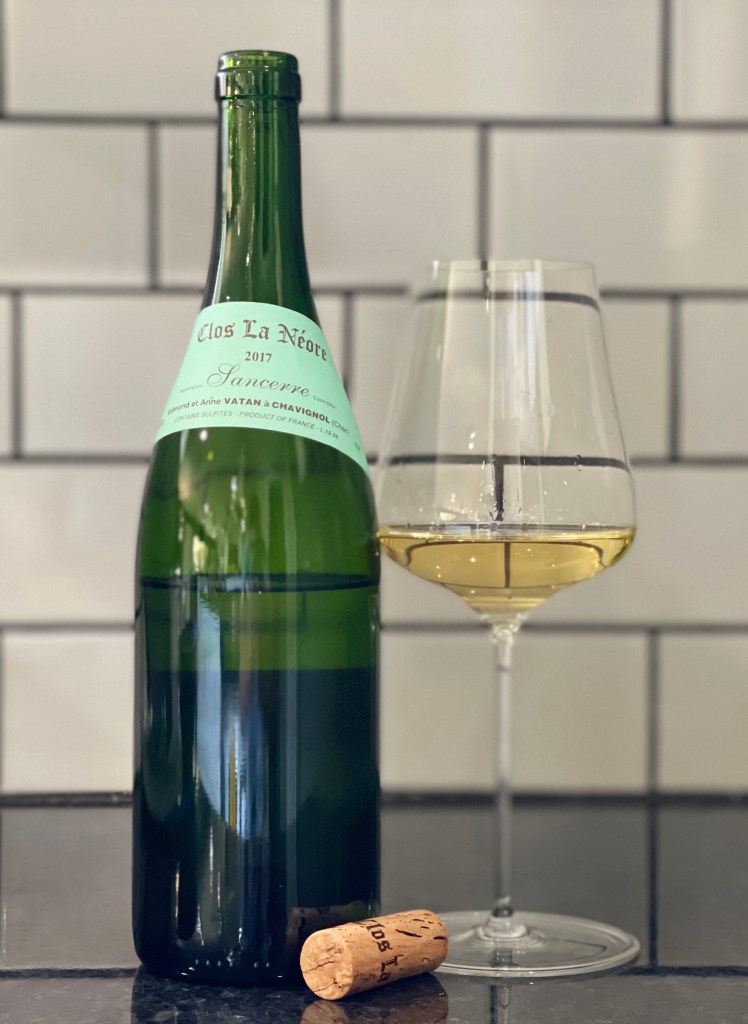
Today’s Wine: 2017 Clos La Néore Sancerre

100% Sauvignon Blanc; 14% ABV

The 2017 Clos La Néore is pale yellow in color. This is a baby by preposterous standards, so at this stage it needs several hours to open up. Only by the end of the day did this start opening up, and I wish we had the restraint to hold it into a second day. The aromas are of pronounced intensity, showcasing notes of lemon and lime zest, white peach, freshly cut grass, wet river stone, and saline mineral. Meanwhile the flavors are also of pronounced intensity, with the palate displaying notes of meyer lemon, tropical citrus, lychee, pineapple, chopped grass, wet slate, and crushed rock mineral. This dry Sauvignon Blanc is medium- to full-bodied with racy high acidity, high alcohol, and a long finish. Very, very good, but just way too young.

Price: $275 (shared by a friend who paid $200). I can’t call this a good value, but I can see what the hype is after this gets several hours of air. This is certainly an excellent representation of the Sauvignon Blanc variety, and one that has the ability to age for decades. But is it a necessary purchase given the price? Probably not.

Beautifully Aged Madeira

Today’s Story: Blandy’s

Blandy’s is a historic and family-owned producer of Madeira wines, established in 1811 on the island of Madeira by John Blandy. John Blandy arrived on the island in early 1808, later establishing his own wine shipping and merchant business in 1811 alongside brothers Thomas and George. As Blandy’s grew and exported wines to all corners of the world, they unsurprisingly became a beacon of quality and strong proponent of Madeira wines over the decades that followed. In 1925, Blandy’s decided to join the Madeira Wine Association which was a group formed by multiple producers to weather the economic and political woes facing the world at that time, continuing to maximize global exposure of their products. Fast forward to 1989, and Blandy’s partnered with the Symington family (a well-established producer of high quality Port wines) so together they could further augment the reputation and quality of Port and Madeira wines throughout the world. This partnership continues to this day, under the title of Madeira Wine Company. Today, Michael and Chris Blandy who are sixth and seventh generation members of the family, respectively, work for the company while Chris handles the day-to-day as CEO.

Blandy’s works with the typical grape varieties for Madeira, which include Tinta Negra, Sercial, Verdelho, Terantez, Bual, and Malvasia (Malmsey). Tinta Negra is used to produce dry and off-dry wines not subject to maceration, as well as medium sweet and sweet wines which do involve maceration on the skins. Meanwhile all the white varieties are subject to skin contact to obtain maximum dry extract from the fruit. Fermentation occurs in temperature-controlled stainless steel tanks, though it is interrupted with natural grape brandy for fortification at different stages. For example, sweet wines are fortified roughly 24 hours after fermentation begins whereas drier wines may spend up to seven days fermenting before fortification.

During the aging process, the wines are heated and this practice occurred by accident when Madeira wine as we know it was first created during the 15th and 16th centuries. During this time, visiting ships to the island were loaded with barrels of wine to both “nourish” the sailors and help provide ballast as they travelled to other ports around the seas. Legend has it that one ship returned with a barrel in tact and, when the producer tasted it, the wine was improved by the warm tropical temperatures that several trips across the equator brought. From that point forward, barrels of the wine were loaded onto ships so they could naturally warm during voyages until this became too costly. Now two main methods exist, the “Canteiro” method where the wines age in American oak casks in the warm attic of the cellars, and the “Estufagem” method where the winemaker controls the heat levels during aging. The Canteiro method, which is used to produce high quality Madeira like the bottle I am reviewing today, is an interesting one. The barrels are never 100% full, allowing the wines to slowly oxidize over time to bring out the signature characteristics of Madeira. Blandy’s loses about 7% of their volumes every year due to evaporation, and this must be controlled by moving barrels from warmer floors to cooler floors of the attic at varying stages.

To learn more, I highly suggest visiting the Blandy’s website here. They have incredible detail regarding the history of both their own company and that of Madeira as a whole, as well as pictures, cultural elements, and a detailed description of the varieties used in their wines.

Today’s Wine: 1968 Verdelho Madeira

100% Verdelho; 20.5% ABV

The 1968 Verdelho Madeira is medium brown in color. Given a bit of time to blossom in the glass, the wine draws you in with aromas of pronounced intensity and offers up a nose of fig, orange zest, raisin, apple pie, salted caramel, toffee, tar, wood varnish, vanilla, and oaky spice. Flavors on the palate are also of pronounced intensity, displaying notes of fig, baked apple, orange peel, caramel, chocolate, almond, and oak-driven baking spice. This medium dry Madeira is full-bodied with high acidity, high alcohol, and a long finish. 100 cases produced, and bottled in 2009. Showed best on days 2 and 3.

Price: $300 (I paid $250). Though I purchased this with a friend for a very good price, I still think the going market rate is more than reasonable. This is a captivating wine that showcases its age beautifully while remaining well-balanced and fairly complex. The only reason this lasted more than one night is because it was not our first or only bottle of the evenings…

Fun Austrian Blend With a Unique Family Background

Today’s Story: Gut Oggau

Gut Oggau is an exciting, relatively new winery in the small town of Oggau in Burgenland, Austria and it was established in 2007 by Eduard and Stephanie Tscheppe. Eduard comes from a winemaking background, having helped his father make conventional wines in Styria. Meanwhile Stephanie has a culinary background, with her family owning the Michelin-starred restaurant Taubenkobel. The couple purchased an abandoned 17th century winery and about 20 hectares (~49 acres) of vineyards, working tirelessly to restore and renovate the facilities which included a 200-year-old screw press. The vineyards were abandoned for about 20 years, so Eduard and Stephanie commenced their venture with biodynamic viticulture without having to worry about any lingering chemicals or treatments that may have been used before. Working with the varieties of Blaufränkisch, Zweigelt, Grüner Veltliner, Welschriesling, Weissburgunder (Pinot Blanc), and Gewürztraminer, Eduard and Stephanie craft wines in a minimally invasive and “natural” manner. All wines ferment spontaneously with natural yeasts, age in used barrels, and are bottled unfined, unfiltered, and with zero or minimal added sulfur.

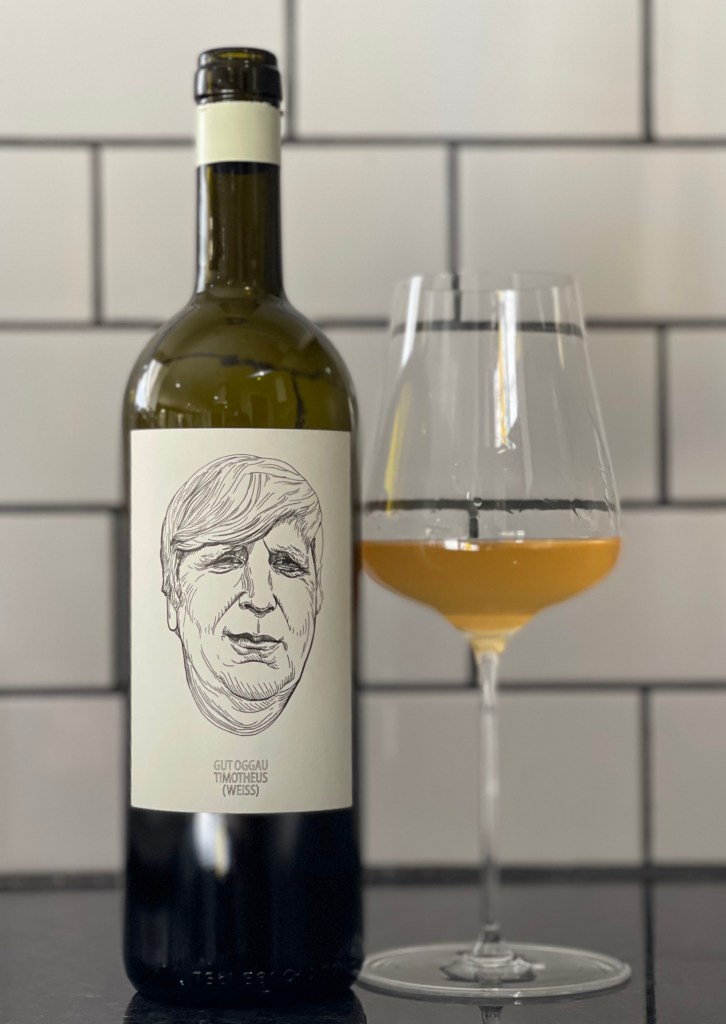
I would be remiss if I did not discuss the interesting labels on these wines. As Eduard and Stephanie crafted their wines adhering to their biodynamic and natural philosophies, they realized that each bottling and each vineyard plot offered differing characteristics and personalities but still had a common thread to show they are “family.” Therefore the Gut Oggau wines are all part of a family tree, with Atanasius, Theodora, and Winifred making up the “young generation” and being more bold and energetic in style. The prior generation, or “the parents,” consists of Joschuari, Wiltrude, Emmeram, Timotheus, and Josephine with these wines characterized by riper notes and more body. Lastly the “grandparents” consist of Mechthild and Bertholdi, with the wines produced from vines up to 60 years of age and they are more traditional in style. Each label has a unique sketch for each fictional family member, and all have their own unique stories to share.

Today’s Wine: 2019 Timotheus

70% Grüner Veltliner, 30% Weissburgunder; 12% ABV

The 2019 Timotheus is medium gold in color and somewhat hazy. Aromas are of medium intensity, showcasing notes of tangerine, peach, apricot, mandarin orange, white wildflower, and slate. Meanwhile the flavors are also of medium intensity, with the palate displaying notes of peach, apricot, dried green herbs, seashell, honey, white pepper, and saline mineral. This is dry and medium-bodied with medium (+) acidity, light tannins, medium alcohol, and a medium (+) length finish. Very fun and different, but also very, very good. One-third of the grapes ferment on the skins for about three weeks and the rest are directly pressed before they’re blended. The wine ages for about 12 months in used barrels before it’s bottled unfined, unfiltered, and with zero added sulfur.

Price: $60. Wines of this style are difficult to discuss in terms of value for me, for one thing because they are not “traditional” and two I haven’t had enough of the “natural” wines with some skin contact for comparison sake yet. However, I find this to be an incredibly fun, enjoyable, high quality, and intriguing wine and for these reasons it was worth the price paid for me.

You Win Some, You Lose Some

Today’s Story: Château Pichon Longueville Comtesse de Lalande

Château Pichon Longueville Comtesse de Lalande is a Second Growth (Deuxième Cru) estate based on the Bordeaux Wine Official Classification of 1855. Pichon Lalande is considered by many to be a classic example of Pauillac, known for its deep, concentrated layers of ripe fruit accompanied by notes of cassis, tobacco, and earth.

With nothing short of a somewhat tumultuous history, Pichon Lalande’s ownership changed hands over the years and earned its name when the founder’s daughter Therese received it as a dowry for her marriage to Jacques de Pichon Longueville. During the 18th century, the estate was dominated by women (Therese de Rauzan, Germaine de Lajus, and Marie Branda de Terrefort) throughout the winemaking process until Baron Joseph de Pichon Longueville took over for his mother. In 1850, with his death, the estate split between his two sons and three daughters and ultimately resulted in the division of Comtesse de Lalande and Pichon Baron.

With no familial heirs, Edouard Miailhe and Louis Miailhe purchased Pichon Lalande following WWI. Edouard’s daughter, May-Eliane de Lencquesaing, took over management in 1978 and became a prominent ambassador for Bordeaux wines while dramatically increasing quality of her estate. One of her major endeavors, and possibly most famous, was growing the size of Pichon Lalande from 40 hectares of vines to 89. In 2007, however, May-Eliane sold a majority stake of the estate to the Rouzaud family, owners of Roederer Champagne, and management changes as well as renovations took place.

I’ve written about Pichon Lalande several times before, with reviews on the 1966, 1986, 1989, 2003, and 2008 vintages.

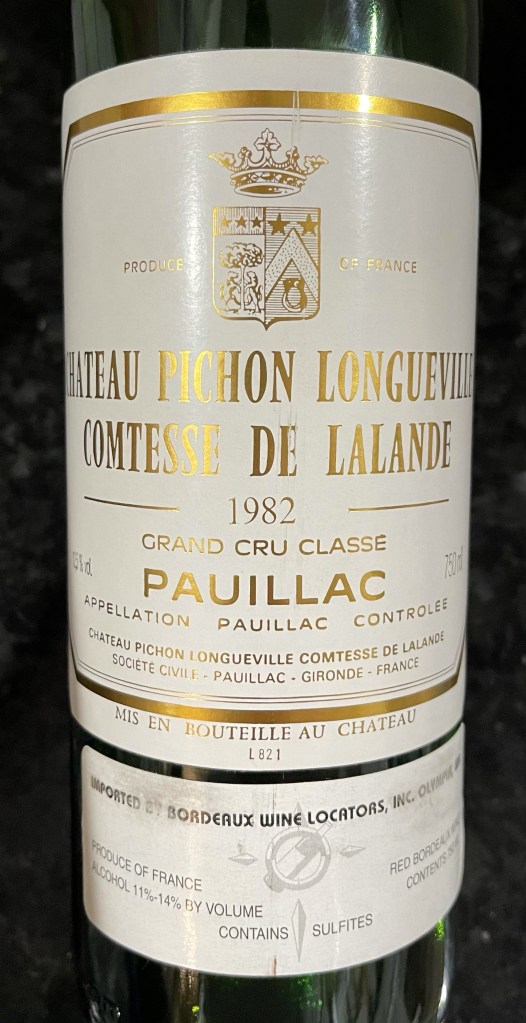
Today’s Wine: 1982 Château Pichon Longueville Comtesse de Lalande

Bordeaux Blend (no tech sheet); 12.5% ABV

I must put a disclaimer on this bottle, as we learned only after pulling the cork this was recorked at the château in 1993. The bottle appears immaculate, fill level is into the neck, the cork is in perfect shape, and there are zero signs of seepage. However my tasting companions and I were disappointed in the wine and I think it might have something to do with the recorking…especially how recent it occurred after the vintage.

The 1982 Pichon Lalande is deep garnet in color. This was rather muted out of the bottle and after 30-45 minutes in the glass, so I decided to decant it. The aromas are of medium intensity, with the nose showcasing notes of blackcurrant, cigar box, scorched earth, graphite, eucalyptus, cinnamon, and creme brûlée. Meanwhile the palate is certainly better and flavors are pronounced, displaying notes of blackcurrant, dried black plum, tobacco, graphite, forest floor, truffle, and cedar. This dry red is medium- to full-bodied with high acidity, medium (+) but fine-grained tannins, medium alcohol, and a long finish. The structure is still very impressive, but the nose is quite lackluster and the palate is better but not at all complex. Overall this was very disappointing given the reputation of the wine, but I think it’s due to the bottle being recorked so early in its life.

Price: $1,000 (shared by a friend who paid $500). I would like to taste this wine again, preferably one with its original cork and strong provenance. This was supposed to be an ethereal wine, but unfortunately it had its issues that outweigh the incredible structure. Certainly not worth the price paid in this instance.

Recorked in 1993

As you can see on the cork, this bottle was rebottled at the château in 1993, per the phrase “rebouche au château en 1993.” I think this is why the bottle didn’t live up to our expectations, as this is certainly not ideal. What’s interesting and somewhat concerning is how short after the vintage this occurred (assuming this was bottled after two years that’s only nine years in bottle before being recorked). You win some, you lose some.

Tense and Precise White Burgundy Built for the Cellar

Today’s Story: Domaine Vincent Dancer

Domaine Vincent Dancer is a small, rising star estate located in the village of Chassagne-Montrachet in Burgundy, France. Established by Vincent Dancer, the domain consists of about 5-6 hectares under vine and was the first certified organic producer in Chassagne-Montrachet. Vincent is originally from Alsace, and though he studied engineering in school he picked up a passion for wine along the way. After some urging from his father, Vincent spent time in Burgundy to learn viticulture and oenology before taking over small acreage of family vines in 1996. Known as a quiet and humble winemaker, Vincent quietly expanded his vineyards and today has holdings in Chassagne-Montrachet, Meursault, Puligny-Montrachet, Pommard, and Beaune. A staunch proponent of hands-off winemaking, Vincent hand-harvests his fruit from fairly low yielding vineyards and refrains from adding any commercial yeasts, enzymes, or acid adjustments during natural fermentation. He also resists bâtonnage, the practice of stirring the lees which is practiced by many producers in Chassagne-Montrachet to add flavors, aromas, and texture to the wine. The wines are bottled unfined and unfiltered, with common descriptors of “tense,” “precise,” and “graceful.” Total production is I believe still under 2,000 cases annually, and not a lot of Vincent’s wines make their way to the US.

I previously wrote about Vincent Dancer when I reviewed the 2018 Bourgogne Blanc, which is a wonderful entry-level wine for the domain.

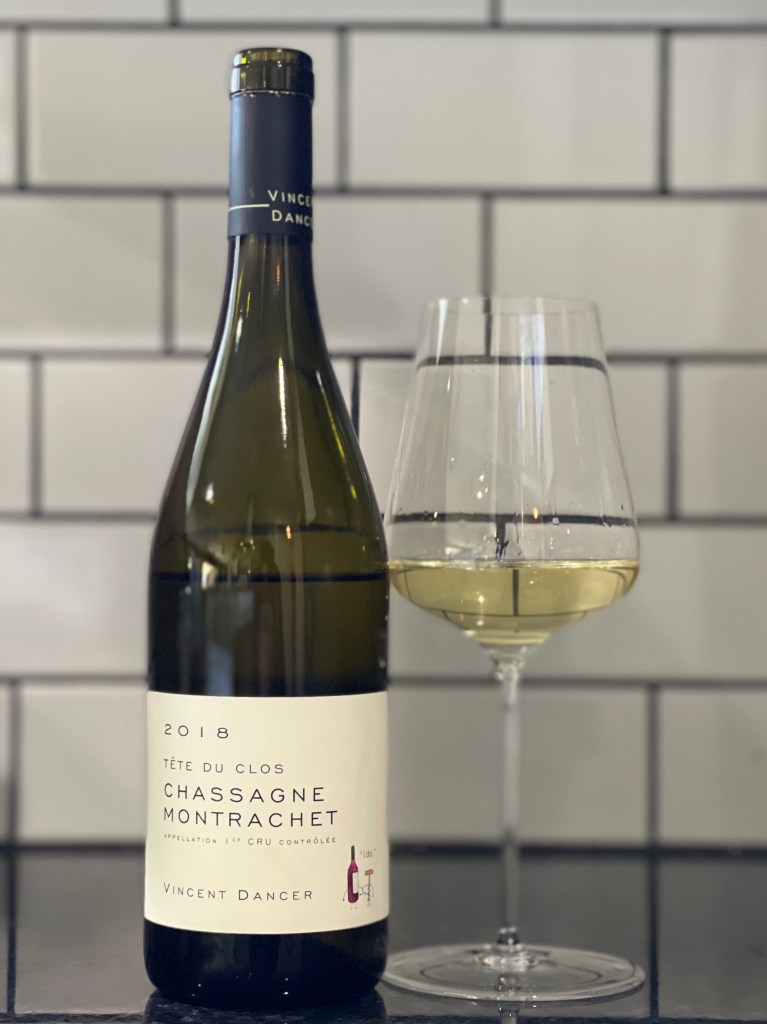
Today’s Wine: 2018 Vincent Dancer Chassagne Montrachet 1er Cru Tête du Clos

100% Chardonnay; 13% ABV

The 2018 Tête du Clos is pale yellow/gold in color. This needs about an hour and a half to two hours to really open up at this young stage, but the nose blossoms into aromas of pronounced intensity. The nose showcases aromas of lemon, crisp golden apple, white floral blossom, flint, wet river stone, a touch of smoke, freshly-baked bread, and saline mineral. Meanwhile the palate is also of pronounced intensity, showcasing notes of crisp pear, lemon zest, yellow apple, honeysuckle, almond, mild dried green herbs, wet stone, and crushed rock mineral. This dry white is full-bodied with high acidity, medium alcohol, and a very long finish. This is outstanding already, but I’ll wait probably five years before opening my next bottle. Very tense and precise.

Price: $175 (I paid $160). By no means an inexpensive white Burgundy, however I think this is absolutely worth the price and I would wager these prices rise further in the years to come. Vincent Dancer is making some of the greatest white Burgundy right now from the wines I’ve tasted, and these should be a must-try for any white Burgundy lover.

Mouton Just Over the Hill

Today’s Story: Château Mouton Rothschild

Château Mouton Rothschild is a historic and highly regarded wine estate located in the Pauillac appellation on the Left Bank of Bordeaux. It is one of five First Growths in Bordeaux, however it did not achieve this status in the original Bordeaux Wine Official Classification of 1855 and instead received the status in 1973 after significant lobbying by Baron Philippe de Rothschild. The estate traces its roots back to the year 1720, when it took its name of Château Brane Mouton from Joseph de Brane when he purchased the estate from Nicolas-Alexandre de Segur. The estate was producing world-class wines during the 18th and 19th centuries, ultimately shifting hands when Baron Nathaniel de Rothschild purchased Brane Mouton in 1853 in a somewhat run-down state. Baron Nathaniel replanted the vineyards and changed the estate’s name, so Château Mouton Rothschild was born.

Though the Rothschild family owned the estate, Baron Nathaniel was part of the English branch of the family and never really traveled to or became involved in the estate. The modern era of the estate actually began in 1922, when Baron Nathaniel’s grandson Baron Philippe de Rothschild, then 20 years old, took over the estate and devoted his life to it. Baron Philippe wasted no time in improving the status of Mouton, becoming the first owner in Bordeaux to insist that all his wine should be bottled at the estate to maintain the highest quality standards and control from the vineyards to the finished product. This was at a time when many producers sold their wines to négociants in barrel for them to bottle, so it was already a revolutionary idea. With all bottling done at Mouton beginning in 1924, Baron Philippe built the now-famous Grand Chai in 1926 for necessary added storage. This Grand Chai is a popular and awe-inspiring stop on a visit to Mouton, as it is 100 meters long, beautifully designed, and home to 1,000 oak barrels on a single level.

Another important contribution Baron Philippe made to Mouton is the tie into art. Beginning with the 1945 vintage, the labels of the Grand Vin change each vintage and feature artwork created by world-renowned artists specifically for the Mouton bottles. For example, a couple of my favorite artists including Picasso and Warhol were featured in the past and add a unique, fun, and eye-catching aspect to the estate’s wines.

When Baron Philippe passed away in 1988, his daughter Baroness Philippine de Rothschild inherited the Mouton estate and left her acting career to pick up after her father’s passion. With her children Camille, Philippe, and Julien, the Baroness not only expanded the reach of the estate but also oversaw still-increasing quality and a stronger tie into the world of the arts. She also oversaw a renovation of the château, and a new vat room came into function in 2012 with a marriage of traditional and technological progress.

The Mouton estate today consists of 90 hectares (222 acres) of vines, planted to roughly 81% Cabernet Sauvignon, 15% Merlot, 3% Cabernet Franc, and 1% Petit Verdot. The vineyards lie on deep, gravelly soil which provides optimal growing conditions and the average vine age is 44 years. All harvesting occurs entirely by hand, with the fruit destemmed and sorted again at the winery before being gravity fed into the fermentation vats. The majority of these vats are made of oak, with a decent percentage left to stainless steel as well. All aging occurs in new oak barrels for about 20 months.

Today’s Wine: 1988 Château Mouton Rothschild

75% Cabernet Sauvignon, 13% Merlot, 10% Cabernet Franc, 2% Petit Verdot; 12.5% ABV

The 1988 Château Mouton Rothschild is deep garnet in color, not really showing any signs of bricking. I drank this as a pop-and-pour, which seemed to be the best bet as this didn’t really change too much over time in the glass. The aromas are of medium intensity, showcasing notes of cassis, cigar box, graphite, green bell pepper, olive, forest floor, coffee grounds, and cedar. Meanwhile the wine’s flavors are also of medium intensity, displaying notes of dried blackcurrant, tobacco, mocha, mushroom, dried green herbs, and cracked pepper. This is a dry red that is medium-bodied with medium acidity, medium (-) tannins, medium alcohol, and a medium length finish. Though I still get some nice notes on this, it is certainly over the hill with the tertiary notes dominating and the structure showing the test of time. I think drinking this 5 years ago would’ve been the correct timing.

Price: $550 (shared by a friend who paid $450). The value proposition of these wines is often less than stellar, for one because there are incredible values for half the price and two with wines of this age provenance becomes key. This bottle I would say was in very good condition and of excellent provenance, however you may get luckier in your tasting if you have an immaculate bottle. Nonetheless, consider drinking up.

Fun and Easygoing Riesling From Northwest Italy

Today’s Story: Oddero

Oddero is one of the great, historical producers of Barolo and Barbaresco, with the family owning property in Piedmont dating back to the 18th century. This being said, Giovanni Battista Oddero started producing wines in the commune of La Morra sometime between the 18th and 19th centuries, kicking off what today marks seven generations of winemaking for the Oddero family.

As Oddero’s wines found their way into the world, first by small barrels, bottling began in 1878 under Giacomo Oddero and the winery recently discovered that their Barolo was exported to the Americas via small barrels as early as the late 19th century. This is in stark contrast to today’s winery, which is impacted immeasurably by another Giacomo (grandson of the above).

The second Giacomo worked tirelessly during the 1950s to renovate the farm and winery, meanwhile fighting to demonstrate the quality of Piedmont wines to the world. In doing so, Giacomo helped lay the foundation for DOC and DOCG certifications for wines of the Langhe and guided agricultural regulation for products such as cheese, nuts, and vegetables.

Today, Oddero is led by his daughter Mariacristina and two grandchildren, Isabella and Pietro. Together they work 35 hectares (about 86 acres) of vineyards of which 16.5 hectares are planted to Nebbiolo in Barolo and Barbaresco. Oddero started experimenting with organic farming practices in 2008, ultimately becoming certified organic in their Nebbiolo, Barbera, and Dolcetto vineyards while the Moscato and Riesling vineyards are still sustainably farmed.

I previously reviewed a couple of Oddero’s wines, first the 2010 Oddero Barolo and then the 2012 Barolo Riserva Bussia Vigna Mondoca.

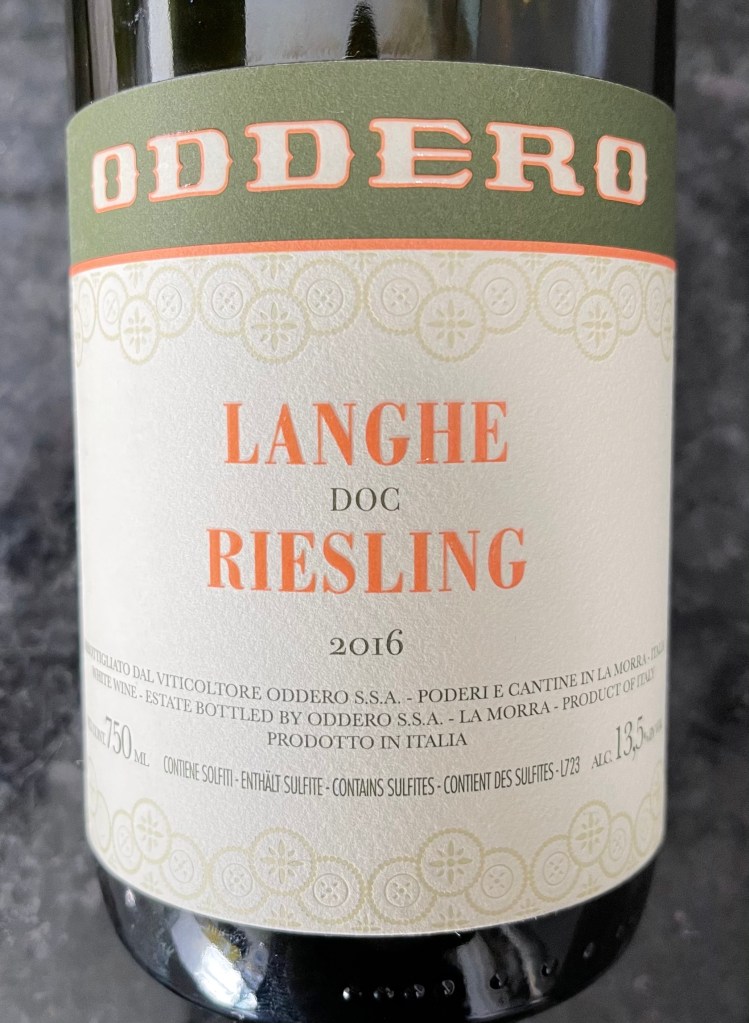
Today’s Wine: 2016 Langhe Riesling

100% Riesling; 13.5% ABV

The 2016 Langhe Riesling is pale yellow in color. Aromas are of medium intensity, showcasing notes of tropical citrus, tangerine, white peach, yellow apple, white floral blossom, petrol, and stony mineral. Meanwhile the flavors are also of medium intensity, with the palate displaying notes of white peach, pineapple, lemon zest, stone fruit, honeysuckle, and crushed rock. This dry Riesling is medium- to full-bodied with medium (+) acidity, medium alcohol, and a medium (+) length finish. This is a very easy-drinking wine, quite enjoyable for patio sipping. It’s not too complex and not as intense as other Rieslings, but it’s a fun wine. Roughly 333 cases produced.

Price: $25. I think this is pretty fairly priced, but there are better values out there in terms of complexity and intensity. It’s a fun wine with an uncommon variety in its region, and as I mentioned a great patio sipper.

Classy and Elegant Barossa Valley Syrah

Today’s Story: Sami-Odi

Sami-Odi is a small but highly regarded winery established in the Barossa Valley of Australia by Fraser McKinley in 2006. Working exclusively with Syrah/Shiraz from the Hoffmann family’s esteemed Dallwitz Vineyard, McKinley farms his rows of often very old vines (some dating back to the 1880s) adhering to organic viticulture. He also picks earlier than most around him, based largely on his high level of importance placed on acidity. Sami-Odi produces two wines each vintage with blending the name of the game, one of them being a vintage bottling assembled from fruit of varying vine age and blocks, with the other being a non-vintage assemblage of various blocks, vine age, and vintage. The Sami-Odi wines are a result of traditional winemaking, with manual work prevalent alongside whole-cluster fermentation and no additions save for a minimal amount of sulfur. Aging occurs in neutral oak, and bottling is gravity-fed with the wines always unfined and unfiltered.

I previously wrote about Sami-Odi when I reviewed the NV Little Wine #9, which is a very fun wine if you missed it.

Today’s Wine: 2017 Hoffman Dallwitz Syrah

100% Syrah; 14.9% ABV

The 2017 Hoffmann Dallwitz Syrah is deep purple in color, certainly very youthful. I’ve read this needs a very long decant right now, and it certainly does so I decanted this for about 9 hours and tasted it a few times along the way. The aromas are of pronounced intensity, showcasing notes of blackberry, blueberry, black plum, violet, smoked game, grilled green herbs, cracked black pepper, cinnamon, allspice, chocolate, and cedar. Meanwhile the flavors are also of pronounced intensity, with the palate displaying notes of black plum, blackberry, tobacco, game, scorched earth, black pepper, coffee grounds, cedar spill, exotic spice, and clove. This dry red is full-bodied with high acidity, high tannins, high alcohol, and a long finish. There’s a beautiful elegance and finesse to this wine not often found in Barossa Valley Shiraz.

Price: $170 (very difficult to find). While I think the Sami-Odi non-vintage bottling holds the better value distinction, it’s remarkable how pure and complex this is given such a young age. There are some elements that need time in the bottle to fully integrate, but given another 5 years or so of cellar age this will be even more exquisite.