Gorgeous Etna Rosso With an Incredible Backstory

Today’s Story: Le Vigne di Eli

Le Vigne di Eli is a small, family-owned winery established on the slopes of Mount Etna in 2006 by Marco de Grazia who is also behind the acclaimed Tenuta delle Terre Nere. Marco decided to establish Le Vigne di Eli after being offered two of Etna’s tiniest and most coveted vineyards (Feudo di Mezzo and Moganazzi-Voltasciara), though instead of adding them to his portfolio at Tenuta delle Terre Nere he started another winery. Marco says the two vineyards made him think of his daughter Elena (Eli), so not only did he create this winery out of his love for her but he uses her artwork on his labels and dedicates a significant portion of his profits to the Ospedale Pediatrico Meyer children’s hospital in Florence to make it truly a “child’s estate.” Over time Marco selected additional tiny vineyards to increase his offerings and the estate produces about 20,000 bottles annually across several Etna Bianco and Etna Rosso bottlings.
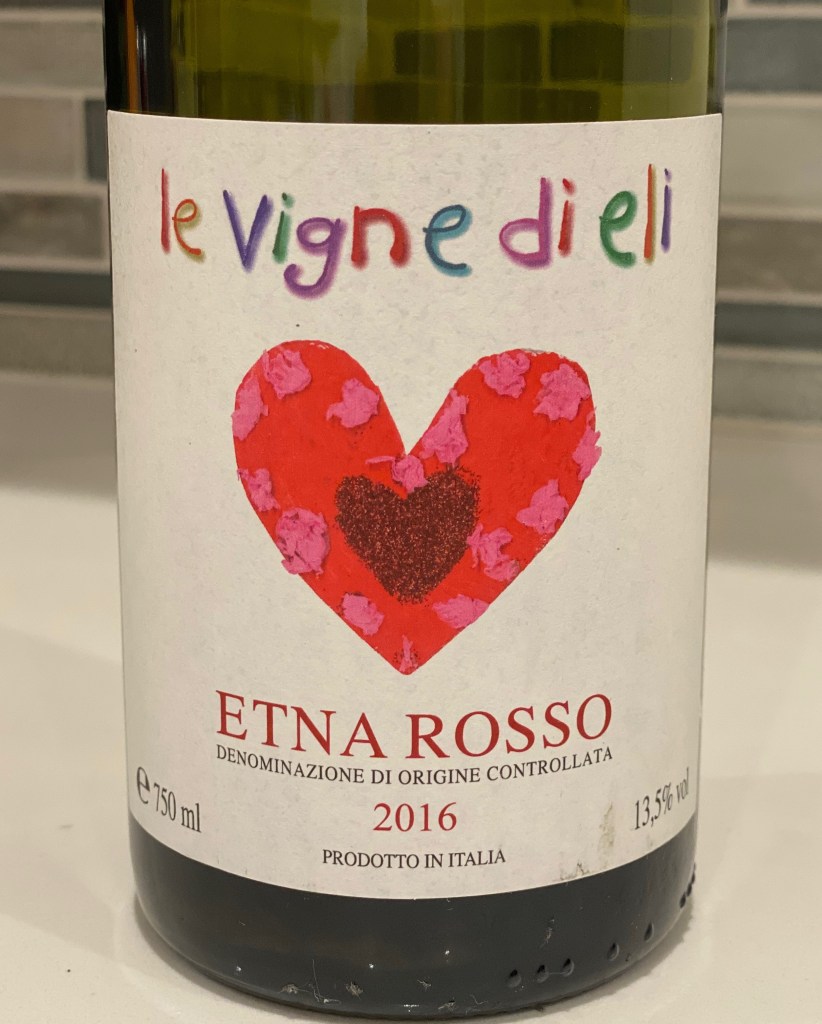
Today’s Wine: 2016 Etna Rosso

98% Nerello Mascalese, 2% Nerello Cappuccio; 13.5% ABV

The 2016 Etna Rosso is moderately opaque and medium garnet in color with bright ruby hues. I let this breathe in the glass for about an hour and the nose emits aromas of ripe strawberry, muddled raspberry, red cherry, red licorice, lavender, tobacco, barnyard, volcanic soil, savory Italian herbs, marine minerality, and oak. Once on the palate, the wine offers notes of strawberry, cherry, wild raspberry, red and purple florals, sweet tobacco, graphite, baking spice, crushed rock minerality, and smoke. This is light- to medium-bodied with vibrant medium (+) acidity, refined medium tannins, and a long herbaceous finish. The wine is incredibly precise and its drinking experience is completely gorgeous. 1,000 cases produced.

Price: $30. This is one of the better Etna Rosso wines I’ve had, and for this price it is a screaming value as a lot of Etna Rosso is (for now). Pair this with chicken parmigiana, tuna with tomatoes, roasted pork, or even pepperoni pizza.

Unique Natural Côtes du Rhône

Today’s Story: Domaine Gramenon

Domaine Gramenon was established in 1978 in Montbrison-sur-Lez which rests in the northernmost area of southern Côtes du Rhône in France. Located on the foothills of the Alps, Domaine Gramenon sits at about 1,150 feet above sea level on soils made largely of limestone, sands, and clay once covered by the sea 86 million years ago. The domaine is largely planted with Grenache thanks to its adaptability to the elevation and region, and many of their vines are old with ages ranging from 50 to 120 years old. Since the domaine’s founding, they practice natural and organic vineyard cultivation though adopted biodynamic practices and received the DEMETER certification in 2010. All harvesting is accomplished by hand and rigorous selection goes into sorting the fruit before they are ultimately shaken (never crushed by tools) into concrete vats. All Domaine Gramenon wines are meant to showcase their terroir in unadulterated fashion, so spring cuvées age in vats and old vine cuvées age in old barrets and minimal (if any) SO2 is added.

To learn more about the domaine, particularly with a wonderful depiction of their terroir, check out the website here.

Today’s Wine: 2018 l’élémentaire

75% Grenache, 25% Syrah; 14.3% ABV

The 2018 l’élémentaire is opaque deep purple in color which leaves heavy staining on the glass. This needs at least an hour or two to decant, but once it opens up the nose showcases aromas of blackberry, black plum, cassis, anise, tobacco, clay, wet gravel, chocolate, and dark roast coffee bean. On the palate, I get notes of blackberry compote, jammy blueberry, plum, black cherry, leather, loamy soil, dried herbs, black pepper, and smoky spice. This wine is medium- to full bodied with medium acidity, medium tannins, and a medium (+) length finish. Drinks better on the second day.

Winemaking process: Produced from 45 year old vines cultivated with biodynamic farming; fruit is sorted manually; 15 day maceration in concrete vats; partially de-stemmed clusters; natural yeast fermentation; light addition of SO2.

Price: $30. Not a bad price for this fun “natural” wine, and it’s one of those that is different than what most people expect from a Grenache/Syrah blend. Pair this with grilled beef, smoked game, or smoky barbecue chicken.

Classic Sonoma County Zin

Today’s Story: Joseph Swan Vineyards

I very recently wrote about Joseph Swan Vineyards when I reviewed their 2012 Mancini Ranch Zinfandel in Not Your Typical Cali Zin, so I wanted to check in on another bottling today while it is fresh in my mind. Today’s wine will be a very different experience, what I expect largely due to its 15.3% ABV versus the 12.9% of the 2012 Mancini Ranch bottling.

To recap……Joseph Swan Vineyards was founded during the early 1970s by Joe Swan, a man whose passion for wine spawned at an early age through reading. However, Joe’s career did not begin in wine but rather as an artist, a flight instructor for the Army Air Corps during WWII, and ultimately a pilot for Western Airlines. Though Joe retired in 1974, his passion for wine remained strong through those middle years and he even produced Zinfandel when stationed in Salt Lake City and made friends visiting the Enology and Viticulture department at UC Davis following the war. In 1967, Joe purchased a small farm planted with 13 acres of Zinfandel, fruit trees, and a pasture near Forestville in the Russian River Valley with a plan to follow his dream of operating a small vineyard and winery. Though Joe made Zinfandel in 1968, he quickly received encouragement from André Tchelistcheff (a highly influential winemaker I discussed in my BV posts, as well as Joe’s friend and mentor) to replant his vineyards to Chardonnay and Pinot Noir. With significant inspiration from French winemakers and the belief that lower production would increase his quality, Joe selected low production clones and both pruned and thinned his vines to significantly reduce yield. In 1987, Joe’s son-in-law Rod Berglund worked the Joseph Swan harvest with him and this would unfortunately be Joe’s last vintage. Joe fell ill during 1988 and passed away January, 1989 but his perfectionism and love of wine carries on with his daughter Lynn and son-in-law Rod today.

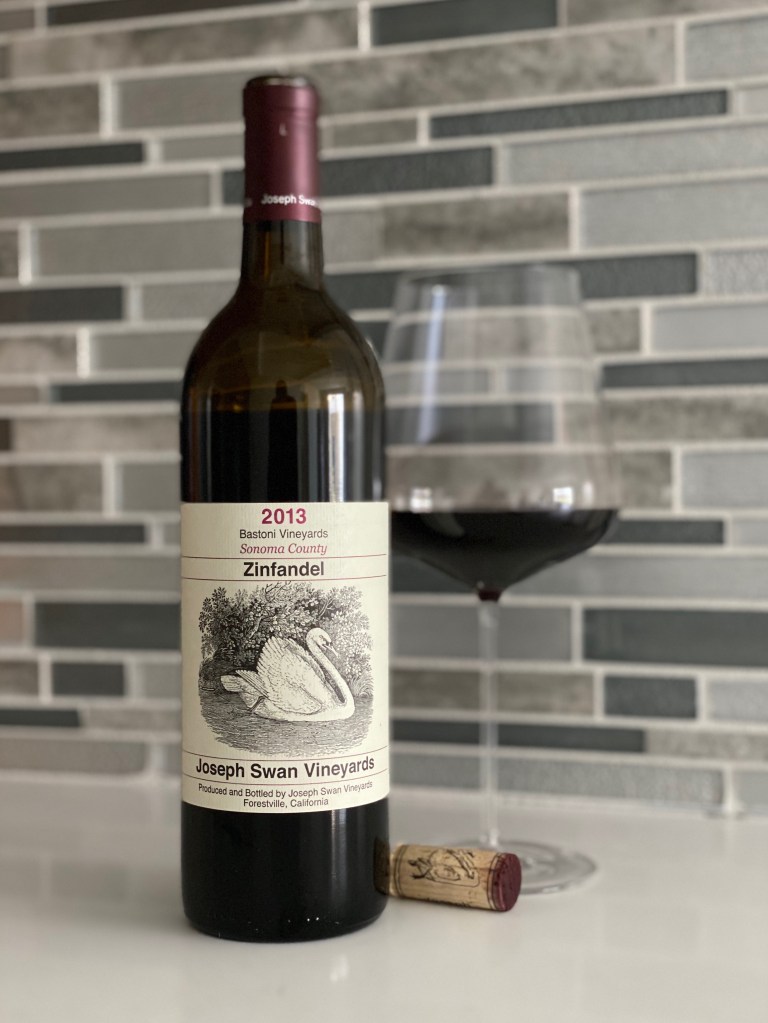
Today’s Wine: 2013 Bastoni Vineyards Zinfandel

100% Zinfandel; 15.3% ABV

The 2013 Bastoni Zinfandel is opaque medium to deep garnet in color with medium ruby variation. Once this opens up, the nose showcases aromas of boysenberry, wild blueberry, cherry, leather, sweet tobacco, rocky soil, cinnamon, a hint of chocolate, and oak. On the palate, I get notes of juicy blackberry, pomegranate, plum, bing cherry, ripe raspberry, pipe tobacco, loamy earth, white pepper, dried green herbs, and a touch of oak. This is medium- to full-bodied with medium (+) acidity, medium tannins, and a long finish with added notes of iron and crushed rock.

Price: $30. This is an incredible value, similar to the 2012 Mancini Ranch I just had and Joseph Swan wines as a whole. This bottling certainly drinks more like your “classic” Californian Zin whereas the Mancini Ranch was more “old-school.” Pair this with barbecue pork sandwiches, pepperoni pizza, or roasted leg of lamb.

Wildly Fun California Mourvèdre

Today’s Story: Dirty & Rowdy Family Winery

Dirty & Rowdy is a small, family-operated winery founded in 2010 by couples Hardy & Kate and Matt & Amy with the goal of producing minimal intervention “honest wines.” Known for their range of Mourvèdre bottlings, Dirty & Rowdy also produces Petite Syrah, Chenin Blanc, and blends that include a GSM and Semillon-dominant white almost all with 100% whole cluster native fermentation, either zero or minimal SO2 added, and no filtering or fining when bottled. Dirty & Rowdy sources their fruit from vineyards in Mendocino, Monterey, Contra Costa, El Dorado, and Amador Counties, with most vineyards organically farmed or at a minimum “responsibly” farmed and unique.

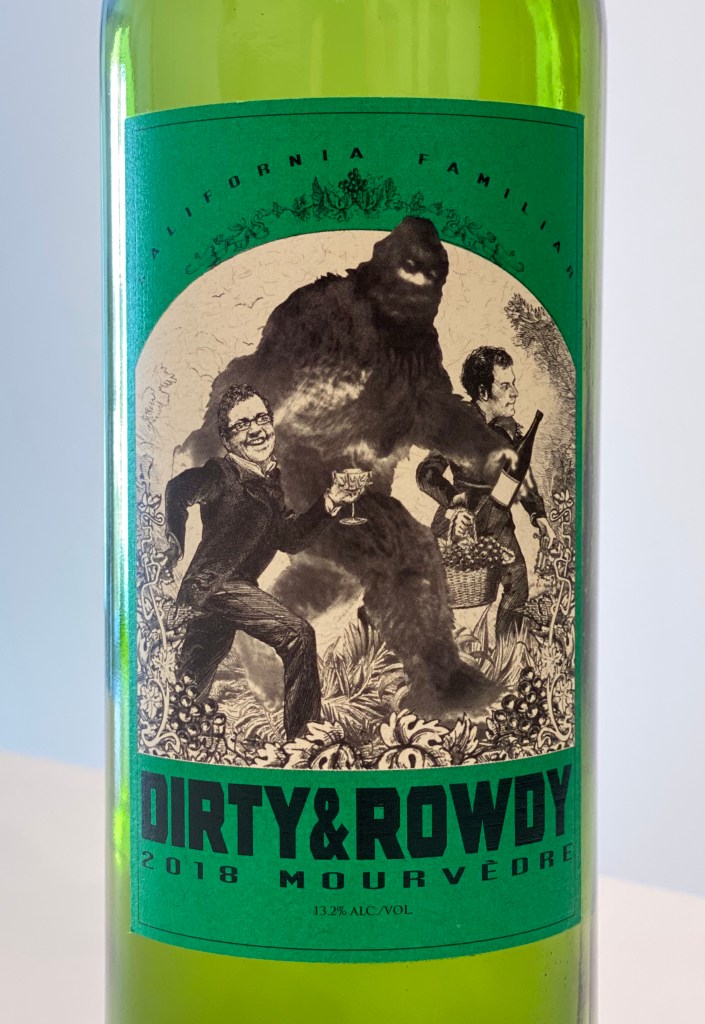
Today’s Wine: 2018 Familiar Mourvèdre

100% Mourvèdre; 13.2% ABV

The 2018 Familiar Mourvèdre is opaque pale purple in color with ruby hues near the bowl of the glass. I decanted this for about an hour, and the nose displays aromas of blueberry, sweet blackberry, plum, violet, dried green herbs, smoked meat, wet gravel, and a hint of oak. Once in the mouth, this wine showcases notes of tart blueberry, black raspberry, strawberry rhubarb, licorice, smoke, red and purple florals, wet granite, and stemmy underbrush. This is medium- to full-bodied with medium (+) acidity, medium tannins, and a medium (+) length finish. 100% whole cluster native fermentation with organic grapes, bottled unfiltered and unfined with minimal SO2 added. 700 cases produced.

Price: $30. This is a really fun, well-made wine to drink and something that broadens the palate of most of today’s wine drinkers. If you’re looking to explore, check out these wines. Pair this with herb-roasted lamb, duck breast, or I imagine this goes quite well with Dirty & Rowdy’s spicy fried chicken (which I will hopefully try one day).

Outstanding Value from Chianti Classico

Today’s Story: Castello di Volpaia

Castello di Volpaia is a historic winery situated in the fortified medieval village of Volpaia in the heart of Chianti Classico. Drenched in winemaking history, Volpaia’s viticultural roots trace to 1172 and they were a founding member of the Lega del Chianti (Chianti League) in 1250. In 1966, a printer and bookbinder named Raffaello Stianti purchased the Volpaia estate and 2/3 of the village, later giving it to his daughter Giovannella and her newlywed husband Carlo Mascheroni as a wedding gift in 1972. Carlo and Giovannella instituted a major renovation project to modernize the winery and convert historical buildings into cellars, all while instituting an underground “wineduct” that carries wine from their fermentation tanks to the cellar by gravity. Castello di Volpaia is the highest elevation winery in Chianti Classico with 114 acres of vineyards situated between 1,300-2,100 feet above sea level. All viticultural practices at the estate are certified organic by Q Certificazioni srl.

Today’s Wine: 2016 Chianti Classico Riserva

100% Sangiovese; 13.5% ABV

The 2016 Chianti Classico Riserva is mostly opaque and medium garnet in color with ruby hues. This needs to decant for an hour or two, but once it does the nose blossoms to showcase aromas of black cherry, blackcurrant, anise, lavender, smoked game, tobacco leaf, damp gravel, dark chocolate, sage, and oak. Once on the palate, this wine delivers notes of blackberry compote, spiced black plum, brambleberry, black cherry, violet, licorice, crushed rock, wet volcanic soil, smoke, savory green herbs, and blood. This is full-bodied with high acidity, medium (+) tannins, and a very long finish. The wine is beautifully complex for how young it is, and based on its structure I would give this another 7-10 years to develop in the bottle.

Price: $35. This is one of the greatest value Italian wines I’ve had, and every time I find either this vintage or the 2015 I stock up. Pair this with chicken parmigiana, ossobuco, or lamb chops.

Remarkably Affordable Grand Cru Chablis

Today’s Wine: 2014 Chablis Grand Cru Les Clos

100% Chardonnay; 12% ABV

The 2014 Les Clos is gorgeous deep gold in color and transparent. I let this open up in the glass for about 45 minutes to an hour and the nose showcases aromas of lemon citrus, white peach, stone fruit, golden apple, white florals, saline minerality, brioche toast, toasted almond, and marine limestone. On the palate, I get notes of golden pear, lemon, orange zest, green apple skins, brine, white lily, honey, beeswax, and chalk. This beauty is full-bodied with mouthwatering high acidity and a plush, well-rounded mouthfeel into a long finish. An incredibly precise and intense wine, I recommend giving this another 7-10 years in the bottle to add additional complexities.

Price: $80 (though this seems difficult to find online and my CellarTracker gives it a value of $100). This is an absolutely beautiful value for Grand Cru Chablis, drinking like one of the best that I’ve had. If you are able to find this for $100 or less, you cannot pass it up. Pair this with shellfish, foie gras, or spaghetti carbonara.

Pinotage Off the Beaten Path

Today’s Story: Beaumont Family Wines

Beaumont Family Wines, as the name implies, is a small family owned and operated winery established in 1974 by Jayne and Raoul Beaumont in Bot River, South Africa. Though the farm was originally established in the 1700s by the Dutch East India Company and is home to the region’s oldest wine cellar, its wine business did not start until the 1940s and halted during the late 1960s. When Jayne and Raoul replanted some of the vineyards and started producing their wines, they established the goal of producing small quantities of high quality wines including Chenin Blanc, Pinotage, Syrah, Mourvèdre, and various blends. All of the wines are crafted to showcase the terroir, so Beaumont practices minimal intervention and traditional winemaking methods including the use of natural yeasts for fermentation and old open concrete fermenters.

For more about Beaumont Family Wines or to browse their portfolio, check out the website here!

Today’s Wine: 2016 Pinotage

100% Pinotage; 14% ABV

The 2016 Pinotage is opaque deep ruby in color and produces moderate staining on the glass. Once this opens up, the nose showcases aromas of blackberry, wild blueberry, juicy black plum, smoked game, sweet tobacco, menthol, rocky mineral, and mixed nuts. On the palate, I get notes of black cherry, jammy blackberry, fig, muddled strawberry, black raspberry, licorice, dried rocky soil, mocha, and smoke. This is medium- to full-bodied with high acidity, medium tannins, and a long finish. 60 barrels produced.

Price: $33. This is a great price-point for the wine and is fairly accessible for those who want to explore South Africa’s signature variety. A cross between Pinot Noir and Cinsault, Pinotage is a fun variety to try for those who like Pinot Noir or want to expand their horizons. Pair this with venison, smoked duck, or a meat lover pizza.

Old-World-Styled Pinot Noir From California

Today’s Story: Mount Eden Vineyards

Mount Eden Vineyards was established in 1945 in the Santa Cruz Mountain Appellation of California, with a focus of crafting small lots of Cabernet Sauvignon, Chardonnay, and Pinot Noir. Located at an elevation of 2,000 feet above the Santa Clara Valley floor, Mount Eden Vineyards is widely considered one of the first “boutique” California wineries and remains true to this philosophy today. Mount Eden believes every bottle is an expression of their terroir and thus winemaker Jeffrey Patterson spends most of his time in the vineyards connecting to his fruit and vines and centering his efforts on producing quality (not high-quantity) fruit. Part of Jeffrey’s focus in the vineyards is also making sure that this land will produce quality fruit for generations to come, so he feels deeply connected to the need to care for his vineyards. In the cellar, Jeffrey practices minimal intervention and all fruit is handled gently before going through fermentation using only natural yeasts. For more on the history of this wonderful winery, check out their website here.

Today’s Wine: 2015 Pinot Noir

100% Pinot Noir; 13.5% ABV

The 2015 Pinot Noir is pale ruby in color and moderately opaque. This is incredibly young and needs a couple hours to open up, but once it does the nose showcases aromas of cherry, black raspberry, black olive, mint, freshly ground green herbs, pine, charred cedar, leather, rocky earth, and incense. Once on the palate, the wine displays notes of tart cherry, dried strawberry, boysenberry, crunchy cranberry, red licorice, rose petal, sweet tobacco, scorched earth, underbrush, rocky minerality, and exotic spice. This is medium-bodied with an incredibly elegant and velvety mouthfeel, vibrant medium (+) acidity, medium (-) tannins, and a long finish. 936 cases produced.

Price: $65. This is an incredibly high-quality Pinot Noir that drinks on par or better than many $100 Pinot Noirs I’ve enjoyed. The one thing to keep in mind, though, is you need to be patient with this and give it at least another 5-7 years of bottle age. Pair this with rack of lamb, herb grilled pork chops, or eggplant parmigiana.

Small Batch Bordeaux Blend From Paso Robles

Today’s Story: Aleksander Wine

Aleksander is a small, family-owned boutique winery established by NBA player Sasha Vujacic and his family when his parents Goran and Ksenija discovered their property in 2009. On what became S&G Estate, a 30 acre property in Paso Robles complete with estate vineyards and its own winery, Aleksander produces Merlot-dominant Bordeaux blends in a “White Label” bottling and a “Reserve” bottling. Aleksander ages their wines in a mix of French, Serbian, and Eastern European oak barrels with the White Label wines calling them home for a minimum of 18 months and the Reserve wines a minimum of 24 months. All wines are aged in the bottles a minimum of 10 months before release.

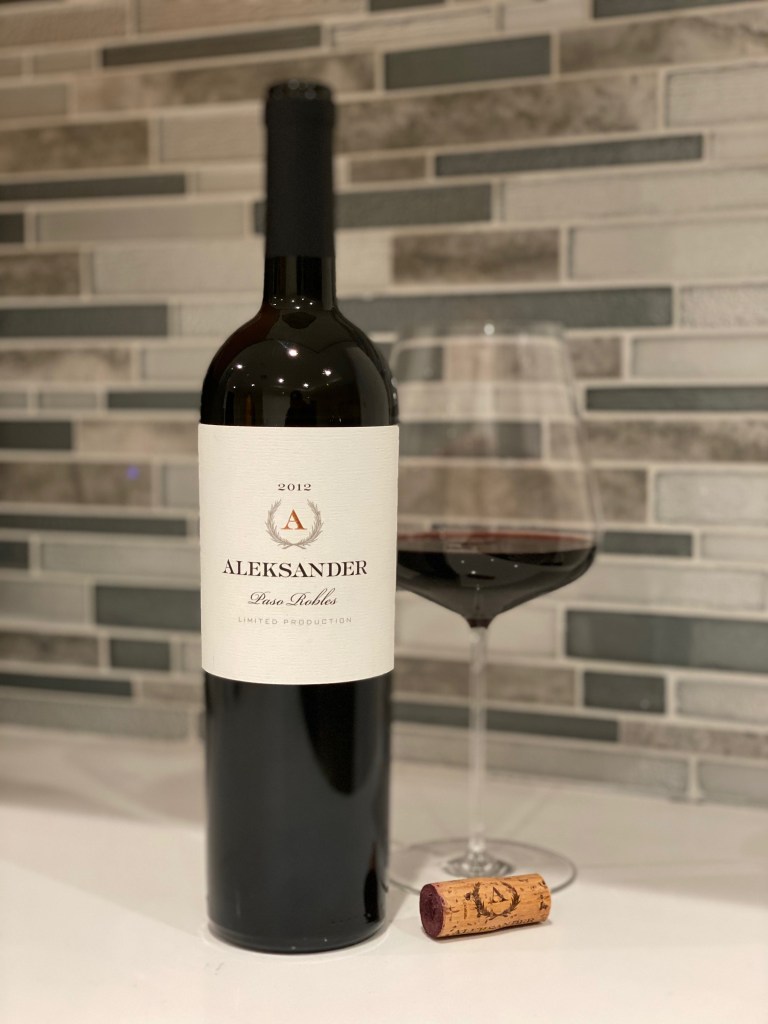
Today’s Wine: 2012 Aleksander Red Blend

55% Merlot, 22% Cabernet Sauvignon, 15% Cabernet Franc, 8% Petit Verdot; 13.8% ABV

The 2012 Aleksander is opaque deep ruby in color with deep purple hues in the bowl. Once this opens up, the nose showcases aromas of blackberry, blueberry, plum, black cherry, redcurrant, violet, loamy soil, wet slate, cigar box, chocolate, and oaky spice. On the palate, I get notes of cassis, anise, blackberry, baked cherry, worn leather, wet gravel, charred earth, ground coffee, dark chocolate, baking spice, and oak. This wine is medium- to full-bodied with high acidity, medium (+) tannins, and a medium (+) length finish.

Price: $70. This is a very solid wine, though it is certainly toward the higher end of price-point I’ve paid for Paso Robles Bordeaux blends. That being said, I think this does stand up to a lot of the Napa wines in this price range and this, while being restrained in ABV and not a jammy fruit bomb, should have broad appeal. Pair this with roasted duck breast, filet mignon, or herb-grilled pork.

Delicious Entry Level Alsatian Riesling

Today’s Story: Domaine Weinbach

Domaine Weinbach was established in 1612 by Capuchin friars and is named for the stream meandering through the property. Located at the foot of a hill called Schlossberg in Alsace, France, the property has been planted to vine since as early as the 9th century and the vineyards are surrounded by ancient walls named Clos des Capucins. During the French Revolution, the domaine sold as national property though came into the Faller family when two brothers acquired it in 1898. Domaine Weinbach remains in the family today and passed to Théo who expanded and improved the winery; then Colette (Théo’s wife), Catherine, and Laurence; and finally to Eddy and Théo who currently work alongside their mother Catherine. The domaine now totals 28 hectares which, since 2005, are entirely farmed according to biodynamic principles. All harvesting is accomplished by hand, and minimal intervention takes priority in the cellar.

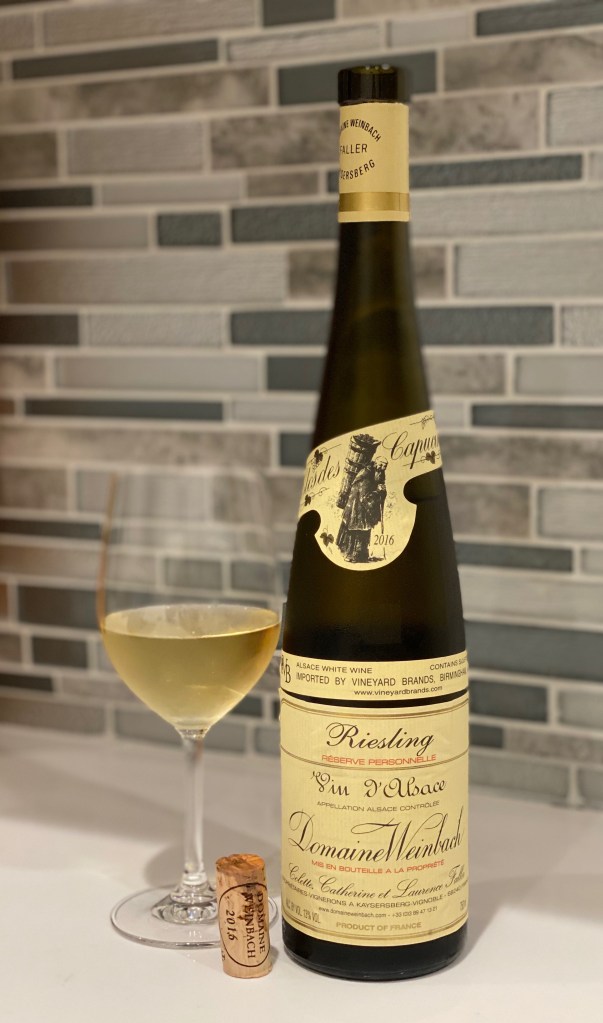
Today’s Wine: 2016 Riesling Réserve Personnelle

100% Riesling; 13% ABV

The 2016 Réserve Personnelle is transparent and medium straw in color with water-white near the rim. On the nose, I get aromas of melon, lemon citrus, stone fruit, green apple, honeysuckle, petrol, saline minerality, and vanilla. Once in the mouth, the wine showcases notes of white peach, pear, pineapple, apricot, white florals, petrol, crushed rock, mineral, cream, and straw. This is medium- to full-bodied with high acidity and a long, mouthwatering finish.

Price: $30. This is a great entry price to explore Alsatian Riesling, which alongside Mosel, Germany produces some of my favorite wines with the variety. Pair this with smoked whitefish, Thai food, or charcuterie with goat cheese.