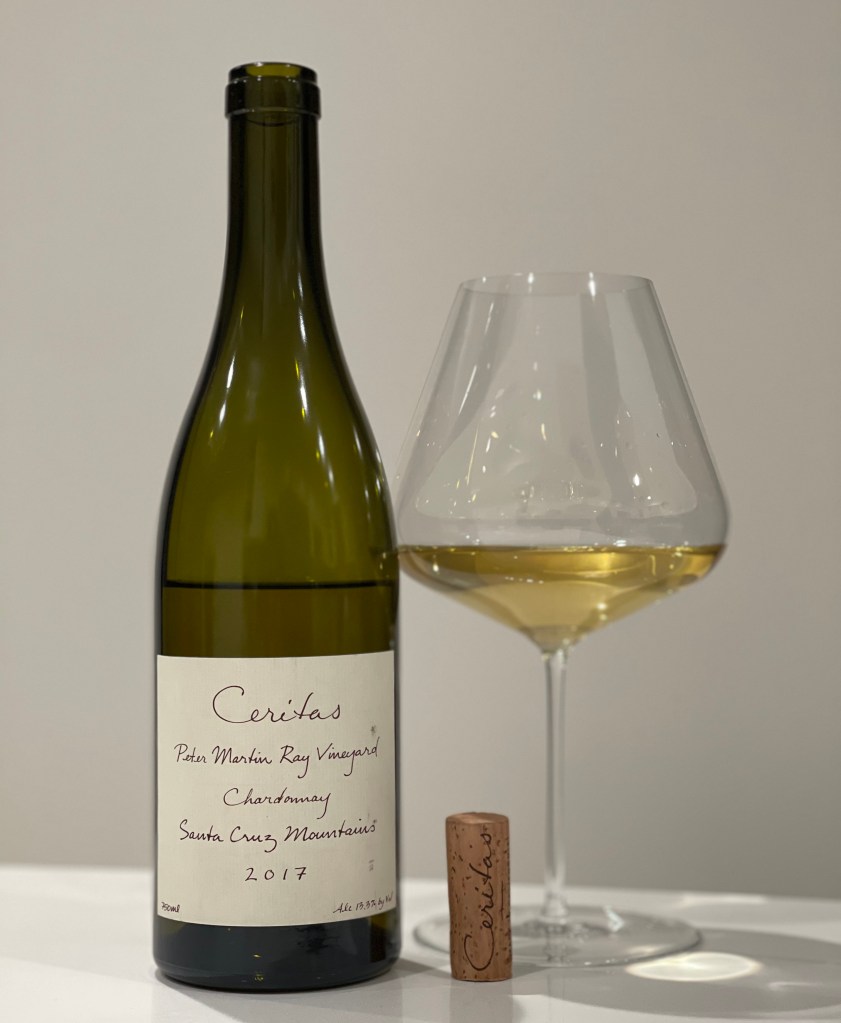
Santa Cruz Mountain Chardonnay With a Burgundian Flair

Today’s Story: Ceritas Wines

Ceritas Wines is a small, family-owned winery spearheaded by husband and wife duo John and Phoebe Raytek. John and Phoebe source their fruit from trusted vintners mainly in the West Sonoma Coast and Santa Cruz Mountains, with all sites practicing sustainable or organic viticulture. John is highly involved in the vineyards they source from, and in many cases the vintners only sell fruit to Ceritas and are labeled “Monopoles.” Considering himself a winemaker of the Old World style, John believes that fruit should lead the way throughout the winemaking process and he is merely there to watch over, listen, and learn about each unique site. In the cellar, John practices minimal intervention but “flexible” winemaking, with the wines meant to showcase with honesty and transparency the terroir of each specific vineyard site.

If this backstory sounds familiar, perhaps you know of Ceritas or perhaps you’ve read my prior reviews of their wines. I previously wrote about the 2017 Porter-Bass Vineyard Pinot Noir, the 2016 Peter Martin Ray Vineyard Cabernet Sauvignon, and most recently the 2016 Trout Gulch Vineyard Chardonnay.

To discover more, such as detailed descriptions of each vineyard site or view the other wines in the Ceritas portfolio, check out their website here.
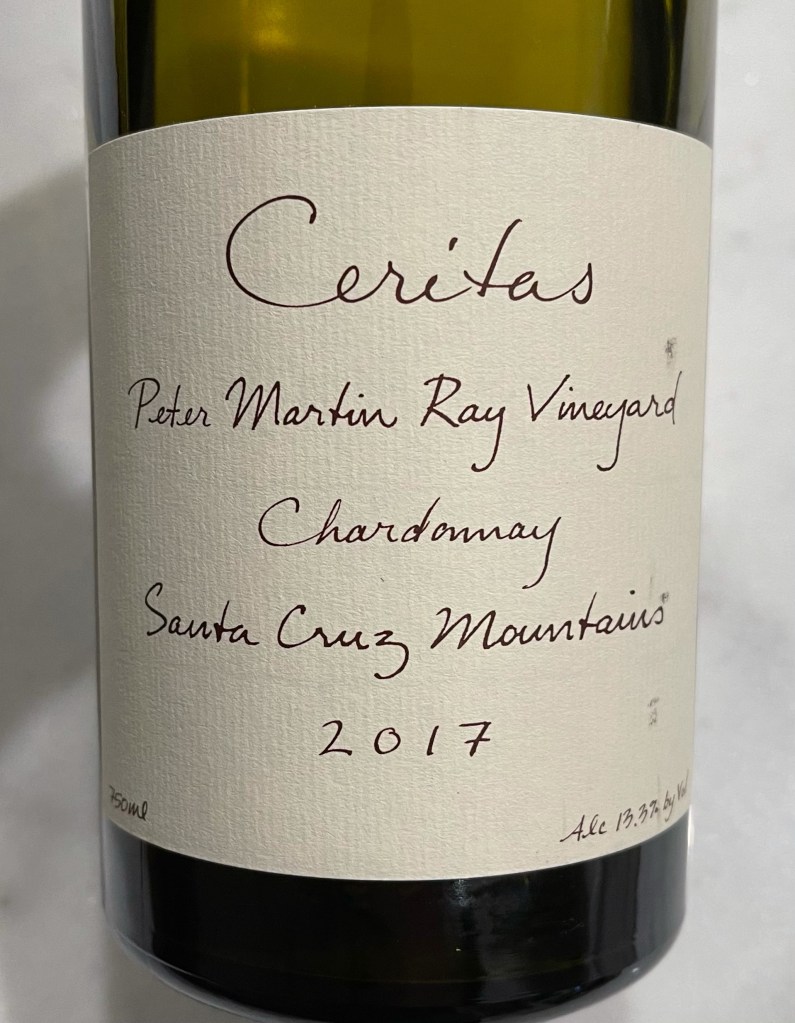
Today’s Wine: 2017 Peter Martin Ray Vineyard Chardonnay

100% Chardonnay; 13.3% ABV

The 2017 Peter Martin Ray Vineyard Chardonnay is transparent pale gold in color. This took about 45 minutes to really blossom in the glass, with the nose eventually opening up to showcase medium intense aromas of yellow apple, lemon, white peach, honeysuckle, flint, wet stone, dried vanilla, and a hint of smoke. Meanwhile the flavors on the palate are quite pronounced, with notes of crisp yellow apple, white peach, lemon, a touch of pineapple, honeysuckle, dill, flint, and a hint of stony mineral. This dry Chardonnay is medium-bodied with high acidity, medium alcohol, and a long finish.

Price: $65. This is a really, really good bottle from Ceritas again. With time in the bottle this should add extra gorgeous complexities and the acidic backbone should help it hold up as the wine develops. This being said though, I think I’d pay the slightly higher secondary market price for the Trout Gulch Chardonnay (though both Chards released the other week at $59 each on the mailing list). Though a year older, the 2016 Trout Gulch I had not too long ago seems to be in a class of its own and that seems to be the general consensus vintage after vintage.
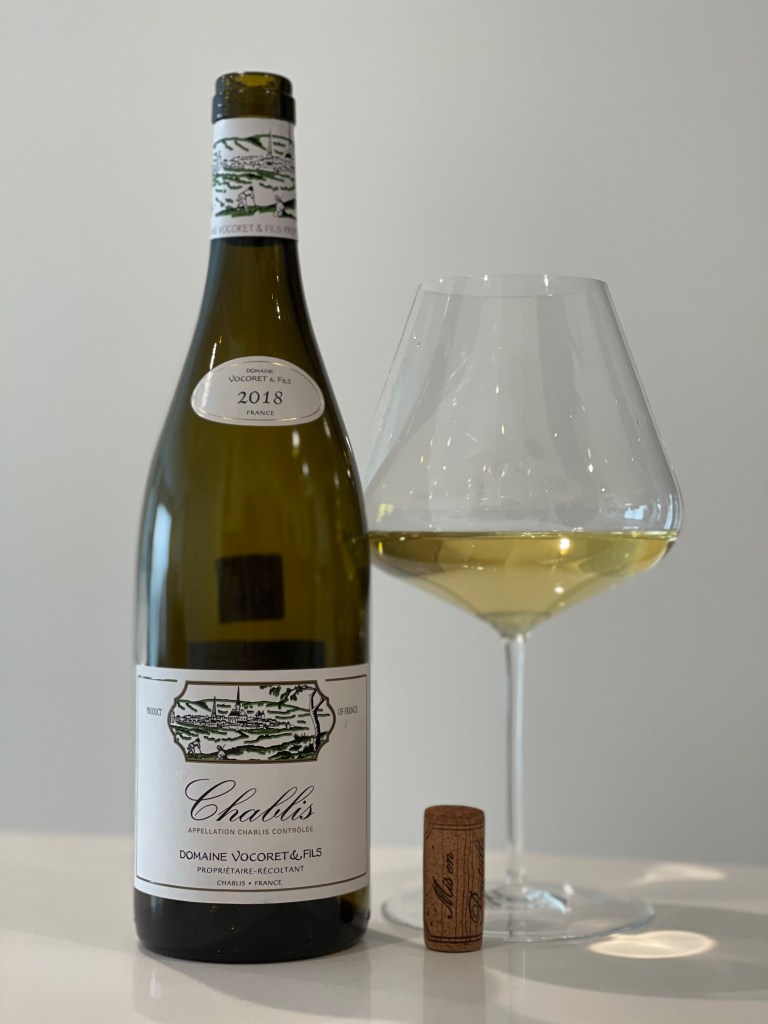
Family-Made Chablis at an Excellent Value

Today’s Story: Domaine Vocoret et Fils

Domaine Vocoret et Fils is a family-owned and operated domain, established in Chablis in 1870 by Edouard Vocoret. Today Domaine Vocoret is under guide of the fourth generation of the family, and their holdings are quite impressive at around 40 hectares of sustainably-farmed vineyards. Of these holdings, roughly 16 hectares are Village level, 17 hectares are 1er Cru, and 4 hectares are the Grand Crus of Les Clos, Blanchot, Valmur, and Vaudésir with the balance Petit Chablis. Though Vocoret invested in modern and high quality winemaking equipment, the production of their wines remains very traditional for Chablis. Grapes are hand-sorted before heading to the pneumatic press, and after fermentation the wines head into stainless steel for aging to preserve their fresh fruit and vibrancy (though the 1er and Grand Crus do see some new oak which is becoming more popular in Chablis today).

Today’s Wine: 2018 Chablis

100% Chardonnay; 12.5% ABV

The 2018 Chablis is transparent pale gold in color. Given some time to blossom in the glass, the aromas are of pronounced intensity with the nose showcasing notes of crisp green apple, lemon, unripe pear, white florals, flint, gunsmoke, wet river stone, and dill. Meanwhile on the palate, which is of medium intensity, I get notes of green apple, lime zest, quince, white peach, chalk, dried green herbs, and white pepper. This dry Chablis is medium-bodied with medium (+) acidity, medium alcohol, and a long finish.

Price: $25. This offers very, very good value for Chablis and Chardonnay as a whole. There is a beautiful and crisp purity of fruit here for its young age and price-point, and the lip-smacking acidity is gorgeous. I’m excited to try more of the Vocoret wines in the near future.

Deliciously Pure Champagne From a Unique House

Today’s Story: Champagne Leclerc Briant

Champagne Leclerc Briant is a unique Champagne house established in 1872 by Lucien Leclerc in the village of Cumières. In 1955, however, the house moved to Épernay following Bertrand Leclerc’s marriage to Jacqueline Briant and they formed the négociant business Champagne Leclerc Briant. Leclerc Briant helped push the boundaries in Champagne, becoming one of the first houses to adopt organic viticulture during the 1960s and bottle single-vineyard Champagnes during the 1970s. Under Pascal, Bertrand and Jacqueline’s son, Leclerc Briant started dabbling with biodynamic viticulture during the 1980s and they became Demeter biodynamic certified in 2003. Unfortunately, Pascal passed away in 2010 far too soon and Leclerc Briant fell into tough times and faced extinction for a couple years, selling off the majority of their vineyards. In 2012, however, an American couple Mark Nunelly and Denise Dupré purchased the house alongside Champagne native Frédéric Zeimett and oenologist Hervé Jestin and the team has brought Leclerc Briant back to greatness.

Leclerc Briant consists of a very small 0.6 hectare vineyard called La Croisette, which is adjacent to the winery in Épernay. They also own roughly 9.6 hectares across various 1er and Grand Cru vineyards, though they source small amounts of Pinot Noir from the Aube and have long-term purchase agreements with other vignerons who own organically or biodynamically farmed vineyards. In the cellars, Jestin practices a non-invasive style of winemaking and sees himself as an observer and guide rather than a heavy hander. The wines all go through spontaneous fermentation and vinify in INOX tank, terracotta egg, or French oak barrel before malolactic fermentation is allowed to happen naturally. After at least nine months in barrel, the wines experience extended aging in the cellars and dosage levels are minimal or at times nonexistent at all to allow the wines to showcase themselves in pure form. All the wines are then bottled unfined and unfiltered.

To view the range of wines from Leclerc Briant, visit the website here. There are truly some unique bottlings, including one that ages submerged 60 meters in the Atlantic Ocean!

Today’s Wine: 2009 Extra Brut Champagne

40% Pinot Noir, 40% Chardonnay, 20% Pinot Meunier; 12% ABV

The 2009 Extra Brut Champagne is transparent medium to deep gold in color. On the nose, I get aromas of lemon, green apple, honeysuckle, brioche, almond, chalk, and lees characteristics such as cheese rind and baked bread. Meanwhile the palate is drop-dead gorgeous with notes of green apple, crisp golden pear, lemon zest, white florals, toast, cheese rind, roasted nuts, cream, and saline mineral. This is light- to medium-bodied with vibrant medium (+) acidity and a long finish. Disgorged in June 2017. Dosage 4 g/L.

Price: $80. I actually think this is a very solid value for vintage Champagne. The precision and vibrancy of the wine is remarkable and this is all around a beautifully pure expression of the terroir. Highly recommended.

Perfectly Aged Napa Valley Chardonnay

Today’s Story: Chateau Montelena

Though I’ve written about Chateau Montelena a few times previously, I feel obligated to revisit them again today after tasting this magnificent 1995 Chardonnay. You may have read my posts for the 2011 Estate Cabernet Sauvignon, 2009 Chardonnay, and/or Twenty Year Ruby, though I will paste the history of this great estate again for convenience.

Chateau Montelena traces its roots back to 1882 when Alfred L. Tubbs purchased 254 acres of rugged land with the dream of turning it into vineyards. Tubbs first planted his vineyards before constructing the chateau in 1886 and bringing in a winemaker from France, and by 1896 the A.L. Tubbs Winery was the seventh-largest in the Napa Valley. This prowess was short-lived, however, when winemaking shut down during Prohibition. With its repeal in 1933, Alfred’s grandson Chapin Tubbs continued harvesting the vineyards to make some wine and started selling fruit to others. He rechristened the winery to Chateau Montelena Winery in 1940 with the name derived from a contraction of Mount St. Helena.

In 1947, Chapin unfortunately passed away and winemaking at Chateau Montelena ceased again two years later. The Tubbs family sold this magnificent estate in 1958 to Yort and Jeanie Frank, a couple who emigrated from Hong Kong after WWII and were then seeking a peaceful place to retire. The Franks did not resume winemaking but rather worked to transform some of the overgrown grounds into a lake and landscaping reminiscent of their native gardens back home. Jade Lake on the property still provides evidence of this today and remains a beautiful and peaceful sanctuary.

The renaissance of this great winemaking estate, however, came about in the early 1970s under the leadership of Jim Barrett. Barrett quickly cleared and replanted the vineyards and brought in modern winemaking equipment alongside a team to oversee the vineyards and production. In 1972, winemaking resumed at Chateau Montelena and within years it would become one of the most important wineries in all of California and at that time even throughout the world. Chateau Montelena today thrives under the watchful eyes of Jim’s son, Bo Barrett.

Arguably the most important event in Chateau Montelena’s history occurred in 1976, though halfway around the world in France. Steven Spurrier, a British wine merchant, sought to put the best Californian wines head to head with the best French wines and assembled the Paris Wine Tasting of 1976 (known as the Judgment of Paris). There were an assortment of red wines and an assortment of white wines, with the Chateau Montelena Chardonnay being one of six Californian whites going against four greats from France’s Burgundy region. The 1973 Chateau Montelena Chardonnay beat all of the other white wines in a blind tasting and shocked not only the panel and those in attendance but the entire world, cementing California as a winemaking region demanding respect. Funny enough, Stag’s Leap Wine Cellars also in Napa Valley won for the red wines with their 1973 Cabernet Sauvignon.

If you’d like something a bit more “fun” to learn about Chateau Montelena, watch the movie Bottle Shock starring Alan Rickman, Bill Pullman, and Chris Pine.

Today’s Wine: 1995 Chardonnay

100% Chardonnay; 13.5% ABV

The 1995 Chardonnay (from magnum) is absolutely beautiful deep gold and transparent. The nose showcases gorgeous and well-aged aromas of apricot, golden pear, tangerine, honeysuckle, white truffle, dried herbs, and wet river stone. Meanwhile the palate displays notes of charred pineapple, apricot, golden delicious apple, white florals, honey, exotic white peppery spice, clove, and crushed rock minerality. Though not the most complex or deepest wine, this is absolutely perfect in terms of balance and I can’t find a single fault with it. The wine offers a fully round, plush, and opulent mouthfeel and is medium-bodied with still-vibrant medium (+) acidity into a long finish.

Price: $90 for 750ml or $180 for this magnum direct from the winery. For a magnum stored in the Montelena cellars until we took delivery late 2019, this is absolutely worth the price. This wine is a breathtaking example of aged Napa Valley Chardonnay and I look forward to drinking it again in another year or two.

Reliable and High Quality Santa Cruz Mountains Chardonnay

Today’s Story: Ridge Vineyards

Ridge Vineyards is another estate I wrote about several times previously, largely because they are a “go-to” or “ole reliable” producer for me thanks to their consistency. To read any of my notes on other bottlings from Ridge, check out the 2015 Syrah/Grenache/Mataro, 2012 Geyserville Vineyard, 2012 Lytton Springs, or 2018 Adelaida Vineyard Roussanne.

Ridge Vineyards, a historic California winery, found its beginnings near the top of Monte Bello Ridge in 1885. Osea Perrone, an Italian doctor in San Francisco, bought 180 acres and constructed the winery into three levels of the mountain using native limestone. He produced the first vintage under the Monte Bello Winery label in 1892, however later as Prohibition crippled the wine industry the facilities were abandoned.

Once Prohibition ended (thankfully), a man by the name of William Short purchased the winery and replanted several parcels to Cabernet Sauvignon in the late 1940s. The breakthrough came, however, in 1959 when the winery changed hands again to Dave Bennion, Hew Crane, Charlie Rosen, and Howard Ziedler and the partnership produced a quarter-barrel of “Estate” Cabernet. One of the greatest Cali Cabs at the time, this Monte Bello wine inspired Dave Bennion to leave Stanford Research Institute (where all partners worked) to focus on winemaking full-time.

As winemaking ramped up at Ridge, I would be remiss not to mention their Zinfandel, first made in 1964 from vines further down the mountain. In 1966, they produced their first Geyserville Zin that many of you should be able to find at your local wine store. By 1968, the winery was approaching 3,000 cases of annual production and had grown from 15 to 45 acres following an acquisition of the original Monte Bello terraces. Ridge demonstrated a quality and character in the upper echelon of California wines, with their 1971 Cab ultimately entered into the Paris Tasting of 1976.

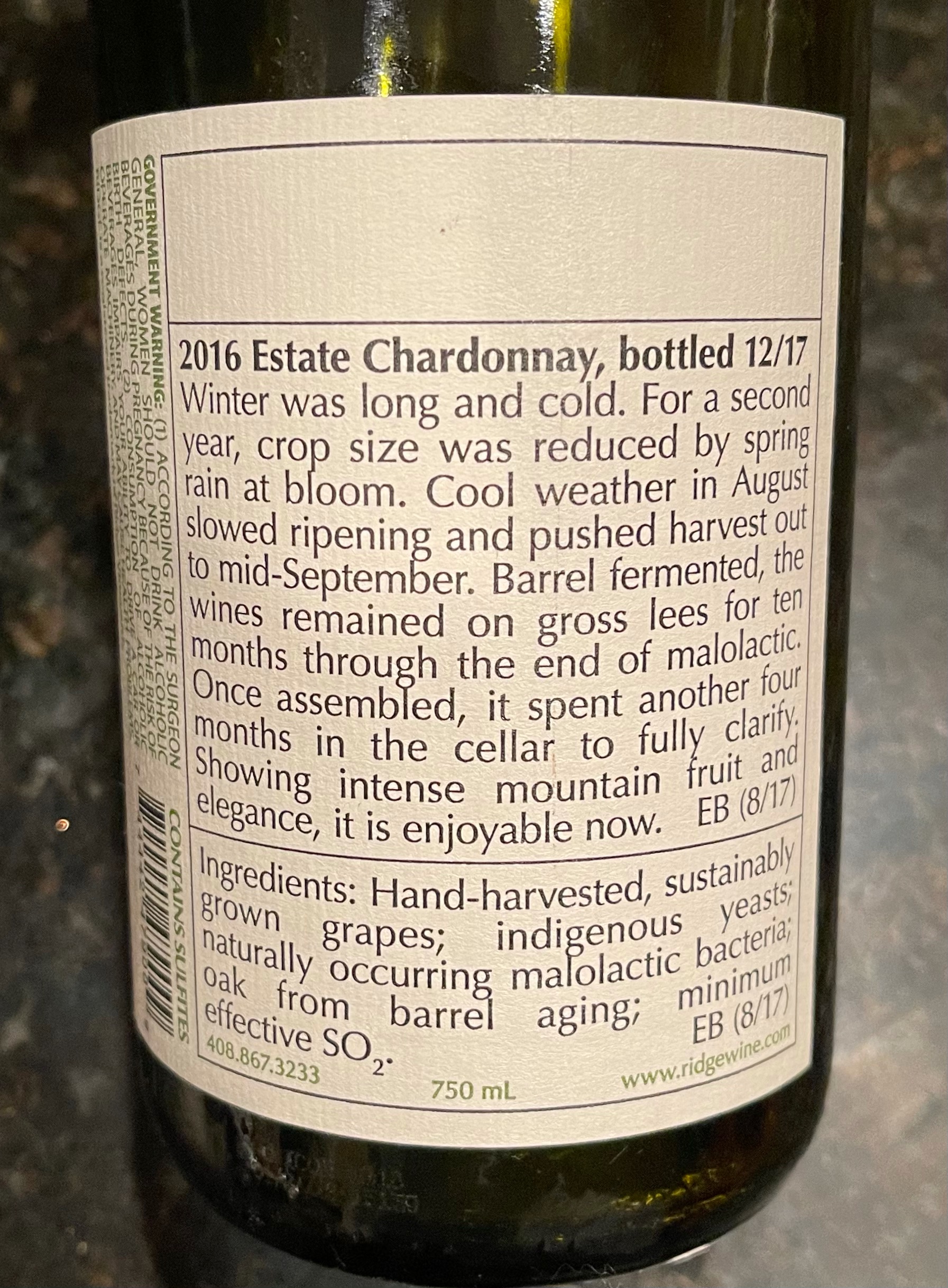
As further background on Ridge, I’d like the opportunity to discuss their winemaking practices as well. Calling their style “pre-industrial,” Ridge shies away from chemicals and additives prevalent in the industry nowadays. They ferment their wines only with natural yeast, do not use commercial enzymes or nutrients to affect color, flavor, or tannin in the wines, and are certified organic. Further, one of my favorite features of a bottle of Ridge is the back label that tells the winemaking process and lists ingredients, which is not common.

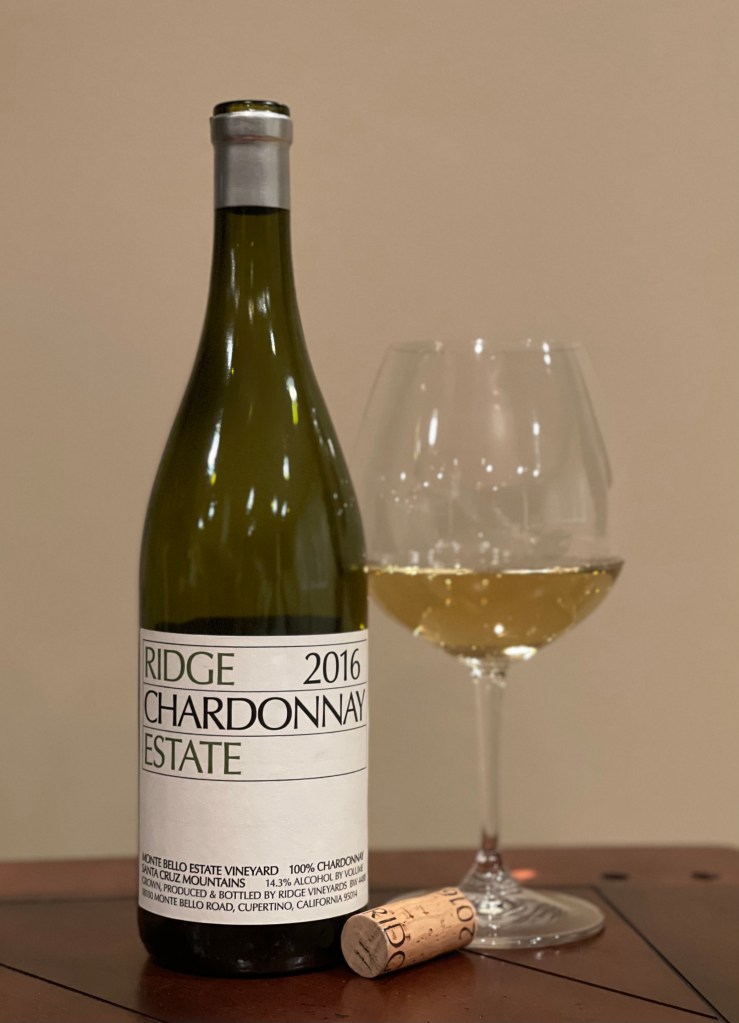
Today’s Wine: 2016 Estate Chardonnay

100% Chardonnay; 14.3% ABV

The 2016 Estate Chardonnay is transparent pale gold in color. Given some time to blossom in the glass, the nose showcases aromas of pear, golden apple, lemon zest, white florals, slight smoky reduction, crushed rock, butter, nutmeg, and exotic peppery spice. Once in the mouth, the wine displays notes of white peach, pineapple, golden pear, green apple, crème brûlée, chamomile, dill, dried vanilla, mild oaky spice, and bright stony mineral. This is medium- to full-bodied with racy medium (+) acidity, and oily and well-rounded mouthfeel, and a long finish.

Price: $55. I think there are better value Chardonnays out there closer to the $40 mark, however the pricing here is certainly not excessive. As always, the Ridge Estate Chardonnay is of impeccable quality and offers an incredibly enjoyable tasting experience now. The Ridge Monte Bello Chardonnay, priced $20 to $30 higher, is a very special wine though if picking between the two.

Profound Bourgogne Blanc From Perhaps the Greatest Name in Meursault

Today’s Story: Domaine Roulot

Domaine Roulot is a renowned Burgundy wine estate situated in the village of Meursault in the Côte de Beaune sub-region. Though Roulot’s history dates back to at least 1830 when Guillaume Roulot registered as a vigneron, the modern domaine traces its roots more directly to a 1930 founding and growing success following WWII under Guy Roulot. Guy came into some vineyard property through his marriage to Geneviève Coche, though he quickly set about purchasing additional vineyard parcels of village and 1er Cru classifications. Unique at the time, Guy vinified and bottled his wines by single vineyard, also mastering the lieu-dit practice of bottling a named vineyard without its own “legal” classification within the larger village. Guy made some of the greatest white Burgundy at the time, even later having his 1973 Meursault Charmes place second for the white wines at the Judgment of Paris in 1976. Sadly, Guy passed away suddenly and far too soon in 1982 and left his domaine in a precarious situation since his son Jean-Marc was in Paris studying acting. Though Domaine Roulot had several winemakers come in until Jean-Marc returned home, it wasn’t until 1989 when he fully took the reigns.

Shortly after taking over, Jean-Marc transitioned fully to organic viticulture and he has not used any herbicides since. Further, any treatments used in the vineyards ensure minimal if any impact on the natural microbial life amongst the vines. In the cellar, Jean-Marc crafts wines based on a philosophy that they should be what he likes to drink, not necessarily what the “modern palate” likes to drink. While many of the wines of Meursault can be rich and concentrated, Roulot’s wines are often described as chiseled, linear, precise, restrained, tense, and transparent. He achieves these descriptors through incredibly rigorous harvesting, very gentle pressing of the fruit, indigenous yeast fermentation, barrel aging for 12 months on lees followed by 6 months in stainless steel, and modest use of new oak of between 10% and 30%. Roulot even minimizes stirring the lees (and mainly does it in vintages of higher acidity), which is a practice more common with producers who like adding richness to the wines.

Today’s Wine: 2017 Bourgogne Blanc

100% Chardonnay; 13.2% ABV

The 2017 Bourgogne Blanc is transparent pale gold/straw yellow in color with water white variation around the rim of the glass. I decanted this for 2 hours due to its youth, and to be honest it probably could’ve decanted for longer. Once open, the nose showcases aromas of peach, green apple, apricot, white florals, matchstick, flint, wet river stone, dill, and almond. Meanwhile on the palate I get notes of golden pear, lemon zest, green apple skins, white peach, honeysuckle, crushed rock, light green herbs, flint, and hazelnut. This very linear and precise Bourgogne Blanc is medium- to full-bodied with gorgeous high acidity into a long finish. Not as intense as I was expecting, but give this at least 4-5 more years of cellaring before touching it.

Price: $90. This is no doubt a fantastic Bourgogne Blanc, and though I opened it young I think there are better values out there. If you can find this closer to $65-70 (and I know a few locations are still priced that way) I would be more intrigued. We shall see if I am proven wrong with more bottle age.

Champagne Charlie

Today’s Story: Champagne Charles Heidsieck

Charles Heidsieck is a well-known Champagne house established by Charles-Camille Heidsieck in 1851 in Reims when he was 29 years old. The grand-nephew of Florens-Louis Heidsieck who established the Champagne Heidsieck et Cie House, Charles grew up amongst the vines and became well-educated alongside a passion for fine Champagne. Quickly recognizing the untapped potential of the Champagne trade in America, Charles traveled to the country in 1852 and won the adoration of New York, titans of business, and the South for his Champagne. He even picked up the nickname Champagne Charlie (of which there is a song and movie titled) along the way thanks to his charm and astute business acumen.

With the success of his Champagne in America, Belgium, and England (amongst France of course), Charles made the audacious purchase of the breathtaking 3rd century chalk cellars known as the Crayères in 1867. Robbed of any light and noise 30 meters below ground, the Crayères can house millions of bottles of Champagne in perfect storage conditions where they age for the minimum four years but at times surpass 40 years. At minimum I suggest you take a look at pictures of these majestic cellars here, which are classified as an UNESCO World Heritage site.

One of the “smaller” top-tier and well-known Champagne houses, Charles Heidsieck consists of about 60 hectares of vines divided between the Marne and Aube departments. These vineyards are all farmed adhering to sustainable viticulture, and they are certified High Environmental Value. The house also holds long-term contracts with winegrowers and cooperatives from whom they purchase extra fruit. In the cellars, a large number of reserve wines have been set aside to provide blending capability into the non-vintage bottlings where, for example, the Brut Réserve consists of about 40% reserve wines with an average age of 10 years.

Today’s Wine: 2008 Brut Millésimé

60% Pinot Noir, 40% Chardonnay; 12% ABV

The 2008 Brut Millésimé is transparent but very vibrant medium gold in color, showcasing beautifully delicate effervescence as well. While this no doubt needs time in the cellar (maybe revisit in 5 years?), the nose displays enticing aromas of ripe pear, golden apple, lemon zest, honeysuckle, crushed rock, brioche, vanilla cream, and almond. The palate is much more tight at this stage, characterized by notes of green apple skins, lemon, lime zest, pineapple, chalk, hazelnut, and lees. This is medium- to full-bodied with racy high acidity and a very tight, precise, and linear attack into a long, long finish.

Price: $100 (though I’ve seen this priced closer to $85-90). I think this is an exquisite Champagne and certainly one I would buy multiple bottles of to cellar. This is a fantastic showing in a fantastic vintage, and I could easily see this bottling appreciating as it falls on more peoples’ radars.

Incredibly Impressive Willamette Valley Chardonnay

Today’s Story: Walter Scott Wines

Walter Scott Wines was established in 2008 by husband and wife Ken Pahlow and Erica Landon in the Willamette Valley of Oregon. Ken comes from a background in wine, which began in 1994 in production, sales, and harvests at St. Innocent Winery. He later moved to Patricia Green Cellars in 2009, coinciding with the first vintage of Walter Scott La Combe Verte Pinot Noir in exchange for harvest labor. Erica, on the other hand, has a background in the restaurant industry and wine education. Her impressive resume includes sommelier and GM for the Ponzi Family’s Dundee Bistro, wine director at one of Portland’s best restaurants Ten 01, and wine director for Bruce Carey Restaurants. Erica has also taught classes for Wine & Spirits Archive, WSET, and the International Sommelier Guild. Lastly I would be remiss if I forgot to mention the youngest member of the Walter Scott team, Lucille who is the daughter of Ken and Erica. She “joined the team” in 2014, the same year Ken and Erica quit their main jobs to focus 100% on Walter Scott.

Walter Scott sources their fruit from a number of growers in the Willamette Valley AVA, with many in the Eola-Amity Hills area around their “home base.” All of the growers are friends of Ken and Erica, who in their words are people they like to sit around a table with while enjoying a glass of wine. All of these vineyard partners practice dry farming without the use of herbicides, pesticides, or fungicides, while some are also organic or biodynamic. This meshes well with Walter Scott’s goal of producing single vineyard and blended bottlings from old vines that offer clonal diversity from expressive terroir.

In the cellar, Ken practices a more “dynamic” winemaking style in that he never follows a recipe and adapts vintage to vintage. The end goal is to purely let the wines speak for themselves and showcase each unique vineyard site with freshness and purity. Ken only ferments with native or ambient yeasts, minimizes punch-downs or extractive techniques, and remains committed in his attention to detail vintage to vintage in order to seek constant improvement. All of the wines age in French oak barrels, with each barrel a small part of the larger whole.

To learn more about Walter Scott Wines, view pictures of the team and vineyards, or purchase some bottles of your own, check out their website here.

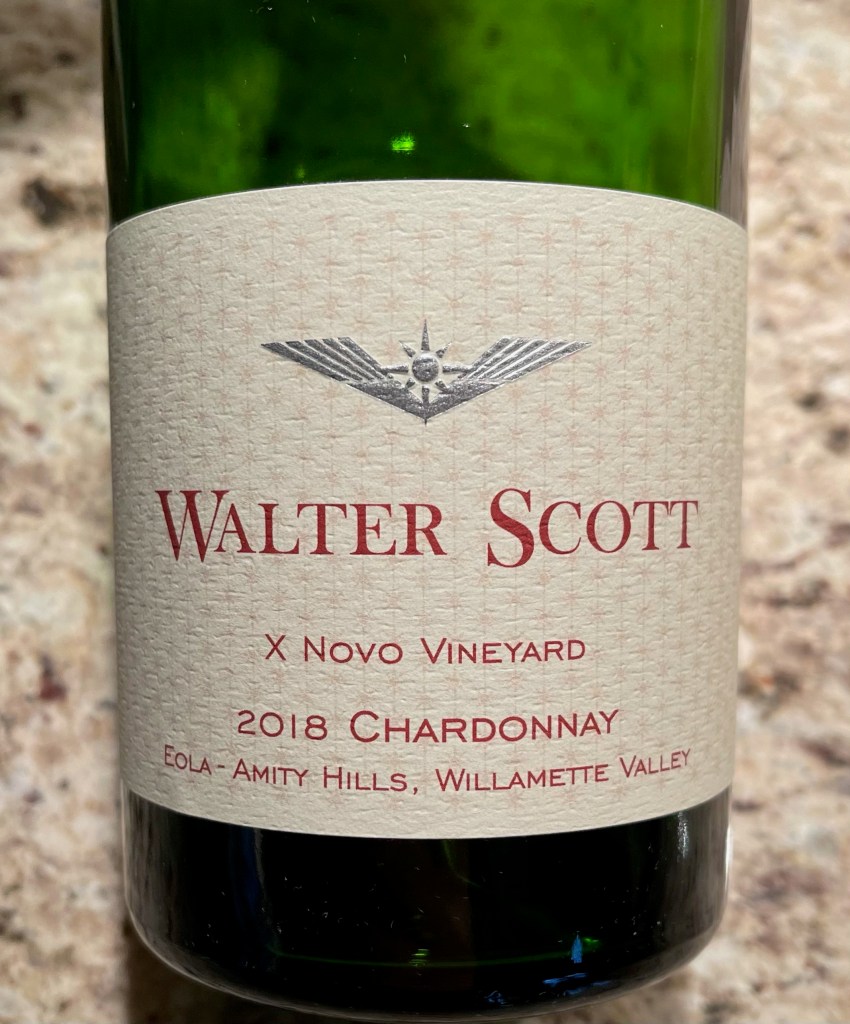
Today’s Wine: 2018 X Novo Vineyard Chardonnay

100% Chardonnay; 13% ABV

The 2018 X Novo Chardonnay is transparent medium gold in color with straw yellow hues. This is an absolutely gorgeous wine from first whiff, offering up a nose of lemon peel, golden apple, quince, dried gravel, reduction (gunpowder and smoke), petrol, limestone, and saline mineral. The palate is equally beautiful, though still pretty tight due to its youth with notes of green apple skins, golden pear, lemon curd, white florals, flint, and crushed rock minerality. This is medium- to full-bodied with gorgeous and mouthwatering high acidity while being very precise and crisp into a long finish. Definitely give this a few more years in the cellar, or drink it over multiple hours now.

Price: $75 (shared by a good friend who paid $65). I think this is a great value Chardonnay, and I know prices are already on the rise as this gets more recognition. Though young, this opened for us and was one of the wines of the night in an incredible lineup, also beating another 2018 Willamette Valley Chardonnay we put it up against.

Young and Rather Tropical Willamette Valley Chardonnay

Today’s Story: Antica Terra

I first wrote about Antica Terra back in January 2020 with the 2017 Botanica Pinot Noir, though these wines hold a fairly sizable allocation in our cellar and I was destined to return to them sooner or later.

Antica Terra was established in 2005 by Scott Adelson, John Mavredakis, and Michael Kramer, three friends and partners who had collaborated before and dreamed of owning a vineyard together. This being said, vines were first planted in 1989 on the property, an 11 acre vineyard on pre-historic seabed in the Eola-Amity Hills of Oregon’s Willamette Valley. Having taken ownership of their new vineyard, Scott, John, and Michael started seeking a winemaker and their crosshairs quickly fell upon Maggie Harrison. Maggie began her winemaking career at Sine Qua Non (known for $200-$1,000+ bottles of cult Rhone varietal wines) working for Manfred Krankl and her expertise was quickly realized. In 2004, Manfred encouraged her to begin her own Syrah project on the side, and Lillian was born (I reviewed two of these Syrahs previously). Maggie worked tirelessly on her passion project wines while still tending to barrels at Sine Qua Non, demonstrating her pure passion for the craft. When Scott, John, and Michael asked Maggie to become their winemaker, she refused profusely though the three friends ultimately convinced her to simply visit the property to offer her opinions of the vineyard. 26 seconds after Maggie stepped foot into the vineyards and observed the fossils, oaks, and vines, “she found herself hunched beneath one of the trees, phone in hand, explaining to her husband that they would be moving to Oregon.”

The vineyard of Antica Terra is rather intense, both in appearance above the earth and underground for the vines. The vines find home amongst fossilized oyster shells and sandstone with no topsoil, leaving them to struggle for nutrients and in turn producing incredibly unique fruit. Aboveground, the vineyard is strewn with boulders, steep grades, and vines that (due to the soil) appear spindly and frail. Fruit for Antica Terra wines forms in tiny clusters with thick-skinned grapes that are half the size that is typical for their varieties and the canopy of these plants is incredibly sensitive. Maggie provides immense care and attention to these delicate vines, which culminates into unique and immeasurably profound wines. Antica Terra produces four Pinot Noir bottlings, two Chardonnays, and one Rosé.

To explore the wines of Antica Terra, join the mailing list, or plan a visit, check out their website here.

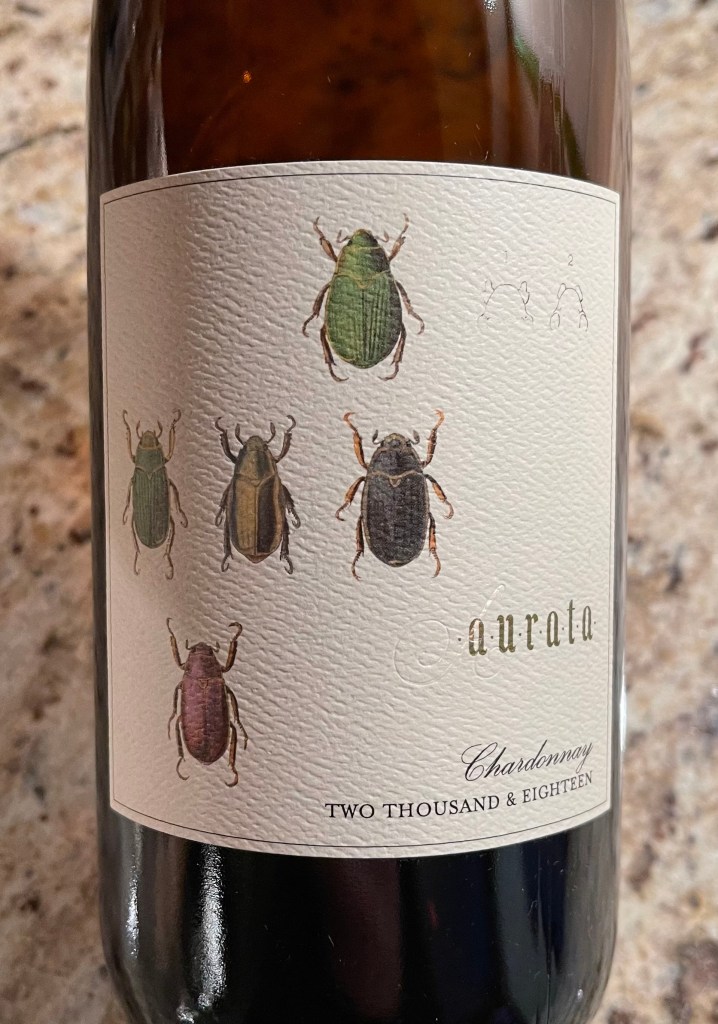
Today’s Wine: 2018 Aurata Chardonnay

100% Chardonnay; 14.1% ABV

The 2018 Aurata Chardonnay is transparent medium to deep gold in color. We let this slow ox for probably an hour or two before drinking it over the following hour. The nose is much more tropical than I imagined, showcasing aromas of white peach, apricot, pineapple, lemon zest, honeysuckle, wet river stone, and delicate green herbs. Meanwhile the palate is tropical as well with notes of lemon, green apple, tropical citrus, white florals, dill, chalk, and gravel. This is medium- to full-bodied with vibrant high acidity and is very dry and nicely rounded into a medium (+) length finish.

Price: $110. I’m very anxious to return to this bottling in another 5 years or so, as it was much different than I was expecting in its youth. On the value side of things, however, I think there are better options out there sub-$100. I remain a huge fan and proponent of Antica Terra Pinot Noir, though.

Lightning in a Bottle

Today’s Story: Ceritas Wines

I previously wrote about Ceritas back in June when I reviewed the 2017 Porter-Bass Vineyard Pinot Noir, and more recently when I reviewed the 2016 Peter Martin Ray Vineyard Cabernet Sauvignon. As these wines can be hard to come by off the mailing list or in restaurants, I jumped at the opportunity to revisit them again today.

Ceritas Wines is a small, family-owned winery spearheaded by husband and wife duo John and Phoebe Raytek. John and Phoebe source their fruit from trusted vintners mainly in the West Sonoma Coast and Santa Cruz Mountains, with all sites practicing sustainable or organic viticulture. John is highly involved in the vineyards they source from, and in many cases the vintners only sell fruit to Ceritas and are labeled “Monopoles.” Considering himself a winemaker of the Old World style, John believes that fruit should lead the way throughout the winemaking process and he is merely there to watch over, listen, and learn about each unique site. In the cellar, John practices minimal intervention but “flexible” winemaking, with the wines meant to showcase with honesty and transparency the terroir of each specific vineyard site.

Today’s Wine: 2016 Trout Gulch Vineyard Chardonnay

100% Chardonnay; 12.5% ABV

The 2016 Trout Gulch Chardonnay is transparent medium gold/yellow in color with water white variation along the edges of the glass. When I first pulled the cork, I felt like I was in Chassagne or Puligny, however given 30-45 minutes to open up this wine transported me to Chablis and I never wanted to leave. The nose is one that could bring a tear to a glass eye, showcasing aromas of lemon curd, Golden Delicious apple, ripe pear, stone fruit, white wildflower, flint rock, white smoke, shaved vanilla bean, cream, saline solution, and briny mineral. And if you haven’t already, break out the tissues because the palate displays notes of yellow apple, quince, lemon and lime zest, peach, white florals, incense, dill, limestone, wet slate, seashell, saline mineral, and white exotic spice. This is medium-bodied with high acidity (which I’ll touch on in a second), a perfectly rounded mouthfeel, and a long finish of about 1 minute. While a chuggable wine, you would immediately regret “wasting” something so pure if you went that route. Oh and yes, the wine’s acidity demands that I address it alone. Is it racy like a Formula 1 car heading to the finish? Is it like sucking on a mouthful of razor blades? Is it like drinking liquid lightning? Or is it perhaps all of the above? Please, you tell me. But while I wait, at risk of attack, I’ll say this is probably the greatest domestic Chardonnay I’ve ever had.

Price: $80. Just buy it if you get the chance.