Boutique Chilean Project From a Rockstar Team

Today’s Story: Aristos

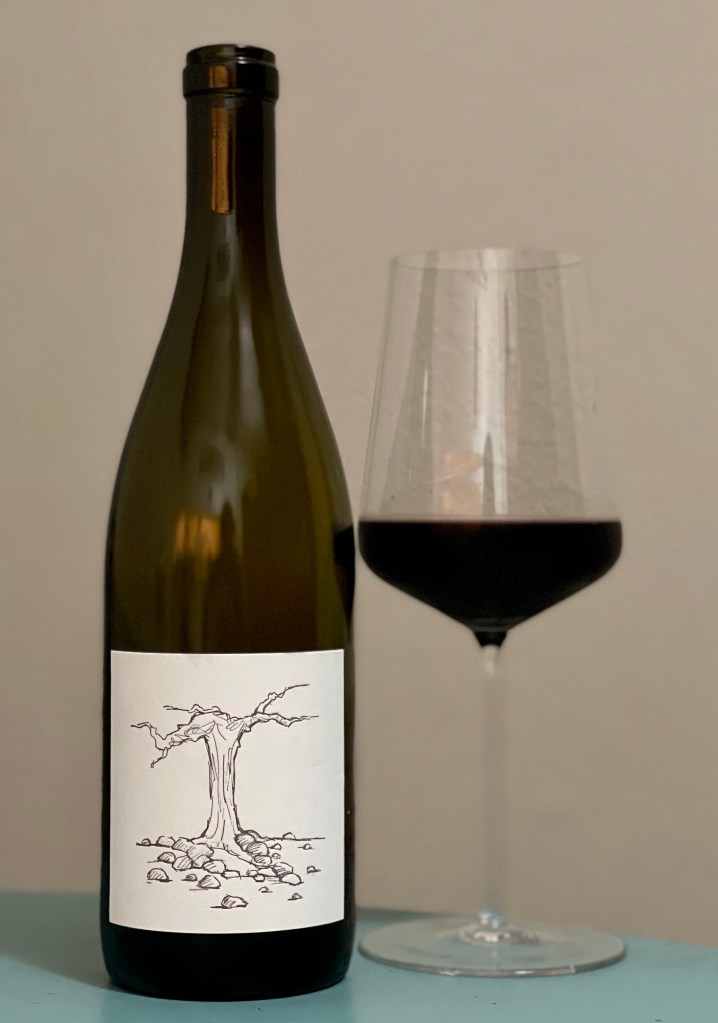
Aristos is a very small winemaking project dreamt up in 2003 by Chilean winemaker Francois Massoc, Chilean terroir expert Pedro Parra, and Burgundy legend Louis-Michel Liger-Belair of Vosne-Romanée. The idea for Aristos came about in a cellar in Vosne-Romanée, with the trio discussing their mutual admiration for terroir and the immense potential of Chile. While the initial idea was to pursue Pinot Noir winemaking in Chile, at the time this wasn’t possible given their knowledge of terroir so Aristos commenced with Chardonnay, Cabernet Sauvignon, Syrah, and Merlot. The first commercial release was 2007, with 10 barrels of Barón (Cabernet Sauvignon, Merlot, and Syrah) and 2 barrels of Duqueza Chardonnay. Over time Aristos grew to about 30 barrels per year (~750 cases) across three wines, and they planted their first Pinot Noir in 2011.

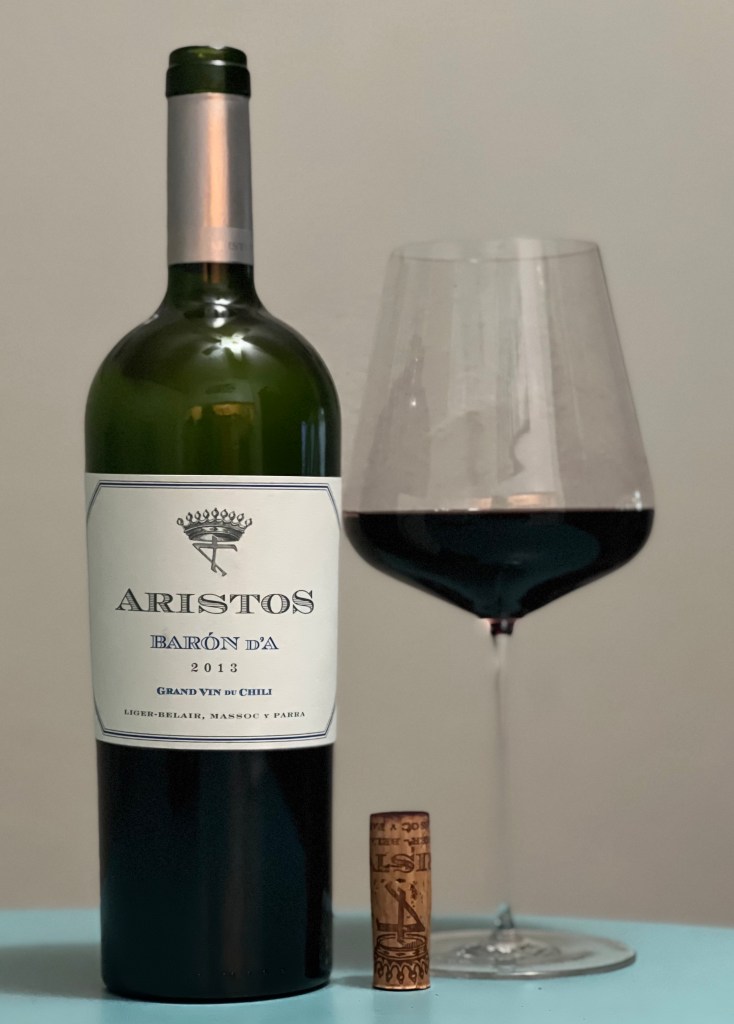
Today’s Wine: 2013 Barón d’A

74% Cabernet Sauvignon, 26% Merlot; 15% ABV

The 2013 Barón d’A is deep ruby in color. Given about an hour to open up, the aromas are of medium (+) intensity and the rather complex nose showcases notes of blackberry, blueberry, plum, licorice, cigar box, damp earth, cracked black pepper, chopped green herbs, vanilla, and oak-driven baking spice. Flavors on the palate are also of medium (+) intensity, displaying spiced plum, black cherry, blackberry, tobacco, green pepper, oregano, iron, underbrush, and allspice. This dry red is full-bodied with medium acidity, medium (+) but silky and refined tannins, high alcohol, and a medium (+) length finish. While this is slightly jammier than I expected, it is rather complex and shows some Old World charm behind all the New World fruit. 283 cases produced.

Price: $54. I think this is a very fair price for the bottle and offers a solid value proposition, if you can find it. While this is a bigger wine than I typically lean toward, the complexity and how well it’s made prove rather enjoyable.
Carneros Chardonnay Drinking Beautifully With Some Age

Today’s Story: Auteur Wines

Auteur Wines, established in 2003, is a relatively small producer of Pinot Noir and Chardonnay in California’s Sonoma Coast. A family venture, Auteur is owned and operated by husband and wife Kenneth and Laura Juhasz. Kenneth found his passion for wine during college while working at restaurants and wine shops, ultimately falling in love with Pinot Noir and the endless possibilities of the variety. He worked harvests in the Willamette Valley, Napa, and New Zealand before starting Auteur with Laura. Laura, on the other hand, grew up in rural Wisconsin and worked in pharma when she met Kenneth in Oregon. Ultimately the two moved to Sonoma to start their passion project of making wine.

Auteur works closely with vineyard partners, sourcing from some of the greatest sites throughout the Sonoma Coast. While Gaps Crown, Ferrington, and Savoy may sound familiar for their Pinot Noir and Hyde for their Chardonnay, Auteur sources from other sites as well of equally incredible pedigree.

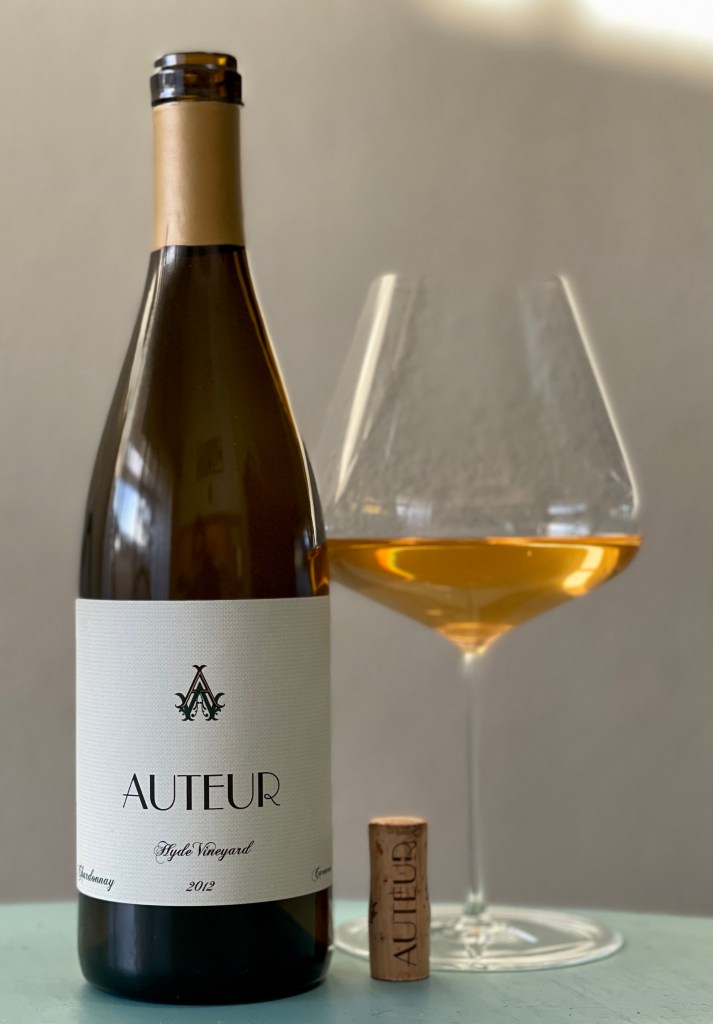
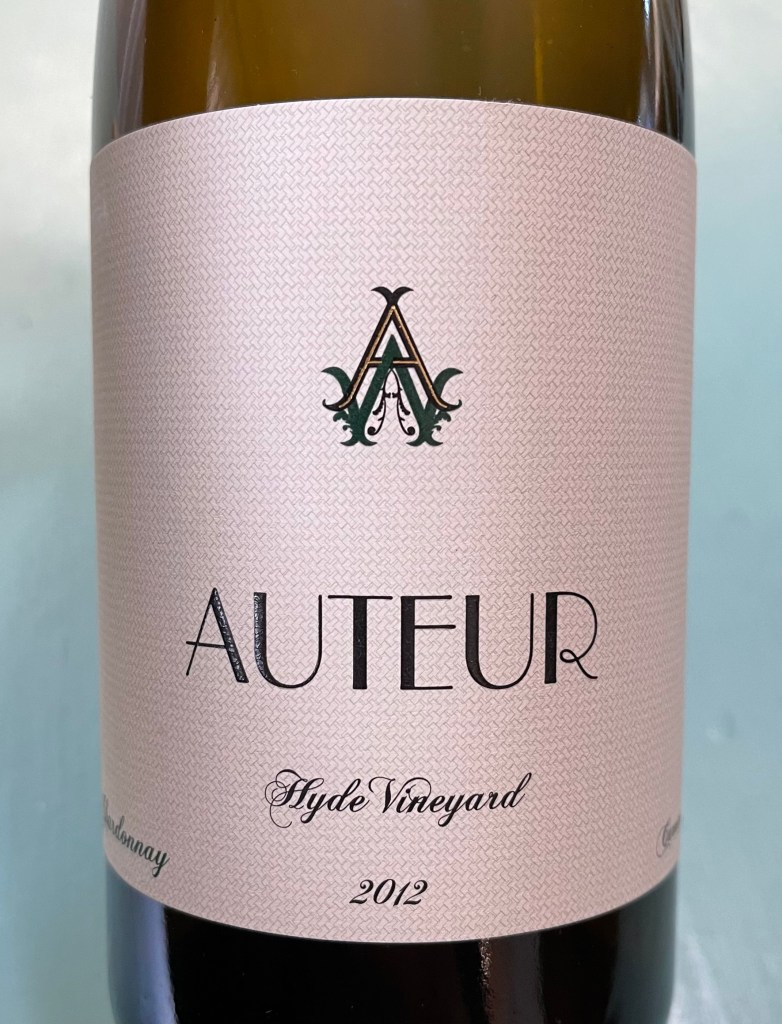
Today’s Wine: 2012 Hyde Vineyard Chardonnay

100% Chardonnay; 13% ABV

The 2012 Hyde Vineyard Chardonnay is deep gold in color, certainly showing some age. Given some time to blossom in the glass, the aromas are of medium (+) intensity and the nose showcases notes of baked pear, yellow apple, apricot, orange marmalade, honey, toasted nuts, buttercream, and stony mineral. Meanwhile the flavors are also of medium (+) intensity and the palate displays notes of baked yellow apple, golden pear, lemon, white florals, brioche, dried vanilla, almond, and mineral. This dry white is medium- to full-bodied with medium (+) acidity, medium alcohol, and a medium length finish.

Price: $40. This is drinking incredibly well right now, both showcasing its age but maintaining acidity and proving complex as it opens in the glass. While I’d love for the finish to be a bit longer, given the age and quality I think this is a fair price if you find it today.

A Fun Take on Cabernet Franc

Today’s Story: Ryme Cellars

Ryme Cellars was established in 2007 by husband and wife team Ryan and Megan Glaab. Ryan and Megan met while both working harvest at Torbreck Winery in Australia, and since then between the two of them they’ve held positions at Pax Wine Cellars, Peay Vineyards, Sine Qua Non, and Marcassin. Ryan and Megan started Ryme with one ton of Aglianico, later expanding into Vermentino, Ribolla Gialla, Cabernet Sauvignon, and Cabernet Franc. Most recently they even added Chardonnay and Pinot Noir to the portfolio. The Ryme wines are those that Ryan and Megan like drinking, both by variety and style standards. Their fruit comes from sustainably- or organically-farmed vineyards, and winemaking is rather simple without cultured yeasts, temperature control, or added enzymes. Most of the reds ferment whole cluster while most of the whites ferment on the skins, and aging occurs in used French oak barriques before bottling unfined and unfiltered.

Today’s Wine: 2017 Alegria Vineyard Cabernet Franc

100% Cabernet Franc; 12.5% ABV

The 2017 Alegria Vineyard Cabernet Franc is medium to deep ruby in color. Given some time to open up in the glass, the wine showcases aromas of medium (+) intensity including black cherry, redcurrant, blackberry, plum, violet, pine, mild cedar, and cocoa powder. Meanwhile the flavors are also of medium (+) intensity, with the palate displaying notes of cherry, black raspberry, blueberry, plum, licorice, sweet tobacco, dried green herbs, and gravel. This dry red is medium-bodied with medium (+) acidity, medium (+) and dusty tannins, medium alcohol, and a medium length finish.

Price: $27. I think this offers pretty solid value given the balance, intensity, and complexity that evolved in the glass. While it could have a longer finish to drive it home, there’s too much good here for the price level.

Textbook Syrah From the Rocks District of Oregon

Today’s Story: Big Table Farm

Big Table Farm is a relatively small winery and farm established in the Willamette Valley of Oregon in 2006 by winemaker Brian Marcy and artist/farmer Clare Carver. Brian worked with wine in Napa Valley prior to starting Big Table Farm, spending a decade with stints at heavyweights like Turley Wine Cellars, Neyers Vineyards, Blankiet Estate, and Marcassin to hone his craft. Meanwhile Clare is a gifted artist and designs wine labels, many of which have been awarded.

Dedicated to Pinot Noir, Chardonnay, and small amounts of Pinot Gris and Syrah, Big Table Farm commenced with only 150 cases of wine and has grown to a few thousand cases today. The wines are made in a minimal style, designed to showcase each unique source’s terroir and all wines are bottled unfined and unfiltered. With a major emphasis on sustainability and Clare’s passion for farming, the duo’s 70 acre property also acts as a working farm where they produce seasonal vegetables and raise animals. A visit to the property will not only showcase the wines, but you will see hens, pigs, goats, draft horses, and cows wandering about with an area dedicated to bee hives as well.

I previously wrote about the 2018 Yamhill-Carlton Pinot Noir2020 Laughing Pig Rosé2014 Willamette Valley Chardonnay, and 2019 The Wild Bee Chardonnay from Big Table Farm.

Today’s Wine: 2018 Funk Estate Vineyard Syrah

100% Syrah; 15.1% ABV

The 2018 Funk Estate Vineyard Syrah is opaque deep purple in color, nearly black at its core. After about an hour to open up, the aromas are of medium (+) intensity and the nose showcases notes of blueberry, blackberry, plum, violet, green olive, black pepper, charred green herbs, and rocky minerality. Meanwhile the flavors are also of medium (+) intensity, with the palate displaying blackberry, black plum, mulberry, blueberry, violet, a hint of smoke, crushed rock, and cracked black pepper. This dry red is full-bodied with medium acidity, medium (+) but fine-grained tannins, high alcohol, and a medium (+) length finish. 134 cases produced.

Price: $48. This is a very solid Syrah and one that offers decent value in my opinion. It’s incredibly true to variety and showcases the terroir of the Rocks District beautifully, all while remaining fairly complex with good intensity and balance.

Merlot as It Should Be

Today’s Story: Enfield Wine Co.

Enfield Wine Co. is a relatively small family-owned and operated winery established by John Lockwood and Amy Seese in 2010. John started working in the wine industry in 2004 at Heron Lake Vineyard, followed by harvests at Littorai, Bodega Melipal in Argentina, and Failla Wines. John remained with Failla for five years managing and farming their Sonoma Coast and Russian River estate vineyards, ultimately starting Enfield as a small passion project. In 2013, John left Failla and devoted his time entirely to Enfield.

Enfield focuses primarily on terroir as a starting point, working with small independent growers across a range of regions to source their fruit. John and Amy purchase fruit from Antle Vineyard and Brosseau Vineyard in the Chalone AVA, Haynes Vineyard in Coombsville, Heron Lake Vineyard in Wild Horse Valley, Jesus & Patricia’s Vineyard in Fort Ross-Seaview, and Shake Ridge Vineyard in Amador County. From these sites they acquire a range of varieties including Pinot Noir, Chardonnay, Syrah, Chenin Blanc, Cabernet Sauvignon, and Tempranillo amongst others, all with varying vine age as well. John’s philosophy is to harvest his fruit for balance and ferment the wines naturally in order to showcase each unique terroir, eschewing a heavy-handed winemaking style. The wines are often fresh, lively, and mineral-driven, though John does enjoy exploring esoteric bottlings as well.

I previously wrote about the 2019 Jurassic Park Vineyard Chenin Blanc from Enfield.

Today’s Wine: 2018 Michael Black Vineyard Merlot

100% Merlot; 13.9% ABV

The 2018 Michael Black Vineyard Merlot is deep ruby in color with deep purple hues in the bowl of the glass. I decanted this for 2.5 hours due to its youth, which seemed perfect. The aromas are of medium (+) intensity, with a rather complex nose showcasing notes of black plum, blackberry, blueberry, violet, licorice, cigar box, clay, dried green herbs, baking spice, and cocoa. Meanwhile the flavors are also of medium (+) intensity and the palate displays notes of blackberry, blueberry, black raspberry, black cherry, sweet tobacco, cedar spill, crushed rock, and eucalyptus. This dry red is medium- to full-bodied with medium acidity, medium (+) but fine-grained tannins, medium (+) alcohol, and a long finish.

Price: $45. I think this offers rather strong value, and it’s a fantastic representation of the Merlot variety. This is very well-balanced, offering great depth and length as well all while being rather young. For those wine drinkers who don’t like Merlot, I’d suggest giving it another shot with this bottling.

Terroir Driven Pinot From the Sta. Rita Hills

Today’s Story: Tyler Winery

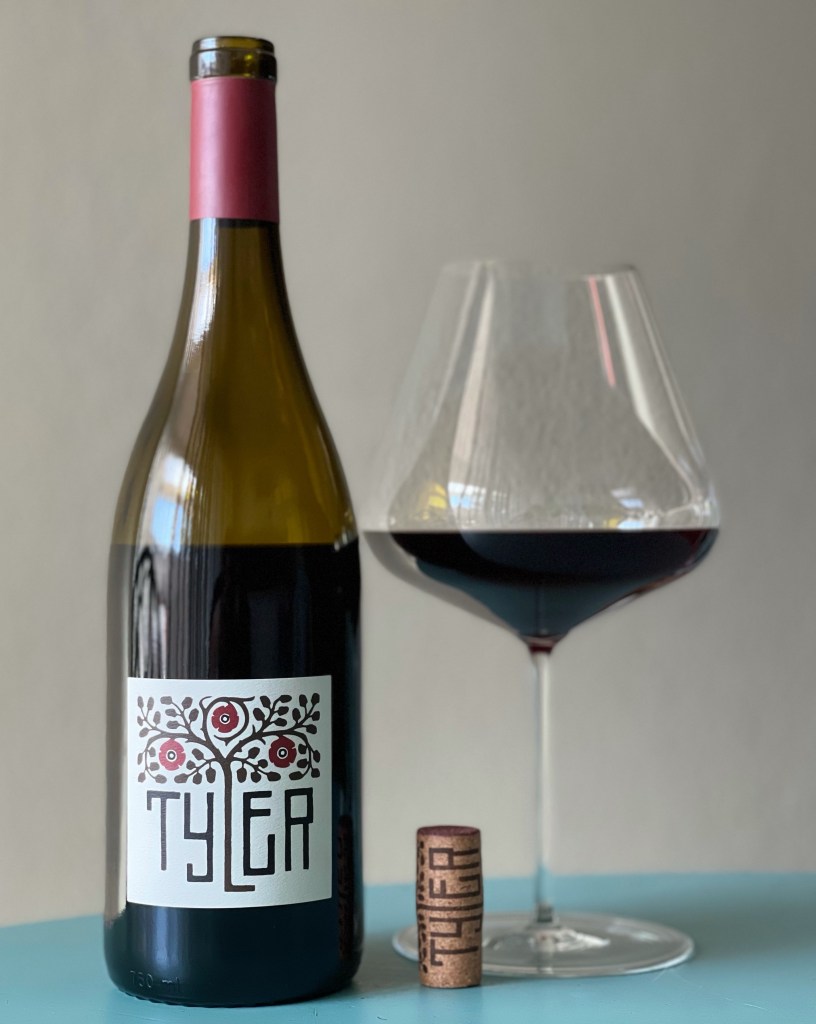
Tyler Winery is a relatively small winery and estate established by Justin Tyler Willett in 2005. At the time, Justin was assistant winemaker at Arcadian Winery and honed his craft with Pinot Noir and Chardonnay while maintaining several barrels in the corner of the cellar that ultimately became Tyler. Tyler Winery sources all of their fruit from Santa Barbara County, with major emphasis in the Sta. Rita Hills and more recently the Santa Maria Valley as well. Within the Sta. Rita Hills, Justin sources from acclaimed sites including Bentrock, La Encantada, La Rinconada, Sanford & Benedict, and Zotovich Family. In the Santa Maria Valley, Justin sources from Dierberg and the highly-regarded Bien Nacido Vineyard. In the past few years, Justin and his wife Amanda also purchased their first estate vineyard, named Mae Estate Vineyard, in the Sta. Rita Hills. In 2017, they planted 28 acres to Chardonnay, Pinot Noir, and Syrah which were transplanted from vine materials sourced from trusting partners in 2015. The 2019 vintage marks the first from this estate site.

On the winemaking side, all vineyards practice organic viticulture and fruit is harvested by hand during the night. Hand-sorting occurs at the winery, then native yeast fermentation begins for both Chardonnay and Pinot Noir in large oak vats. Wines are barreled down once dry, and new oak usage varies by variety, block, vine age, and vintage though the preference seems to go toward neutral oak. After a year or so in barrel, the wines are racked, blended, and returned to barrel for several more months. When ready, the wines are usually bottled unfined and unfiltered with the end result meant to showcase the unique terroir of each vineyard site or the appellation as a whole.

To learn or explore Tyler further, check out their website here.

Today’s Wine: 2019 Sta. Rita Hills Pinot Noir

100% Pinot Noir; 13.2% ABV

The 2019 Sta. Rita Hills Pinot Noir is pale ruby in color. I let this open up for 45 minutes to an hour in the glass and it really blossoms. The aromas are of medium (+) intensity, with the nose showcasing notes of black cherry, stemmy strawberry, licorice, new leather, game, gravel, damp earth, thyme, and some oaky spice. Meanwhile the flavors are also of medium (+) intensity, incorporating notes of tart cherry, black raspberry, spiced plum, rose, sweet tobacco, cured meat, crushed rock, charred green herbs, and mild baking spice. This dry red is light- to medium-bodied with medium (+) acidity, medium (-) tannins, medium alcohol, and a medium (+) length finish.

Price: $38 from the winery (I found it for $34 retail). I find this to be a rather solid value for domestic Pinot Noir, especially if you can find it closer to the $30 mark which seems reasonable with some searching. The wine is a very good expression of the Sta. Rita Hills, with balance, length, intensity, and complexity to match (and at such a young age).

Gorgeous Sonoma Coast Syrah

Today’s Story: Pax Mahle Wines

Pax Mahle Wines was established in 2000 by Pax and Pam Mahle with a focus on Syrah and more “esoteric” varieties that can thrive in the cooler climate vineyards of Sonoma County and Mendocino. Pax and Pam moved to California wine country in 1997, though after a few years with Dean & DeLuca sourcing wines Pax decided he wanted to move into the production side of the wine business. Though Pax quickly rose to stardom producing Rhône variety wines (namely his Syrah), he expanded into working with Trousseau Gris, Chenin Blanc, Gamay Noir, and Mission with similar success. Pax farms his vineyards eschewing the use of chemicals and crushes his fruit by hand and foot as part of his minimal intervention philosophy. Pax only uses natural yeasts during fermentation and sulfur is added as minimally as required for stabilization only. Thanks to the high quality vineyard sites and his winemaking philosophy, Pax’s wines are magnificent representations of the varieties and terroir from which they come.

I previously wrote about the 2017 Sonoma Hillsides Syrah from Pax.

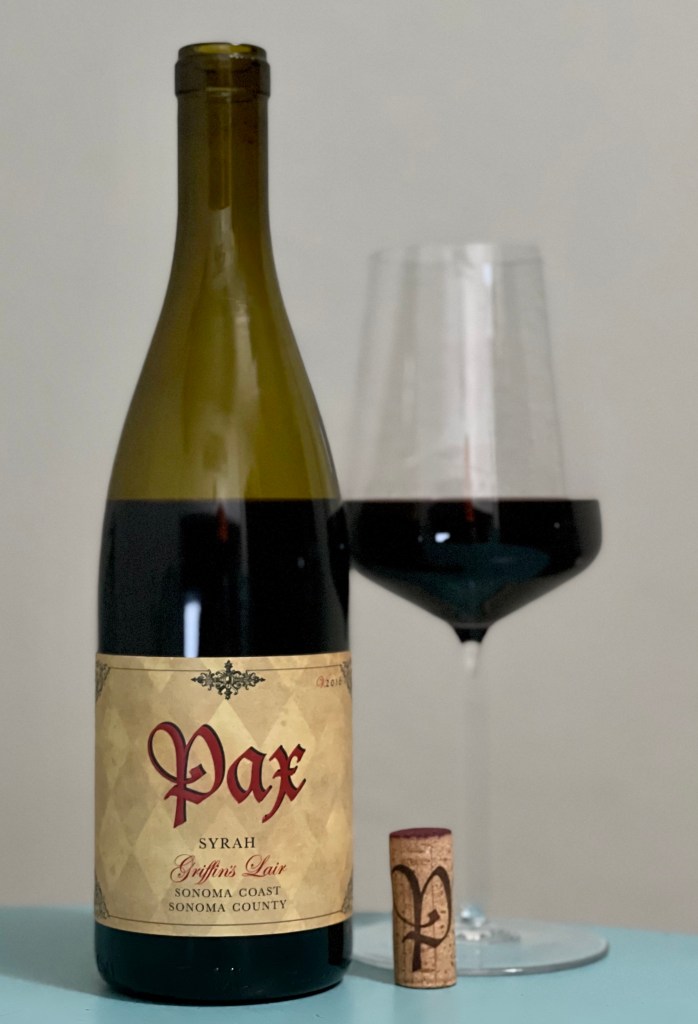
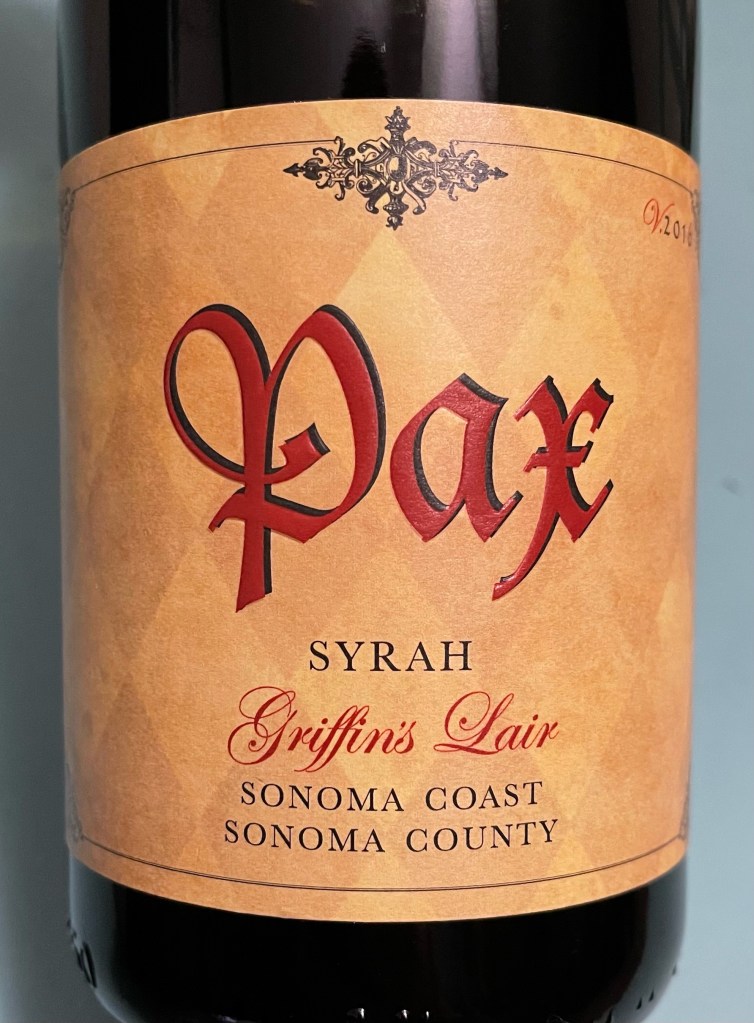
Today’s Wine: 2016 Griffin’s Lair Syrah

100% Syrah; 13.2% ABV

The 2016 Griffin’s Lair Syrah is deep ruby in color but with deep purple hues in the bowl of the glass. I let this open up in the glass for about an hour, though I think decanting is the proper move. The aromas are of medium (+) intensity, with the nose showcasing notes of blueberry, blackberry, plum, violets, pine, cracked pepper, iron, and crushed rock. Meanwhile the flavors are also of medium (+) intensity and the palate displays notes of blueberry, black plum, black cherry, sweet tobacco, mild smoke, cracked green peppercorn, charred green herbs, and chalk. This dry red is medium-bodied with medium (+) acidity, medium (+) but fine-grained tannins, medium alcohol, and a medium (+) length finish. Very good quality, though I think patience will be further rewarded by cellaring this bottling.

Price: $60 (I found it for $50). I think this is somewhere between the fairly-priced and good value status, especially if you find it for around $50 like I did. There’s a great Old World charm to this wine, while the complexity and intensity are quite solid. It is still rather youthful though, so decant this or give it a couple more years.

Young but Promising Santa Barbara County Pinot Noir

Today’s Story: Liquid Farm

Liquid Farm is a Chardonnay-focused winery established in 2009 in the Sta. Rita Hills AVA of Santa Barbara County, California. Founded by Jeff and Nikki Nelson, Liquid Farm started with four barrels of wine and the dream to produce Old World style Chardonnay while supporting local viticulture. Two of these first four barrels showcased a more mineral-driven profile that reminded Jeff and Nikki of Chablis so they named it White Hill after the white chalky hills of Chablis. The other two barrels showcased warmer tones and fuller profiles reminiscent of Meursault, so they named that wine Golden Slope after the Côte d’Or. Though Liquid Farm expanded their portfolio over time, they still focus on four Chardonnay bottlings as well as a rosé and small amounts of Pinot Noir.

Sticking to their love of terroir-driven wines, the winemaking philosophy at Liquid Farm is rather hands-off. Under the guide of winemaker James Sparks, winemaking follows the path of minimal intervention from manual harvest through to native yeast fermentation and aging in neutral oak barrels. The team makes no machine adjustments or additions to the wine in order to preserve a sense of place and true-to-variety profile, ultimately even letting the wines go through malolactic fermentation naturally. Given the cool climate of Sta. Rita Hills, these wines are often bottled with higher natural acidity and lower alcohol which makes them perfect table wines for anyone who appreciates the style and an expression of terroir.

I previously reviewed the 2016 Golden Slope Chardonnay from Liquid Farm. You can also check out their website here.

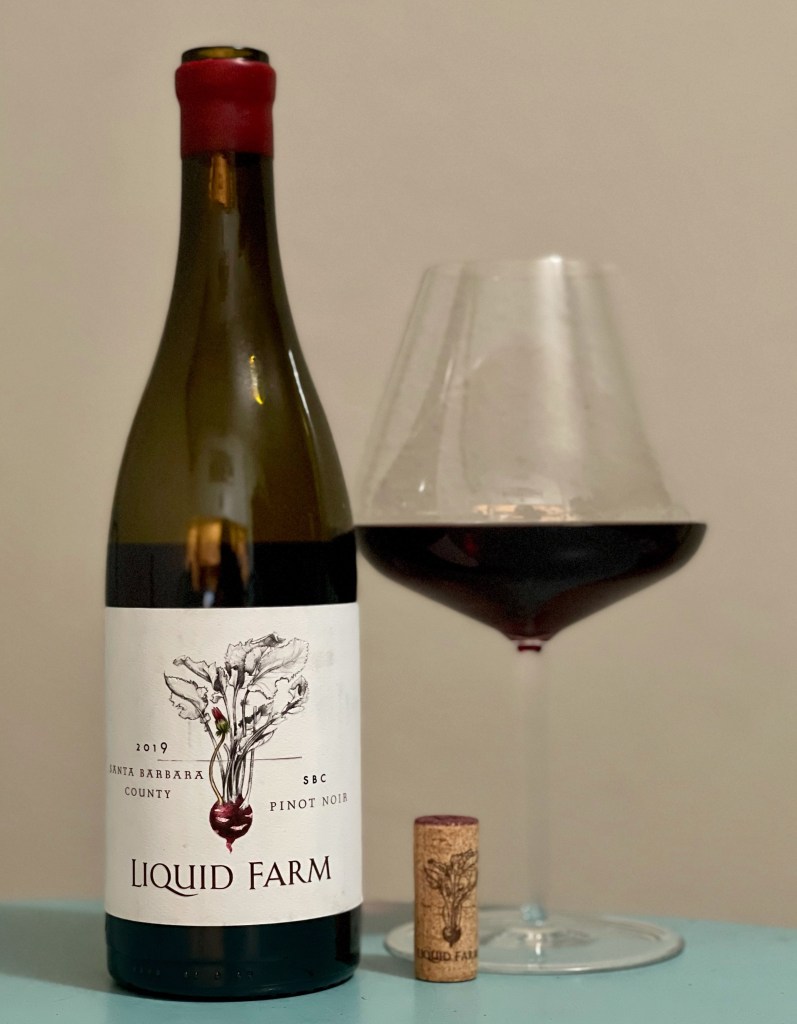
Today’s Wine: 2019 SBC Pinot Noir

100% Pinot Noir; 13% ABV

The 2019 SBC Pinot Noir is pale ruby in color. Due to the wine’s youth, I let this open up in the glass for about 45 minutes and it blossomed more and more as I drank it. The aromas are of medium (+) intensity, with the nose displaying notes of ripe red cherry, raspberry jam, cranberry, leather, violet, cola, clove, and very faint cedar. Meanwhile the flavors are also of medium (+) intensity and the palate showcases notes of black raspberry, strawberry, cherry cola, sweet tobacco, clove, cracked pepper, and a touch of ground herbs. This dry red is medium-bodied with medium (+) acidity, medium (-) tannins, medium alcohol, and a medium length finish. Fruit on this right now is gorgeous, though I’d recommend holding onto this for another year or two and I wager you’ll be rewarded as everything comes together.

Price: $45 (I found it for $40). I think this is pretty fairly-priced, particularly closer to the $40 level and with many stores selling this for $50. It’s a bit richer than I was expecting, though I think some of this can be attributed to youth and the wine should integrate well over the years to come. High quality is there, and this does a solid job of representing Santa Barbara County Pinot Noir.

Non-Vintage Grower Champagne with Remarkable Depth and Precision

Today’s Story: Champagne Agrapart & Fils

Champagne Agrapart & Fils is a grower Champagne house established by Arthur Agrapart in 1894. Situated in the village of Avize in the Côte de Blancs, the Agrapart holdings include 12 hectares (30 acres) of predominantly Chardonnay in mostly Grand Cru vineyards in Avize, Oger, Cramant, and Oiry. Today under the guide of fourth generation Pascal Agrapart (joined in 1984), the vineyards are farmed organically (and they have been for some time) while average vine age hovers around 40 years with many of the vines aged 70 years or older. Agrapart produces roughly 5,400 cases or less of Champagne each vintage, partially in an effort to maintain the highest quality standards both in the vineyards and in the cellar. At the end of the day these Champagnes are meant to show a true sense of place, so winemaking is rather hands-off including native yeast fermentation, long aging on the lees, and used-oak barrel aging. Come bottling, each wine is bottled unfined and unfiltered.

Agrapart produces seven wines, beginning with the entry-level 7 Crus that I am reviewing today. The 7 Crus is a non-vintage bottling, made by blending two vintages together with fruit sourced from four Grand Cru vineyards and three 1er Cru vineyards. Next up is the non-vintage Terroirs bottling, which is a Blanc de Blancs (100% Chardonnay) sourced from only Grand Cru vineyards and made up of two vintages. To wrap up the non-vintage selections, the Complantée bottling is a field blend of today’s standard Chardonnay, Pinot Noir, and Pinot Meunier Champagne varieties accompanied by “ancient” varieties of Arbane, Petit Meslier, and Pinot Blanc. It is also made exclusively with Grand Cru fruit.

The three main vintage wines of Agrapart include Minéral, Avizoise, and Vénus. All three of these are Blanc de Blancs made with only Grand Cru fruit, with the Minéral showcasing the precise and saline nature of the chalky soils. Meanwhile the Avizoise tends to be denser and richer thanks to deep, clay-rich topsoil and the Vénus is a single-vineyard expression of Avize. Last but not least, Agrapart produces very limited quantities of the Expérience bottling which is as natural as Champagne can get. This is a Blanc de Blancs Grand Cru and Brut Nature wine, made from old vines in Avize and produced without any external additives whatsoever. It’s also only made in select vintages, and is highly sought after.

Champagne Agrapart

Today’s Wine: NV ‘7 Crus’ Extra Brut

90% Chardonnay, 10% Pinot Noir; 12% ABV

The NV ‘7 Crus’ Extra Brut Champagne is medium to deep gold in color with gorgeous and delicate effervescence. Aromas are of pronounced intensity, with the nose showcasing notes of green apple skins, ripe pear, lemon zest, white peach, honey, brioche toast, cheese rind, vanilla cream, crushed chalk, and wet limestone. Meanwhile the flavors are also of pronounced intensity with the palate displaying notes of peach, green apple, nectarine, quince, chamomile, honey, freshly-baked bread, oyster shell, sea salt, and crushed stone minerality. This dry Champagne is medium-bodied with high acidity, medium alcohol, and a medium (+) length finish.

Price: $60. Though not inexpensive, I think this Champagne offers solid value as the intensity and complexity are profound. There is remarkable depth to this wine for an “entry level” bottling and the precision is laser-like. This drinks up there with Champagnes significantly more expensive.

California Rosé of a Unique Blend

Today’s Story: Arnot-Roberts

Arnot-Roberts is a boutique winery established in 2001 by Duncan Arnot Meyers and Nathan Lee Roberts, two childhood friends who grew up together in Napa Valley. After college, Nathan started working with his father as a cooper of oak wine barrels while Duncan pursued winemaking throughout Napa and Sonoma counties. Arnot-Roberts began with a single barrel of wine the duo produced in their basement and over time grew through the purchase of fruit from renowned vineyards in Napa, Sonoma, El Dorado, and Amador counties as well as the Santa Cruz Mountains. When selecting vineyards, Arnot-Roberts makes sure the farmers are both “passionate and conscientious” because their goal is to produce small quantities of honest, terroir-driven, and single-vineyard wines which truly express their unique place. The winemaking style is a mix of Old World and New World, with use of indigenous fermentation, little or no new oak, and often whole cluster.

I previously reviewed the 2016 Que Syrah Vineyard, 2018 North Coast Trousseau, 2018 Watson Ranch Chardonnay, and 2016 Vare Vineyard Ribolla Gialla from Arnot-Roberts.

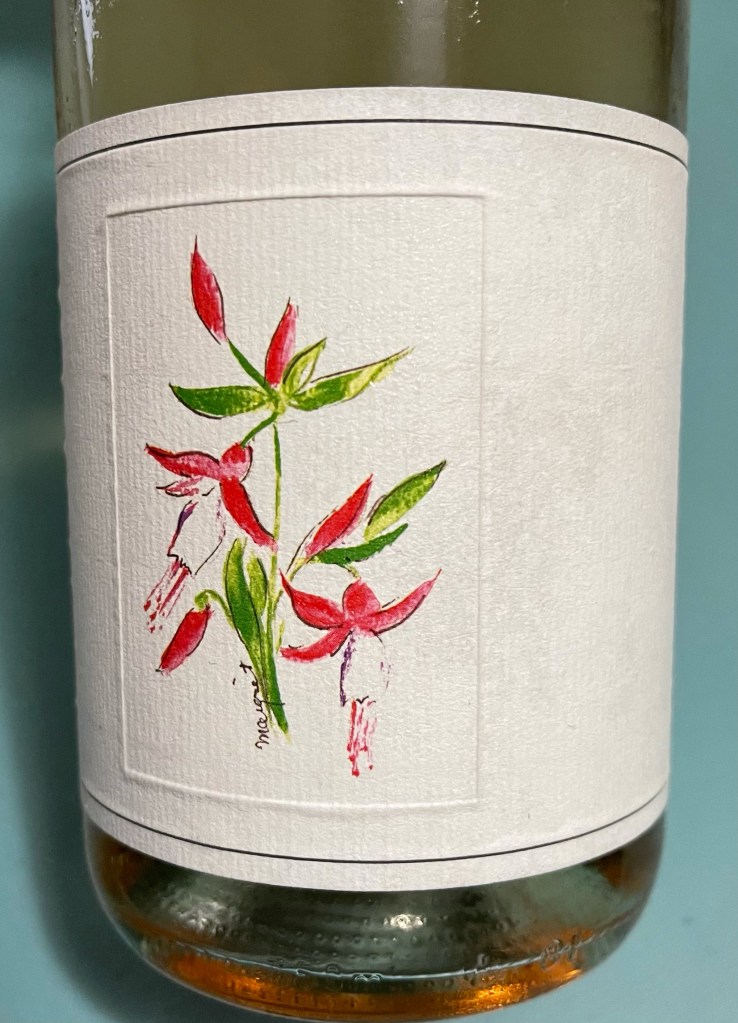
Today’s Wine: 2020 Rosé

68% Touriga Nacional, 16% Gamay Noir, 11% Cabernet Franc, 5% Grenache; 11% ABV

The 2020 Rosé is pale copper in color with hues of pale salmon. The nose seems somewhat muted and aromas are of medium (-) intensity, showcasing notes of cantaloupe, white strawberry, raspberry, bubble gum, cured meat, and chalky mineral. Meanwhile the flavors are of medium intensity and the palate displays notes of white cherry, raspberry, watermelon, orange rind, bubble gum, and saline. This dry rosé is light- to medium-bodied with medium acidity, low alcohol, and a medium-length finish. Fun to try given the blend, but this is lacking in intensity and length I was hoping for.

Price: $30 (but you should be able to find this around $25 in some locations). I can’t call this wine a good value, especially since I paid slightly more than the average $30 price-tag online. It’s lacking in intensity, complexity, and length which is somewhat disappointing given the Arnot-Roberts wines I’ve enjoyed in the past. Having enjoyed the Triennes rosé the other day at half the price, I find this a tough sell for me personally albeit it’s fun to try nonetheless given the blend.